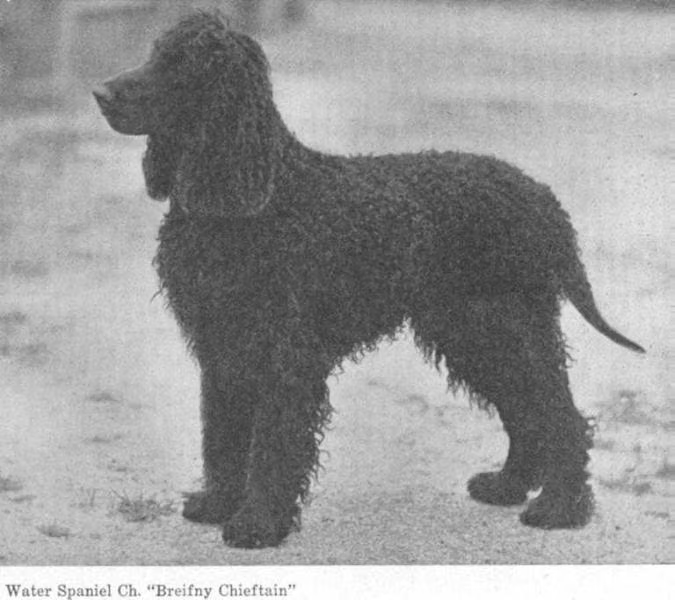
The Irish Water Spaniel is an intelligent, clownish retriever recognized by its curly coat and distinctive rat-like tail.
How the Irish Water Spaniel coat is built, and what that means when you groom it.
Caution: A Irish Water Spaniel coat mats easily.
Fine or long hair tangles at the base of the coat, out of sight, where the mats tighten and pull on the skin. Brushing has to reach right down to the roots in sections, not just skim the surface.
Information: A Irish Water Spaniel needs clipping every few weeks.
This coat keeps growing rather than shedding out, so it has to be trimmed every few weeks. Left to grow it mats down against the skin and traps moisture, dirt and heat.
A few of the Irish Water Spaniel profiles members have added to United Pet Club.
A large, curly-coated retriever from Ireland, admired for its intelligence, playful nature and aptitude in water. It typically lives 12 to 13 years.
The Irish Water Spaniel is a large gundog raised in Ireland to retrieve game from water and dense cover. Tallest of the spaniels, and among the most readily identified, it carries a thick coat of liver-coloured curls and a lean, tapering tail commonly likened to a rat's tail. The spaniel in its name notwithstanding, it works as a retriever and takes to cold water as happily as to dry land.
Those who keep the breed speak of its loyalty and its clownishness in equal measure. An Irish Water Spaniel bonds tightly with its household and will muck about in ways that seem deliberately comic, yet it brings genuine concentration to any task set before it. Being both alert and clever, it learns quickly, and it is equally quick to register when training has grown dull or repetitive.
Here is an energetic, adaptable dog that wants a purpose, regular exercise and reliable human company. It best suits households that relish the outdoors and will commit to coat care and consistent training.
| Attribute | Detail |
|---|---|
| Origin | Ireland |
| Size | Large |
| Lifespan | 12 to 13 years |
| Group / role | Gundog (water retriever) |
| Good with | Families, older children, active owners |
The Irish Water Spaniel is right for anyone wanting an involved, spirited companion and able to furnish daily exercise together with mental work. It gets on well with active families and with owners who enjoy swimming, walking or dog sports. It suits a sedentary household poorly, and it is no match for an owner who cannot keep pace with regular coat upkeep.
Established in Ireland during the mid-nineteenth century, the breed owes its modern form chiefly to Justin McCarthy of Dublin.
Curly-coated water dogs were at work across the rivers, bogs and coast of Ireland long before the modern breed emerged, and a number of regional types were kept to bring wildfowl to hand. Early writings set a southern Irish water dog apart from a northern one, and the breed recognised today descends for the most part from the southern line.
The modern Irish Water Spaniel is inseparable from Justin McCarthy of Dublin, whose dog Boatswain, whelped around 1834, is regarded as the breed's foundation sire. McCarthy's line fixed the curled coat, the topknot and the smooth rat tail that define the type. As he left no record of the crosses he used, the precise ancestry remains a matter of debate.
Through the second half of the nineteenth century the breed attracted wider interest and featured at early shows in Britain and Ireland. In the United Kingdom it is recognised by The Kennel Club, and it gained American Kennel Club recognition in 1884, placing it among the earliest breeds on that register.
Across the twentieth century it stayed an uncommon yet well-established gundog. Breeders still favour working ability and companionship over show numbers, and the population stays modest beside the mainstream retrievers.
A large, robustly built dog with a thick liver-coloured coat of tight curls, a topknot and the unmistakable smooth rat tail.
As the tallest of the spaniels, the Irish Water Spaniel has a powerful, faintly rectangular body made for swimming and forcing through cover. A pronounced topknot of long, loose curls falls to a peak between the eyes, whereas the muzzle stays comparatively smooth. Sturdy and athletic best describes it, rather than refined.
| Trait | Standard |
|---|---|
| Height | Dogs 22 to 24 in (56 to 61 cm); bitches 21 to 23 in (53 to 58 cm) |
| Weight | Dogs 55 to 68 lb (25 to 31 kg); bitches 45 to 58 lb (20 to 26 kg) |
| Coat | Dense, tight liver-coloured curls with a smooth face and lower tail |
| Colours | Solid liver (a dark reddish brown), sometimes with a purplish cast |
| Eyes | Small, almond-shaped, hazel to dark amber |
The coat is what marks the breed out. Tight, crisp ringlets clothe the body, neck and upper legs, while the face, throat and tip of the tail remain short and smooth. That contrast between the curled body and the bare, tapering tail produces the rat-tail appearance. Solid liver is the sole permitted colour, a dark reddish brown that in certain light shows a faint purple sheen. Water-resistant and naturally oily, the double coat keeps the dog warm in cold water yet calls for regular grooming to prevent matting.
Devoted, playful and intelligent, the breed is affectionate with family, frequently reserved with strangers, and generally amiable with other dogs.
In the Irish Water Spaniel a working dog's focus meets a decidedly comic temperament. At home it is affectionate and closely attached to its people, forever devising playful, attention-seeking turns that owners find amusing. Clever and alert, it reads a situation and learns with ease, though an independent streak can make it obstinate once it decides a task is pointless.
With its family the breed is gentle and devoted, and it usually suits older children who handle it calmly. Strangers meet a reserved rather than an effusive welcome; it holds back at first and warms up slowly, which is why early socialisation counts for so much. Alert enough to note a caller, it is not as a rule aggressive.
With other dogs it is generally sociable where reared together or introduced with care. Its retriever heritage lends it a moderate prey drive, so sensible supervision around small pets is wise. A bored Irish Water Spaniel may grow noisy or destructive, so consistent exercise and mental work are what keep its behaviour sound.
| Trait | Rating |
|---|---|
| Affection | 5 |
| Energy | 4 |
| Trainability | 4 |
| Vocalness | 2 |
| Shedding | 1 |
The breed calls for regular brushing and periodic trimming of the curly coat, along with substantial daily exercise and room to move.
The Irish Water Spaniel fares best in a home with secure outdoor space and an owner who is present and active. Its water-resistant coat lets it cope with a range of climates, though in warm weather it must always have shade and water. Suburban life suits it provided its exercise needs are met, but long spells alone, or a strictly indoor and inactive routine, do not.
Feed a complete diet suited to a large, active dog across two meals a day, with portions adjusted to the dog's body condition.
An Irish Water Spaniel does well on a complete, balanced diet formulated for large active dogs. Select a food matched to the dog's life stage, with sufficient protein for muscle and moderate fat for an energetic working frame. Daily quantities turn on age, weight and activity, so take body condition as your guide and adjust the portion as the dog gains or loses condition. Fresh water should always be to hand, particularly after exercise or a swim.
| Life stage | Amount per day | Meals |
|---|---|---|
| Puppy (2 to 6 months) | Per product guide, by weight | 3 to 4 |
| Junior (6 to 12 months) | About 2.5 to 3.5 cups | 2 to 3 |
| Adult | About 2 to 3 cups | 2 |
| Senior | About 1.75 to 2.5 cups | 2 |
Keep treats to about 10 per cent of daily calories so the dog stays lean, which eases the joints of a large, active breed. Most dogs on a complete diet require no supplements, though a vet may advise joint or skin support in some instances. Bring in any change of food gradually, over roughly a week, to avoid an upset stomach.
Generally healthy and living about 12 to 13 years, the breed warrants attention to hip dysplasia, ear infections and certain eye conditions.
The Irish Water Spaniel is on the whole a sound, hardy breed with a typical lifespan of 12 to 13 years. As with many large dogs, joint health and routine preventive care make the greatest difference to a long and comfortable life. Responsible breeders test for the conditions known in the breed, so it is worth asking what health screening the parents have undergone.
| Condition | Signs | Note |
|---|---|---|
| Hip dysplasia | Stiffness, limping, reluctance to jump | Common in large breeds; screening of breeding stock helps |
| Ear infections | Head shaking, odour, scratching at ears | The long, curly ears trap moisture; regular cleaning lowers risk |
| Hypothyroidism | Weight gain, low energy, coat changes | Manageable with daily medication once diagnosed |
| Eye conditions | Cloudiness or reduced vision | Includes conditions such as cataracts; eye examinations help detect early |
Intelligent and trainable yet independent, the breed responds best to varied, reward-based sessions begun early.
Quick to learn and fond of having a task, the Irish Water Spaniel makes an able pupil in obedience, retrieving and dog sports. An independent, at times obstinate streak means it wearies of drilling, so short and varied sessions serve better than long repetition. The breed is sensitive and watches its handler closely, so calm, consistent guidance yields far more than harsh correction. Early socialisation with people, dogs and unfamiliar settings tempers its natural reserve towards strangers.
Irish Water Spaniels reach breeding maturity near two years, average around four to seven puppies per litter and follow the usual canine gestation of about 63 days.
Breeding an Irish Water Spaniel demands planning and health screening, given the breed's small population and the value of keeping the stock sound. Dogs mature physically sooner, but responsible breeders generally wait until around two years of age so that health clearances, hip and eye evaluations among them, can be completed first. Mating follows the bitch's season, and gestation runs about 63 days from conception.
Litters average four to seven puppies, the exact number differing from one bitch to another. Newborn puppies arrive blind and deaf and depend wholly on the dam for warmth and feeding. The eyes and ears open across the first two to three weeks, and weaning begins around three to four weeks as the puppies take up solid food. The stretch from roughly three to twelve weeks is the key period for socialisation, when handling, gentle new experiences and time with the litter shape the adult temperament. Puppies usually go to their new homes at eight weeks or older.
| Metric | Value |
|---|---|
| Breeding maturity | About 2 years |
| Gestation | About 63 days |
| Average litter size | 4 to 7 puppies |
| Eyes and ears open | 2 to 3 weeks |
| Weaning | 3 to 4 weeks |
| Ready for new homes | 8 weeks or older |
Your Irish Water Spaniel's details on a record that satisfies UK microchip law: free with United Pet Club, for life, with nothing to renew.
Give your Irish Water Spaniel five minutes of paperwork before it needs rescuing. The free profile takes a name, a date of birth, a photo and your contact details, and it lives on a registry that never charges for the privilege. Dog registration works whether the chip is already in or still on the to-do list.
The implant happens at the vet surgery; the record is your half of the bargain, and the 2016 regulations expect it kept up to date. Register the microchip free on the lifetime plan: any brand a British vet implants is accepted, amendments after moving house cost nothing, and the record stays searchable through the lookups rescue centres and wardens turn to first. Create your free account and square it away this evening.
Set up a free United Pet Club account, add your Irish Water Spaniel's details and a photo, and save. The profile stays live for the whole of the dog's life at no charge, and the chip number can be added the moment you have it.
Key the fifteen digit number into your free United Pet Club account with your current address and phone number. The lifetime plan accepts any brand a British vet implants, and amendments after a house move are free.
Yes. Dogs in England, Scotland and Wales have had to be chipped since 2016, with the keeper's details kept current. The law covers the chip; keeping the record pointing at a live phone number is what United Pet Club handles, free.
Nothing at all. The United Pet Club lifetime plan covers the profile, the microchip record and every amendment without a fee, so there is no renewal to remember.
Owners commonly ask about the breed's size, temperament, grooming demands, lifespan, suitability for families and how readily one can be found.
It is a large breed and the tallest of the spaniels. Dogs stand about 22 to 24 inches at the shoulder and weigh roughly 55 to 68 pounds, while bitches stand about 21 to 23 inches and weigh roughly 45 to 58 pounds.
Devoted, playful and intelligent, and often decidedly clownish at home. It bonds closely with its family, keeps its distance from strangers, and stays alert without being aggressive as a rule.
It falls in the moderate to high maintenance bracket. The curly coat wants brushing every few days and trimming every six to eight weeks, and the dog needs at least an hour of exercise daily plus mental work.
Around 12 to 13 years is typical. Sound preventive care, a lean body condition and regular ear care all support a long, comfortable life.
Yes, for active families. They are affectionate and loyal and generally suit older children who handle them calmly. They are right for owners who can provide exercise, training and company.
Very little. The dense, curly coat sheds far less than that of many breeds, though it still needs regular brushing and trimming to keep it from matting.
No. It is an uncommon breed with modest numbers, so prospective owners often approach breed clubs or reputable Kennel Club registered breeders and may have to wait for a puppy.


![Harp [Colonel the Hon. W. Le Poer Trench], a Female Irish Water Spaniel registered with United Pet Club](https://media.unitedpetclub.com/m/5FFuhpTGq4/harp-colonel-the-hon-w-le-poer-trench-irish-water-spaniel_orig.avif "Harp [Colonel the Hon. W. Le Poer Trench] — Irish Water Spaniel")