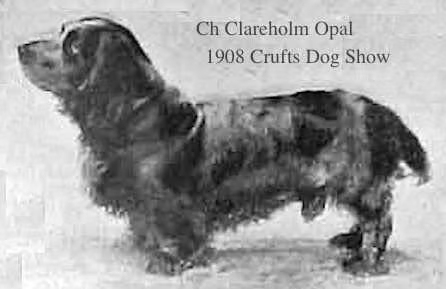
The Field Spaniel is a calm, dignified English sporting breed, known for its sweet, sensitive nature and devotion to its people.
How the Field Spaniel coat is built, and what that means when you groom it.
Caution: A Field Spaniel coat mats easily.
Fine or long hair tangles at the base of the coat, out of sight, where the mats tighten and pull on the skin. Brushing has to reach right down to the roots in sections, not just skim the surface.
A few of the Field Spaniel profiles members have added to United Pet Club.
The Field Spaniel is a medium-sized English gundog with a calm, gentle and devoted nature. It lives around 12 to 13 years and suits owners wanting a quiet companion.
The Field Spaniel is a medium-sized gundog of English origin. It was developed through the nineteenth century to retrieve and flush game from heavy cover. Nowadays it is kept as a family companion far more often than as a working dog, although it retains the steady working temperament for which it was bred.
The breed carries a long body set low to the ground, a glossy coat in a single colour or roan, and a calm, thoughtful expression. It ranks among the less common spaniels, and comparatively few are registered each year against the numbers seen in the Cocker or the Springer.
Field Spaniels are gentle and sensitive dogs. They form a close bond with their household and would sooner remain near their people than work at any distance. Harsh handling does not suit them, and they fare best with patient, consistent owners.
| Item | Detail |
|---|---|
| Origin | England |
| Size | Medium (around 18 inches at the shoulder) |
| Lifespan | 12 to 13 years |
| Group / role | Sporting / gundog (flushing and retrieving) |
| Good with | Families, older children, other dogs, and pets it is raised with |
The Field Spaniel suits a household that can provide daily exercise and steady company. It does well with families, with older children, and with anyone wanting a dog that keeps close. Its sensitivity makes it a poor choice for a home that is loud, chaotic or empty for long periods. A first-time owner can manage the breed so long as they are prepared to be gentle and consistent.
The Field Spaniel developed in nineteenth-century England from the spaniel stock behind the Cocker and Springer. Exaggerated early breeding almost ruined it before reformers restored a moderate dog.
The Field Spaniel is of English origin. Through the early to middle nineteenth century, land spaniels were frequently divided by size within a single litter rather than by breed. The smaller pups were termed Cockers and the larger ones were put to field work. It was from these larger land spaniels that the Field Spaniel developed, distinguished as a separate type through the latter half of the nineteenth century.
The breed gained recognition in England during the 1890s, and a breed club was established to promote it. Early Field Spaniels were bred towards a black, single-colour coat that set them apart from the parti-coloured spaniels of the day.
In the late Victorian era, breeders drove the type to an extreme. Dogs were bred longer in the body and shorter in the leg, in part through crosses with the Sussex Spaniel and the Basset Hound. The outcome was a heavy, low-slung animal ill-suited to the field work after which it was named, and its popularity duly declined.
Through the early and middle twentieth century, breeders laboured to reverse that damage. They reintroduced English Springer Spaniel blood to restore leg length, balance and working ability. The Field Spaniel of today is a moderate, upstanding dog rather than the exaggerated Victorian animal. Its numbers remain low, and several kennel clubs, including The Kennel Club, count it among their rarer native breeds.
The Field Spaniel is a medium-sized dog of moderate length, standing around 18 inches at the shoulder, with a glossy single-colour or roan coat, long feathered ears and a level back.
The Field Spaniel is built for balance rather than for extremes. It stands slightly longer than it is tall, with a level topline, moderate bone and well-developed muscle. The head is long and lean, with a defined stop and long, low-set ears carried close to the head. The overall impression is that of a dignified, well-balanced sporting dog, and the movement is smooth and covers ground.
| Trait | Detail |
|---|---|
| Height | About 17 to 18 inches at the shoulder |
| Weight | About 35 to 50 pounds |
| Coat | Single, moderately long, glossy and flat or slightly wavy, with feathering on the ears, chest, legs, and underside |
| Colours | Black, liver, or roan, sometimes with tan points; a small white marking on the chest is permitted |
| Eyes | Almond-shaped, dark to hazel, with a gentle, serious expression |
The coat forms a single layer, so the breed does not carry the dense undercoat found in some other gundogs. It lies flat or with a slight wave and grows longer feathering on the ears, chest, backs of the legs and belly. The permitted colours are black, liver and roan, any of which may carry tan points above the eyes, on the cheeks and on the legs. A small amount of white on the chest is allowed. Regular brushing is needed to keep the feathering free of mats.
The Field Spaniel is calm, gentle and devoted, with a sensitive nature that keeps it attached to its family. It is generally friendly but can be reserved with strangers.
The Field Spaniel is noted for a quiet, even temper. At home it is calm and affectionate, and it forms a strong attachment to the household. It is inclined to follow its people from room to room and is at its happiest when taken into daily life. Left on its own for long periods, it may become anxious or restless.
With strangers the breed is usually polite yet reserved to begin with, warming up once it feels at ease. It is not a guard dog, though it may bark to announce a caller. Early and continued socialisation helps a naturally cautious dog remain confident.
With children the Field Spaniel is patient and gentle, and it generally suits a household with older children who handle it calmly. Being a sensitive breed, it can be unsettled by rough play and loud, sudden handling. It ordinarily gets along with other dogs, and with cats or smaller pets when reared alongside them, though its gundog ancestry may draw its interest towards birds and small animals out of doors.
| Trait | Rating |
|---|---|
| Affection | 5 |
| Energy | 3 |
| Trainability | 4 |
| Vocalness | 2 |
| Shedding | 3 |
The Field Spaniel needs regular brushing of its feathered coat, roughly an hour of daily exercise and steady company. It is not suited to being left alone for long.
The Field Spaniel adapts to most homes, from houses with gardens to smaller dwellings where exercise is sufficient. It is an indoor dog that wishes to live with its family rather than be kept outside. As it bonds closely and dislikes isolation, it suits a household where someone is at home for much of the day or can arrange company when out.
The Field Spaniel does well on a complete, balanced dog food fed in measured meals suited to its age and activity. Adults usually eat about 1.5 to 2 cups of dry food daily, across two meals.
Feed a complete, balanced food formulated for the dog's life stage. Puppies require a diet made for growth, whereas adults do well on standard maintenance food. The amounts given below are general starting points; the correct portion depends on the food's calorie content, the dog's weight and how active it is. Adjust according to body condition, keeping the waist visible and the ribs easy to feel. The breed is inclined to gain weight if overfed, so measure the meals rather than leaving food down throughout the day.
| Life stage | Amount per day | Meals per day |
|---|---|---|
| Puppy (2 to 6 months) | About 1 to 2 cups, by growth and brand | 3 to 4 |
| Puppy (6 to 12 months) | About 1.5 to 2 cups | 2 to 3 |
| Adult | About 1.5 to 2 cups | 2 |
| Senior / less active | About 1.25 to 1.75 cups | 2 |
Keep treats to no more than around 10 percent of daily calories and deduct them from the meal portions. Plain options such as small pieces of carrot or commercial training treats work well. Most Field Spaniels on a complete diet need no supplements. Consult a vet before adding joint, skin or other supplements, since a dog already eating a balanced food has no need of the extras.
The Field Spaniel is generally a sound breed that lives around 12 to 13 years. The chief concerns are hip dysplasia, eye disorders, ear infections and hypothyroidism.
The Field Spaniel is a reasonably healthy breed with a typical lifespan of 12 to 13 years. As with most pedigree dogs, it carries a few inherited risks, and responsible breeders screen their stock to reduce them. The long, pendulous ears make ear care a routine part of keeping the dog well. Buyers should ask breeders for the hip and eye test results of both parents.
| Condition | Signs | Note |
|---|---|---|
| Hip dysplasia | Stiffness, limping, reluctance to jump or climb | Inherited joint problem; parents should be hip-scored |
| Eye disorders (such as PRA and cataract) | Cloudy eyes, bumping into objects, night-vision loss | Breeding dogs should have current eye examinations |
| Ear infections | Head shaking, scratching, odour, discharge | Linked to the long drop ears; manage with routine cleaning |
| Hypothyroidism | Weight gain, low energy, coat and skin changes | Diagnosed by blood test and managed with daily medication |
The Field Spaniel is intelligent and eager to please, which makes it trainable, though its sensitivity calls for gentle, reward-based methods. Early socialisation builds confidence.
The Field Spaniel learns quickly and wishes to work with its handler. It responds best to calm, positive training and may shut down or grow anxious under harsh corrections or shouting. Short, consistent sessions hold its attention better than long drills. Its gundog ancestry means it takes pleasure in scent work and retrieving, which can serve as both exercise and reward.
Field Spaniels reach sexual maturity around 6 to 12 months but should not be bred until mature, usually after two years. Gestation lasts around 63 days, with litters of four to six puppies.
Females typically come into their first season between 6 and 12 months, but responsible breeders wait until a dog is at least two years old so that it can be health-tested and is fully mature. Before mating, both parents should pass hip and eye screening and be confirmed sound in health and temperament.
Gestation runs around 63 days from conception. Litters average four to six puppies, though the number varies. The dam usually whelps unaided, but a clean, quiet space and access to veterinary support should be ready should trouble arise.
Puppies are born blind and deaf and depend wholly on the dam for their first weeks. The eyes open at around two weeks, and weaning begins near four weeks. The period from roughly three to twelve weeks is important for socialisation, so puppies should encounter gentle handling, household sounds and new experiences before going to new homes, usually at eight weeks or later.
| Metric | Value |
|---|---|
| Sexual maturity | About 6 to 12 months |
| Recommended breeding age | After about 2 years, once health-tested |
| Gestation | About 63 days |
| Average litter size | 4 to 6 puppies |
| Eyes open | About 2 weeks |
| Weaning | Around 4 to 7 weeks |
| Go to new homes | 8 weeks or later |
Your Field Spaniel's details on a record that satisfies UK microchip law: free with United Pet Club, for life, with nothing to renew.
Microchipping has been compulsory for dogs in England, Scotland and Wales since 2016, and the rules are strict about keeping the details behind the chip current. A free United Pet Club profile holds your Field Spaniel's record for the whole of its life, with your phone number and address sitting where a scan can reach them. Registering your dog is done in minutes and costs nothing, now or later.
The implant happens at the vet surgery; the record is your half of the bargain, and the 2016 regulations expect it kept up to date. Register the microchip free on the lifetime plan: any brand a British vet implants is accepted, amendments after moving house cost nothing, and the record stays searchable through the lookups rescue centres and wardens turn to first. Create your free account and square it away this evening.
Set up a free United Pet Club account, add your Field Spaniel's details and a photo, and save. The profile stays live for the whole of the dog's life at no charge, and the chip number can be added the moment you have it.
Key the fifteen digit number into your free United Pet Club account with your current address and phone number. The lifetime plan accepts any brand a British vet implants, and amendments after a house move are free.
Yes. Dogs in England, Scotland and Wales have had to be chipped since 2016, with the keeper's details kept current. The law covers the chip; keeping the record pointing at a live phone number is what United Pet Club handles, free.
Nothing at all. The United Pet Club lifetime plan covers the profile, the microchip record and every amendment without a fee, so there is no renewal to remember.
Common questions about the Field Spaniel's size, temperament, care needs, lifespan, suitability for families, and how easy the breed is to find.
It is a medium-sized dog, standing around 17 to 18 inches at the shoulder and weighing roughly 35 to 50 pounds. The body is slightly longer than the dog is tall.
It is calm, gentle and devoted, with a sensitive nature. It bonds closely with its family, is usually friendly towards other animals, and is inclined to be reserved with strangers at first.
The care required is moderate. The feathered coat needs brushing two or three times a week, the long ears need weekly cleaning, and the dog needs about an hour of daily exercise and steady company. It does not cope well when left alone for long.
Most live around 12 to 13 years. Good nutrition, regular veterinary care and keeping the dog at a healthy weight all help it stay well into old age.
Yes. They are patient and gentle, and they suit families with older children who handle them calmly. They generally get along with other dogs, and with cats or smaller pets they are reared alongside.
No. The Field Spaniel is one of the rarer spaniels, with comparatively few puppies registered each year. Buyers often join a waiting list with a health-testing breeder rather than finding a litter quickly.
Not usually. They are fairly quiet dogs that may bark to announce a caller but are not given to constant barking. Anxiety from being left alone too long can increase the noise.


![Black Prince [Mr A Clinton Wilmerding], a Male Field Spaniel registered with United Pet Club](https://media.unitedpetclub.com/m/ZISf28fzxz/black-prince-mr-a-clinton-wilmerding-field-spaniel_orig.avif "Black Prince [Mr A Clinton Wilmerding] — Field Spaniel")