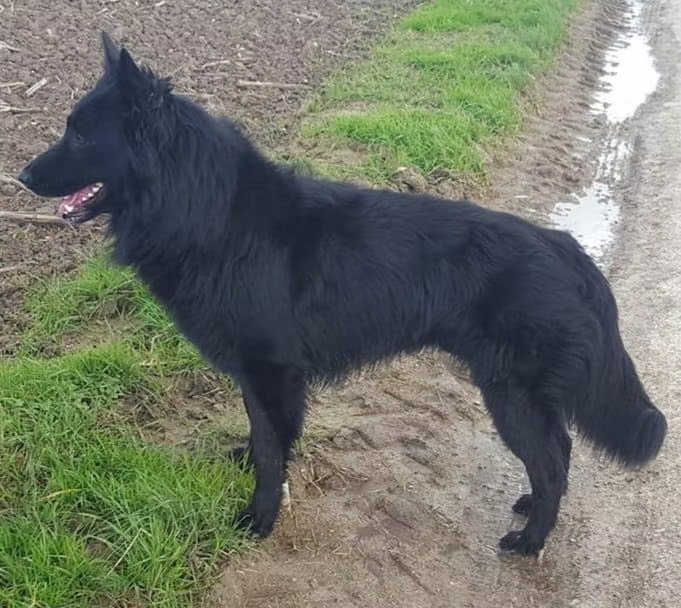
The Belgian Shepherd is an intelligent, devoted herding breed known for its alertness, versatility, and watchful loyalty.
How the Belgian Shepherd coat is built, and what that means when you groom it.
Critical: A Belgian Shepherd should not be shaved.
The undercoat keeps heat out as well as in, and the outer coat shields the skin from sun and insect bites. Clipping the whole coat off removes both. It often grows back patchy, soft or a different colour, and in some animals the guard hairs never return properly. Brush the undercoat out instead of cutting it off.
Caution: A Belgian Shepherd coat mats easily.
Fine or long hair tangles at the base of the coat, out of sight, where the mats tighten and pull on the skin. Brushing has to reach right down to the roots in sections, not just skim the surface.
Information: A Belgian Shepherd drops its undercoat in heavy bursts.
The undercoat comes out in heavy bursts over a few weeks. An undercoat rake, or a bath followed by a proper blow-dry, clears it far faster than daily brushing. Clipping the coat down is not a shortcut for this.
A few of the Belgian Shepherd profiles members have added to United Pet Club.
The Belgian Shepherd is a large, intelligent herding dog from Belgium, prized for its alertness, versatility, and strong bond with its handler.
The Belgian Shepherd is a large working dog developed in Belgium for herding and guarding livestock. It is square in build, athletic, and quick to react to its surroundings. The breed exists in several coat varieties, which some kennel clubs register as separate breeds and others group under one name.
These dogs were bred to work alongside people throughout the day, and that history shapes their behaviour. A Belgian Shepherd watches its environment closely, learns tasks quickly, and forms a strong bond with the family it lives with. The same drive that makes it a capable working partner means it requires a job, structured activity, or training to remain settled at home.
Owners often describe the breed as devoted and serious. It is affectionate with its own household and reserved with strangers, which reflects its long use as a guardian. With consistent handling and daily exercise, it makes a steady, responsive companion.
| Attribute | Detail |
|---|---|
| Origin | Belgium |
| Size | Large |
| Lifespan | 12 to 14 years |
| Group / role | Herding and guarding |
| Good with | Family members and dogs raised alongside; reserved with strangers |
The Belgian Shepherd suits an active household that can provide daily exercise and ongoing training. It works well for those interested in dog sports, herding, or obedience, and for owners who want a watchful dog at home. It is less suited to a sedentary lifestyle or to first-time owners unable to commit time to handling and structure.
The Belgian Shepherd was standardised in Belgium in the late 1800s from regional herding dogs, with separate coat varieties recognised as the breed was formalised.
The breed traces to the herding dogs kept across Belgium during the 1800s. Farmers and shepherds used hardy, medium-to-large dogs to move and protect sheep, with local types varying by region rather than following any single standard.
In 1891 a group of breeders and the veterinarian Adolphe Reul began to study and catalogue these dogs in an effort to define a national breed. Reul examined animals from the area around Brussels and grouped them by coat type and colour, which laid the groundwork for the varieties recognised later.
The distinct coat varieties came to be associated with Belgian place names, including Groenendael (long black coat), Tervuren (long fawn-to-mahogany coat), Malinois (short fawn coat), and Laekenois (rough or wiry coat). Belgian breed standards were drawn up in the following years to describe these dogs as one breed in several forms.
During the twentieth century the dogs spread beyond herding into police, military, and guard work, where the short-coated Malinois in particular became widely used. The Kennel Club in the United Kingdom and registries elsewhere differ in how they classify the varieties: some treat them as one breed with sub-types, while others list them as separate breeds.
The Belgian Shepherd is a square, well-muscled dog of large size with an alert head carriage and a coat that varies by variety from short to long to wiry.
The Belgian Shepherd is built for endurance and agility rather than bulk. The body fits into a square outline, with the height at the withers roughly equal to the length of the body. The chest is deep, the back level, and the legs straight and well-boned. The head is carried high and gives the breed its characteristic alert, attentive expression.
The ears are triangular, stiff, and set high. The tail reaches at least to the hock and is carried low at rest, lifting when the dog is active. Movement is smooth and tireless, with the dog often inclined to move in a circle rather than a straight line, a trait left over from its herding background.
| Trait | Standard |
|---|---|
| Height | Males 60 to 66 cm, females 56 to 62 cm at the withers |
| Weight | Males 25 to 30 kg, females 20 to 25 kg |
| Coat | Varies by variety: short, long, or rough/wiry; weather-resistant double coat |
| Colours | Black, fawn, mahogany, or grey depending on variety, often with a black mask or overlay |
| Eyes | Medium, almond-shaped, brown, with an alert expression |
Coat type is the main feature that separates the varieties. The long-coated forms have a dense outer coat with feathering on the legs and tail and a fuller collar of hair around the neck. The short-coated form has a close, hard outer coat with a thick undercoat. The rough-coated form has a dry, wiry texture. Colour ranges from solid black through fawn and mahogany to grey, and many fawn dogs carry a darker overlay and a black facial mask. All varieties share a weather-resistant double coat suited to outdoor work.
The Belgian Shepherd is loyal, highly intelligent, and watchful, devoted to its family while reserved and alert toward strangers.
The Belgian Shepherd is an alert, hardworking dog that stays closely focused on its owner. Within the family it is affectionate and attentive, attaching to its people rather than spreading its loyalty widely. This closeness can make it sensitive to harsh handling and to long periods alone.
With strangers the breed is naturally reserved and observant. It notices changes in its environment quickly and will give warning, which reflects its long use as a guardian. Early and ongoing socialisation helps it distinguish a genuine threat from ordinary activity and prevents wariness from becoming nervousness.
With other animals, behaviour depends on upbringing. A Belgian Shepherd raised alongside other dogs generally accepts them, though its herding instinct can lead it to chase or nip at moving animals, children, or cyclists. Steady exposure and training channel that drive into acceptable outlets. The breed's intelligence and energy mean a bored dog will find its own activities, so it does best with mental and physical work each day.
| Trait | Rating |
|---|---|
| Affection | 4 |
| Energy | 5 |
| Trainability | 5 |
| Vocalness | 3 |
| Shedding | 4 |
The Belgian Shepherd needs substantial daily exercise, regular coat care that varies by variety, and an environment that gives it room and a job to do.
Caring for a Belgian Shepherd centres on meeting its high activity needs and keeping its mind occupied. A dog left without enough exercise or stimulation will often develop pacing, chewing, or barking. Grooming demands differ by coat variety, but all of them shed.
The breed does best in a home with a securely fenced garden and an owner who is present and active. It can adapt to smaller spaces only if its exercise and training needs are fully met. It tolerates cold well thanks to its double coat but requires shade and water in warm weather.
The Belgian Shepherd needs a complete, high-quality diet matched to its active large-breed build, divided into two meals a day and adjusted to its workload.
An active Belgian Shepherd requires a complete and balanced diet with sufficient protein and fat to support its energy output. Choose a food formulated for large or active breeds and adjust the amount to the dog's age, weight, and daily activity. A working or sporting dog burns considerably more than a pet kept at moderate exercise, so portions should follow body condition rather than a fixed figure. Fresh water should be available at all times.
| Life stage | Amount per day | Meals |
|---|---|---|
| Puppy (2 to 6 months) | Per puppy food label, divided | 3 to 4 |
| Junior (6 to 12 months) | Per large-breed growth food | 2 to 3 |
| Adult | Roughly 300 to 450 g dry food, by activity | 2 |
| Senior | Reduced calories, maintain protein | 2 |
Keep treats to around ten per cent of daily calories so the main diet remains balanced. Small, low-fat treats work well as training rewards, which matters for a breed trained as frequently as this one. Most dogs on a complete diet require no supplements; add joint support or other supplements only on the advice of a vet, and feed large-breed puppies a diet with controlled calcium to support steady growth.
The Belgian Shepherd is generally a healthy, hardy breed living 12 to 14 years, with a few inherited and joint conditions worth monitoring through screening and routine care.
The Belgian Shepherd is a robust working breed with a typical lifespan of 12 to 14 years. Responsible breeding and regular veterinary care keep most dogs healthy through their working years. As with many active large breeds, joint and eye conditions appear most often, and a small number of inherited disorders are tracked by health-testing programmes.
| Condition | Signs | Note |
|---|---|---|
| Hip dysplasia | Stiffness, limping, trouble rising | Screen breeding stock; manage weight and exercise |
| Elbow dysplasia | Foreleg lameness, reluctance to exercise | Inherited joint malformation; screening helps |
| Progressive retinal atrophy | Night blindness, declining vision | Inherited; DNA and eye testing available |
| Epilepsy | Seizures | Managed with veterinary care where it occurs |
| Bloat (gastric torsion) | Swollen abdomen, retching, distress | Emergency; risk in deep-chested dogs |
The Belgian Shepherd is one of the most trainable breeds, learning quickly with consistent, reward-based handling, early socialisation, and an outlet for its drive.
The Belgian Shepherd is highly trainable and eager to work, which is why it is widely used in herding, sport, and service roles. It learns new commands quickly and reads its handler closely. That sensitivity works in both directions: it responds well to clear, calm direction and poorly to harsh corrections, which can make it anxious or withdrawn. Consistency and early socialisation matter more for this breed than for many others, because its intelligence and energy will find an outlet whether or not the owner provides one.
Belgian Shepherds reach breeding maturity at around two years, carry litters for about nine weeks, and produce an average of six to ten puppies that need early socialisation.
Breeding a Belgian Shepherd requires health-tested parents and a thorough understanding of the breed's working temperament. Dogs reach physical maturity before they are emotionally ready to breed, so responsible breeders wait until both parents are approximately two years old and have passed hip, elbow, and eye screening. Females come into season roughly twice a year.
Gestation lasts about 63 days from conception. Litters average six to ten puppies, though size varies with the individual female. The mother manages most early care, but the breeder should monitor the whelping and the first weeks closely.
The early weeks are where the breed's later character is shaped. Puppies need gentle handling, exposure to household sounds, and contact with people and other animals from an early age. This early socialisation produces confident adults and reduces the wariness the breed can otherwise show. Puppies usually go to their new homes at around eight to nine weeks.
| Metric | Value |
|---|---|
| Breeding maturity | About 2 years |
| Seasons per year | Roughly 2 |
| Gestation | About 63 days |
| Average litter size | 6 to 10 puppies |
| Weaning age | About 6 to 8 weeks |
| Homing age | About 8 to 9 weeks |
Your Belgian Shepherd's details on a record that satisfies UK microchip law: free with United Pet Club, for life, with nothing to renew.
Microchipping has been compulsory for dogs in England, Scotland and Wales since 2016, and the rules are strict about keeping the details behind the chip current. A free United Pet Club profile holds your Belgian Shepherd's record for the whole of its life, with your phone number and address sitting where a scan can reach them. Registering your dog is done in minutes and costs nothing, now or later.
The implant happens at the vet surgery; the record is your half of the bargain, and the 2016 regulations expect it kept up to date. Register the microchip free on the lifetime plan: any brand a British vet implants is accepted, amendments after moving house cost nothing, and the record stays searchable through the lookups rescue centres and wardens turn to first. Create your free account and square it away this evening.
Set up a free United Pet Club account, add your Belgian Shepherd's details and a photo, and save. The profile stays live for the whole of the dog's life at no charge, and the chip number can be added the moment you have it.
Key the fifteen digit number into your free United Pet Club account with your current address and phone number. The lifetime plan accepts any brand a British vet implants, and amendments after a house move are free.
Yes. Dogs in England, Scotland and Wales have had to be chipped since 2016, with the keeper's details kept current. The law covers the chip; keeping the record pointing at a live phone number is what United Pet Club handles, free.
Nothing at all. The United Pet Club lifetime plan covers the profile, the microchip record and every amendment without a fee, so there is no renewal to remember.
Common questions about the Belgian Shepherd's size, temperament, care needs, lifespan, suitability, and availability.
It is a large breed. Males stand 60 to 66 cm at the withers and weigh 25 to 30 kg; females stand 56 to 62 cm and weigh 20 to 25 kg.
It is loyal, intelligent, and alert. The breed is affectionate with its own family and reserved with strangers, with a strong watchful and protective instinct.
It is demanding rather than difficult. It needs 1 to 2 hours of daily exercise, regular training, and coat care that varies by variety. It is best suited to experienced, active owners.
The typical lifespan is 12 to 14 years, supported by a lean weight, regular veterinary care, and breeding from health-tested parents.
It can be, in an active household that provides exercise, training, and time. Its herding instinct means it should be supervised with young children, and early socialisation is important.
Yes. All varieties shed, with heavier seasonal shedding. Regular brushing, more frequent for the long-coated forms, keeps loose hair manageable.
Availability depends on the variety and region. The short-coated Malinois is common through working lines, while the long and rough-coated varieties can take longer to source from a responsible breeder. The Kennel Club's find-a-breeder service is a useful starting point in the UK.