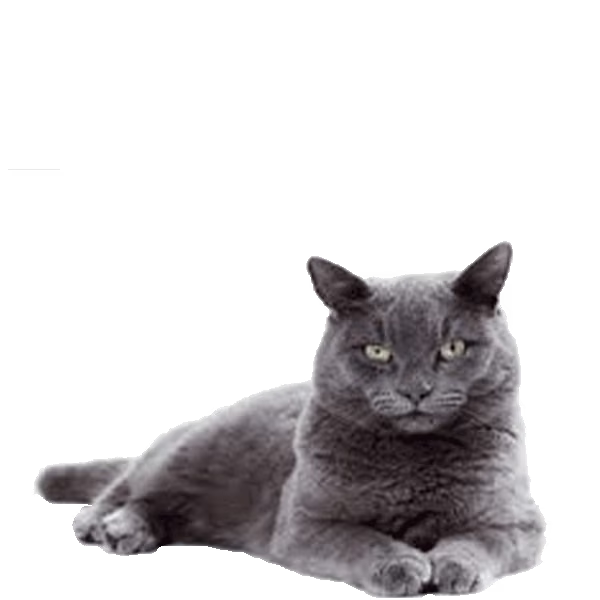
The Korat is a devoted, affectionate breed treasured in Thailand as a good-luck cat with a silver-blue coat and gentle, loyal heart.
How the Korat coat is built, and what that means when you groom it.
The Korat is a small cat from Thailand with a silver-blue coat, prized for centuries as a good-luck companion and known for its devoted, gentle nature.
The Korat is one of the oldest natural cat breeds, originating in the Korat province of northeastern Thailand. It is a small to medium cat with a single, close-lying coat that is blue tipped with silver, giving the fur a faint sheen in good light. The breed is built on a heart-shaped head, large green eyes, and a compact, muscular body that feels heavier than it looks.
In its homeland the Korat is called Si-Sawat and is regarded as a cat of good fortune. Pairs were traditionally given to brides and to people the giver wished well. The breed remained close to its native population for a long time, and breeders outside Thailand still trace pedigrees back to imported foundation cats.
Korats form strong bonds with their people. They tend to attach to one or two members of a household, follow them from room to room, and use a soft voice to ask for attention. They are alert and observant rather than busy, and they often prefer calm, predictable homes over noisy, high-traffic ones.
| Attribute | Detail |
|---|---|
| Origin | Thailand (Korat province) |
| Size | Small to medium |
| Lifespan | 12 to 15 years |
| Group/role | Companion cat |
| Good with | Attentive adults, older children, calm households |
The Korat fits people who want a close, interactive cat and can give it steady company. It does best with owners who are home often or who keep a second compatible pet. Quiet households suit it better than chaotic ones, since the breed is sensitive to sudden noise and frequent change. Families with gentle older children, single owners, and seniors who want a devoted lap cat all tend to match the breed well.
The Korat is a natural Thai breed documented for centuries as the Si-Sawat good-luck cat, brought to the West in the mid-twentieth century from a small number of imported cats.
The Korat takes its name from the Korat province (Nakhon Ratchasima) in northeastern Thailand, where it has existed as a natural breed for centuries. In Thailand it is known as the Si-Sawat, a name that refers to its silver-blue colour and carries a sense of good fortune and prosperity.
The breed appears in a Thai manuscript known as the Tamra Maew, or Cat-Book Poems, a collection of verse and illustration describing native cats. The Si-Sawat is among the cats depicted there, which places written record of the type well before its arrival in the West. Korats were given in pairs to mark weddings and to wish good luck, and they were kept and bred close to their original population.
Korats reached the United States in 1959, when a breeding pair was imported from Thailand. American breeders built their lines from this and later imports, keeping the population close to its Thai roots rather than crossing widely with other breeds. The Korat Cat Fanciers Association was formed in the following years to record pedigrees and promote the breed.
Major registries, including The Kennel Club's feline counterparts, recognised the Korat through the 1960s, and breeders have continued to import cats directly from Thailand to maintain genetic diversity. The breed remains relatively uncommon, and many catteries still trace their cats to documented foundation imports.
The Korat is a small, muscular cat with a heart-shaped face, large luminous green eyes, and a single silver-tipped blue coat that has no other accepted colour.
The Korat is a compact, semi-cobby cat that carries surprising weight for its size because of dense muscle. The head forms a heart shape when viewed from the front, with a strong jaw and a slight stop on the nose. The ears are large, set high, and rounded at the tips. The eyes are the breed's most striking feature: large, round when open, and a luminous green at maturity. Kittens are often born with amber or yellow-green eyes that deepen to full green over the first two to four years.
| Trait | Standard |
|---|---|
| Height | About 23 to 25 cm at the shoulder |
| Weight | 2.7 to 4.5 kg |
| Coat | Short, single, close-lying, no undercoat |
| Colours | Blue tipped with silver only |
| Eyes | Large, round, luminous green at maturity |
The Korat has one accepted colour: a solid blue coat in which each hair is tipped with silver. The silver tipping catches the light and produces a halo or sheen, which is most visible on a cat in good condition. The coat is short, fine, and lies flat against the body, with no woolly undercoat. Because there is only one coat layer and no undercoat, the Korat sheds less than many cats and needs little grooming. There are no markings, patches, or alternative colours in the breed standard.
The Korat is affectionate, devoted, and gentle, forming deep bonds with its people while remaining alert and sensitive to noise and change.
The Korat is a people-focused cat that attaches closely to its household, often choosing one or two favourite people. It likes to stay near them, sit on a lap, and join whatever they are doing. The breed communicates with a soft, expressive voice rather than constant loud demands, and it reads its owner's moods with noticeable attention.
With family, the Korat is warm and loyal. With strangers it tends to be reserved at first, watching from a distance before deciding to approach. It is intelligent and curious and learns household routines quickly. The breed can be assertive about wanting company and may dislike being left alone for long stretches.
Korats are sensitive cats. Sudden noise, rough handling, and frequent disruption unsettle them. They usually do well with another calm, compatible cat or a respectful dog, but they can be wary of boisterous animals. With gentle older children who handle them quietly, they are affectionate; very young, loud children are a poorer match.
| Trait | Rating |
|---|---|
| Affection | 5 |
| Energy | 3 |
| Trainability | 4 |
| Vocalness | 3 |
| Shedding | 2 |
The Korat is low-maintenance to groom thanks to its single coat, but it needs steady company, moderate play, and a calm, stable home to stay content.
The Korat's single, short coat is easy to maintain and sheds modestly.
The Korat has moderate energy and enjoys short, regular bouts of play.
The Korat thrives in a calm, predictable indoor home. It dislikes loud, chaotic settings and copes poorly with long hours alone, so a companion pet or a household where someone is often present helps. Keep feeding, play, and rest on a steady routine, and introduce any change gradually. Indoor housing protects this uncommon breed from traffic, theft, and disease.
The Korat needs a complete, protein-rich cat food fed in measured portions to keep its dense, muscular body in good condition without excess weight.
As an obligate carnivore, the Korat needs a complete and balanced diet built around animal protein. Choose a quality cat food appropriate to the cat's life stage and follow the feeding guide on the label, then adjust to body condition. The Korat is muscular and can carry more weight than its frame suggests, so portion control matters. Fresh water should always be available, and many cats benefit from some wet food to support hydration.
| Life stage | Amount per day | Meals |
|---|---|---|
| Kitten (2 to 12 months) | Per label, free-fed or 3 to 4 meals | 3 to 4 |
| Adult (1 to 7 years) | About 50 to 70 g of dry, or equivalent wet | 2 |
| Senior (7+ years) | Adjusted to weight and activity | 2 |
Keep treats to no more than about ten per cent of daily calories so the main diet stays balanced. A complete commercial food usually needs no added supplements; give any vitamins or joint support only on a veterinarian's advice. Use small, low-calorie treats during training and play to reward the cat without encouraging weight gain.
The Korat is generally a healthy, long-lived breed of 12 to 15 years, with a known genetic risk for two related neurological storage disorders that responsible breeders screen for.
The Korat is a robust natural breed and usually lives 12 to 15 years with good care. Its main documented health concern is a pair of inherited neurological conditions, GM1 and GM2 gangliosidosis, which are lysosomal storage disorders seen in the breed. Reliable DNA tests exist for both, and reputable breeders test their breeding cats so affected kittens are not produced. Buying from a breeder who screens for these conditions is the most important health step for prospective owners.
| Condition | Signs | Note |
|---|---|---|
| GM1 gangliosidosis | Tremors, weakness, declining coordination in young cats | Inherited; DNA test available, breeders should screen |
| GM2 gangliosidosis | Progressive neurological decline in early life | Inherited; DNA test available, breeders should screen |
| Dental disease | Bad breath, drooling, tartar, sore gums | Common in cats; managed with dental care |
| Obesity | Weight gain, reduced activity | Manage with measured portions and play |
The Korat is intelligent and eager to please its people, making it responsive to gentle, reward-based training for litter habits, handling, and simple tricks.
The Korat is a smart, attentive cat that learns quickly and enjoys interacting with its owner, which gives training a strong foundation. Because the breed is sensitive, it responds far better to patience and rewards than to pressure or scolding. Short, positive sessions hold its interest, and the close bond it forms means it is often motivated by praise and time with its person as much as by food.
Korat breeding centres on health-tested parents and careful, ethical pairing, since the breed carries inherited gangliosidosis and is uncommon enough to require attention to genetic diversity.
Responsible Korat breeding begins with DNA testing both parents for GM1 and GM2 gangliosidosis so that no affected kittens are produced. The breed is relatively rare, and many lines trace to a small number of foundation imports, so breeders also weigh genetic diversity and sometimes work with cats imported directly from Thailand. Females typically reach sexual maturity within the first year, though responsible breeders wait until a queen is physically mature and health-checked before mating.
Gestation in cats lasts about 63 to 67 days. Korat litters are usually small to moderate in size. Queens generally raise their kittens well, and newborns depend fully on the mother for warmth and milk in the first weeks. Kittens open their eyes within the first two weeks and begin weaning around four to six weeks. Eye colour is amber or yellow-green at first and deepens toward the breed's mature green over the following years.
Kittens should stay with the mother and litter until at least twelve weeks so they are weaned, socialised, vaccinated, and ready for a new home. Early gentle handling helps produce confident adults that match the breed's affectionate character.
| Metric | Value |
|---|---|
| Sexual maturity | Around 6 to 12 months (breed when mature) |
| Gestation | About 63 to 67 days |
| Litter size | Typically 2 to 5 kittens |
| Eyes open | Around 7 to 14 days |
| Weaning | About 4 to 6 weeks |
| Ready for new home | 12 weeks or older |
England now requires chipped pet cats, and a free United Pet Club record keeps your Korat on the right side of that rule for life.
Start your Korat's paperwork with the profile: name, colouring, a photo and your contact details, saved to a registry that never sends a bill. Cat registration works with or without a chip, so there is nothing to wait for.
The vet surgery implants the chip; recording it is yours to do, and in England the law now expects it done for cats. Register the microchip with United Pet Club free on the lifetime plan: every brand is accepted, amendments after moving house cost nothing, and the record answers the database checks rescue centres run on every stray. Create your free account and have both jobs sorted the same afternoon.
Create a free United Pet Club account, add your Korat's name, colouring and a photo, and save. The profile is free for the whole of the cat's life, and England's cat microchipping rule makes a current record worth having from day one.
Enter the fifteen digit number from your paperwork into your free United Pet Club account with your address, phone and email. The lifetime plan never charges for the record or for keeping it current.
In England, yes: pet cats have needed a chip since June 2024, with kittens done by twenty weeks. Scotland and Wales have not followed yet, but a chipped and registered Korat is covered wherever you live.
Nothing. Profile, chip record and unlimited amendments are free for life with United Pet Club, wherever in the UK you and the cat happen to live.
Common questions about the Korat cover its size, temperament, care needs, lifespan, suitability as a pet, and how readily the breed can be found in the UK.
The Korat is a small to medium cat, usually weighing about 2.7 to 4.5 kg. It is muscular and dense, so it often feels heavier than it looks.
Korats are affectionate, devoted, and gentle. They bond closely with one or two people, stay near their owners, and use a soft voice. They are reserved with strangers and sensitive to noise and change.
Grooming is easy because of the single, short coat, which needs only weekly brushing. The greater need is for company and a calm home, since the breed dislikes being left alone for long and is unsettled by disruption.
With good care a Korat typically lives 12 to 15 years. Buying from a breeder who DNA-tests for GM1 and GM2 gangliosidosis supports a healthy, long life.
Yes, for the right household. It suits attentive adults, older children who handle cats gently, and homes with a calm routine. It is less suited to very loud, busy environments or long daily absences.
The Korat is an uncommon breed, so finding a kitten usually means contacting a dedicated breeder and joining a waiting list rather than buying on short notice.
No. The Korat has a single coat with no woolly undercoat, so it sheds less than many cats and is relatively low-maintenance to groom.
