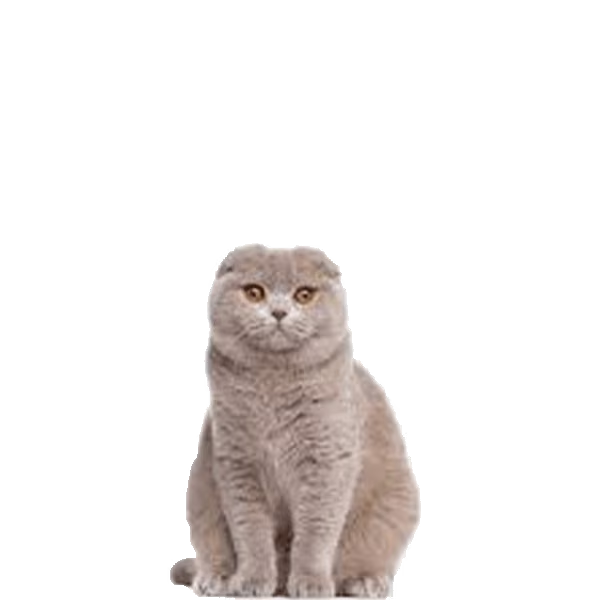
The Foldex is an affectionate, calm breed prized for its folded ears, round face, and sweet, sociable companionship.
How the Foldex coat is built, and what that means when you groom it.
Critical: A Foldex should not be shaved.
The undercoat keeps heat out as well as in, and the outer coat shields the skin from sun and insect bites. Clipping the whole coat off removes both. It often grows back patchy, soft or a different colour, and in some animals the guard hairs never return properly. Brush the undercoat out instead of cutting it off.
The Foldex is a medium-sized cat from Canada, known for its folded ears, round face, and a calm, affectionate temperament that suits it well to life as a steady household companion.
The Foldex is a medium-sized domestic cat developed in Canada. It is the result of crossing the Scottish Fold with the Exotic Shorthair, carrying the folded ears of the Scottish Fold together with the rounded, cobby build of the Exotic. The breed is sometimes called the Exfold.
A typical Foldex has a round head, large round eyes, full cheeks, and small ears that fold forward and down against the skull. The body is compact and muscular, set on short to medium legs. Coats come in both short and medium-long lengths. The overall impression is soft and rounded, with no sharp angles.
In temperament the Foldex is affectionate, gentle, calm, good-natured, and sociable. It bonds closely with the people it lives with, tolerates handling well, and tends to stay quiet rather than vocal. These traits suit it to families, couples, and single owners who want a placid indoor cat.
| Attribute | Detail |
|---|---|
| Origin | Canada |
| Size | Medium |
| Lifespan | 13 to 18 years |
| Role | Companion / lap cat |
| Good with | Families, children, other calm pets |
The Foldex suits owners who want an even-tempered indoor cat that enjoys company. It does well in flats and houses alike, gets along with respectful children and other animals, and copes better with regular human contact than with long stretches alone. Households that are out all day should plan for company or a second pet.
The Foldex was developed in Quebec, Canada, from the 1990s by crossing the Scottish Fold with the Exotic Shorthair, and it gained recognition from the Canadian Cat Association.
The Foldex originated in the province of Quebec, Canada. Breeding work began in the 1990s, with the aim of combining the folded ears of the Scottish Fold with the round face and dense, plush coat of the Exotic Shorthair.
The two parent breeds shaped the result directly. The Scottish Fold, which appeared in Scotland in the 1960s, contributes the forward-folded ears caused by a natural cartilage mutation. The Exotic Shorthair, a shorthaired variant of the Persian, contributes the cobby body, short muzzle, and large round eyes.
The Canadian Cat Association recognised the Foldex, and the breed remains most established in Canada, where it was created. Numbers outside its home country stay limited, and the Foldex is far less common than either parent breed.
Because the folded-ear trait comes from a gene that also affects cartilage, responsible breeding pairs folded-ear cats with straight-eared partners. This practice is intended to reduce the risk of skeletal problems linked to inheriting the trait from both parents.
The Foldex is a compact, rounded medium cat with small forward-folded ears, large round eyes, and a short or medium-long plush coat available in a wide range of colours.
The Foldex has a balanced, rounded look. The head is broad and round with full cheeks, a short nose, and a firm chin. The ears are small and fold forward and downward, sitting close to the head. The eyes are large, round, and set well apart. The body is medium in size, muscular, and cobby, carried on short to medium legs with rounded paws.
| Trait | Standard |
|---|---|
| Height | About 23 to 28 cm at the shoulder |
| Weight | 3 to 6 kg |
| Coat | Short or medium-long, dense and plush |
| Colours | Most colours and patterns, including solid, tabby, bicolour, and pointed |
| Eyes | Large and round, colour matched to coat |
The Foldex comes in two coat lengths. The shorthair has a dense, soft coat that stands slightly off the body, while the longer variety has a medium plush coat with light feathering. Both feel soft to the touch. A broad palette is accepted, covering solid shades such as black, white, blue, and cream, as well as tabby, tortoiseshell, bicolour, and colourpoint patterns. Ear fold can vary from a single loose fold to a tighter triple fold.
The Foldex is affectionate, calm, and sociable, bonding closely with its household, getting on well with children and other pets, and staying quiet rather than demanding.
The Foldex has a gentle, easygoing personality. It is affectionate without being clingy and tends to follow family members from room to room, settling nearby or on a lap. With strangers it is usually reserved at first, then warms up once it has had time to observe.
The breed is sociable and adapts well to homes with children who handle it kindly, and it generally tolerates other cats and calm dogs. Play sessions are moderate rather than frantic, and the cat is content to nap for much of the day. The Foldex is quiet, using soft sounds rather than loud or frequent calls. Because it forms strong attachments, it prefers steady company and may become withdrawn if left alone for long periods.
| Trait | Rating |
|---|---|
| Affection | 5 |
| Energy | 2 |
| Trainability | 3 |
| Vocalness | 2 |
| Shedding | 3 |
The Foldex needs routine coat brushing, gentle ear checks because of the fold, modest daily play, and a stable indoor home with its people nearby.
The Foldex is a low-maintenance cat overall, but the folded ears and dense coat call for a few regular habits.
The Foldex is suited to indoor life and adapts to flats. It values calm, routine, and the company of its household. Provide soft resting spots, a quiet litter area, and access to a window perch. Keep major changes gradual, since the breed prefers stability.
The Foldex needs a complete, protein-rich cat diet with measured portions to prevent weight gain on its compact, low-energy frame.
Feed the Foldex a complete and balanced diet formulated for cats, with animal protein as the main ingredient. Because the breed is calm and not highly active, portion control matters to avoid excess weight. Fresh water should always be available, and wet food can help support hydration.
| Life stage | Amount per day | Meals |
|---|---|---|
| Kitten (2 to 12 months) | Per pack, fed to appetite | 3 to 4 |
| Adult (1 to 7 years) | 55 to 75 g dry or equivalent wet | 2 |
| Senior (7 years and older) | Adjusted for activity and weight | 2 |
Keep treats to no more than 10 per cent of daily calories. A healthy cat on a complete diet usually needs no extra supplements, but a vet may advise omega-3 fatty acids or joint support for older cats. Introduce any new food gradually over several days.
The Foldex generally lives 13 to 18 years, but the folded-ear gene carries a risk of cartilage and joint problems, so responsible breeding and routine vet care are important.
The Foldex is generally a hardy cat with a typical lifespan of 13 to 18 years. The main health concern is tied to the same gene that produces the folded ears, which affects cartilage throughout the body. This can lead to a skeletal condition affecting the joints and tail. Reputable breeders pair folded-ear cats only with straight-eared partners to lower this risk.
| Condition | Signs | Note |
|---|---|---|
| Osteochondrodysplasia | Stiff gait, reluctance to jump, thickened tail | Linked to the folded-ear gene |
| Ear issues | Wax buildup, odour, head shaking | Folded ears need regular checks |
| Dental disease | Bad breath, drooling, reduced eating | Common in many cats; prevent with dental care |
| Weight gain | Excess body fat, low activity | Manage with portion control |
The Foldex is moderately trainable through patient, reward-based sessions, learning litter habits, basic cues, and routines well thanks to its calm nature.
The Foldex is calm and people-oriented, which helps with training. It is not as driven as some active breeds, so short, consistent sessions work best. The cat responds to gentle, reward-based methods and can learn its name, come when called, accept handling, and use a scratching post. Litter training is usually straightforward.
Foldex breeding requires pairing a folded-ear cat with a straight-eared partner to protect kitten health, with litters typically of three to five kittens after a roughly two-month pregnancy.
Breeding the Foldex centres on the folded-ear gene. Two folded-ear cats must never be bred together, because kittens inheriting the trait from both parents face a high risk of serious skeletal disease. Responsible breeders pair one folded-ear cat with a straight-eared cat, so a litter contains both folded and straight-eared kittens.
Cats reach breeding maturity at around 9 to 12 months, though many breeders wait until the cat is older and fully assessed. Pregnancy lasts roughly 63 to 67 days. Litters usually contain three to five kittens. Newborn kittens are born with straight ears, and any fold begins to appear at about three to four weeks of age.
Kittens should stay with the mother until at least 12 weeks, by which point they are weaned, litter trained, and well socialised. Breeders monitor ear development, joint health, and growth before placing kittens in new homes.
| Metric | Value |
|---|---|
| Breeding maturity | About 9 to 12 months |
| Gestation | 63 to 67 days |
| Litter size | 3 to 5 kittens |
| Ear fold appears | About 3 to 4 weeks |
| Weaning / rehoming | From 12 weeks |
| Required pairing | Folded-ear x straight-ear only |
England now requires chipped pet cats, and a free United Pet Club record keeps your Foldex on the right side of that rule for life.
Since June 2024, pet cats in England must be microchipped, with kittens chipped by twenty weeks, and a chip is only useful once a record stands behind it. A free United Pet Club profile ties your details to your Foldex for life. Registering your cat takes a few minutes, suits indoor cats as much as roamers, and costs nothing.
Until the fifteen digit number is lodged in a registry, your Foldex's chip identifies nobody. Lodge it free with United Pet Club: the lifetime plan takes any brand, keeps every update free, and leaves the record searchable day and night. Microchip registration first, then a free account if you are new here.
Create a free United Pet Club account, add your Foldex's name, colouring and a photo, and save. The profile is free for the whole of the cat's life, and England's cat microchipping rule makes a current record worth having from day one.
Enter the fifteen digit number from your paperwork into your free United Pet Club account with your address, phone and email. The lifetime plan never charges for the record or for keeping it current.
In England, yes: pet cats have needed a chip since June 2024, with kittens done by twenty weeks. Scotland and Wales have not followed yet, but a chipped and registered Foldex is covered wherever you live.
Nothing. Profile, chip record and unlimited amendments are free for life with United Pet Club, wherever in the UK you and the cat happen to live.
Common questions about the Foldex cover its size, temperament, care needs, lifespan, suitability for families, and availability in the UK.
The Foldex is a medium-sized cat. Most adults weigh between 3 and 6 kg and stand about 23 to 28 cm at the shoulder, with a compact, muscular build.
The Foldex is affectionate, calm, gentle, and sociable. It bonds closely with its household, gets along with children and other calm pets, and stays quiet rather than vocal.
No. It needs weekly to twice-weekly brushing depending on coat length, regular ear checks because of the fold, modest daily play, and routine vet care. It is otherwise low-maintenance.
A Foldex typically lives 13 to 18 years with good nutrition, a healthy weight, and regular veterinary care.
Yes. Its calm, tolerant nature suits families with respectful children, couples, and single owners, and it adapts well to flat living. It prefers steady company over long periods alone.
They are uncommon. The breed is most established in Canada, where it was developed, and numbers elsewhere are limited, so buyers may face waiting lists with reputable breeders.
The folded-ear gene can affect cartilage and joints. Risk is reduced when breeders pair folded-ear cats only with straight-eared partners, and owners should watch for stiffness or a thickened tail.
