

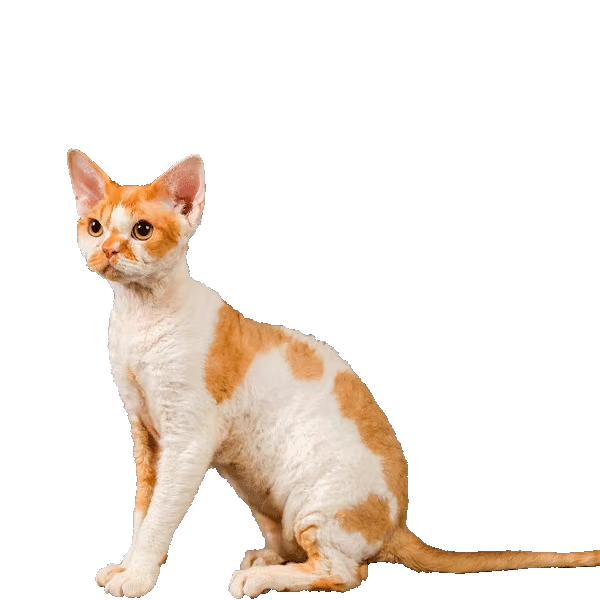
Devon Rex
The Devon Rex is a mischievous, playful breed adored for its big ears, wavy coat, and clownish, people-loving antics.
- Size
- Small
- Lifespan
- 9–15 years
- Origin
- United Kingdom
- Temperament
- Mischievous
- Standard colours
- Black, White and Blue and 13 more
Characteristics
Coat and grooming
How the Devon Rex coat is built, and what that means when you groom it.
- Coat layers
- Single coat
- Coat texture
- Curly, Wavy
- Coat length
- Short
- Shedding
- Low shedding
Devon Rex colours and patterns
What each club's breed standard says about every Devon Rex colour and pattern. Point at a ruling to see the club's own wording.
Breed standards describe the Devon Rex in Black, White, Blue, Lilac, Silver, Platinum, Brown, Chocolate, Seal, Sable, Cinnamon, Red, Gold, Cream, Fawn and Champagne. Standard patterns: Solid, Bicolour, Harlequin, Pointed, Tabby, Mackerel tabby, Classic tabby, Spotted tabby, Ticked tabby, Tortoiseshell, Calico, Torbie, Mink, Sepia, Van, Smoke, Shaded, Chinchilla and Caliby.
| Colour or pattern | TICA | CFA | FIFE | GCCF |
|---|---|---|---|---|
| Black | Standard | Standard (“Black”) | Standard (“black”) | Standard |
| White | Standard (“dominant white”) | Standard (“White”) | Standard (“white”) | Standard |
| Blue | Standard | Standard (“Blue”) | Standard (“blue”) | Standard |
| Lilac | Standard | Standard (“Lavender”) | Standard (“lilac”) | Standard |
| Silver | No ruling | Standard (“Silver”) | Standard (“silver”) | No ruling |
| Platinum | Standard | Standard | Standard (“lilac”) | No ruling |
| Brown | Standard | Standard (“Brown Tabby”) | Standard (“black tabby”) | No ruling |
| Chocolate | Standard | Standard (“Chocolate”) | Standard (“chocolate”) | Standard |
| Seal | Standard | Standard (“Seal”) | Standard (“seal”) | No ruling |
| Sable | Standard | Standard (“seal mink / seal sepia”) | Standard (“brown”) | No ruling |
| Cinnamon | Standard | Standard (“Cinnamon”) | Standard (“cinnamon”) | Standard |
| Red | Standard | Standard (“Red”) | Standard (“red”) | Standard |
| Gold | No ruling | No ruling | Standard (“golden”) | No ruling |
| Cream | Standard | Standard (“Cream”) | Standard (“cream”) | Standard |
| Fawn | Standard | Standard (“Fawn”) | Standard (“fawn”) | Standard |
| Champagne | Standard | Standard | Standard (“chocolate”) | No ruling |
| Patterns | ||||
| Solid | Standard (“Solid”) | Standard (“Solid”) | Standard (“solid”) | No ruling |
| Bicolour | Standard (“and White”) | Standard (“Bi-Color”) | Standard (“bicolour”) | No ruling |
| Harlequin | No ruling | No ruling | Standard (“harlequin”) | No ruling |
| Pointed | Standard (“Pointed”) | Standard (“Pointed”) | Standard (“Siamese pointed”) | No ruling |
| Tabby | Standard (“Tabby”) | Standard (“lynx point”) | Standard (“tabby”) | No ruling |
| Mackerel tabby | No ruling | Standard (“Mackerel Tabby”) | Standard (“mackerel”) | No ruling |
| Classic tabby | No ruling | Standard (“Classic Tabby”) | Standard (“blotched”) | No ruling |
| Spotted tabby | No ruling | Standard (“Spotted Tabby”) | Standard (“spotted”) | No ruling |
| Ticked tabby | No ruling | Standard (“Ticked Tabby”) | Standard (“ticked”) | No ruling |
| Tortoiseshell | Standard (“Tortoiseshell”) | Standard (“Tortoiseshell”) | Standard (“tortie”) | No ruling |
| Calico | Standard (“Tortie and White”) | Standard (“Calico”) | Standard (“tortie with white”) | No ruling |
| Torbie | No ruling | Standard (“Patched Tabby”) | Standard (“tortie tabby”) | No ruling |
| Mink | Standard (“Mink”) | Standard (“Mink”) | Standard (“Tonkinese pointed”) | No ruling |
| Sepia | Standard (“Sepia”) | Standard (“Sepia”) | Standard (“Burmese pointed”) | No ruling |
| Van | No ruling | Standard (“Van Bi-Color / Van Calico”) | Standard (“van”) | No ruling |
| Smoke | Standard (“Silver/Smoke”) | Standard (“Smoke”) | Standard (“smoke”) | No ruling |
| Shaded | No ruling | Standard (“Shaded”) | Standard (“shaded”) | No ruling |
| Chinchilla | No ruling | Standard (“Chinchilla”) | Standard (“shell”) | No ruling |
| Caliby | Standard (“Tortie and White”) | Standard (“Calico”) | Standard (“tortie with white”) | No ruling |


| Colour or pattern | TICA | CFA | FIFE |
|---|---|---|---|
| Blue | Standard (“Blue”) | Standard (“any shade of blue”) | Standard (“deep blue”) |
| Orange | No ruling | No ruling | Standard (“copper or deep orange”) |
| Copper | No ruling | No ruling | Standard (“copper or deep orange”) |
| Yellow | No ruling | Standard (“yellow/gold”) | Standard (“golden yellow”) |
| Gold | No ruling | Standard (“yellow/gold”) | Standard (“golden yellow”) |
| Green | No ruling | Standard (“green”) | Standard (“green”) |
| Aqua | No ruling | Standard (“aqua / blue/green”) | Standard (“aquamarine”) |
| Patterns | |||
| Odd-eyed | Standard (“odd”) | No ruling | Standard (“odd eyed”) |

What the rulings mean
- Standard
- Described by the club's breed standard.
Colour changes
How a Devon Rex's colours can change over its life.
Brownchanges toCopal
Coat · With age · from 0 to 52 weeks
Blackchanges toRusset
Coat · Progressive
Tabbychanges toSolid
Coat · With age · from 0 to 39 weeks
Whitechanges toShaded
Coat · With age
Whitechanges toChinchilla
Coat · With age
Tabbychanges toShaded
Coat · With age · from 0 to 6 weeks
Tabbychanges toChinchilla
Coat · With age · from 0 to 6 weeks
Bluechanges toTortoiseshell
Coat · With age
Blackchanges toBrown
Coat · With body condition · can change back
Blackchanges toBrown
Coat · In the sun · can change back
Blackchanges toBrown
Coat · Progressive
Whitechanges toPointed
Coat · With age · from 1 to 52 weeks
Solidchanges toSmoke
Coat · With age · from 3 to 104 weeks
Bluechanges toGreen
Eyes · With age · from 4 to 17 weeks
Bluechanges toYellow
Eyes · With age · from 4 to 17 weeks
Bluechanges toGold
Eyes · With age · from 4 to 17 weeks
Bluechanges toCopper
Eyes · With age · from 4 to 17 weeks
Bluechanges toOrange
Eyes · With age · from 4 to 17 weeks
Bluechanges toHazel
Eyes · With age · from 4 to 17 weeks
Bluechanges toAmber
Eyes · With age · from 4 to 17 weeks
Pinkchanges toSeal
Nose · With age · from 1 to 52 weeks
Pinkchanges toBlue
Nose · With age · from 1 to 52 weeks
Pinkchanges toChocolate
Nose · With age · from 1 to 52 weeks
Pinkchanges toLilac
Nose · With age · from 1 to 52 weeks
Pinkchanges toSeal
Paw pads · With age · from 1 to 52 weeks
Pinkchanges toBlue
Paw pads · With age · from 1 to 52 weeks
Pinkchanges toChocolate
Paw pads · With age · from 1 to 52 weeks
Pinkchanges toLilac
Paw pads · With age · from 1 to 52 weeks
Sources
Each ruling comes from the club's published breed standard or colour list.
Devon Rex breed standard
What each club's standard asks of the Devon Rex: size, build and forms. A club speaks only for itself, and a figure no club published is left out.
Conformation
Head shape
Modified wedge
“Modified wedge, with very full cheeks”
Head shape
NarrowFault
“Narrow, long or domestic head”
Stop
Pronounced
“Strongly marked stop”
Muzzle length
Short
“Short, well-developed”
Eye shape
Oval
“Oval in shape”
Eye shape
Oblique
“sloping toward the outer edge of the ear”
Eye set
Wide-set
“Large, wide set”
Ear set
Low
“Large, low-set, wide at the base”
Ear set
HighFault
“set too high”
Ear size
Large
“Large, low-set, wide at the base”
Ear size
SmallFault
“Ears that are small”
Ear tip
Rounded
“tapering to rounded tips”
Ear tip
Tufted (lynx tips)Alternate
“with or without ear muffs and tufts”
Leg length
Long
“Long, medium fine in boning”
Chest
Broad
“medium length but broad chested”
Feet
Oval
“Small and oval”
Tail length
Long
“Long, tapering, medium fine boned”
Tail length
ShortFault
“Short, bare or bushy tail”
Tail shape
Tapering
“Long, tapering, medium fine boned”


Markings


Parts of the body


About the Devon Rex
The Devon Rex is a small, people-oriented cat from England, known for its wavy coat, oversized ears, and playful, mischievous character.
The Devon Rex is a small domestic cat recognised by its short wavy coat, broad head with prominent cheekbones, large low-set ears, and big expressive eyes. The look is often described as elfin or pixie-like. Adults usually weigh between 2.7 and 4 kg (roughly 6 to 9 lb), which places the breed at the smaller end of the cat size range.
This is a cat bred and kept for companionship rather than work. Devon Rex cats are active, curious, and strongly attached to people. They tend to follow their owners from room to room, sit on shoulders or laps, and involve themselves in whatever the household is doing. Many retain their kitten-like playfulness well into adulthood.
The wavy coat is the result of a natural genetic mutation first identified in Devon, England, in 1960. The coat is short and soft, and many owners report that grooming demands are modest, though the breed still sheds and is not hypoallergenic.
| Attribute | Detail |
|---|---|
| Origin | United Kingdom (Devon, England) |
| Size | Small (about 2.7 to 4 kg) |
| Lifespan | 9 to 15 years |
| Group / role | Companion / domestic shorthair-type |
| Good with | Families, children, other pets, attentive single-person homes |
Who it suits
The Devon Rex fits households that want an interactive, affectionate cat and can give it daily attention. It suits families with children, multi-pet homes, and owners who are home often or who can provide company and toys. It is a poor match for people who want an independent, low-contact cat, because the breed can become bored or unhappy when left alone for long stretches.
History and origin of the Devon Rex
The Devon Rex traces to a single curly-coated kitten born in Devon, England, in 1960, and was developed into a recognised breed over the following decade.
The Devon Rex began in 1960 near Buckfastleigh in Devon, England. A woman named Beryl Cox took in a curly-coated kitten she named Kirlee, born to a stray cat living near a disused tin mine. Kirlee's wavy coat came from a natural genetic mutation.
At first the kitten was thought to share its origin with the Cornish Rex, a curly-coated cat that had appeared in neighbouring Cornwall a decade earlier. Breeders attempted to mate Kirlee with Cornish Rex cats, but the resulting kittens had straight coats. This showed that the two curls came from different recessive genes, and the Devon line was established as a separate breed.
Breeders used Kirlee as the foundation male and crossed him with cats carrying the same recessive gene to fix the wavy coat. Because the gene pool started from one cat, early breeding relied on a small number of founders. Outcrossing to other shorthaired cats was used to widen the gene pool while keeping the coat type.
The breed gained championship recognition with major cat registries during the 1960s and 1970s and spread from the United Kingdom to North America and other regions, where it remains a recognised pedigree breed today.
Devon Rex appearance and breed standard
The Devon Rex is a small cat with a wedge-shaped face, very large low-set ears, big eyes, and a short, soft, wavy coat that is its most defining feature.
The Devon Rex has a distinctive head shaped like a short wedge, with full cheeks, a strong chin, and a clear stop in the nose profile. The most striking feature is the pair of very large ears set low and wide on the head, giving the face an open, alert look. The eyes are large, oval, and set well apart. The body is slim and hard-muscled with a broad chest and long legs, and the cat often carries itself in a slightly arched, springy posture.
| Trait | Standard |
|---|---|
| Height | About 25 to 30 cm at the shoulder (10 to 12 in) |
| Weight | About 2.7 to 4 kg (6 to 9 lb) |
| Coat | Short, soft, wavy (rexed); fine and loose |
| Colours | All colours and patterns, including solid, tabby, tortoiseshell, bicolour, and pointed |
| Eyes | Large, oval, wide-set; colour usually matches coat |
Coat and colours
The coat is the defining feature. It is short, fine, and arranged in soft waves rather than tight curls, and it can feel thin or sparse in places such as the head, neck, and chest. Some Devon Rex cats have lighter coverage on the underside and ears. The whiskers and eyebrows are often short, curled, or stubbly and may break easily.
The breed is accepted in the full range of cat colours and patterns. This includes solid shades such as black, white, blue, and cream, as well as tabby, tortoiseshell, calico, smoke, and pointed patterns. Coat colour does not affect the wavy texture, which depends only on the rex gene.
What the Devon Rex standard says, club by club
What the breed standards say about the build of the Devon Rex. Clubs compared: ACFA, CCA, CFA, FIFE, GCCF, LOOF, TICA, WCF.
Clubs set their own figures for the Devon Rex. These come from each club's published standard: ACFA, CCA, CFA, FIFE, GCCF, LOOF, TICA, WCF.
Build and forms
At least one club accepts each of these:
- Head shape: Modified wedge, Wedge, Broad
- Facial profile: Nose break
- Stop: Pronounced, Moderate
- Muzzle length: Short
- Eye shape: Oval, Oblique
- Eye set: Wide-set, Well set
- Eye size: Large
- Ear set: Low
- Ear size: Large
- Ear tip: Rounded, Tufted (lynx tips)
Forms the clubs penalise
A fault or a disqualification is a judgment under a show standard. It can affect placings and, at some clubs, registration.
- Disqualifying: Head shape: Round (GCCF); Head shape: Narrow (GCCF); Facial profile: Straight (GCCF, LOOF); Stop: Pronounced (GCCF); Bite: Undershot (GCCF); Bite: Overshot (GCCF); Bite: Malocclusion (GCCF); Ear set: High (GCCF); Ear size: Small (GCCF); Toes: Polydactyl (extra toes) (ACFA, CFA)
- Fault: Head shape: Round (CFA, LOOF); Head shape: Narrow (CCA, CFA, LOOF, TICA); Stop: Pronounced (CCA); Eye shape: Round (GCCF); Ear set: High (CFA, LOOF, TICA); Ear size: Small (CFA, LOOF, TICA); Body type: Cobby (GCCF); Chest: Narrow (LOOF); Tail length: Short (CCA, CFA, GCCF, LOOF, TICA)
Markings
Each club's ruling on the breed's named marks:
- Locket: Alternate (CCA, CFA, LOOF, TICA)
- Buttons: Alternate (CCA, CFA)
- Blaze: Standard (CCA, CFA)
- Patch: Alternate (CCA)
See every point side by side: compare the clubs.
Rulings come from each club's published breed standard, and clubs revise their standards. Before a show or a registration, check the current text with the club.
Which forms do clubs penalise in the Devon Rex?
Disqualifying: Head shape: Round (GCCF); Head shape: Narrow (GCCF); Facial profile: Straight (GCCF, LOOF); Stop: Pronounced (GCCF); Bite: Undershot (GCCF); Bite: Overshot (GCCF); Bite: Malocclusion (GCCF); Ear set: High (GCCF); Ear size: Small (GCCF); Toes: Polydactyl (extra toes) (ACFA, CFA). Fault: Head shape: Round (CFA, LOOF); Head shape: Narrow (CCA, CFA, LOOF, TICA); Stop: Pronounced (CCA); Eye shape: Round (GCCF); Ear set: High (CFA, LOOF, TICA); Ear size: Small (CFA, LOOF, TICA); Body type: Cobby (GCCF); Chest: Narrow (LOOF); Tail length: Short (CCA, CFA, GCCF, LOOF, TICA).
Which Devon Rex colours the clubs accept
Every club we track accepts Black, White, Blue, Lilac, Chocolate, Cinnamon for the Devon Rex.
On the Devon Rex, every club we track agrees on Black, White, Blue, Lilac, Chocolate, Cinnamon. Clubs compared: CFA, FIFE, GCCF, TICA.
Patterns listed as standard for the Devon Rex: Solid, Bicolour, Harlequin, Pointed, Tabby, Mackerel tabby.
Beyond the main colour
Standards rule on more than the main colour. These are listed as standard:
- Eyes: Blue, Orange, Copper, Yellow, Gold, Green
- Nose: Black, Blue, Lilac, Brown, Chocolate, Cinnamon
- Paw pads: Black, Blue, Lilac, Brown, Cinnamon, Brick red
Rulings come from each club's published breed standard, and clubs revise their standards. Before a show or a registration, check the current text with the club.
Which Devon Rex colours do all the clubs accept?
All of these clubs accept Black, White, Blue, Lilac, Chocolate, Cinnamon: CFA, FIFE, GCCF, TICA.
Devon Rex temperament and personality
The Devon Rex is affectionate, playful, and mischievous, forming strong bonds with people and generally getting along well with children and other pets.
The Devon Rex is one of the more people-focused cat breeds. It tends to seek out human company, perch on shoulders, burrow under blankets, and stay close to its owner during the day. Many owners describe the breed as dog-like in its attachment, and some Devon Rex cats learn to come when called or play fetch.
With family members the breed is warm and demonstrative. It usually does well with respectful children who can match its energy and play style. With strangers, most Devon Rex cats are confident and curious rather than shy, though individuals vary. The breed generally tolerates and often enjoys the company of other cats and friendly dogs, which makes it a reasonable choice for multi-pet homes.
The playful, mischievous side is constant. These cats climb, explore high shelves, open cabinets, and investigate food left out. They are intelligent and active, and they need toys, attention, and interaction to stay content. A bored Devon Rex may become noisy or destructive. The breed is moderately vocal, communicating with chirps and soft calls rather than loud, persistent meowing.
| Trait | Rating |
|---|---|
| Affection | 5 |
| Energy | 5 |
| Trainability | 4 |
| Vocalness | 3 |
| Shedding | 2 |
Devon Rex care and grooming
The Devon Rex needs gentle, minimal coat care plus regular ear cleaning, daily play, and a warm indoor home, since its thin coat offers little insulation against the cold.
Grooming
- Brushing is rarely needed; the fine, wavy coat can be damaged by aggressive brushing, so use a soft cloth or gentle stroking to remove loose hair.
- Clean the large ears regularly, as they can build up wax and oils faster than in many breeds.
- Wipe the skin or give an occasional gentle bath if the coat feels greasy, since the sparse coat absorbs less skin oil.
- Trim nails every few weeks and check the stubby whiskers and brows, which can break.
- Brush the teeth regularly and schedule dental checks.
Exercise
- Provide daily interactive play with wand toys, balls, and puzzle feeders to use the breed's high energy.
- Offer climbing space such as cat trees and shelves, since the breed loves height.
- Rotate toys to keep a curious, intelligent cat engaged and prevent boredom.
Environment
The Devon Rex is an indoor cat. Its thin coat gives little protection from cold, so the home should be kept warm and free of draughts, and the cat will often seek out heated spots, sunny windows, and laps. Because the breed is social, it does best where it has company for much of the day. Provide warm bedding and safe high perches.
Grooming a Devon Rex
The Devon Rex coat: Single coat, Curly, Wavy, Short, Low shedding.
Most of what a Devon Rex needs from grooming follows from its coat.
- Coat layers: Single coat
- Coat texture: Curly, Wavy
- Coat length: Short
- Shedding: Low shedding
What this coat asks of you
- A single coat has no dense undercoat, so there is less to brush out and less insulation against the cold.
- Curls hide mats close to the skin, so comb down to the roots and keep the length under control.
- A wavy coat tangles more than it looks. Comb through the waves, not just over them.
- Short hair rarely tangles but it still sheds, so regular brushing keeps the loose hair down.
- Low shedding does not mean low upkeep. Hair that stays in the coat can still tangle unless it is brushed out.
A groomer who knows the breed can adapt all of this to the individual animal. Sore skin, mats pressed against the skin or a sudden change in the coat are worth showing to a vet.
What kind of coat does a Devon Rex have?
On our records: Coat layers: Single coat; Coat texture: Curly, Wavy; Coat length: Short; Shedding: Low shedding.
How much does a Devon Rex shed?
Low shedding does not mean low upkeep. Hair that stays in the coat can still tangle unless it is brushed out.
Devon Rex nutrition and feeding
The Devon Rex needs a complete, protein-rich cat food fed in measured daily portions, with fresh water always available and care taken to avoid foods that are toxic to cats.
As an active cat, the Devon Rex benefits from a complete and balanced diet built around animal protein. Choose a quality commercial cat food that meets recognised feline nutrition standards for the cat's life stage. The breed's high energy means it burns calories quickly, but portions should still be measured to prevent overfeeding. Fresh water should always be available, and a mix of wet and dry food can help with hydration.
| Life stage | Amount per day | Meals |
|---|---|---|
| Kitten (to 12 months) | Feed to appetite per label, growth formula | 3 to 4 |
| Adult (1 to 7 years) | About 110 to 170 g wet or equivalent dry | 2 |
| Senior (8+ years) | Adjusted to weight and activity | 2 |
Treats and supplements
Treats should stay under about 10 per cent of daily calories. A balanced complete diet usually supplies all required nutrients, so supplements are not needed unless a veterinarian recommends them for a specific condition. Watch the cat's weight at regular check-ups and adjust food amounts if it gains or loses condition.
Devon Rex health and common conditions
The Devon Rex generally lives 9 to 15 years and is mostly healthy, but the breed has known risks including a muscle disorder, heart disease, and patellar luxation.
The Devon Rex is generally a healthy breed with a typical lifespan of 9 to 15 years. Because the modern population descends from a small number of founders, it carries a few inherited conditions that responsible breeders screen for. Buying from a breeder who tests breeding cats and provides health records reduces the risk of passing these on.
| Condition | Signs | Note |
|---|---|---|
| Devon Rex myopathy (spasticity) | Muscle weakness, head bobbing, difficulty swallowing | Inherited muscle disorder; appears in young cats |
| Hypertrophic cardiomyopathy (HCM) | Lethargy, breathing trouble, sudden weakness | Heart muscle thickening; screened by cardiac ultrasound |
| Patellar luxation | Skipping gait, hind-leg lameness | Kneecap slips out of place; varies in severity |
| Hereditary skin and coat issues | Greasy skin, yeast or ear infections | Linked to the sparse coat and ear wax build-up |
Preventive care
- Annual veterinary check-ups, with twice-yearly visits for senior cats.
- Core vaccinations and parasite prevention as advised by a veterinarian.
- Regular ear cleaning to prevent wax build-up and infection.
- Dental care, including brushing and professional cleaning when needed.
- Weight monitoring and a balanced diet to avoid obesity.
Devon Rex training and enrichment
The Devon Rex is intelligent and people-oriented, making it one of the more trainable cat breeds when taught with patience and positive rewards.
The Devon Rex learns quickly and enjoys interaction, so it responds well to training that many cats ignore. Owners often teach this breed to fetch, walk on a harness, use puzzle feeders, and follow simple cues. Because the cat is motivated by attention and food, short, frequent sessions work better than long ones. Keep training positive, since cats do not respond to punishment and may withdraw or become stressed.
Basics
- Start with litter training, which most kittens pick up early with a clean, accessible box.
- Introduce a scratching post and reward its use to protect furniture.
- Use clicker or marker training paired with small treats to teach cues such as come or sit.
- Build toward tricks like fetch or harness walking once the basics are reliable.
- Provide daily enrichment with puzzle toys and play to channel the breed's energy.
Devon Rex breeding and raising kittens
Devon Rex cats reach breeding maturity within the first year, carry litters for about two months, and typically produce small to average-sized litters that need careful, warm rearing.
Female Devon Rex cats usually reach sexual maturity between 5 and 10 months, though responsible breeders wait until a queen is physically mature, often around one year, before mating. Gestation lasts about 63 to 67 days. Litters are commonly small to average, with three to four kittens being typical.
Newborn kittens are especially dependent on warmth because of the breed's thin coat, so the nest must be kept warm and draught-free. Kittens nurse for the first weeks and begin weaning onto solid food at around four weeks, completing it by about eight weeks. Early, gentle handling helps produce the friendly, people-focused temperament the breed is known for.
Because the breed descends from a small founder group, ethical breeding programmes track pedigrees to limit inbreeding and screen breeding cats for heart disease, the inherited muscle disorder, and patellar problems. Kittens usually stay with the mother and litter until at least 12 weeks before going to new homes.
| Metric | Value |
|---|---|
| Sexual maturity | About 5 to 10 months |
| Recommended first breeding | Around 12 months |
| Gestation | About 63 to 67 days |
| Average litter size | 3 to 4 kittens |
| Weaning age | About 8 weeks |
| Ready for new home | 12 weeks or older |
Microchip and registration for your Devon Rex
England now requires chipped pet cats, and a free United Pet Club record keeps your Devon Rex on the right side of that rule for life.
How to register a Devon Rex in the United Kingdom
Start your Devon Rex's paperwork with the profile: name, colouring, a photo and your contact details, saved to a registry that never sends a bill. Cat registration works with or without a chip, so there is nothing to wait for.
The vet surgery implants the chip; recording it is yours to do, and in England the law now expects it done for cats. Register the microchip with United Pet Club free on the lifetime plan: every brand is accepted, amendments after moving house cost nothing, and the record answers the database checks rescue centres run on every stray. Create your free account and have both jobs sorted the same afternoon.
How do I register my Devon Rex in the UK?
Create a free United Pet Club account, add your Devon Rex's name, colouring and a photo, and save. The profile is free for the whole of the cat's life, and England's cat microchipping rule makes a current record worth having from day one.
How do I register my Devon Rex's microchip?
Enter the fifteen digit number from your paperwork into your free United Pet Club account with your address, phone and email. The lifetime plan never charges for the record or for keeping it current.
Does a Devon Rex have to be microchipped in the UK?
In England, yes: pet cats have needed a chip since June 2024, with kittens done by twenty weeks. Scotland and Wales have not followed yet, but a chipped and registered Devon Rex is covered wherever you live.
What does it cost to register a Devon Rex in the UK?
Nothing. Profile, chip record and unlimited amendments are free for life with United Pet Club, wherever in the UK you and the cat happen to live.
Frequently asked questions about the Devon Rex
Common questions about the Devon Rex cover its size, personality, care needs, lifespan, suitability for families, and where to find one in the UK.
How big does a Devon Rex get?
The Devon Rex is a small cat. Most adults weigh about 2.7 to 4 kg (6 to 9 lb) and stand roughly 25 to 30 cm at the shoulder, with males usually larger than females.
What is the Devon Rex's personality like?
It is affectionate, playful, and mischievous. The breed is strongly people-oriented, often following owners around, sitting on laps or shoulders, and keeping a kitten-like energy well into adulthood.
Is the Devon Rex difficult to care for?
Coat grooming is minimal because the wavy coat needs little brushing, but the breed needs regular ear cleaning, a warm draught-free home, and daily play and attention to stay content.
How long do Devon Rex cats live?
The typical lifespan is 9 to 15 years. Regular veterinary care, screening for inherited conditions, and a balanced diet help support a long, healthy life.
Are Devon Rex cats good for families?
Yes. They generally do well with respectful children, other cats, and friendly dogs, which makes them a good fit for active, social households that can give them regular attention.
Are Devon Rex cats hypoallergenic?
No. Although they shed little and have a thin coat, they still produce the allergens found in cat saliva and skin. No cat breed is truly hypoallergenic.
Where can I find a Devon Rex in the UK?
The Devon Rex is a recognised pedigree breed but is less common than mainstream cats. Kittens are usually obtained from breeders registered with The Kennel Club (KC) or the Governing Council of the Cat Fancy (GCCF), and breed-specific rescues occasionally have cats available.
From the community
Ask about the Devon RexNo questions about the Devon Rex yet. Be the first to ask.
Browse Cat breeds