
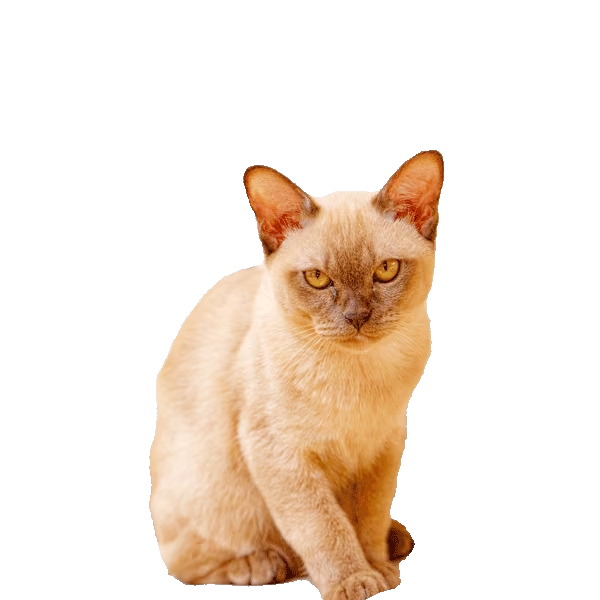
Burmese
The Burmese is an affectionate, people-oriented cat famous for its dog-like devotion and warm, playful personality.
- Size
- Medium
- Lifespan
- 16–18 years
- Origin
- United Kingdom
- Temperament
- Affectionate
- Standard colors
- Blue, Platinum and Sable and 5 more
Characteristics
Coat and grooming
How the Burmese coat is built, and what that means when you groom it.
- Coat layers
- Single coat
- Coat texture
- Smooth, Satin
- Coat length
- Short
- Shedding
- Low shedding
Burmese colors and patterns
What each club's breed standard says about every Burmese color and pattern. Point at a ruling to see the club's own wording.
Breed standards describe the Burmese in Blue, Platinum, Sable, Cinnamon, Red, Cream, Fawn and Champagne. Standard patterns: Tortoiseshell and Sepia.
| Color or pattern | TICA | CFA | FIFE | GCCF |
|---|---|---|---|---|
| Blue | Standard | Standard (“Blue”) | Standard (“Blue”) | Standard (“Blue”) |
| Platinum | Standard | Standard (“Platinum”) | Standard (“Lilac”) | Standard (“Lilac”) |
| Sable | Standard (“sable”) | Standard (“Sable”) | Standard (“Brown”) | Standard (“Brown”) |
| Cinnamon | Standard | No ruling | No ruling | No ruling |
| Red | Standard | No ruling | Standard (“Red”) | Standard (“Red”) |
| Cream | Standard | No ruling | Standard (“Cream”) | Standard (“Cream”) |
| Fawn | Standard | No ruling | No ruling | No ruling |
| Champagne | Standard | Standard (“Champagne”) | Standard (“Chocolate”) | Standard (“Chocolate”) |
| Patterns | ||||
| Tortoiseshell | Standard (“Tortoiseshell”) | No ruling | Standard (“tortie”) | Standard (“Tortie”) |
| Sepia | Standard (“Sepia”) | Standard | Standard (“Burmese”) | Standard (“Burmese Colour Restriction”) |
| Ticked | No ruling | No ruling | No ruling | Fault (“Ticking”) |
| Tabby | No ruling | No ruling | No ruling | Fault (“tabby markings”) |
| Smoke | No ruling | No ruling | No ruling | Fault (“smoke undercoat”) |


| Color or pattern | TICA | CFA | FIFE | GCCF |
|---|---|---|---|---|
| Amber | No ruling | No ruling | Standard (“amber”) | Standard (“amber”) |
| Yellow | No ruling | Standard (“yellow”) | Standard (“all shades of yellow from chartreuse to amber”) | Standard (“yellow”) |
| Gold | Standard (“Gold”) | Standard (“gold”) | Standard (“golden yellow”) | Standard (“golden yellow”) |
| Blue | No ruling | Disqualifying (“Blue”) | Fault (“more blue than yellow pigmentation”) | Disqualifying (“blue”) |
| Orange | No ruling | No ruling | No ruling | Fault (“orange”) |
| Green | Disqualifying (“Green”) | Fault (“Green”) | No ruling | Fault (“Green”) |
| Copper | No ruling | No ruling | No ruling | Disqualifying (“copper”) |
| Color or pattern | CFA | FIFE | GCCF |
|---|---|---|---|
| Blue | No ruling | Standard (“blue-grey”) | Standard (“blue”) |
| Lilac | Standard (“Lavender-pink”) | Standard (“lavender”) | Standard (“lavender pink”) |
| Slate | Standard (“Slate gray”) | No ruling | Standard (“dark-grey”) |
| Brown | Standard (“Brown / Light warm brown”) | Standard (“rich brown”) | Standard (“rich brown”) |
| Chocolate | No ruling | Standard (“chocolate-brown”) | Standard (“warm chocolate brown”) |
| Seal | No ruling | Standard (“seal brown”) | No ruling |
| Pink | No ruling | Standard (“pink”) | Standard (“pink”) |
| Color or pattern | CFA | FIFE | GCCF |
|---|---|---|---|
| Blue | Standard (“slate gray to warm pinkish blue”) | Standard (“pinkish blue-grey”) | Standard (“blue”) |
| Lilac | Standard (“Lavender-pink”) | Standard (“lavender”) | Standard (“lavender pink”) |
| Brown | Standard (“Brown”) | No ruling | Standard (“brown”) |
| Chocolate | No ruling | Standard (“cinnamon to chocolate”) | Standard (“brick pink shading to chocolate”) |
| Seal | No ruling | Standard (“seal brown”) | No ruling |
| Cinnamon | No ruling | Standard (“cinnamon to chocolate”) | No ruling |
| Pink | No ruling | Standard (“pink”) | Standard (“pink”) |
What the rulings mean
- Standard
- Described by the club's breed standard.
- Fault
- Named by the club's breed standard as a fault: the animal can be shown but is penalised.
- Disqualifying
- The club's breed standard disqualifies an animal of this colour or pattern.
Color changes
How a Burmese's colors can change over its life.
Tabbychanges toSolid
Coat · With age · from 0 to 39 weeks
Tabbychanges toShaded
Coat · With age · from 0 to 6 weeks
Tabbychanges toChinchilla
Coat · With age · from 0 to 6 weeks
Bluechanges toTortoiseshell
Coat · With age
Tabbychanges toSepia
Coat · With age
Bluechanges toGreen
Eyes · With age · from 4 to 17 weeks
Bluechanges toYellow
Eyes · With age · from 4 to 17 weeks
Bluechanges toGold
Eyes · With age · from 4 to 17 weeks
Bluechanges toCopper
Eyes · With age · from 4 to 17 weeks
Bluechanges toOrange
Eyes · With age · from 4 to 17 weeks
Bluechanges toHazel
Eyes · With age · from 4 to 17 weeks
Bluechanges toAmber
Eyes · With age · from 4 to 17 weeks
Pinkchanges toSeal
Nose · With age · from 1 to 52 weeks
Pinkchanges toBlue
Nose · With age · from 1 to 52 weeks
Pinkchanges toChocolate
Nose · With age · from 1 to 52 weeks
Pinkchanges toLilac
Nose · With age · from 1 to 52 weeks
Pinkchanges toSeal
Paw pads · With age · from 1 to 52 weeks
Pinkchanges toBlue
Paw pads · With age · from 1 to 52 weeks
Pinkchanges toChocolate
Paw pads · With age · from 1 to 52 weeks
Pinkchanges toLilac
Paw pads · With age · from 1 to 52 weeks


Sources
Each ruling comes from the club's published breed standard or color list.
Health
Conditions recorded as more common in the Burmese than in its species as a whole. A higher risk is not a diagnosis: many never develop any of them, and your vet can say which screening tests are worth doing.
High risk
- Endocrine system
Diabetes mellitus
Strong evidence
This content is for educational purposes and is not a substitute for professional veterinary advice. If you are worried about your pet, contact your veterinarian.
All health conditionsAbout the Burmese cat
The Burmese is a medium-sized, people-oriented cat known for dog-like devotion, a muscular compact body, and a warm, playful temperament.
The Burmese is a medium-sized shorthaired cat that attaches itself closely to its people. It is heavier than it looks, with a compact muscular body that earns it the nickname 'a brick wrapped in silk.' The coat is short, glossy, and lies flat against the skin.
This breed is talkative without being shrill, and it tends to follow household members from room to room. Many Burmese greet visitors, ride on shoulders, and stay involved in whatever is happening at home. Their devotion is often compared to that of a dog.
Burmese cats typically live 16 to 18 years and remain active well into their later years. They suit owners who want an interactive companion rather than an independent pet.
| Attribute | Detail |
|---|---|
| Origin | United Kingdom (developed from a foundation cat brought from Burma) |
| Size | Medium |
| Lifespan | 16 to 18 years |
| Group/role | Companion shorthair |
| Good with | Families, children, other cats, cat-friendly dogs |
Who it suits
The Burmese fits households where someone is home much of the day or where a second pet provides company. It is a poor choice for people who want a low-contact cat, because it dislikes long periods alone and seeks constant interaction. Its sociable nature makes it well matched to busy family homes and to first-time cat owners who want an engaged companion.
History and origin of the Burmese
The modern Burmese traces to a single brown female cat, Wong Mau, brought to the United States in 1930, with British breeders later developing a distinct line recognised by The Kennel Club.
The breed descends from a brown female cat named Wong Mau, taken from South-East Asia to the United States in 1930. Dr Joseph Thompson of San Francisco began a breeding programme with her, crossing her with Siamese cats because no similar mates existed at the time.
Careful selective breeding over the following years separated the darker, solid-coated offspring from Siamese-pointed kittens. The Cat Fanciers' Association first recognised the Burmese in 1936, then suspended recognition in 1947 over concerns about Siamese crossing, and restored it in 1953 once the lines had stabilised.
British breeders imported Burmese cats and developed their own line, which grew more elongated and was shaped by separate standards. This produced the two recognisable types seen today: the rounder American (or contemporary) Burmese and the slightly more moderate British (or traditional) Burmese. The breed described here is the United Kingdom line.
From the original brown, breeders expanded the accepted colours over later decades, adding dilute shades while keeping the dense, satin-like coat that defines the breed.
Burmese appearance and breed standard
The Burmese is a compact, muscular medium cat with a short satin coat, expressive rounded eyes in shades of gold, and a body heavier than its size suggests.
The Burmese has a substantial, well-muscled body on sturdy legs. The British type shows a slightly longer, more moderate frame than the rounder American type, but both are solid and surprisingly heavy when lifted. The head is rounded with a short muzzle and large, expressive eyes set well apart.
The coat is the breed's signature feature: short, fine, and very close-lying, with a satin sheen that shows the muscle underneath.
| Trait | Standard |
|---|---|
| Height | 25 to 30 cm at the shoulder |
| Weight | 3.5 to 5.5 kg (males heavier than females) |
| Coat | Short, fine, glossy, close-lying |
| Colours | Brown (sable), blue, chocolate, lilac, red, cream, and tortie variations |
| Eyes | Large, rounded, gold to yellow |
Coat and colours
Brown, also called sable, is the original and most familiar colour, a deep warm shade that lightens slightly on the underparts. The dilute and red-series colours were added through later breeding. The British standard recognises a wider palette than the American standard, including chocolate, lilac, red, cream, and tortoiseshell patterns. Whatever the colour, the coat carries little undercoat, so it sits flat and reflects light.
Burmese temperament and personality
The Burmese is affectionate, playful, and strongly attached to people, often described as dog-like, and it does not cope well with long periods of solitude.
The Burmese is one of the most people-focused cat breeds. It seeks out laps, shoulders, and any warm spot near its owner, and it stays interested in family activity. With children it is patient and playful, often tolerating handling that other cats would avoid. It usually accepts other cats and cat-friendly dogs, and it tends to fare better with feline company than alone.
With strangers the Burmese is curious rather than shy. Many will greet guests directly. The breed keeps a kitten-like playfulness into adulthood and enjoys fetch, puzzle toys, and interactive games.
The main caution is its dislike of being left alone. A Burmese left for long hours each day can become bored or stressed, so a companion animal or regular human presence is important. The voice is soft and conversational, lighter than a Siamese, used to stay in contact rather than to demand.
| Trait | Rating |
|---|---|
| Affection | 5 |
| Energy | 4 |
| Trainability | 4 |
| Vocalness | 3 |
| Shedding | 2 |
Burmese care and grooming
The Burmese is low-maintenance to groom thanks to its short coat, but it needs daily interaction and play to stay content.
Grooming
- Brush weekly with a soft brush or rubber mitt to remove loose hair and spread skin oils.
- Wipe the coat with a damp cloth or chamois for extra shine; bathing is rarely needed.
- Trim nails every two to three weeks.
- Check and clean ears as needed, and brush teeth regularly to limit dental disease.
Exercise
- Schedule two or more interactive play sessions daily using wand toys or thrown toys for fetch.
- Provide puzzle feeders and rotate toys to keep the mind busy.
- Offer climbing trees and shelves; the breed is active and likes height.
Environment
The Burmese is well suited to indoor life and prefers warm, settled homes. It feels the cold more than many breeds because of its thin coat and low undercoat, so warm sleeping spots matter. Company is part of its care: a second cat or a household with people home often is the best environment. Provide scratching posts, resting perches near windows, and a quiet retreat for sleep.
Burmese nutrition and feeding
The Burmese does well on a complete high-protein cat diet fed in measured meals, with attention to portion control because the breed can gain weight.
Feed a complete, balanced cat food with animal protein as the main ingredient. The Burmese is muscular and active, so it benefits from quality protein, but it also has a healthy appetite and can put on weight if fed free-choice. Measured meals work better than leaving food out all day. Fresh water should always be available, and a mix of wet and dry food supports hydration and dental health.
| Life stage | Amount per day | Meals |
|---|---|---|
| Kitten (2 to 12 months) | Follow package amount for growth; feed to appetite | 3 to 4 |
| Adult (1 to 7 years) | About 50 to 70 g dry or equivalent wet, adjusted to weight | 2 |
| Senior (8 years and older) | Adjusted to maintain lean weight and activity | 2 |
Treats and supplements
Keep treats to no more than ten per cent of daily calories and subtract them from meal portions to prevent weight gain. A cat on a complete commercial diet usually needs no extra supplements; add vitamins or joint support only on a veterinarian's advice.
Burmese health and lifespan
The Burmese is generally healthy and long-lived at 16 to 18 years, but the breed carries a few inherited conditions worth screening for.
The Burmese is a robust, long-lived breed, commonly reaching 16 to 18 years with good care. Its overall health is sound, though a small number of inherited conditions appear in breed lines and responsible breeders screen for them. Routine veterinary care, weight control, and dental attention all support a long life.
| Condition | Signs | Note |
|---|---|---|
| Diabetes mellitus | Increased thirst, urination, weight loss | More common in Burmese; weight control lowers risk |
| Hypokalaemic polymyopathy | Muscle weakness, neck flexion, unsteady gait | Inherited; genetic test available in some lines |
| Flat-chested kitten syndrome | Flattened ribcage in young kittens | Affects neonates; many mild cases improve with growth |
| Dental disease | Bad breath, drooling, reduced appetite | Regular brushing and cleaning help prevent it |
Preventive care
- Annual veterinary check-ups, moving to twice yearly for seniors.
- Keep vaccinations and parasite control current.
- Maintain lean body weight to reduce diabetes risk.
- Brush teeth and schedule dental cleanings as advised.
- Ask the breeder about genetic screening for hypokalaemia.
Training the Burmese
The Burmese is intelligent and eager to interact, which makes it one of the more trainable cat breeds for tricks, fetch, and harness walking.
The Burmese learns quickly and enjoys the attention that training brings. Its people-focused nature means it responds well to short, reward-based sessions, and many take readily to fetch, sit, and even harness walking. Keep sessions brief and end on success, since a bored cat loses interest fast. Litter training is usually straightforward; provide a clean box in a quiet spot and the kitten adapts early.
Basics
- Start with the litter box: place it away from food and noise and keep it clean.
- Introduce a clicker or marker word paired with a treat so the cat links the sound to a reward.
- Teach one simple behaviour at a time, such as coming when called.
- Reward immediately and keep sessions to a few minutes.
- Build up to fetch or harness work once the basics are reliable.
Breeding Burmese cats
Burmese queens mature early and produce moderate litters, and responsible breeding includes health screening for the inherited conditions in the breed.
Burmese cats reach sexual maturity relatively early, and queens can come into season from around five to six months, though responsible breeders wait until full maturity before mating. Gestation runs about 63 to 67 days, and litters average four to five kittens. Burmese mothers are usually attentive and care for their young well.
Kittens should stay with the mother until at least twelve to fourteen weeks so they are fully weaned, litter trained, and socialised. Because the breed carries inherited conditions, ethical breeding programmes screen breeding stock for hypokalaemia where testing is available and watch litters for flat-chested kitten syndrome. Early handling supports the breed's friendly, people-oriented temperament.
| Metric | Value |
|---|---|
| Sexual maturity | 5 to 7 months (mating delayed to full maturity) |
| Gestation | 63 to 67 days |
| Average litter size | 4 to 5 kittens |
| Weaning age | About 8 weeks |
| Recommended rehoming age | 12 to 14 weeks |
Microchip and registration for your Burmese
England now requires chipped pet cats, and a free United Pet Club record keeps your Burmese on the right side of that rule for life.
How to register a Burmese in the United Kingdom
Since June 2024, pet cats in England must be microchipped, with kittens chipped by twenty weeks, and a chip is only useful once a record stands behind it. A free United Pet Club profile ties your details to your Burmese for life. Registering your cat takes a few minutes, suits indoor cats as much as roamers, and costs nothing.
Until the fifteen digit number is lodged in a registry, your Burmese's chip identifies nobody. Lodge it free with United Pet Club: the lifetime plan takes any brand, keeps every update free, and leaves the record searchable day and night. Microchip registration first, then a free account if you are new here.
How do I register my Burmese in the UK?
Create a free United Pet Club account, add your Burmese's name, colouring and a photo, and save. The profile is free for the whole of the cat's life, and England's cat microchipping rule makes a current record worth having from day one.
How do I register my Burmese's microchip?
Enter the fifteen digit number from your paperwork into your free United Pet Club account with your address, phone and email. The lifetime plan never charges for the record or for keeping it current.
Does a Burmese have to be microchipped in the UK?
In England, yes: pet cats have needed a chip since June 2024, with kittens done by twenty weeks. Scotland and Wales have not followed yet, but a chipped and registered Burmese is covered wherever you live.
What does it cost to register a Burmese in the UK?
Nothing. Profile, chip record and unlimited amendments are free for life with United Pet Club, wherever in the UK you and the cat happen to live.
Frequently asked questions about the Burmese
Common questions about Burmese size, temperament, care needs, lifespan, suitability, and availability.
How big does a Burmese cat get?
The Burmese is a medium-sized cat, typically 25 to 30 cm at the shoulder and 3.5 to 5.5 kg in weight, with males heavier than females. It is compact and muscular, so it feels heavier than it looks.
What is the Burmese temperament like?
It is affectionate, playful, and strongly attached to people, often described as dog-like. It seeks constant company and stays involved in family life, but it dislikes being left alone for long.
Is the Burmese easy to care for?
Grooming is simple because of the short coat, needing only a weekly brush. The bigger commitment is social: the breed needs daily interaction and ideally a companion, so its care is more about attention than maintenance.
How long do Burmese cats live?
Burmese cats commonly live 16 to 18 years with good care, placing them among the longer-lived cat breeds.
Is the Burmese good for families and first-time owners?
Yes. It is patient with children, sociable with other pets, and engaging enough to suit first-time owners who want an interactive companion. It is less suited to homes empty for long hours.
Are there different types of Burmese?
Yes. There is a rounder American (contemporary) type and a more moderate British (traditional) type developed in the United Kingdom. The two were shaped by separate breed standards and differ mainly in body and head shape.
Does the Burmese have any health concerns?
The breed is generally healthy but can carry inherited conditions such as hypokalaemic polymyopathy, a tendency towards diabetes, and flat-chested kitten syndrome. Buying from a breeder who screens breeding cats reduces the risk.
From the community
Ask about the BurmeseNo questions about the Burmese yet. Be the first to ask.
Browse Cat breeds