
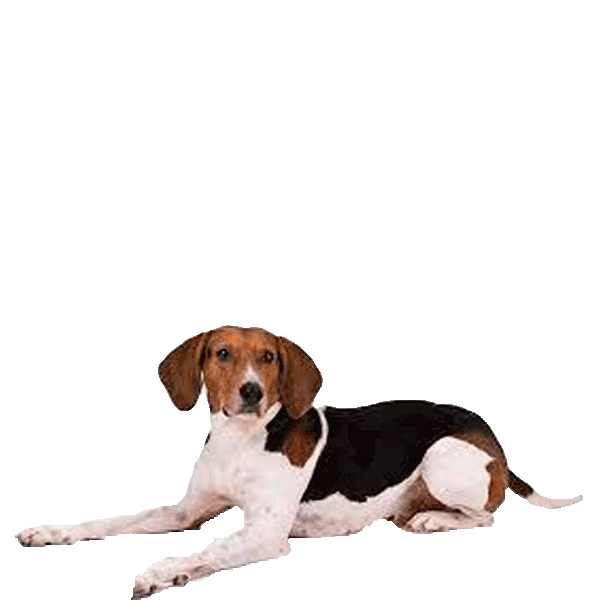
Treeing Walker Coonhound
The Treeing Walker Coonhound is a friendly, energetic scenthound known for its speed, melodious bark, and skill at treeing game.
- Size
- Large
- Lifespan
- 12–13 years
- Origin
- United States
- Temperament
- Friendly
- Standard colors
- Black, White and Tan
Characteristics
Coat and grooming
How the Treeing Walker Coonhound coat is built, and what that means when you groom it.
- Coat layers
- Single coat
- Coat texture
- Smooth
- Coat length
- Short
- Shedding
- Moderate shedding
Treeing Walker Coonhound colors and patterns
What each club's breed standard says about every Treeing Walker Coonhound color and pattern. Point at a ruling to see the club's own wording.
Breed standards describe the Treeing Walker Coonhound in Black, White and Tan. Standard patterns: Tricolour, Spotted and Tan point.
| Color or pattern | AKC | UKC |
|---|---|---|
| Black | Standard (“Black”) | Standard (“black may be the predominant color”) |
| White | Standard (“White”) | Standard (“Tri-colored (white-black-tan)”) |
| Tan | Standard (“Tri-Colored”) | Standard (“Tri-colored (white-black-tan)”) |
| Albino | Fault | Disqualifying (“Albinism”) |
| Patterns | ||
| Tricolour | Standard (“Tri-Colored”) | Standard (“Tri-colored (white-black-tan) is preferred”) |
| Spotted | Standard (“Black Spots”) | Standard (“White with tan spots, or white with black spots is acceptable”) |
| Tan point | Standard (“White Markings, Tan Trim”) | Standard (“tan trim”) |


| Color or pattern | AKC | UKC |
|---|---|---|
| Black | Standard (“dark in color, brown or black”) | Standard (“Color is dark, brown or black”) |
| Dark brown | Standard (“dark in color, brown or black”) | Standard (“Color is dark, brown or black”) |
| Light brown | Fault (“yellow or light eyes”) | No ruling |
| Yellow | Fault (“yellow or light eyes”) | No ruling |
| Color or pattern | AKC | UKC |
|---|---|---|
| Black | Standard (“Nostrils large and black”) | Standard (“black pigment preferred”) |
| Patterns | ||
| Butterfly nose | No ruling | Standard (“White or pink spots inside the nostril or on the outside of the nose are acceptable”) |

What the rulings mean
- Standard
- Described by the club's breed standard.
- Fault
- Named by the club's breed standard as a fault: the animal can be shown but is penalised.
- Disqualifying
- The club's breed standard disqualifies an animal of this colour or pattern.
Color changes
How a Treeing Walker Coonhound's colors can change over its life.
Blackchanges toRust
Coat · With body condition · can change back
Blackchanges toGrey
Coat · Progressive
Blackchanges toBrown
Coat · In the sun · can change back
Whitechanges toRoan
Coat · With age · from 2 weeks
Tan pointchanges toSaddle
Coat · With age · from 6 to 156 weeks
Blackchanges toSnow nose
Nose · With the season · can change back
Blackchanges toPink
Nose · With the season · can change back


Sources
Each ruling comes from the club's published breed standard or color list.
Meet some of our Treeing Walker Coonhound
A few of the Treeing Walker Coonhound profiles members have added to United Pet Club.

About the Treeing Walker Coonhound
The Treeing Walker Coonhound is a large American scenthound bred to trail and tree raccoons and other game, known for its speed, stamina, and loud, musical voice.
The Treeing Walker Coonhound is a large, athletic scenthound developed in the United States for hunting raccoons and other game. The breed works by following a scent trail at speed, then chasing the quarry up a tree and holding it there with a steady, carrying bark until the hunter arrives. That working purpose shapes almost everything about the dog: the long legs, the deep chest, the powerful nose, and the famous voice.
Outside of hunting, the Treeing Walker is friendly and sociable. It tends to get along with people of all ages and usually does well with other dogs, having been bred to hunt in packs. The same drive that makes it a tireless tracker also makes it an energetic companion that needs a job, a long daily run, or both. Owners often describe the breed as easygoing in the house once its exercise needs are met, and restless or noisy when they are not.
The breed is sometimes nicknamed the "People's Choice" among coonhound enthusiasts. It shares ancestry with the English and American Foxhounds and carries a similar build, though it is bred and trained specifically to tree game rather than to run it to ground.
| Attribute | Detail |
|---|---|
| Origin | United States |
| Size | Large |
| Lifespan | 12 to 13 years |
| Group/role | Scenthound, treeing hunter |
| Good with | Families, children, other dogs (with training and exercise) |
Who it suits
This breed fits active households that can give it a long daily outlet for running and scent work. It suits hunters, runners, hikers, and families with a secure yard. It is a poor match for apartment living without serious exercise, for owners sensitive to noise, or for anyone who cannot manage a strong prey drive and a tendency to follow a scent over long distances.
History and origins
The Treeing Walker Coonhound descends from English and American Foxhounds bred in the United States, with roots traced to the Walker family of Kentucky in the 19th century.
The Treeing Walker Coonhound traces back to imported English Foxhounds brought to the American colonies. Colonial hunters crossed these dogs to develop hounds suited to American game and terrain, producing the foundation stock that later became the American Foxhound.
The breed name comes from the Walker family of Kentucky, who were prominent in developing Walker-strain hounds during the 19th century. A key influence was a stolen or traded dog known as "Tennessee Lead," brought into the Walker lines in the mid-1800s. Lead carried strong treeing instinct and game sense, and his descendants reinforced those traits in the strain.
For much of its history the Treeing Walker was registered together with other coonhounds under the broad "English" coonhound label. Breeders kept the treeing line distinct, selecting for dogs that would chase game up a tree and bark to mark it rather than fight or run it down. Over time the treeing strain was recognised as a separate breed.
In the United States, the United Kennel Club recognised the Treeing Walker Coonhound as its own breed in 1945. The American Kennel Club granted full recognition much later, in 2012, placing it in the Hound Group. Today the breed remains a working hunting dog first, with a growing presence as a companion and competition animal.
Appearance and breed standard
The Treeing Walker Coonhound is a lean, tall scenthound with a smooth tricolour coat, long legs, and long drop ears built for endurance and speed.
The Treeing Walker is built for athletic, ground-covering work. It has a clean, muscular frame with a deep chest, well-sprung ribs, and long legs that give it speed and reach. The head is moderately broad with a long muzzle and large, low-set ears that hang close to the head. The overall impression is of a fast, balanced hound with no exaggeration.
| Trait | Standard |
|---|---|
| Height | 20 to 27 inches (51 to 69 cm) at the shoulder |
| Weight | 50 to 70 pounds (23 to 32 kg) |
| Coat | Short, smooth, dense, close-fitting |
| Colours | Tricolour (white, black, and tan); also white and black, or white and tan |
| Eyes | Dark, round, soft expression |
Coat and colours
The coat is short and smooth, lying close to the body, and gives some protection in brush and weather while staying easy to maintain. The classic and most common pattern is tricolour with a predominantly white body marked by black and tan. White-and-black or white-and-tan patterns also occur. A clearly marked, mostly white dog is easier to spot at a distance in the field, which is part of why the pattern was favoured by hunters.
Temperament and personality
The Treeing Walker Coonhound is friendly, energetic, and sociable, bonding closely with its family while staying driven by scent and prone to loud, frequent vocalising.
The Treeing Walker is a friendly, outgoing dog that generally enjoys human company. It tends to be affectionate with its family and patient with children, and it is usually welcoming rather than wary toward strangers, which makes it a poor guard dog despite its loud voice. Because it was bred to hunt in packs, it commonly gets along with other dogs.
The breed is high-energy and hardworking. Without enough physical and mental activity, a Treeing Walker can become bored, restless, and destructive. Its nose is powerful and its prey drive is strong, so it may ignore commands when it locks onto a scent and will roam if not contained. Small pets such as cats can trigger the chase instinct, though some dogs raised with them adjust.
Vocalising is central to the breed. The bay is loud, carrying, and used naturally to mark treed game. Owners should expect frequent barking and a distinctive howl, which can be an issue in close housing.
| Trait | Rating |
|---|---|
| Affection | 5 |
| Energy | 5 |
| Trainability | 3 |
| Vocalness | 5 |
| Shedding | 3 |
Care and grooming
The Treeing Walker Coonhound is low-maintenance to groom but demands a great deal of daily exercise and secure containment to stay healthy and settled.
Grooming
- Brush the short coat weekly to remove loose hair and limit shedding
- Bathe only when needed, as the breed can carry a houndy odour that frequent washing will not fully remove
- Check and clean the long drop ears regularly, since they trap moisture and are prone to infection
- Trim nails every few weeks and brush teeth several times a week
Exercise
- Provide at least one to two hours of vigorous activity daily
- Offer long runs, hikes, or off-leash time in a securely fenced area
- Add scent games and tracking work to engage the nose and mind
- Keep the dog leashed or fenced in open spaces, because a fresh trail will override recall
Environment
The Treeing Walker does best with space and an active owner. A house with a tall, secure fence suits it well; this breed can climb and dig, so containment must be solid. It is not well matched to apartment life unless exercise is intensive and consistent, and its loud voice can carry to neighbours.
Nutrition and feeding
The Treeing Walker Coonhound needs a balanced diet sized to its large frame and high activity level, with feeding adjusted for working versus companion dogs.
The Treeing Walker is a large, active breed and benefits from a complete diet formulated for large or active dogs. Working hounds in season burn far more energy than companion dogs and may need increased portions, while less active pets need careful portioning to avoid weight gain. Feed two measured meals a day rather than free-feeding, and always provide fresh water, especially after exercise.
| Life stage | Amount per day | Meals |
|---|---|---|
| Puppy (2 to 6 months) | Per product guide for growth, divided | 3 to 4 |
| Puppy (6 to 12 months) | Per product guide for growth | 2 to 3 |
| Adult | Roughly 2.5 to 3.5 cups of quality dry food | 2 |
| Working adult (in season) | Increased per activity and condition | 2 to 3 |
| Senior | Reduced to maintain healthy weight | 2 |
Treats and supplements
Keep treats to a small share of daily calories, especially since food is a useful training reward for a scent-driven breed. Most dogs on a complete commercial diet need no extra supplements. Discuss joint support or other additions with a veterinarian, particularly for heavily worked or ageing dogs.
Health and common conditions
The Treeing Walker Coonhound is generally healthy with a lifespan of 12 to 13 years, with ear infections, hip dysplasia, and eye conditions among the issues to watch.
The Treeing Walker Coonhound is considered a hardy, generally healthy breed, helped by its working background and lack of extreme physical features. Typical lifespan is 12 to 13 years. As with any large, active dog, joint and ear health deserve attention, and responsible breeders screen breeding stock for inherited conditions.
| Condition | Signs | Note |
|---|---|---|
| Ear infections | Head shaking, odour, scratching, discharge | Long drop ears trap moisture; clean and check regularly |
| Hip dysplasia | Stiffness, limping, trouble rising | Inherited joint condition; screen breeding dogs |
| Eye conditions | Cloudiness, redness, vision changes | Includes issues such as cataracts; check during exams |
| Injuries and overheating | Cuts, soreness, heavy panting | Field work raises injury and heat risk; monitor in hot weather |
Preventive care
- Keep vaccinations and parasite prevention current, including tick control for dogs that work in brush
- Inspect ears, eyes, feet, and skin regularly, especially after time in the field
- Maintain a healthy weight to protect the joints
- Schedule annual veterinary checkups, moving to twice yearly for seniors
Training the Treeing Walker Coonhound
The Treeing Walker Coonhound is intelligent and willing but independent and easily distracted by scent, so training works best when it is early, consistent, and reward-based.
The Treeing Walker is smart and capable, but it was bred to work independently on a trail, which means it can be single-minded and slow to respond once it catches a scent. Training takes patience and consistency. Start early, keep sessions short and engaging, and use food and praise as rewards, since harsh methods tend to backfire with a sensitive, sociable hound. Recall is the hardest skill to build and may never be fully reliable off-leash in open ground, so a fence and a leash are part of managing this breed.
Basics
- Begin socialisation and handling in puppyhood, exposing the dog to people, dogs, and places
- Teach name response and basic cues (sit, down, stay) in low-distraction settings first
- Build recall steadily with high-value rewards, then add distractions gradually
- Practise loose-leash walking, since the breed pulls hard toward interesting smells
- Channel the nose into approved outlets such as tracking or scent games
- Address barking early by rewarding quiet and not reinforcing demand baying
Breeding and raising young
The Treeing Walker Coonhound reaches breeding maturity in its first to second year, with an average gestation of about 63 days and typical litters of several puppies.
Breeding the Treeing Walker should be approached responsibly, with attention to temperament, working ability, and health screening of both parents. Females are generally bred after they are physically mature, commonly from around 18 months to two years, rather than at their first heat. Gestation averages about 63 days from conception. Litters vary, with several puppies being typical for a large hound.
Newborn puppies are helpless and depend fully on the dam for warmth and nursing in the first weeks. Early handling, gentle exposure to household sights and sounds, and beginning socialisation before puppies go to new homes all help produce stable, sociable adults. Given the breed's strong working drive, matching active puppies to suitable homes is an important part of responsible breeding.
| Metric | Value |
|---|---|
| Breeding maturity | About 18 months to 2 years |
| Gestation | Approximately 63 days |
| Litter size | Several puppies (large-hound range) |
| Weaning | Around 6 to 8 weeks |
| Recommended health checks | Hips, eyes, general soundness |
Registering a Treeing Walker Coonhound in Canada: profile and microchip
A free lifetime United Pet Club record for your Treeing Walker Coonhound, with the microchip registered at no cost and kept current through every move.
Treeing Walker Coonhound registration and microchip registration in Canada
Canadian shelters and vet clinics scan strays at intake as a matter of routine, and the scan helps only when a registry ties your Treeing Walker Coonhound to a phone that still rings. Registering your dog with United Pet Club takes a few minutes, never costs anything, and works whether or not a chip is in place yet. Add the breed, a photo, and your postal code, and the record is live.
Sixty seconds with a scanner reads the chip; whether your Treeing Walker Coonhound gets home depends on the record behind the number. Microchip registration with United Pet Club is free for life, takes every brand sold in Canada, and keeps the record searchable on both sides of the border. Sign up free and give the number somewhere to point.
How do I register my Treeing Walker Coonhound in Canada?
Open a free United Pet Club account, fill in your Treeing Walker Coonhound's name, breed details, and a photo, and save. The lifetime plan is free, no chip required, and the chip number can be attached after your vet appointment.
How do I register my Treeing Walker Coonhound's microchip?
Add the 15-digit number to your account along with your address, postal code, and phone number. Registration and unlimited updates are free for life, and chips from any manufacturer a Canadian vet uses are accepted.
Is a microchip required for a Treeing Walker Coonhound in Canada?
There is no federal requirement, but several cities fold chips into their licensing bylaws, and travel with the dog goes smoother when the chip is registered. The record, not the implant, is what identifies your Treeing Walker Coonhound.
What does Treeing Walker Coonhound registration cost in Canada?
Nothing, ever. United Pet Club's lifetime plan covers the profile, the chip record, and every update without fees or renewals.
Frequently asked questions
Common questions about the Treeing Walker Coonhound, covering its size, temperament, care needs, lifespan, suitability, and availability.
How big does a Treeing Walker Coonhound get?
It is a large breed, standing roughly 20 to 27 inches at the shoulder and weighing about 50 to 70 pounds, with a lean, athletic build.
Is the Treeing Walker Coonhound a good family dog?
Yes, it is friendly and sociable and usually does well with children and other dogs. It needs a lot of exercise, and its loud voice and strong prey drive should be considered.
Are they hard to care for?
Grooming is easy thanks to the short coat, but the breed is demanding on exercise. It needs one to two hours of vigorous activity a day and secure containment, so it is not a low-effort dog.
How long do Treeing Walker Coonhounds live?
The typical lifespan is 12 to 13 years. Regular exercise, a healthy weight, and routine veterinary care help support a full life.
Do they bark a lot?
Yes. The breed was developed to bay loudly when it trees game, so frequent, carrying barking and howling are normal and can be an issue in close quarters.
Can they live in an apartment?
It is not an ideal apartment dog. Its high energy, need for space, and loud voice make a house with a secure yard a much better fit unless exercise is intensive and consistent.
Where can I get a Treeing Walker Coonhound?
They are available through breeders, often within hunting and coonhound communities, as well as through breed-specific and general rescues. Choose a source that screens for health and temperament.
From the community
Ask about the Treeing Walker CoonhoundNo questions about the Treeing Walker Coonhound yet. Be the first to ask.
Browse Dog breeds