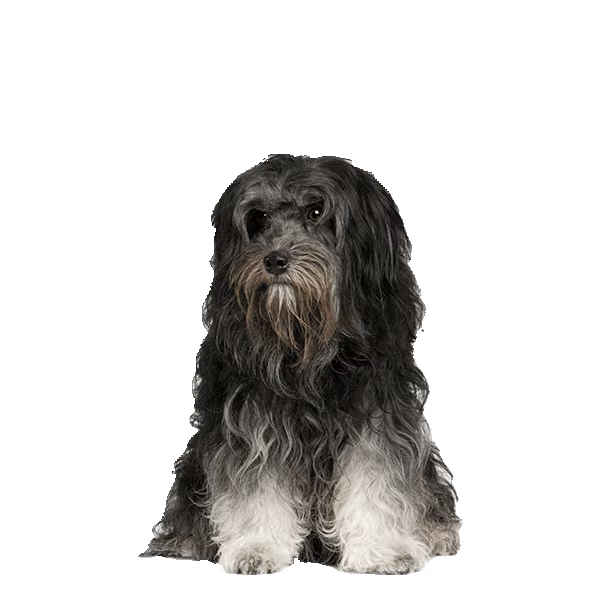
The Schapendoes is a friendly, agile Dutch herding breed full of cheerful energy and quick, intelligent enthusiasm for work and play.
How the Schapendoes coat is built, and what that means when you groom it.
Caution: A Schapendoes coat mats easily.
Fine or long hair tangles at the base of the coat, out of sight, where the mats tighten and pull on the skin. Brushing has to reach right down to the roots in sections, not just skim the surface.
Information: A Schapendoes needs clipping every few weeks.
This coat keeps growing rather than shedding out, so it has to be trimmed every few weeks. Left to grow it mats down against the skin and traps moisture, dirt and heat.
The Schapendoes is a medium-sized Dutch herding dog with a long, shaggy coat and a friendly, energetic character. It suits active homes that can give it daily exercise and mental work.
The Schapendoes is a medium-sized herding breed from the Netherlands. It was bred to move flocks of sheep across open heathland, so it is built for stamina and quick changes of direction rather than raw power. The breed is light on its feet and covers ground with an easy, springy gait.
The most recognizable feature is the long, slightly wavy coat that falls over the eyes and gives the face a soft, open look. Underneath the hair is a lean, athletic dog of moderate bone. Adults usually stand 40 to 50 cm at the shoulder and weigh roughly 12 to 25 kg.
In character the Schapendoes is friendly, good-natured and intelligent. It bonds closely with its family and tends to stay cheerful and busy. The breed enjoys problem-solving and physical activity, which makes it a strong candidate for dog sports such as agility and obedience.
| Attribute | Detail |
|---|---|
| Origin | Netherlands |
| Size | Medium (about 40 to 50 cm tall, 12 to 25 kg) |
| Lifespan | 12 to 15 years |
| Group/role | Herding dog (sheep droving) |
| Good with | Families, older children and active owners |
The Schapendoes fits a household that is home often and willing to provide an hour or more of activity each day. It does well with people who want a participant in walks, hikes and dog sports rather than a quiet companion. The coat needs regular brushing, so owners should be ready for a grooming routine. Because the breed is people-oriented, it is not a good match for homes where it would be left alone for long stretches.
The Schapendoes is an old Dutch farm dog that herded sheep on the heaths. It nearly disappeared during the Second World War and was rebuilt by Dutch breeders in the 1940s.
The Schapendoes developed in the Netherlands as a working sheepdog on the heathlands and small farms. For generations it was kept by shepherds for its herding ability rather than its looks, so type varied from region to region. The name translates roughly as sheep dog in Dutch, which reflects its everyday job of moving and guarding flocks.
The breed belongs to a wider family of long-haired European herding dogs that includes the Bearded Collie, the Puli and the Bergamasco. These dogs share a shaggy coat suited to wet, cold weather and a body type built for agility over rough ground. The Schapendoes was not formally documented for most of its history because it was a regional farm dog passed along by working shepherds.
Dutch cynologist Pieter van der Sande took an interest in the breed in the 1940s and worked to preserve it. The population had fallen sharply during the Second World War, when many were lost and breeding nearly stopped. A small group of remaining dogs formed the basis of a recovery program.
The Dutch breed club was established in 1947, and a breed standard followed. The Schapendoes was recognized by the Raad van Beheer, the Dutch kennel authority, and later gained recognition from the Federation Cynologique Internationale. Today it remains most common in the Netherlands and is still valued as both a companion and a sport dog.
The Schapendoes is a lightly built medium dog with a long, wavy double coat that covers the eyes. It comes in a range of colours, with blue-grey and black most typical.
The Schapendoes is slightly longer than it is tall, with a lean frame and moderate bone. The overall impression is of a light, agile dog rather than a heavy one. The head carries abundant hair that forms a topknot, moustache and beard, and the long coat falls forward over the eyes. The tail is long and well covered with hair, carried low at rest and raised in motion.
| Trait | Standard |
|---|---|
| Height | Females about 40 to 47 cm; males about 43 to 50 cm at the withers |
| Weight | Roughly 12 to 25 kg |
| Coat | Long, wavy, dense double coat with a soft undercoat |
| Colours | All colours permitted; blue-grey to black are most common |
| Eyes | Large, round, set well apart; brown, often hidden by the coat |
The coat is the defining feature. It is long, dry to the touch and slightly wavy, with a thick undercoat that gives weather protection. Hair can reach 7 cm or more on the body and forms the characteristic facial furnishings. The texture is meant to be functional rather than silky, and a slight curl is acceptable.
All coat colours are allowed by the standard, but shades from blue-grey through to black are seen most often. Some dogs carry white markings. The coat needs regular grooming to prevent the wavy hair from matting, particularly behind the ears, under the legs and around the rear.
The Schapendoes is friendly, good-natured and intelligent, with high energy and a strong bond to its family. It is alert with strangers but rarely aggressive.
The Schapendoes is an affectionate and lively dog that wants to be part of family life. It forms close attachments to its people and tends to follow them from room to room. The breed is good-natured with children and usually gets along with other dogs when raised and socialized well.
With strangers the Schapendoes is alert and may bark to announce a visitor, but it is not a guard dog and warms up quickly once introduced. Its herding background shows in a tendency to be watchful, busy and quick to respond to movement, which can extend to chasing or circling if not given an outlet.
This is an intelligent breed that thinks for itself. It learns fast but can be independent, so it does best with owners who keep training varied and engaging. Boredom and too little exercise can lead to barking, restlessness and chewing. Given enough activity and company, the Schapendoes is a cheerful, balanced companion.
| Trait | Rating |
|---|---|
| Affection | 5 |
| Energy | 5 |
| Trainability | 4 |
| Vocalness | 3 |
| Shedding | 3 |
The Schapendoes needs frequent brushing to keep its long coat free of mats and at least an hour of exercise a day. It is happiest with an active family and plenty of mental work.
The Schapendoes adapts to a house with a yard or an active apartment household, provided it gets daily exercise and is not left alone for long periods. It tolerates cool, wet weather well thanks to its double coat but needs shade and water in heat. Because it is people-focused, it settles best where it can spend time with the family.
Feed the Schapendoes a complete, balanced diet suited to its life stage and activity level, split into two meals a day. Keep an eye on weight given its athletic build.
The Schapendoes does well on a complete and balanced diet formulated for active medium breeds. Because it is a working-type dog, its calorie needs rise with exercise and drop during quieter periods, so portions should be adjusted to keep the dog lean. Ribs should be easy to feel but not see. Fresh water should always be available.
| Life stage | Amount per day | Meals |
|---|---|---|
| Puppy (2 to 6 months) | Per food label, divided | 3 to 4 |
| Junior (6 to 12 months) | Per food label, divided | 2 to 3 |
| Adult (1 to 7 years) | About 150 to 300 g dry food | 2 |
| Senior (8+ years) | Slightly reduced, watch weight | 2 |
Keep treats to no more than about 10 percent of daily calories and account for them in meal portions. Use small, low-fat rewards during training. A healthy dog on a complete diet usually needs no extra supplements, but a veterinarian may advise omega-3 fatty acids or joint support for older or heavily worked dogs. Introduce any diet change gradually over about a week to avoid stomach upset.
The Schapendoes is generally healthy with a lifespan of 12 to 15 years. The main concerns are hip dysplasia and an inherited eye disease, both reduced by health-tested parents.
The Schapendoes is a hardy breed with relatively few inherited problems compared with many pedigree dogs. With good care most live 12 to 15 years. The breed benefits from a small but actively managed gene pool, and responsible breeders screen for the conditions known to occur. Buying from health-tested parents is the single best way to lower risk.
| Condition | Signs | Note |
|---|---|---|
| Hip dysplasia | Stiffness, limping, reluctance to jump | Parents should have hip scores |
| Progressive retinal atrophy | Night blindness, declining vision | DNA test available for breeding stock |
| Ear issues | Head shaking, odour, scratching | More likely in long-coated, hairy ears |
The Schapendoes is intelligent and quick to learn but somewhat independent. Short, varied, reward-based sessions work best, paired with early socialization.
The Schapendoes learns quickly and enjoys having a job, which makes training rewarding. It can also be independent and easily bored, so repetitive drilling tends to backfire. Keep sessions short, varied and positive, and finish while the dog is still keen. The breed responds well to activities that combine thinking and movement, such as agility and trick training. Early, broad socialization with people, other animals and everyday situations helps the naturally alert dog stay confident and calm.
Schapendoes reach breeding maturity at around two years. Litters average four to six puppies after a gestation of about 63 days, and health testing of both parents is essential.
Responsible breeding of the Schapendoes focuses on temperament, working ability and health, with care taken over the limited gene pool. Both parents should be hip scored and eye tested before mating, and breeders typically wait until a dog is physically and mentally mature, around two years of age. Bitches are usually mated within a sound, planned program rather than at first season.
Gestation lasts about 63 days. Litters commonly contain four to six puppies, though numbers vary. The dam raises the litter actively in the first weeks, and human handling should begin gently and early to build well-socialized puppies. Pups are usually weaned by seven to eight weeks and should not leave the breeder before that age, with many staying slightly longer. Early exposure to household sights, sounds and gentle handling sets the foundation for the breed's friendly adult character.
| Metric | Value |
|---|---|
| Breeding maturity | About 2 years |
| Gestation | About 63 days |
| Average litter size | 4 to 6 puppies |
| Weaning age | 7 to 8 weeks |
| Recommended health tests | Hip score, eye test (PRA) |
A free lifetime United Pet Club record for your Schapendoes, with the microchip registered at no cost and kept current through every move.
Canadian shelters and vet clinics scan strays at intake as a matter of routine, and the scan helps only when a registry ties your Schapendoes to a phone that still rings. Registering your dog with United Pet Club takes a few minutes, never costs anything, and works whether or not a chip is in place yet. Add the breed, a photo, and your postal code, and the record is live.
Sixty seconds with a scanner reads the chip; whether your Schapendoes gets home depends on the record behind the number. Microchip registration with United Pet Club is free for life, takes every brand sold in Canada, and keeps the record searchable on both sides of the border. Sign up free and give the number somewhere to point.
Open a free United Pet Club account, fill in your Schapendoes's name, breed details, and a photo, and save. The lifetime plan is free, no chip required, and the chip number can be attached after your vet appointment.
Add the 15-digit number to your account along with your address, postal code, and phone number. Registration and unlimited updates are free for life, and chips from any manufacturer a Canadian vet uses are accepted.
There is no federal requirement, but several cities fold chips into their licensing bylaws, and travel with the dog goes smoother when the chip is registered. The record, not the implant, is what identifies your Schapendoes.
Nothing, ever. United Pet Club's lifetime plan covers the profile, the chip record, and every update without fees or renewals.
Common questions about the Schapendoes cover its size, temperament, grooming needs, lifespan, suitability for families, and how easy it is to find.
It is a medium breed, standing roughly 40 to 50 cm at the shoulder and weighing about 12 to 25 kg, with a light, athletic build rather than a heavy one.
It is friendly, good-natured and intelligent, with high energy and a strong attachment to its family. It is alert with strangers but rarely aggressive and usually good with children and other dogs.
The main commitments are grooming and exercise. The long, wavy coat needs brushing two to three times a week, and the dog needs at least an hour of activity plus mental work each day.
Most live 12 to 15 years. The breed is generally healthy, and buying from hip-scored and eye-tested parents lowers the risk of inherited problems.
Yes, for active families that are home often. It is affectionate and playful with children but needs daily exercise and company, so it is not suited to homes where it would be alone for long periods.
They are most common in the Netherlands and are less widespread elsewhere, so expect a waiting list. Look for breeders who health test their dogs and follow the breed club's guidance.
