
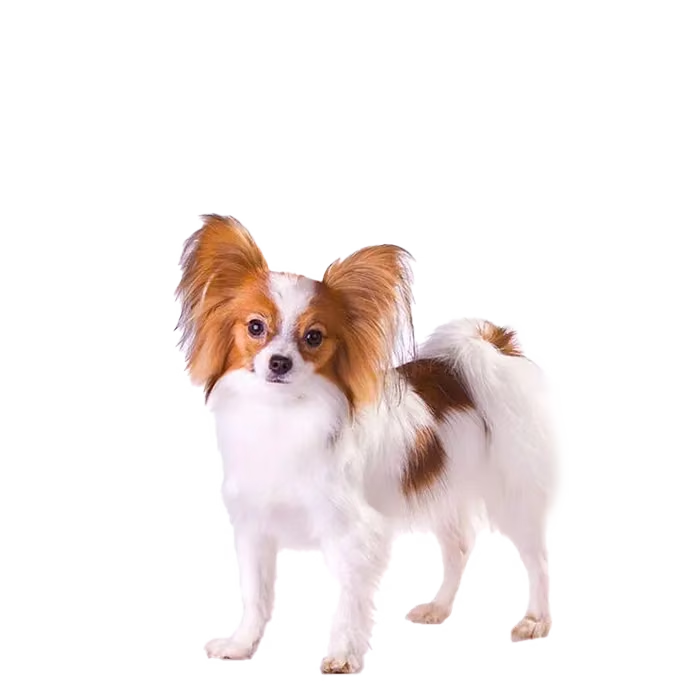
Papillon
The Papillon is a friendly, butterfly-eared toy breed prized for its brightness, agility, and eager-to-learn charm.
- Size
- Toy
- Lifespan
- 14–16 years
- Origin
- France
- Temperament
- Friendly
- Standard colors
- Black, White and Silver and 5 more
Characteristics
Coat and grooming
How the Papillon coat is built, and what that means when you groom it.
- Coat layers
- Single coat
- Coat texture
- Silky
- Coat length
- Long
- Shedding
- Moderate shedding
Grooming guidance
Caution: A Papillon coat mats easily.
Fine or long hair tangles at the base of the coat, out of sight, where the mats tighten and pull on the skin. Brushing has to reach right down to the roots in sections, not just skim the surface.
Papillon colors and patterns
What each club's breed standard says about every Papillon color and pattern. Point at a ruling to see the club's own wording.
Breed standards describe the Papillon in Black, White, Silver, Liver, Tan, Red, Lemon and Fawn. Standard patterns: Tricolour, Parti-colour, Sable and Tan point.
| Color or pattern | FCI | AKC | UKC | KC | KUSA |
|---|---|---|---|---|---|
| Black | Standard (“All colours are admitted on a coat with a white background”) | Standard (“White & Black”) | Standard (“white with patches of any color”) | Standard (“Black & White”) | Standard (“White with patches: may be any colour except liver”) |
| White | Standard (“All colours are admitted on a coat with a white background”) | Standard (“White & Black”) | Standard (“white with patches of any color”) | Standard (“White with patches”) | Standard (“White with patches”) |
| Silver | Standard (“All colours are admitted on a coat with a white background”) | Standard (“White & Silver”) | Standard (“white with patches of any color”) | Standard (“Silver & White”) | Standard (“White with patches: may be any colour except liver”) |
| Liver | Standard (“All colours are admitted on a coat with a white background”) | Standard (“White & Liver”) | Standard (“white with patches of any color”) | Not recognised (“any colour except liver”) | Not recognised (“any colour except liver”) |
| Tan | Standard (“All colours are admitted on a coat with a white background”) | Standard (“White Black & Tan”) | Standard (“white with patches of any color”) | Standard (“Tricolours, black and white with tan spots over eyes”) | Standard (“Tri-colours: black and white with tan spots over eyes”) |
| Red | Standard (“All colours are admitted on a coat with a white background”) | Standard (“White & Red”) | Standard (“white with patches of any color”) | Standard (“Red & White”) | Standard (“White with patches: may be any colour except liver”) |
| Lemon | Standard (“All colours are admitted on a coat with a white background”) | Standard (“White & Lemon”) | Standard (“white with patches of any color”) | Standard (“Lemon & White”) | Standard (“White with patches: may be any colour except liver”) |
| Fawn | Standard (“All colours are admitted on a coat with a white background”) | Standard (“Fawn & White”) | Standard (“white with patches of any color”) | Standard (“White with patches, which may be any colour except liver”) | Standard (“White with patches: may be any colour except liver”) |
| Albino | No ruling | No ruling | Disqualifying (“Albinism”) | Not recognised | Not recognised |
| Patterns | |||||
| Tricolour | Standard (“All colours are admitted on a coat with a white background”) | Standard (“White Black & Tan”) | Standard (“They may be any parti-color”) | Standard (“Tricolours, black and white with tan spots over eyes”) | Standard (“Tri-colours: black and white with tan spots over eyes”) |
| Parti-colour | Standard (“All colours are admitted on a coat with a white background”) | Standard (“Always parti-color or white with patches of any color(s)”) | Standard (“The Papillon is always parti-colored”) | Standard (“White with patches, which may be any colour except liver”) | Standard (“White with patches: may be any colour except liver”) |
| Sable | Standard (“All colours are admitted on a coat with a white background”) | Standard (“White & Sable”) | Standard (“They may be any parti-color”) | Standard (“Sable & White”) | Standard (“White with patches: may be any colour except liver”) |
| Tan point | Standard (“All colours are admitted on a coat with a white background”) | Standard (“White Black & Tan”) | Standard (“They may be any parti-color”) | Standard (“tan spots over eyes, tan inside ears, on cheeks, and under root of tail”) | Standard (“tan spots over eyes, tan inside ears, on cheeks, and under root of tail”) |
| Solid | No ruling | Disqualifying (“An all-white dog or a dog with no white”) | Disqualifying (“An all white dog. A dog with no white.”) | Not recognised | Not recognised |


| Color or pattern | FCI | AKC | UKC | KC | KUSA |
|---|---|---|---|---|---|
| Dark brown | Standard (“Dark in colour”) | Standard (“Eyes dark”) | Standard (“dark”) | Standard (“dark with dark rims”) | Standard (“dark with dark rims”) |
| Light brown | Fault (“light in colour”) | No ruling | No ruling | No ruling | No ruling |
| Color or pattern | FCI | AKC | UKC | KC | KUSA |
|---|---|---|---|---|---|
| Black | Standard (“Small, black and round”) | Standard (“Nose black”) | Standard (“The small, black, rounded nose”) | Standard (“Nose black”) | Standard (“Nose black”) |
| Pink | Disqualifying (“Pink or pink spotted nose”) | Fault | Fault | No ruling | No ruling |
| Patterns | |||||
| Butterfly nose | Disqualifying (“Pink or pink spotted nose”) | No ruling | No ruling | No ruling | No ruling |

What the rulings mean
- Standard
- Described by the club's breed standard.
- Fault
- Named by the club's breed standard as a fault: the animal can be shown but is penalised.
- Disqualifying
- The club's breed standard disqualifies an animal of this colour or pattern.
- Not recognised
- The club does not accept this colour or pattern for the breed.
Color changes
How a Papillon's colors can change over its life.
Blackchanges toRust
Coat · With body condition · can change back
Blackchanges toGrey
Coat · Progressive
Blackchanges toBrown
Coat · In the sun · can change back
Whitechanges toRoan
Coat · With age · from 2 weeks
Tan pointchanges toSaddle
Coat · With age · from 6 to 156 weeks
Blackchanges toSnow nose
Nose · With the season · can change back
Blackchanges toPink
Nose · With the season · can change back


Sources
Each ruling comes from the club's published breed standard or color list.
Meet some of our Papillon
A few of the Papillon profiles members have added to United Pet Club.
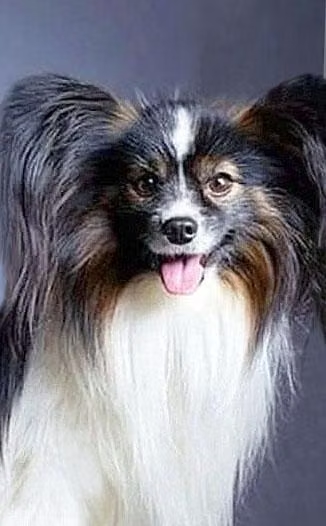


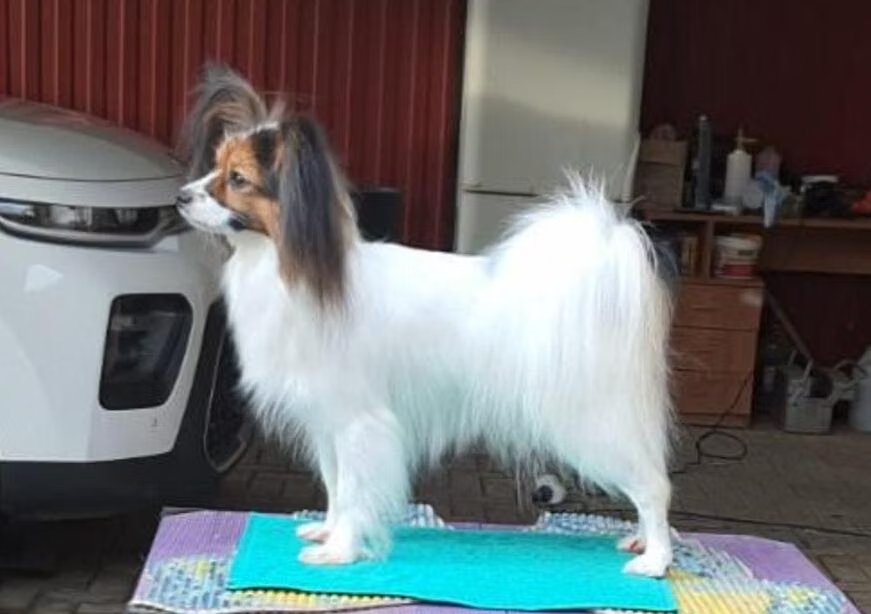

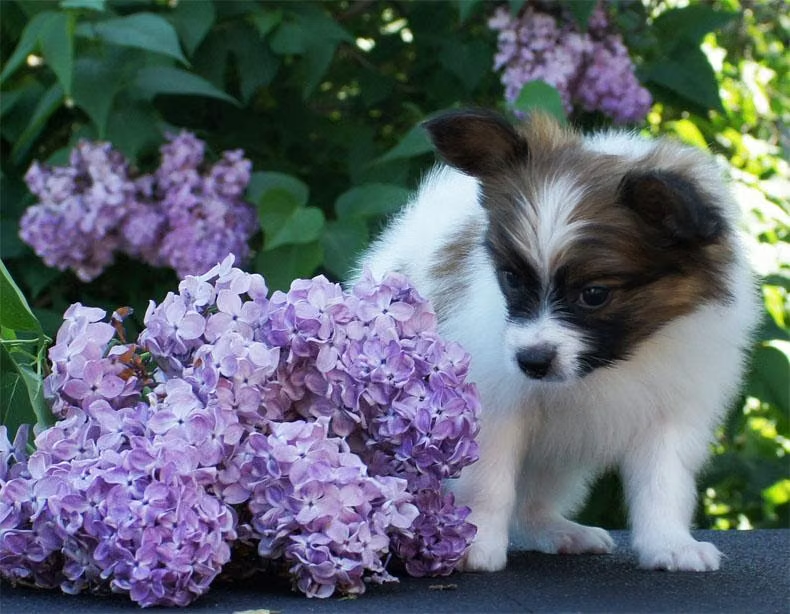
About the Papillon
The Papillon is a friendly toy breed from France, named for its butterfly-shaped ears, known for intelligence, agility, and a strong willingness to learn.
The Papillon is a toy breed weighing about 5 to 10 pounds and standing 8 to 11 inches at the shoulder. Its name is the French word for butterfly, a reference to the large fringed ears that flare out from each side of the head. The breed also appears in a drop-eared form, where the ears hang down rather than stand erect. That variety is called the Phalene, the French word for moth.
Despite the dainty frame, this is an active and capable dog. The Papillon learns quickly, responds well to training, and competes at a high level in agility and obedience. It carries itself with an alert, lively manner and stays interested in what its people are doing.
The coat is long, fine, and single layered, with feathering on the ears, chest, legs, and tail. Colouring is white with patches of a second colour. Life expectancy is long for a dog, commonly 14 to 16 years.
| Attribute | Detail |
|---|---|
| Origin | France |
| Size | Toy (5 to 10 lb, 8 to 11 in) |
| Lifespan | 14 to 16 years |
| Group/role | Toy companion, agility and obedience competitor |
| Good with | Families, older children, other dogs, attentive owners |
Who it suits
The Papillon fits owners who want a small dog with an active mind. It suits people who enjoy training games, agility, or daily mental work. The breed adapts to apartments and houses alike, provided it gets exercise and company. Households with very young children should supervise closely, because the small build can be injured by rough handling.
History and origin
The Papillon descends from small spaniels painted across European courts from the 16th century onward, with the erect butterfly ear emerging as a distinct feature over later generations.
The Papillon belongs to a family of small companion spaniels often called dwarf spaniels or continental toy spaniels. Dogs of this type appear in European paintings from the 16th century, frequently on the laps of nobles and in the arms of court ladies. Artists in Italy, Spain, and France recorded the small dogs across many portraits of the period.
The early form had drop ears, the version now known as the Phalene. The erect, fringed ear that gives the modern Papillon its name developed later, and for a long time both ear types appeared in the same litters. France and Belgium are the countries most associated with the breed’s refinement into its present shape.
The dogs were popular among the French aristocracy, and the breed is often linked in popular accounts to royal households of the 17th and 18th centuries. Whatever the exact court connections, the small spaniels were established companions of wealthy European families well before formal breed clubs existed.
Organised breeding and standards arrived with the rise of kennel clubs in the late 19th and 20th centuries. The Papillon and the drop-eared Phalene are recognised as a single breed by most registries, judged together with ear carriage as a point of variation rather than a separate breed. In Canada, the Canadian Kennel Club recognises the Papillon within the Toy Group.
Appearance and breed standard
The Papillon is a small, fine-boned toy dog with a long single coat, a plumed tail, and the large fringed ears that give the breed its butterfly name.
The Papillon is light and elegant in build, with fine bone and a level topline. The head is small with a defined stop and a tapering muzzle shorter than the skull. The most recognisable feature is the ears. In the erect form they are large, set toward the back of the head, and carried out at an angle with long fringing that suggests open butterfly wings. In the Phalene form the same ears hang down.
The tail is set high and carried arched over the back, draped with a long plume of hair. Movement is light and free, covering ground easily for such a small dog.
| Trait | Standard |
|---|---|
| Height | 8 to 11 inches at the shoulder |
| Weight | 5 to 10 pounds |
| Coat | Long, fine, single layered, with feathering on ears, chest, legs, and tail |
| Colours | White with patches of any colour; a coloured mask over the eyes and ears is typical |
| Eyes | Dark, round, medium sized, alert in expression |
Coat and colours
The coat is always parti-coloured, meaning white with patches of a second colour. Common combinations include white with black, white with red or sable, and white with brown. Tricolour dogs carry black and white with tan markings over the eyes and inside the ears. A symmetrical mask of colour across the face and ears is preferred, often with a white blaze down the centre of the head. The single coat has no woolly undercoat, which keeps grooming simpler than the length might suggest.
Temperament and personality
The Papillon is friendly, bright, and energetic, bonding closely with its family while staying alert and quick to learn.
The Papillon is an outgoing and curious dog that stays involved in household life. It bonds closely with its people and prefers company to long stretches alone. With family members it is affectionate and playful, and it usually greets familiar guests with interest rather than fear.
With strangers the breed tends to be alert and may bark to announce visitors, but it is not typically aggressive. Early socialisation helps it stay confident around new people and places. Around other dogs the Papillon is generally sociable, and many get on well with cats raised alongside them. Its small size means interactions with large dogs should be supervised.
This is a thinking breed. It learns commands fast, enjoys problem solving, and can grow bored or noisy without enough to do. Owners who provide training games and daily activity tend to see the calmer, steadier side of the dog. The Papillon is sensitive to its owner's mood and responds best to patient, consistent handling.
| Trait | Rating |
|---|---|
| Affection | 5 |
| Energy | 4 |
| Trainability | 5 |
| Vocalness | 3 |
| Shedding | 2 |
Care and daily needs
The Papillon needs regular brushing of its single coat, daily exercise and mental work, and a safe indoor environment suited to a small, agile dog.
Grooming
- Brush the coat two or three times a week to prevent tangles in the feathering on the ears, legs, and tail
- Check and gently clean the ears, since the long fringing can trap debris
- Trim the hair between the foot pads and keep nails short
- Bathe every few weeks or when the coat is dirty; the single coat dries quickly
- Brush the teeth several times a week, as small breeds are prone to dental buildup
Exercise
- Provide 30 to 60 minutes of activity a day across walks and play
- Add training games or puzzle feeders to use the breed's quick mind
- Consider agility or obedience, where the breed excels
- Keep play with larger dogs supervised to protect the small frame
Environment
The Papillon adapts to apartments or houses. Canadian winters pose a real challenge for this breed: its single coat offers minimal insulation, so a dog coat is practical for outdoor time in cold weather, and a warm indoor spot is essential. Secure fencing and supervision outdoors matter, since a small dog can slip through gaps and is vulnerable to birds of prey.
Nutrition and feeding
The Papillon does well on a complete small-breed diet fed in measured portions across two to three meals a day, with care taken against low blood sugar in puppies.
Feed a complete, balanced food formulated for small or toy breeds. Small kibble suits the small mouth and supports dental health. Because the breed is tiny, portions are small and easy to overfeed, so measure meals rather than free feeding. Watch body condition: you should feel the ribs without a layer of fat over them.
Toy puppies can develop low blood sugar, called hypoglycaemia, if meals are spaced too far apart. Young puppies should eat several small meals a day to keep energy steady. Always provide fresh water.
| Life stage | Amount per day | Meals |
|---|---|---|
| Puppy (2 to 6 months) | About 1/4 to 1/2 cup | 3 to 4 |
| Puppy (6 to 12 months) | About 1/3 to 1/2 cup | 3 |
| Adult | About 1/4 to 1/2 cup | 2 |
| Senior | Adjust down for activity | 2 |
Treats and supplements
Keep treats to about 10 percent of daily calories to avoid weight gain in such a small dog. Use small training treats or pieces of the regular kibble for reward-based work. A dog on a complete commercial diet usually needs no supplements; ask a veterinarian before adding any, since toy dogs are sensitive to dosing.
Health and common conditions
The Papillon is generally healthy and long lived at 14 to 16 years, with patellar luxation, dental disease, and certain eye conditions among the issues to watch.
The Papillon is one of the longer lived dog breeds, commonly reaching 14 to 16 years. It is generally robust for its size, but like many toy breeds it has a few conditions worth monitoring. Buying from breeders who screen their stock and keeping up with veterinary care reduce the risk of inherited and age-related problems.
| Condition | Signs | Note |
|---|---|---|
| Patellar luxation | Skipping, hind-leg lameness, sudden hop | Common in toy breeds; ranges from mild to surgical |
| Dental disease | Bad breath, tartar, loose teeth | Small jaws crowd teeth; regular brushing helps |
| Progressive retinal atrophy | Night blindness, declining vision | Inherited; breeders can screen for it |
| Open fontanelle | Soft spot on the skull | Seen in some toy puppies; needs care to avoid head injury |
| Collapsing trachea | Honking cough, especially on a collar | Use a harness rather than a neck collar |
Preventive care
- Keep core vaccinations and parasite prevention up to date
- Brush the teeth and schedule dental checks
- Maintain a lean body weight to protect joints
- Use a harness instead of a collar to spare the trachea
- Ask about knee and eye screening when choosing a puppy
Training
The Papillon is one of the most trainable toy breeds, learning fast and thriving on reward-based work, with consistent house-training as the main early task.
The Papillon ranks among the brightest toy dogs and learns new commands with little repetition. It enjoys the mental work of training and does well in obedience, agility, and trick work. The breed responds to gentle, consistent methods and can become anxious or stubborn if handled harshly. Short, frequent sessions hold its attention better than long drills.
House-training is the area that takes the most patience. Like many small dogs, the Papillon has a small bladder and benefits from a steady schedule and frequent outings. Early socialisation to people, sounds, and other animals helps prevent the nervous barking that toy breeds can develop.
Basics
- Start socialisation early, exposing the puppy to varied people, places, and gentle handling
- Set a consistent house-training routine with frequent trips outside and praise for success
- Teach sit, down, come, and stay in short daily sessions
- Introduce a harness early and practise loose-leash walking
- Add games, tricks, or agility once the basics are reliable to channel the energy
Breeding
Papillons reach maturity around one year, carry small litters averaging two to four puppies, and benefit from health screening of the parents before mating.
Papillons reach sexual maturity at around 6 to 12 months, though responsible breeders wait until a bitch is physically mature, usually closer to two years, before her first litter. Health testing of both parents for knee, eye, and heart conditions is standard practice before mating.
Gestation runs about 63 days. Litters are small, often two to four puppies, in keeping with the breed's size. Because the puppies are tiny and toy bitches can have difficulty whelping, breeders monitor the birth closely and keep a veterinarian on call. A caesarean section is sometimes needed.
Newborn puppies are fragile and need a warm, quiet whelping area. Maintaining a steady temperature and watching for low blood sugar are priorities in the first weeks. Puppies usually stay with the dam until at least 8 to 12 weeks, which allows time for early socialisation before they go to new homes. In Canada, breeders registered with the CKC are expected to follow the club's Code of Ethics, which includes health testing and minimum age at placement.
| Metric | Value |
|---|---|
| Sexual maturity | 6 to 12 months |
| Recommended first breeding | Around 2 years |
| Gestation | About 63 days |
| Average litter size | 2 to 4 puppies |
| Weaning age | About 4 to 6 weeks |
| Leave for new home | 8 to 12 weeks |
Registering a Papillon in Canada: profile and microchip
A free lifetime United Pet Club record for your Papillon, with the microchip registered at no cost and kept current through every move.
Papillon registration and microchip registration in Canada
A Papillon with a current record gets home; one without waits out a stray hold. That is the whole argument for registering your dog with United Pet Club: a free lifetime profile carrying your name, your postal code, and a photo, ready for whichever clinic or shelter runs the scan.
Sixty seconds with a scanner reads the chip; whether your Papillon gets home depends on the record behind the number. Microchip registration with United Pet Club is free for life, takes every brand sold in Canada, and keeps the record searchable on both sides of the border. Sign up free and give the number somewhere to point.
How do I register my Papillon in Canada?
Open a free United Pet Club account, fill in your Papillon's name, breed details, and a photo, and save. The lifetime plan is free, no chip required, and the chip number can be attached after your vet appointment.
How do I register my Papillon's microchip?
Add the 15-digit number to your account along with your address, postal code, and phone number. Registration and unlimited updates are free for life, and chips from any manufacturer a Canadian vet uses are accepted.
Is a microchip required for a Papillon in Canada?
There is no federal requirement, but several cities fold chips into their licensing bylaws, and travel with the dog goes smoother when the chip is registered. The record, not the implant, is what identifies your Papillon.
What does Papillon registration cost in Canada?
Nothing, ever. United Pet Club's lifetime plan covers the profile, the chip record, and every update without fees or renewals.
Frequently asked questions
Common questions about Papillon size, temperament, care, lifespan, and suitability as a family or apartment dog.
How big does a Papillon get?
The Papillon is a toy breed. Most weigh 5 to 10 pounds and stand 8 to 11 inches at the shoulder.
Is the Papillon a good family dog?
Yes, it is friendly and affectionate with its family and usually good with older children and other dogs. Because it is small and delicate, supervise it around very young children who may handle it roughly.
Is a Papillon easy to care for?
Grooming is moderate. The single coat needs brushing two or three times a week and has no heavy undercoat. The bigger commitments are daily exercise, mental work, and patient house-training.
How long do Papillons live?
They are long lived for dogs, commonly reaching 14 to 16 years with good care.
Are Papillons good apartment dogs?
Yes. They adapt well to apartments as long as they get daily exercise and company. They may bark to announce visitors, so early training helps manage noise.
Are Papillons hard to train?
No. They are among the most trainable toy breeds and learn quickly with reward-based methods. House-training takes the most patience because of their small bladder.
What is the difference between a Papillon and a Phalene?
They are the same breed with different ear carriage. The Papillon has erect, fringed butterfly ears, while the Phalene has drop ears. Both can appear in the same litter.
From the community
Ask about the PapillonNo questions about the Papillon yet. Be the first to ask.
Browse Dog breeds