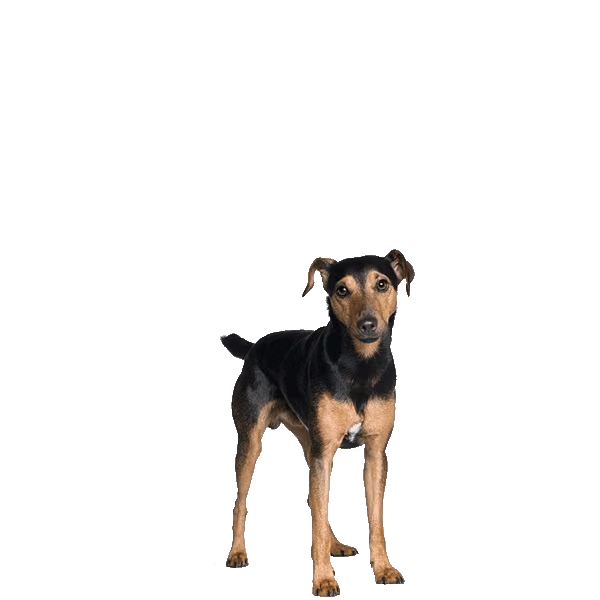
The Toy Manchester Terrier is a spirited, keen-eyed toy breed known for its alertness, devotion, and lively terrier energy.
How the Manchester Terrier (Toy) coat is built, and what that means when you groom it.
The Toy Manchester Terrier is a small, smooth-coated companion dog from England, known for its sharp alertness, devotion to its owner, and lively terrier temperament.
The Toy Manchester Terrier is a compact, smooth-coated toy breed that weighs no more than 12 pounds. It shares its ancestry and black-and-tan colouring with the Standard Manchester Terrier and looks like a miniature version of that dog. Both varieties trace back to the same English working stock; the Toy was developed by selective reduction in size while retaining the original build and markings.
Despite its small frame, this is a true terrier in attitude. It is quick, curious, and tightly bonded to its people. The breed tends to attach strongly to one or two members of a household and follows them from room to room. Owners often describe it as a watchful companion that notices every sound at the door.
The coat is short, dense, and glossy, which keeps grooming simple. The breed is generally healthy and long-lived, with a typical lifespan of 15 to 17 years. It suits people who want a small, low-maintenance dog with an active mind rather than a placid lap dog.
| Attribute | Detail |
|---|---|
| Origin | England |
| Size | Toy (under 12 lb) |
| Lifespan | 15 to 17 years |
| Group/role | Toy companion (terrier ancestry) |
| Good with | Attentive adults, older children, single-pet or experienced multi-pet homes |
This breed fits people who want a small, devoted dog that stays mentally engaged. It does well in apartments and houses alike, provided it gets daily activity and company. Its strong attachment means it dislikes long stretches alone. Households with very small children should supervise interactions, since the dog is small and the temperament is spirited. People who enjoy a responsive, trainable companion and can offer steady attention tend to do well with this breed.
The Toy Manchester Terrier descends from English black-and-tan terriers bred to control rats, later refined into a smaller companion version of the Standard Manchester Terrier.
The breed traces to the black-and-tan terriers kept in England to control rats and other vermin. These working dogs were common in towns and cities, where rat infestations were a constant problem. In the area around Manchester, breeders refined the black-and-tan terrier into a more consistent type, which gave the breed its name.
The larger Manchester Terrier was used for rat killing and, at times, for the rat-baiting contests popular in the nineteenth century. Some owners wanted a smaller version of the same dog as a household companion. Selective reduction in size produced very small specimens, and these small black-and-tan terriers became fashionable as pets.
For a period, the smallest examples were promoted under names such as the English Toy Terrier (Black and Tan). Reducing size too far brought health and structural problems, and breeders later worked to stabilise a sound toy type that kept correct proportions and markings.
In Canada, the Canadian Kennel Club (CKC) recognises both the Toy and Standard Manchester Terrier as separate breeds. The two share common ancestry and the same distinctive black-and-tan pattern, divided by the size threshold. The breed remains relatively uncommon in Canada compared with many other toy dogs.
The Toy Manchester Terrier is a small, sleek dog with a smooth black-and-tan coat, a long wedge-shaped head, and naturally erect ears.
The Toy Manchester Terrier has a clean, athletic outline that reads as a smaller copy of the Standard variety. The body is slightly longer than tall, with a slightly arched topline over the loin. The head is long and narrow, tapering to a wedge, with small dark eyes and a keen expression. The Toy variety must carry naturally erect ears, which give the breed its alert look. Cropped ears are not permitted in the Toy.
| Trait | Standard |
|---|---|
| Height | About 10 to 12 in at the shoulder |
| Weight | Not exceeding 12 lb |
| Coat | Short, smooth, dense, and glossy |
| Colours | Black and tan (mahogany tan markings in a defined pattern) |
| Eyes | Small, dark, almond-shaped |
The coat is short and tight against the body, with a hard, smooth texture and a clear shine. Colour is jet black with rich mahogany tan markings in a fixed pattern: a spot above each eye, tan on the muzzle and cheeks, tan on the lower legs and feet, and a small black mark (often called a thumbprint) on the front of each foreleg. The dividing line between black and tan should be sharp rather than blended. The short coat shows the dog's outline clearly, so structure and condition are easy to assess.
The Toy Manchester Terrier is devoted, alert, and spirited, with strong attachment to its owner and a watchful response to strangers and other animals.
This breed combines toy-dog devotion with terrier drive. It bonds closely to its household and often picks one favourite person. It is responsive and observant, quick to notice changes in its environment, and it tends to announce visitors. With family it is affectionate and playful, staying near its people through the day.
With strangers the breed is usually reserved at first and warms up once it judges the person to be safe. Early and ongoing socialisation helps prevent shyness or excessive wariness. Alert enough to act as a small watchdog, it is too small to serve as a guard dog.
With other pets, results depend on the individual and on early exposure. The terrier background means a prey drive toward small animals such as rodents, so households with hamsters or similar pets should manage contact carefully. Many get along with other dogs and with cats they are raised alongside. The breed is intelligent and learns quickly, but it can be independent and will test boundaries if rules are inconsistent.
| Trait | Rating |
|---|---|
| Affection | 5 |
| Energy | 4 |
| Trainability | 4 |
| Vocalness | 3 |
| Shedding | 2 |
The Toy Manchester Terrier needs little grooming thanks to its short coat, but it requires daily activity, mental engagement, and company to stay content.
The breed adapts well to apartments or houses because of its small size. It is sensitive to cold due to its thin coat and lack of undercoat, so a sweater or coat is useful in cold weather. Canadian winters can be hard on this breed; even a brief outing at temperatures below 0 degrees Celsius calls for a warm coat and booties on icy or salted pavement. It prefers to be near its people and does not cope well with long hours alone.
The Toy Manchester Terrier needs a measured diet of quality small-breed food, split into small meals, with portions controlled to prevent weight gain.
Feed a complete, balanced diet formulated for small or toy breeds and matched to the dog's life stage. Small dogs have fast metabolisms relative to their size, and small-breed kibble is sized for their mouths. Measure portions rather than free-feeding, since extra weight strains the joints and heart of a small dog. Fresh water should be available at all times.
| Life stage | Amount per day | Meals |
|---|---|---|
| Puppy (2 to 6 months) | About 1/4 to 1/2 cup | 3 to 4 |
| Adult (1 yr and up) | About 1/4 to 1/2 cup | 2 |
| Senior | About 1/4 to 1/2 cup (often reduced) | 2 |
Keep treats to about 10 percent of daily calories and subtract them from meal portions to avoid overfeeding. Small, low-calorie treats work well for training a dog this size. Most dogs on a complete diet do not need supplements; ask a veterinarian before adding any. Watch the body condition closely, since a small overage in food shows quickly on a toy breed.
The Toy Manchester Terrier is generally healthy and long-lived at 15 to 17 years, with a few inherited conditions to watch for, including kneecap and eye problems.
The Toy Manchester Terrier is a hardy, long-lived breed, with a typical lifespan of 15 to 17 years. Responsible breeders screen for the inherited conditions known in the breed, and routine veterinary care helps catch problems early. As with many toy breeds, dental health and kneecap stability deserve particular attention over the dog's life.
| Condition | Signs | Note |
|---|---|---|
| Patellar luxation | Skipping gait, intermittent hind-leg lameness | Common in toy breeds; ranges from mild to surgical |
| Von Willebrand disease | Excess bleeding after injury or surgery | Inherited clotting disorder; DNA testing available |
| Progressive retinal atrophy | Night blindness progressing to vision loss | Inherited eye disease; screening available |
| Dental disease | Tartar, bad breath, loose teeth | Crowded small jaws need regular dental care |
| Legg-Calve-Perthes disease | Limping, hip pain in young dogs | Hip joint degeneration seen in small breeds |
The Toy Manchester Terrier is intelligent and quick to learn, and it responds best to consistent, reward-based training started early.
This is a smart, willing breed that picks up commands quickly. Its terrier independence means it works best when training is consistent and motivating rather than repetitive or harsh. Short, varied sessions hold its attention better than long drills. Early socialisation with people, places, and other animals helps prevent the shyness that can appear in sensitive toy breeds, and it tempers the prey drive toward small animals.
Housetraining can take patience, as it does with many small dogs, so a steady schedule and crate routine help. The breed enjoys having a job and can do well in activities such as obedience, agility, and rally. CKC-sanctioned events offer a good outlet for this kind of work in Canada, and the breed's speed and quick mind suit competitive performance well.
Breeding the Toy Manchester Terrier requires health screening of the parents and care during whelping, with litters that are typically small.
Responsible breeding of the Toy Manchester Terrier starts with health screening of both parents for the inherited conditions known in the breed, including von Willebrand disease, patellar luxation, and eye disease. Breeders generally wait until a dog is physically and mentally mature before a first mating. Because the breed is small, litters tend to be modest in number, and whelping should be monitored, with veterinary support on hand in case of complications.
Newborn puppies are tiny and need a warm, draft-free whelping area, since they lose body heat quickly. The dam usually raises the litter with close supervision. Early gentle handling and socialisation from the breeder lay the groundwork for the breed's confident, devoted adult temperament. Puppies should remain with the dam and littermates until they are weaned and ready to go to new homes, generally around eight weeks or later. In Canada, breeders registered with the CKC are bound by a code of ethics that covers health testing and puppy placement practices.
| Metric | Value |
|---|---|
| Sexual maturity | Around 6 to 12 months (breed later, once mature) |
| Gestation | About 63 days |
| Typical litter size | About 2 to 4 puppies |
| Weaning age | About 6 to 8 weeks |
| Recommended health tests | vWD, patella, eye screening |
A free lifetime United Pet Club record for your Manchester Terrier (Toy), with the microchip registered at no cost and kept current through every move.
Put your Manchester Terrier (Toy) on the registry before the gate is ever left open. The free United Pet Club profile stores the dog's name, birth date, and photo beside your contact details, and it stays free for as long as the dog is with you. Dog registration asks for a few fields, not a fee.
The vet implants the chip and leaves the recording part to you. Register the microchip on the free lifetime plan: any brand a Canadian clinic implants is accepted, updates after a change of address are free, and a current record keeps the border paperwork the Canadian Food Inspection Agency asks about from becoming a scramble. Create your free account and finish both in one evening.
Open a free United Pet Club account, fill in your Manchester Terrier (Toy)'s name, breed details, and a photo, and save. The lifetime plan is free, no chip required, and the chip number can be attached after your vet appointment.
Add the 15-digit number to your account along with your address, postal code, and phone number. Registration and unlimited updates are free for life, and chips from any manufacturer a Canadian vet uses are accepted.
There is no federal requirement, but several cities fold chips into their licensing bylaws, and travel with the dog goes smoother when the chip is registered. The record, not the implant, is what identifies your Manchester Terrier (Toy).
Nothing, ever. United Pet Club's lifetime plan covers the profile, the chip record, and every update without fees or renewals.
Common questions about the Toy Manchester Terrier cover its size, temperament, care needs, lifespan, suitability, and availability.
It is a toy breed weighing no more than 12 pounds and standing roughly 10 to 12 inches at the shoulder. It looks like a smaller version of the Standard Manchester Terrier.
It is devoted, alert, and spirited. It bonds closely to its owner, often favouring one person, and stays watchful and curious. It carries true terrier energy in a small body.
Grooming is easy thanks to the short coat, which needs only weekly brushing. The greater needs are daily exercise, mental engagement, company, and protection from cold weather because of the thin coat. Canadian winters call for a coat and booties on icy or salted surfaces.
The breed is long-lived, with a typical lifespan of 15 to 17 years when kept at a healthy weight and given routine veterinary care.
It adapts well to apartments and suits attentive adults and homes with older children. Interactions with very young children should be supervised because the dog is small and lively. It dislikes long periods alone.
It can live with other dogs and with cats it is raised alongside, but its terrier prey drive means caution around small animals such as rodents. Early socialisation improves results.
It is a relatively uncommon breed in Canada, so finding a puppy may take patience and a wait list. The CKC breeder directory is a useful starting point. Look for breeders who screen the parents for the breed's inherited conditions.
