
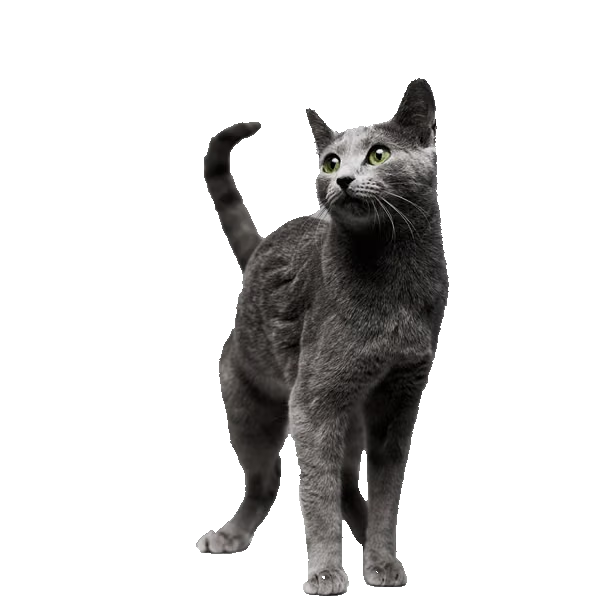
Russian Blue
The Russian Blue is a gentle, intelligent cat with a shimmering silver-blue coat, devoted to its family yet reserved with strangers.
- Size
- Medium
- Lifespan
- 15–20 years
- Origin
- Russia
- Temperament
- Gentle
- Standard colors
- Blue
Characteristics
Coat and grooming
How the Russian Blue coat is built, and what that means when you groom it.
- Coat layers
- Double coat
- Coat texture
- Plush
- Coat length
- Short
- Shedding
- Seasonal shedding
Grooming guidance
Critical: A Russian Blue should not be shaved.
The undercoat keeps heat out as well as in, and the outer coat shields the skin from sun and insect bites. Clipping the whole coat off removes both. It often grows back patchy, soft or a different colour, and in some animals the guard hairs never return properly. Brush the undercoat out instead of cutting it off.
Information: A Russian Blue drops its undercoat in heavy bursts.
The undercoat comes out in heavy bursts over a few weeks. An undercoat rake, or a bath followed by a proper blow-dry, clears it far faster than daily brushing. Clipping the coat down is not a shortcut for this.
Russian Blue colors and patterns
What each club's breed standard says about every Russian Blue color and pattern. Point at a ruling to see the club's own wording.
Breed standards describe the Russian Blue in Blue. Standard patterns: Solid.
| Color or pattern | TICA | CFA | FIFE | GCCF |
|---|---|---|---|---|
| Blue | Standard (“Blue”) | Standard (“Blue”) | Standard (“blue-grey with silver sheen”) | Standard (“Russian Blue”) |
| Black | No ruling | No ruling | No ruling | No ruling |
| White | No ruling | No ruling | No ruling | No ruling |
| Patterns | ||||
| Solid | Standard (“Solid”) | Standard (“even bright blue throughout”) | Standard (“solid”) | No ruling |
| Pointed | No ruling | No ruling | No ruling | Not recognised (“colourpoint”) |


| Color or pattern | TICA | CFA | FIFE | GCCF |
|---|---|---|---|---|
| Green | Standard (“green”) | Standard (“vivid green”) | Standard (“vivid green”) | Standard (“Vivid green”) |
| Blue | No ruling | No ruling | No ruling | Not recognised (“blue”) |
| Patterns | ||||
| Odd-eyed | No ruling | No ruling | No ruling | Not recognised (“odd”) |

What the rulings mean
- Standard
- Described by the club's breed standard.
- Not recognised
- The club does not accept this colour or pattern for the breed.
Color changes
How a Russian Blue's colors can change over its life.
Bluechanges toTortoiseshell
Coat · With age
Solidchanges toSmoke
Coat · With age · from 3 to 104 weeks
Yellowchanges toGreen
Eyes · With age · from 4 weeks
Pinkchanges toSeal
Paw pads · With age · from 1 to 52 weeks
Pinkchanges toBlue
Paw pads · With age · from 1 to 52 weeks
Pinkchanges toChocolate
Paw pads · With age · from 1 to 52 weeks
Pinkchanges toLilac
Paw pads · With age · from 1 to 52 weeks


Sources
Each ruling comes from the club's published breed standard or color list.
About the Russian Blue
The Russian Blue is a medium-sized cat from Russia with a short silver-blue coat and vivid green eyes, gentle and devoted at home but reserved with strangers.
The Russian Blue is a shorthaired cat known for its dense blue-grey coat and bright green eyes. The fur carries silver tipping that catches light, giving the coat a shimmering appearance. Adults are medium in size, with a fine-boned but muscular body that often feels heavier than it looks.
This is a quiet, even-tempered cat. It bonds closely with the people it lives with and often picks one or two favourites. Around visitors and in noisy situations it tends to retreat and watch from a distance, warming up only once it feels safe. The breed is intelligent and observant, and it notices changes in routine and surroundings.
Russian Blues suit households that value a calm companion. They adapt well to apartments and to owners who keep regular hours, since they dislike chaos and sudden change. They can live with respectful children and other pets when introductions are handled gradually.
| Attribute | Detail |
|---|---|
| Origin | Russia |
| Size | Medium |
| Lifespan | 15 to 20 years |
| Group/role | Shorthair companion cat |
| Good with | Calm families, considerate children, other gentle pets |
Who it suits
The breed fits people who want an affectionate but undemanding cat. It is a good choice for quieter homes, for owners who are out during the day but home in the evening, and for those who prefer a pet that shows devotion without constant noise. Loud, high-traffic households tend to stress this cat.
History and origin of the Russian Blue
The Russian Blue traces to northern Russia and reached western Europe by the mid-1800s, with later breeding work in Britain and Scandinavia shaping the modern cat.
The breed is generally held to come from northern Russia. One common account links it to the port of Arkhangelsk on the White Sea, which is why the cat was sometimes called the Archangel cat in early English writing. Whether the breed truly originated there or simply shipped from there is not settled, but the northern Russian connection is consistent across early records.
The cat appeared in western Europe during the 1800s, likely carried by sailors trading along northern routes. A blue cat shown at the Crystal Palace cat show in London in 1875 is one of the earliest documented public appearances of the type in Britain.
Through the late nineteenth and early twentieth centuries, breeders in England developed the cat alongside other blue shorthairs. The two World Wars cut numbers sharply, and to rebuild the breed afterward some breeders crossed surviving cats with other types, including blue point Siamese and British Shorthairs. Later breeding work, much of it in Scandinavia and Britain, moved the breed back toward the lighter, finer cat seen today.
The modern Russian Blue is recognised by the major cat registries and is bred to a defined standard. Regional lines differ slightly in build and coat, but the silver-tipped blue coat and green eyes remain the defining features.
Russian Blue appearance and coat
The Russian Blue is a medium, fine-boned cat with a short double coat in even blue-grey, silver tipping, and rounded green eyes.
The Russian Blue has a graceful, fine-boned frame with firm muscle underneath. The body is medium in length, the legs are long, and the cat stands as though on its toes. The head forms a smooth wedge with a flat top and large, wide-set ears. The eyes are rounded and set fairly wide, and in adults they are a clear green.
| Trait | Standard |
|---|---|
| Height | About 23 to 28 cm at the shoulder |
| Weight | 3 to 5.5 kg, males larger than females |
| Coat | Short, dense, plush double coat that stands out from the body |
| Colours | Even blue-grey with silver tipping; blue is the only accepted colour |
| Eyes | Rounded, wide-set, vivid green in adults |
Coat and colours
The defining feature is the double coat. A soft undercoat lies beneath guard hairs of equal length, which makes the fur stand away from the body and feel plush. The base colour is a solid blue-grey, and the silver tips on each guard hair produce the shimmer that sets the breed apart. Kittens are sometimes born with faint tabby ghost markings that fade as the coat matures. Eye colour shifts from yellowish in kittens to green by adulthood. Only the blue coat is accepted in show standards, though related breeding programmes have produced white and black coated cats under separate names.
Russian Blue temperament and behaviour
The Russian Blue is gentle, devoted, and intelligent, affectionate with its own people but reserved and watchful around strangers.
The Russian Blue is calm and gentle by nature. It forms strong attachments to its household and often follows favoured people from room to room. Affection is given on the cat's terms, and many individuals prefer to sit nearby rather than be carried or held for long.
With strangers the breed is reserved. New visitors usually prompt the cat to leave the room or observe from a high perch until things settle. This caution is normal for the breed and not a sign of poor socialisation. With respectful children the cat is patient, though it dislikes rough handling and will withdraw rather than scratch. It generally accepts other cats and calm dogs when introductions are slow.
The breed is intelligent and quietly playful. It learns routines quickly, enjoys puzzle toys and games of fetch, and is sensitive to change in the home. Sudden disruption, loud noise, or an unpredictable schedule can make the cat anxious.
| Trait | Rating |
|---|---|
| Affection | 4 |
| Energy | 3 |
| Trainability | 4 |
| Vocalness | 2 |
| Shedding | 2 |
Russian Blue care and daily routine
The Russian Blue needs only light grooming and moderate play, and it does best in a calm, stable home with predictable routines.
Grooming
- Brush the coat once a week to remove loose hair and keep the double coat plush.
- Increase brushing during seasonal shedding in spring and autumn.
- Trim nails every two to three weeks.
- Check ears and brush teeth regularly to support dental health.
- Bathing is rarely needed; the dense coat stays clean on its own.
Exercise
- Offer two or three short play sessions a day with wand toys or balls.
- Provide puzzle feeders and toys to occupy the cat's mind.
- Give a tall cat tree or shelf so the cat can climb and watch from height.
- Rotate toys to keep interest, since the breed loses interest in the same items over time.
Environment
The Russian Blue prefers a quiet, predictable home. It tolerates being alone during the workday better than many breeds but still wants company in the evening. Keep feeding times and litter habits consistent, since the cat dislikes change. A clean litter box matters, as this breed is particular about hygiene and may avoid a box that is not kept fresh.
Russian Blue nutrition and feeding
The Russian Blue does well on a complete high-protein cat diet fed in measured portions, since the breed is prone to overeating and weight gain.
The Russian Blue needs a complete, balanced diet built around animal protein. Like all cats it is an obligate carnivore and requires nutrients such as taurine that come from meat. Wet food, dry food, or a combination all work, provided the product is labelled as complete for the cat's life stage. Fresh water should always be available.
This breed has a strong appetite and can beg convincingly. Measured portions matter, because the cat will eat past its needs if food is left out freely. Watch body condition rather than relying on the bowl, and adjust amounts as activity changes.
| Life stage | Amount per day | Meals |
|---|---|---|
| Kitten (to 12 months) | Follow package guidance, fed to appetite | 3 to 4 |
| Adult | About 200 to 280 kcal, by weight and activity | 2 |
| Senior (10+ years) | Slightly reduced, monitor weight | 2 |
Treats and supplements
Treats should stay under about 10 percent of daily calories to protect against weight gain. A diet that is complete and balanced usually needs no added supplements. Discuss any supplement, such as joint support for older cats, with a veterinarian before starting it.
Russian Blue health and lifespan
The Russian Blue is a generally healthy breed with a long lifespan of 15 to 20 years, though it is prone to weight gain and shares some risks common to all cats.
The Russian Blue is considered a hardy, generally healthy breed and is not linked to a long list of inherited disorders. With good care many cats live 15 to 20 years. The most common practical concern is obesity, because the breed enjoys food and will overeat if portions are not controlled. Excess weight raises the risk of diabetes, joint strain, and other problems.
| Condition | Signs | Note |
|---|---|---|
| Obesity | Weight gain, reduced activity, difficulty grooming | Most common issue; managed with portion control and play |
| Dental disease | Bad breath, drooling, reluctance to eat hard food | Regular brushing and checkups help prevent it |
| Bladder and urinary issues | Straining, frequent or bloody urination | Common across cats; needs prompt veterinary care |
| Diabetes | Increased thirst, urination, weight change | Risk rises with obesity; more likely in older cats |
Preventive care
- Keep vaccinations and parasite control current.
- Schedule an annual veterinary exam, and twice yearly for senior cats.
- Weigh the cat regularly and adjust food to maintain a healthy condition.
- Maintain dental care through brushing and professional cleaning as advised.
- Keep the litter box clean and watch for changes in toilet habits.
Russian Blue training and enrichment
The Russian Blue is intelligent and quick to learn, responding well to patient, reward-based training for litter habits, tricks, and games like fetch.
The Russian Blue is among the more trainable cats. It learns routines fast, can pick up simple tricks, and many individuals enjoy fetching toys. Its sensitivity means it responds best to calm, consistent handling. Harsh correction backfires with this reserved breed and erodes trust, so reward what you want rather than punishing what you do not.
Basics
- Place a clean litter box in a quiet, low-traffic spot and keep it fresh; most Russian Blues take to it easily.
- Provide a scratching post early and reward the cat for using it.
- Use short play and training sessions of a few minutes, ending while the cat is still interested.
- Teach one cue at a time, such as coming when called, using treats and a steady marker word.
- Build tolerance for handling and carriers gradually so vet visits cause less stress.
Russian Blue breeding and raising kittens
Russian Blue queens carry litters for roughly 63 to 67 days and typically produce small to medium litters of kittens that develop their coat and green eye colour over the first year.
Responsible Russian Blue breeding is done by registered breeders who screen for health and temperament. Cats reach sexual maturity at several months of age, but breeding is delayed until the cat is physically mature, usually well into the second year. Queens come into heat in cycles and may call loudly during this time.
Gestation runs about 63 to 67 days. Litters are usually small to medium. Newborn kittens are blind and fully dependent, and they nurse for the first weeks before weaning onto solid food. The silver-tipped coat and clear green eye colour develop over the first year, and faint kitten tabby markings fade as the coat matures. Kittens should stay with the mother and littermates until around 12 to 13 weeks so they are weaned, socialised, and ready for vaccination before going to new homes.
| Metric | Value |
|---|---|
| Sexual maturity | Around 5 to 10 months |
| Recommended breeding age | Physical maturity, roughly 18 months or older |
| Gestation | About 63 to 67 days |
| Litter size | Typically 3 to 5 kittens |
| Weaning | Around 7 to 8 weeks |
| Ready for new home | About 12 to 13 weeks |
Your Russian Blue on the registry, microchip included
Free lifetime registration for your Russian Blue, plus a microchip record that satisfies bylaws like Montreal's and never costs a cent.
Registering a Russian Blue and its microchip in Canada
An open balcony door is all it takes for a Russian Blue to become a shelter intake. The free United Pet Club profile answers that scan with your name, your postal code, and the cat's photo. Register your cat once; it holds for her whole life.
A chip the vet implanted but nobody registered reads as a dead end on the scanner. Register the microchip free on the lifetime plan: every brand a Canadian clinic implants is accepted, updates after each move are free, and the record answers the lookup tools shelters lean on. Create your free account and close both gaps tonight.
How do I register my Russian Blue in Canada?
Sign up free with United Pet Club, add your Russian Blue's name, colouring, and a photo, and the record is live. Indoor and outdoor cats alike stay covered for life at no charge.
How do I register my Russian Blue's microchip?
Type the 15-digit number from your vet paperwork into your free account and confirm your contact details. The plan accepts every chip brand and never charges for updates.
Do cats like the Russian Blue have to be microchipped in Canada?
In some cities, yes. Montreal's bylaw requires pet cats to be chipped and licensed, and other municipalities are moving the same way. The registration behind the chip is yours to keep current, and with United Pet Club that part is free.
What does it cost to register a Russian Blue in Canada?
Zero. The lifetime plan includes the profile, microchip registration, and every future update, with no renewal fees.
Russian Blue frequently asked questions
Common questions about the Russian Blue cover its size, temperament, care needs, lifespan, suitability, and how to find one in Canada.
How big does a Russian Blue get?
It is a medium-sized cat. Adults usually weigh between 3 and 5.5 kg, with males larger than females, and stand about 23 to 28 cm at the shoulder. The plush coat can make the cat look heavier than it is.
What is the Russian Blue's temperament like?
It is gentle, devoted, and intelligent. The breed bonds closely with its household and is affectionate at home, but it is reserved and watchful around strangers until it feels comfortable.
Is the Russian Blue hard to care for?
No. The coat needs only weekly brushing, and the cat is content with moderate play. The main care priorities are controlled feeding to prevent weight gain and a calm, predictable home.
How long do Russian Blues live?
They are a long-lived breed. With good care many reach 15 to 20 years.
Is a Russian Blue good for families or apartments?
Yes, in calm households. It does well in apartments and with considerate children and other gentle pets, but it dislikes noise and chaos, so very busy homes are less suitable.
Are Russian Blues good for people with allergies?
They are sometimes described as easier for allergy sufferers, but no cat is truly hypoallergenic. Anyone with allergies should spend time with the breed before making a commitment.
Where can I find a Russian Blue in Canada?
Through registered breeders who health-screen their cats, or occasionally through breed-specific rescue groups. The Canadian Cat Association (CCA) and Cat Fanciers' Association (CFA) can help locate reputable breeders. Purebred kittens are less common than many breeds, so expect a wait.
From the community
Ask about the Russian BlueNo questions about the Russian Blue yet. Be the first to ask.
Browse Cat breeds