
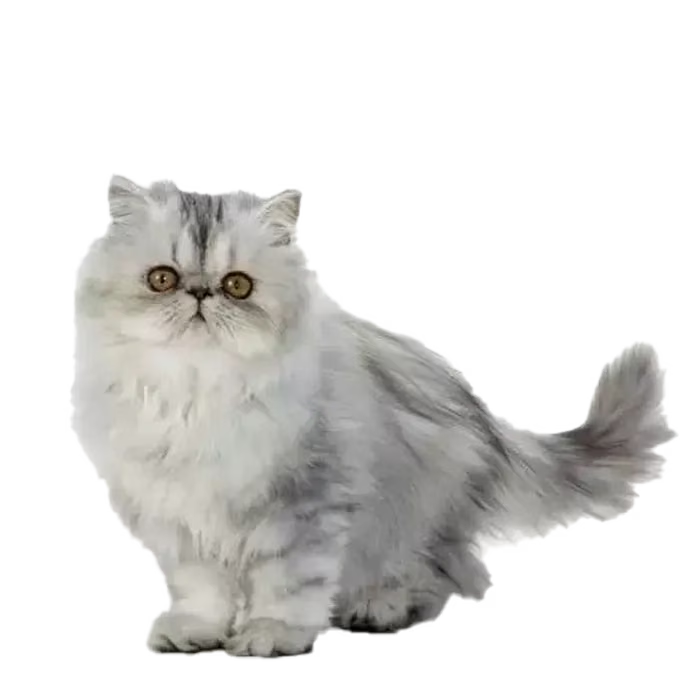
Persian (modern)
The modern Persian is a calm, gentle, and dignified longhaired cat that loves a serene home and quiet companionship.
- Size
- Medium
- Lifespan
- 10–15 years
- Origin
- Iran
- Temperament
- Calm
- Standard colors
- Black, White and Blue and 10 more
Characteristics
Coat and grooming
How the Persian (modern) coat is built, and what that means when you groom it.
- Coat layers
- Double coat
- Coat texture
- Silky
- Coat length
- Long
- Shedding
- Heavy shedding
Grooming guidance
Critical: A Persian (modern) should not be shaved.
The undercoat keeps heat out as well as in, and the outer coat shields the skin from sun and insect bites. Clipping the whole coat off removes both. It often grows back patchy, soft or a different colour, and in some animals the guard hairs never return properly. Brush the undercoat out instead of cutting it off.
Caution: A Persian (modern) coat mats easily.
Fine or long hair tangles at the base of the coat, out of sight, where the mats tighten and pull on the skin. Brushing has to reach right down to the roots in sections, not just skim the surface.
Persian (modern) colors and patterns
What each club's breed standard says about every Persian (modern) color and pattern. Point at a ruling to see the club's own wording.
Breed standards describe the Persian (modern) in Black, White, Blue, Lilac, Silver, Brown, Chocolate, Seal, Cinnamon, Red, Gold, Cream and Fawn. Standard patterns: Solid, Bicolour, Harlequin, Pointed, Tabby, Mackerel tabby, Classic tabby, Spotted tabby, Tortoiseshell, Calico, Torbie, Van, Smoke, Shaded, Chinchilla and Caliby.
| Color or pattern | TICA | CFA | FIFE | GCCF | WCF |
|---|---|---|---|---|---|
| Black | Standard | Standard (“Black”) | Standard (“black”) | Standard (“Black”) | Standard |
| White | Standard (“white”) | Standard (“White”) | Standard (“white”) | Standard (“White”) | Standard (“pure white”) |
| Blue | Standard | Standard (“Blue”) | Standard (“blue”) | Standard (“Blue”) | Standard |
| Lilac | Standard | Standard (“Lilac”) | Standard (“lilac”) | Standard (“Lilac”) | Standard |
| Silver | Standard (“silver”) | Standard (“Silver”) | Standard (“silver”) | Standard (“Silver”) | Standard (“Silver”) |
| Brown | No ruling | Standard (“Brown Tabby”) | Standard (“black tabby”) | Standard (“Brown Tabby”) | No ruling |
| Chocolate | Standard | Standard (“Chocolate”) | Standard (“chocolate”) | Standard (“Chocolate”) | Standard |
| Seal | Standard | Standard (“Seal Point”) | Standard (“seal”) | Standard (“Seal Point”) | Standard |
| Cinnamon | Standard | No ruling | No ruling | No ruling | Standard |
| Red | Standard | Standard (“Red”) | Standard (“red”) | Standard (“Red Self”) | Standard |
| Gold | Standard (“golden”) | Standard (“Golden”) | Standard (“golden”) | Standard (“Golden”) | Standard (“Golden”) |
| Cream | Standard | Standard (“Cream”) | Standard (“cream”) | Standard (“Cream”) | Standard |
| Fawn | Standard | No ruling | No ruling | No ruling | Standard |
| Patterns | |||||
| Solid | No ruling | Standard (“Solid”) | Standard (“solid”) | Standard (“Self”) | No ruling |
| Bicolour | Standard (“with white colors/patterns”) | Standard (“Bi-Color”) | Standard (“bicolour”) | Standard (“Bi-colour”) | Standard (“bicolor”) |
| Harlequin | No ruling | No ruling | Standard (“harlequin”) | No ruling | Standard (“harlequin”) |
| Pointed | Standard (“HI: Pointed”) | Standard (“Himalayan”) | Standard (“Siamese pointed”) | Standard (“Colourpoint”) | Standard (“Colourpoint”) |
| Tabby | No ruling | Standard (“Himalayan Lynx”) | Standard (“tabby”) | Standard (“Tabby Point”) | No ruling |
| Mackerel tabby | No ruling | Standard (“Mackerel Tabby”) | Standard (“mackerel”) | Standard (“Mackerel Tabby Pattern”) | No ruling |
| Classic tabby | No ruling | Standard (“Classic Tabby”) | Standard (“blotched”) | Standard (“Classic Tabby Pattern”) | No ruling |
| Spotted tabby | No ruling | No ruling | Standard (“spotted”) | Standard (“Spotted Tabby Pattern”) | No ruling |
| Tortoiseshell | No ruling | Standard (“Tortoiseshell”) | Standard (“tortie”) | Standard (“Tortoiseshell”) | No ruling |
| Calico | No ruling | Standard (“Calico”) | Standard (“tortie with white”) | Standard (“Tortie & White”) | No ruling |
| Torbie | No ruling | Standard (“Patched Tabby”) | Standard (“tortie tabby”) | Standard (“Tortie Tabby”) | No ruling |
| Van | No ruling | No ruling | Standard (“van”) | No ruling | Standard (“van”) |
| Smoke | No ruling | Standard (“Smoke”) | Standard (“smoke”) | Standard (“Smoke”) | No ruling |
| Shaded | No ruling | Standard (“Shaded”) | Standard (“shaded”) | Standard (“Shaded Silver / Shaded Cameo”) | No ruling |
| Chinchilla | No ruling | Standard (“Chinchilla”) | Standard (“shell”) | Standard (“Chinchilla / Tipped”) | No ruling |
| Caliby | No ruling | Standard (“Calico”) | Standard (“tortie with white”) | Standard (“Tortie & White”) | No ruling |
| Mink | Not recognised | No ruling | No ruling | No ruling | Not recognised (“Tonkinese pointed”) |
| Sepia | Not recognised | No ruling | No ruling | No ruling | Not recognised (“Burmese ... pointed”) |


| Color or pattern | TICA | CFA | FIFE | GCCF | WCF |
|---|---|---|---|---|---|
| Blue | Standard (“Blue”) | Standard (“deep blue”) | Standard (“deep blue”) | Standard (“Decidedly blue”) | Standard (“Blue / intense blue”) |
| Hazel | No ruling | Standard (“hazel”) | No ruling | Standard (“hazel”) | No ruling |
| Orange | Standard (“orange eyed”) | No ruling | Standard (“copper or deep orange”) | Standard (“deep orange”) | Standard (“Intense orange”) |
| Copper | Standard (“Copper”) | Standard (“brilliant copper”) | Standard (“copper or deep orange”) | Standard (“copper”) | No ruling |
| Green | Standard (“green”) | Standard (“green”) | Standard (“green”) | Standard (“emerald”) | Standard (“intense green”) |
| Aqua | No ruling | Standard (“blue-green”) | Standard (“blue green”) | Standard (“blue-green”) | No ruling |
| Amber | No ruling | Disqualifying (“amber”) | No ruling | Disqualifying (“amber”) | No ruling |
| Yellow | No ruling | Disqualifying (“yellow”) | No ruling | Disqualifying (“yellow”) | No ruling |
| Gold | No ruling | Disqualifying (“gold”) | No ruling | Disqualifying (“gold”) | No ruling |
| Patterns | |||||
| Odd-eyed | Standard (“odd”) | Standard (“odd-eyed”) | Standard (“odd eyed”) | Standard (“Odd-Eyed”) | Standard (“odd”) |

| Color or pattern | CFA | GCCF |
|---|---|---|
| Black | Standard (“black”) | Standard (“Black”) |
| Blue | Standard (“blue”) | Standard (“Blue-grey”) |
| Lilac | Standard (“lavender”) | Standard (“Lilac”) |
| Brown | Standard (“brown”) | No ruling |
| Chocolate | No ruling | Standard (“Chocolate”) |
| Seal | Standard (“seal brown”) | No ruling |
| Cinnamon | Standard (“cinnamon pink”) | No ruling |
| Brick red | Standard (“brick red”) | Standard (“brick red”) |
| Pink | Standard (“pink”) | Standard (“Pink”) |
| Color or pattern | CFA | GCCF |
|---|---|---|
| Black | Standard (“black”) | Standard (“Black”) |
| Blue | Standard (“blue”) | Standard (“Blue-grey”) |
| Lilac | Standard (“lavender pink”) | Standard (“Lilac”) |
| Brown | Standard (“brown”) | Standard (“dark brown”) |
| Chocolate | No ruling | Standard (“Chocolate”) |
| Seal | Standard (“seal brown”) | Standard (“seal brown”) |
| Cinnamon | Standard (“cinnamon-pink”) | No ruling |
| Brick red | Standard (“brick red”) | Standard (“brick red”) |
| Pink | Standard (“pink”) | Standard (“Pink”) |
What the rulings mean
- Standard
- Described by the club's breed standard.
- Disqualifying
- The club's breed standard disqualifies an animal of this colour or pattern.
- Not recognised
- The club does not accept this colour or pattern for the breed.
Color changes
How a Persian (modern)'s colors can change over its life.
Brownchanges toCopal
Coat · With age · from 0 to 52 weeks
Blackchanges toRusset
Coat · Progressive
Tabbychanges toSolid
Coat · With age · from 0 to 39 weeks
Whitechanges toShaded
Coat · With age
Whitechanges toChinchilla
Coat · With age
Tabbychanges toShaded
Coat · With age · from 0 to 6 weeks
Tabbychanges toChinchilla
Coat · With age · from 0 to 6 weeks
Bluechanges toTortoiseshell
Coat · With age
Blackchanges toBrown
Coat · With body condition · can change back
Blackchanges toBrown
Coat · In the sun · can change back
Blackchanges toBrown
Coat · Progressive
Whitechanges toPointed
Coat · With age · from 1 to 52 weeks
Solidchanges toSmoke
Coat · With age · from 3 to 104 weeks
Bluechanges toGreen
Eyes · With age · from 4 to 17 weeks
Bluechanges toYellow
Eyes · With age · from 4 to 17 weeks
Bluechanges toGold
Eyes · With age · from 4 to 17 weeks
Bluechanges toCopper
Eyes · With age · from 4 to 17 weeks
Bluechanges toOrange
Eyes · With age · from 4 to 17 weeks
Bluechanges toHazel
Eyes · With age · from 4 to 17 weeks
Bluechanges toAmber
Eyes · With age · from 4 to 17 weeks
Pinkchanges toSeal
Nose · With age · from 1 to 52 weeks
Pinkchanges toBlue
Nose · With age · from 1 to 52 weeks
Pinkchanges toChocolate
Nose · With age · from 1 to 52 weeks
Pinkchanges toLilac
Nose · With age · from 1 to 52 weeks
Pinkchanges toSeal
Paw pads · With age · from 1 to 52 weeks
Pinkchanges toBlue
Paw pads · With age · from 1 to 52 weeks
Pinkchanges toChocolate
Paw pads · With age · from 1 to 52 weeks
Pinkchanges toLilac
Paw pads · With age · from 1 to 52 weeks
Sources
Each ruling comes from the club's published breed standard or color list.
Health
Conditions recorded as more common in the Persian (modern) than in its species as a whole. A higher risk is not a diagnosis: many never develop any of them, and your vet can say which screening tests are worth doing.
High risk
- Urinary system
Feline polycystic kidney disease
Strong evidenceHereditaryInheritance: Autosomal dominant
This content is for educational purposes and is not a substitute for professional veterinary advice. If you are worried about your pet, contact your veterinarian.
All health conditionsAbout the modern Persian cat
The modern Persian is a calm, gentle, longhaired cat from Iran that suits a quiet home and steady companionship, though its coat requires daily care.
The modern Persian is a medium-sized longhaired cat recognised for its long flowing coat, broad round head, and quiet manner. It ranks among the oldest established cat types in the fancy and remains one of the most familiar pedigreed cats worldwide. The breed sits at the calm end of the feline temperament range. Most Persians move at an unhurried pace and settle into a household routine rather than seeking high activity.
The "modern" label distinguishes today's show-type Persian, with its very flat or extreme face, from older and more moderate doll-face lines. Both share the same heavy coat and placid character. The face shape mainly affects grooming, tear staining, and breathing, which is worth considering when choosing a kitten.
A Persian suits people who want a companion cat that stays close, tolerates handling, and enjoys a settled environment. The coat is the main commitment. Daily brushing is part of normal care, not an occasional task.
| Attribute | Detail |
|---|---|
| Origin | Iran |
| Size | Medium |
| Lifespan | 10 to 15 years |
| Group / role | Longhair companion cat |
| Good with | Quiet households, families with older children, calm single pets |
Who it suits
The Persian fits homes that value a low-energy, affectionate cat and can commit to daily grooming. It is a good match for apartment living and for owners who spend much of their time at home. It is less suited to households wanting an active, climbing, or highly playful cat, or to people who cannot keep up with coat care and routine face cleaning.
History and origin of the Persian cat
The Persian traces to longhaired cats from Iran, formerly Persia, and was shaped into a defined show breed in Britain before being refined into the flat-faced modern type seen today.
The breed takes its name from Persia, the historical name for Iran, where longhaired cats were recorded in early accounts of cats brought to Europe. European interest in longhaired cats grew during the 1600s and 1700s as imports arrived from the Near East. Early longhairs were grouped loosely and not yet standardised.
The Persian as a defined breed took shape in Britain in the late nineteenth century. Longhaired cats featured at early organised cat shows, including the London show of 1871, and breeders began selecting for the long coat and rounded head that define the type.
Through the twentieth century the breed spread across Europe and North America, becoming one of the most numerous pedigreed cats. Breeders selected for an increasingly round head and a flatter face, producing the show or modern type seen today.
More moderate lines, often called doll-face or traditional Persians, kept a longer muzzle and remain available alongside the flat-faced modern cats. Both descend from the same longhaired foundation.
Appearance and breed standard of the Persian cat
The Persian is a medium, heavy-boned longhaired cat with a round head, short flat face, small ears, large round eyes, and a long dense double coat in a wide range of colours.
The Persian has a cobby, broad-chested body set on short thick legs, giving it a low, solid outline. The head is round and massive with full cheeks, a short broad nose, and small rounded ears set wide and low. The eyes are large, round, and set far apart, giving the breed its open expression. The modern show type carries a notably flat face, with the nose break level with or close to the eyes.
| Trait | Standard |
|---|---|
| Height | About 25 to 30 cm at the shoulder |
| Weight | 3.5 to 5.5 kg (males larger than females) |
| Coat | Long, thick double coat with a full ruff and plumed tail |
| Colours | Solid, tabby, bicolour, calico, smoke, shaded, and pointed (Himalayan) |
| Eyes | Large and round; colour linked to coat (copper, blue, green, or odd-eyed) |
Coat and colours
The coat is one of the longest of any cat breed, with a soft dense undercoat beneath longer guard hairs. A pronounced ruff frames the neck and the tail is short and full. The breed is available in a wide colour range across solids such as white, black, blue, red, and cream, plus tabby, tortoiseshell, bicolour, calico, smoke, and shaded patterns. Pointed Persians, with a pale body and darker face, ears, legs, and tail, are often called Himalayans. Coat length and density mean that mats form quickly without regular brushing.
Persian cat temperament and behaviour
Persians are affectionate, gentle, and calm cats that bond quietly with their people, tolerate handling well, and prefer a peaceful, settled home over a busy one.
The Persian is a quiet, even-tempered companion. It forms close attachments to its household and tends to follow people from room to room without demanding constant attention. Persians are affectionate on their own terms and often choose a warm lap or a favoured resting spot over active play.
With family, the breed is gentle and tolerant, which makes it suitable for considerate children who handle a cat calmly. With strangers, most Persians are reserved rather than fearful and warm up gradually. They generally coexist well with other calm pets, though they may avoid boisterous animals.
The breed is low energy and content with short bursts of gentle play. Persians are among the quieter cats and rarely vocalise loudly. They prefer stability and can find frequent noise, change, or commotion stressful, so a predictable home suits them best.
| Trait | Rating |
|---|---|
| Affection | 4 |
| Energy | 2 |
| Trainability | 2 |
| Vocalness | 2 |
| Shedding | 4 |
Persian cat care and grooming
Persians need daily brushing to prevent mats, routine face and eye cleaning, gentle exercise, and a calm indoor environment where temperatures stay comfortable.
Grooming
- Brush the full coat daily with a wide-tooth comb and a slicker brush to prevent mats and tangles.
- Wipe the eyes and facial folds daily with a soft damp cloth, since the flat face causes tear overflow and staining.
- Bathe every four to six weeks to keep the coat clean and reduce grease.
- Trim nails every two to three weeks and check ears during grooming.
- Clip the coat around the hindquarters if soiling becomes a recurring problem.
Exercise
- Offer short daily play sessions with wand toys or rolling balls to keep weight in check.
- Provide low, easy-access perches and scratching posts rather than tall climbing towers.
- Keep play gentle and brief, in line with the breed's low energy level.
Environment
Persians do best as indoor cats in a calm, stable home. The long coat is not suited to outdoor exposure, and the flat face can struggle in heat. Keep rooms at a comfortable temperature (ideally around 20 to 22°C / 68 to 72°F), provide quiet resting spots, and avoid frequent disruption.
Persian cat nutrition and feeding
Persians need a complete cat diet balanced for life stage, with controlled portions to avoid weight gain and food shapes suited to a flat-faced jaw.
Feed a complete and balanced cat food appropriate to the cat's life stage, with animal protein as the main ingredient. Cats are obligate carnivores and require taurine, which quality cat foods supply. Because Persians are low energy, portion control is important to avoid weight gain. Flat-faced cats can find it hard to pick up standard kibble, so larger or specially shaped pieces, or a mix of wet food, can help.
Fresh water should always be available. Wet food supports hydration and can benefit cats that drink little on their own.
| Life stage | Amount per day | Meals |
|---|---|---|
| Kitten (2 to 12 months) | Per label, fed to appetite | 3 to 4 |
| Adult (1 to 7 years) | About 200 to 250 kcal | 2 |
| Senior (7+ years) | Adjusted to weight and activity | 2 |
Treats and supplements
Keep treats to no more than about 10 percent of daily calories. A complete diet usually needs no extra supplements. Hairball remedies or fibre can help manage the breed's heavy shedding, and joint or kidney support may be recommended for older cats. Introduce any supplement only on veterinary advice.
Persian cat health and common conditions
Persians live about 10 to 15 years and are prone to inherited kidney disease, breathing and tear-duct problems tied to the flat face, and a few coat-related concerns.
With good care most Persians live 10 to 15 years. The breed is generally hardy but carries several known health concerns, some linked directly to the flat-faced conformation. Choosing a kitten from a breeder who screens for inherited disease lowers the risk of the most serious problems. Registering with the Canadian Kennel Club (CKC) or a recognised feline body can help connect owners with breeders who follow health-testing protocols.
| Condition | Signs | Note |
|---|---|---|
| Polycystic kidney disease (PKD) | Increased thirst, weight loss, poor appetite | Inherited; a DNA test identifies carriers |
| Brachycephalic airway issues | Noisy or laboured breathing, heat intolerance | Linked to the flat face; worse in extreme types |
| Excessive tearing and eye irritation | Wet, stained fur below the eyes | Tear ducts are distorted by face shape |
| Hypertrophic cardiomyopathy (HCM) | Lethargy, breathing difficulty | Heart muscle disease; screened by ultrasound |
| Dental malocclusion | Trouble eating, plaque buildup | Short jaw can crowd teeth |
Preventive care
- Schedule annual veterinary checkups, with more frequent visits for senior cats.
- Keep core vaccinations and parasite control up to date.
- Ask breeders for PKD DNA testing and HCM screening of parents.
- Clean the eyes and face daily to limit infection and staining.
- Monitor weight and water intake, since changes can flag kidney or other disease.
Training a Persian cat
Persians are gentle and food-motivated but not eager to perform tricks; calm, consistent, reward-based training works best for litter habits and handling routines.
The Persian is intelligent but not driven to perform, so training aims at good household habits rather than tricks. The breed responds to patience and routine. Because Persians dislike commotion, training works best in short, quiet sessions. Most learn litter box use easily and can be taught to accept grooming, nail trimming, and carrier use, which are the practical priorities for this coat-heavy, flat-faced breed.
Basics
- Place a low-sided litter box in a quiet, easy-to-reach spot and keep it clean.
- Introduce grooming early, rewarding the cat for sitting still during short combing sessions.
- Handle the paws and face gently from kittenhood so nail trims and eye cleaning are accepted.
- Leave a carrier open with bedding inside so the cat enters it willingly before vet trips.
- Use brief, calm play to encourage gentle interaction and discourage scratching of furniture.
Breeding Persian cats
Persian queens reach maturity around 7 to 12 months, carry kittens for roughly 63 to 67 days, and produce small litters that need attentive early care.
Responsible Persian breeding centres on health screening and the particular demands of the flat-faced type. Queens generally reach sexual maturity between about 7 and 12 months, though many breeders wait until full physical maturity before a first mating. Cats are induced ovulators, so mating itself triggers ovulation.
Gestation runs about 63 to 67 days. Litters are typically small, often around two to four kittens. Persian kittens are born with short coats that lengthen over the following months, and they open their eyes within the first one to two weeks. The flat face can complicate nursing and birth in some lines, so breeders monitor queens closely and involve a veterinarian throughout. Both parents should be screened for PKD and HCM before breeding, and kittens normally go to new homes at around 12 to 14 weeks once weaned, vaccinated, and litter trained.
| Metric | Value |
|---|---|
| Sexual maturity | About 7 to 12 months |
| Gestation | 63 to 67 days |
| Average litter size | 2 to 4 kittens |
| Eyes open | 7 to 14 days |
| Weaning age | About 8 to 10 weeks |
| Recommended rehoming age | 12 to 14 weeks |
Your Persian (modern) on the registry, microchip included
Free lifetime registration for your Persian (modern), plus a microchip record that satisfies bylaws like Montreal's and never costs a cent.
Registering a Persian (modern) and its microchip in Canada
Registering a Persian (modern) is a smaller job than most people expect: name, colouring, photo, contact details, save. The record costs nothing for the life of the cat and works chip or no chip. Cat registration is where to start.
Where a bylaw like Montreal's requires the chip, the record behind it still falls to you. United Pet Club keeps that record free for life: any manufacturer, unlimited updates, searchable from any clinic in the country. Microchip registration plus a free account covers cat and chip in one sitting.
How do I register my Persian (modern) in Canada?
Sign up free with United Pet Club, add your Persian (modern)'s name, colouring, and a photo, and the record is live. Indoor and outdoor cats alike stay covered for life at no charge.
How do I register my Persian (modern)'s microchip?
Type the 15-digit number from your vet paperwork into your free account and confirm your contact details. The plan accepts every chip brand and never charges for updates.
Do cats like the Persian (modern) have to be microchipped in Canada?
In some cities, yes. Montreal's bylaw requires pet cats to be chipped and licensed, and other municipalities are moving the same way. The registration behind the chip is yours to keep current, and with United Pet Club that part is free.
What does it cost to register a Persian (modern) in Canada?
Zero. The lifetime plan includes the profile, microchip registration, and every future update, with no renewal fees.
Frequently asked questions about Persian cats
Common questions about the Persian cover its size, temperament, grooming demands, lifespan, suitability for Canadian homes, and where to find one.
How big does a Persian cat get?
The Persian is a medium-sized cat. Adults usually weigh about 3.5 to 5.5 kg and stand around 25 to 30 cm at the shoulder, with males larger than females. The heavy coat can make them look bigger than they actually are.
What is the Persian cat's temperament like?
Persians are affectionate, gentle, calm, and dignified. They are low energy, quiet, and bond closely with their people. They prefer a settled home and tend to be reserved with strangers at first.
Are Persian cats hard to care for?
The main effort is grooming. The long double coat needs daily brushing to prevent mats, and the flat face requires daily eye and face cleaning. Beyond that, their calm nature and indoor lifestyle make them straightforward to keep.
How long do Persian cats live?
Most Persians live about 10 to 15 years with good veterinary care, a balanced diet, and an indoor life. Screening parents for inherited kidney and heart disease helps support a full lifespan.
Is a Persian a good cat for an apartment or a Canadian family?
Yes, for calm households. Persians suit apartments and families with considerate, older children. They are less suited to noisy, high-activity homes or owners who cannot commit to daily grooming. Their low activity level also means indoor heating in Canadian winters is not a concern as long as the home stays comfortably warm.
Where can I find a Persian cat in Canada?
Persians are one of the most popular pedigreed breeds and are available from breeders and rescue organisations across Canada. Look for breeders registered with the Canadian Kennel Club (CKC) or a recognised feline association who DNA-test for polycystic kidney disease and screen for heart disease. Ask about the face type as well, since flatter cats need more eye and breathing care.
From the community
Ask about the Persian (modern)No questions about the Persian (modern) yet. Be the first to ask.
Browse Cat breeds