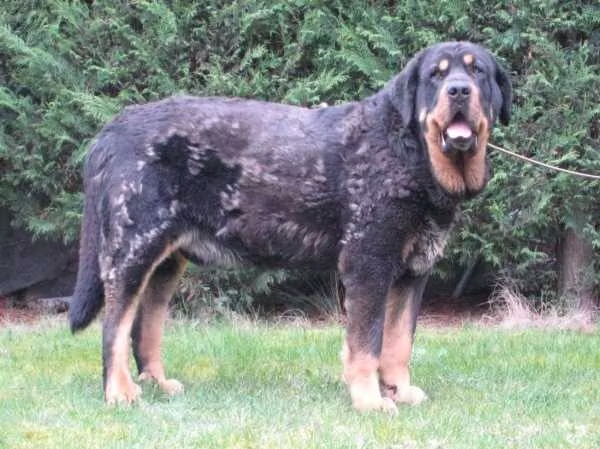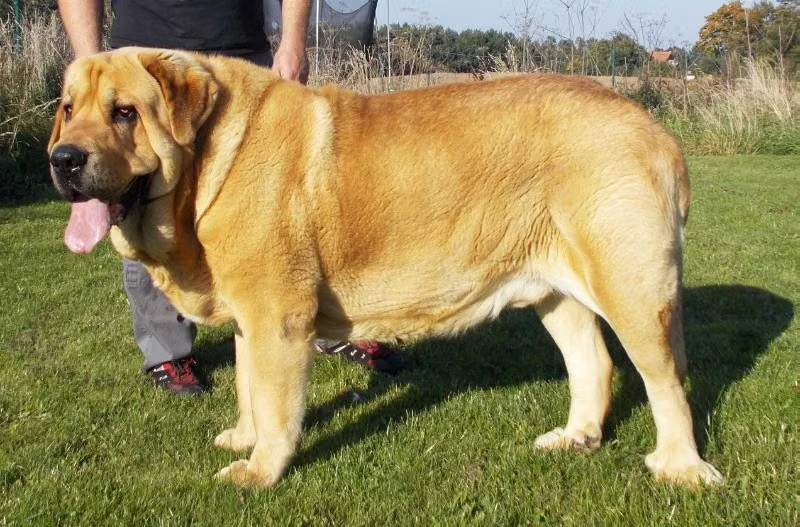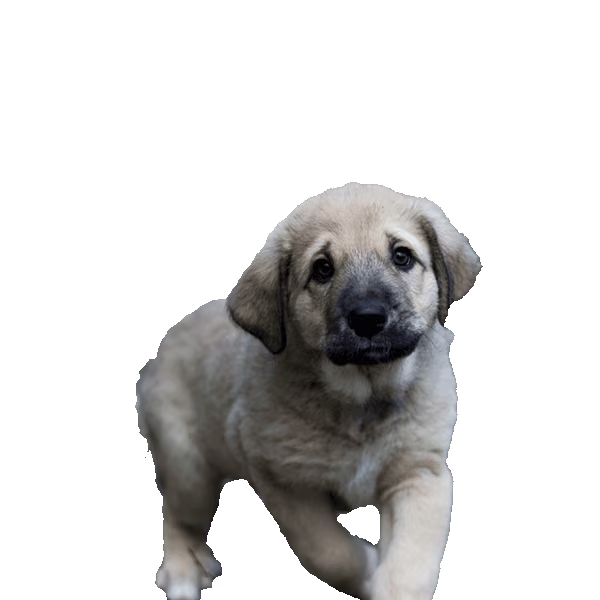
The Spanish Mastiff is a massive, dignified livestock guardian known for its calm presence and unwavering protective instinct.
How the Spanish Mastiff coat is built, and what that means when you groom it.
Critical: A Spanish Mastiff should not be shaved.
The undercoat keeps heat out as well as in, and the outer coat shields the skin from sun and insect bites. Clipping the whole coat off removes both. It often grows back patchy, soft or a different colour, and in some animals the guard hairs never return properly. Brush the undercoat out instead of cutting it off.
Information: A Spanish Mastiff drops its undercoat in heavy bursts.
The undercoat comes out in heavy bursts over a few weeks. An undercoat rake, or a bath followed by a proper blow-dry, clears it far faster than daily brushing. Clipping the coat down is not a shortcut for this.
A few of the Spanish Mastiff profiles members have added to United Pet Club.
The Spanish Mastiff is a giant livestock guardian from Spain: calm and steady at home, but fiercely protective of family and property.
The Spanish Mastiff (Mastín Español) is one of the largest dog breeds in the world. Males commonly stand over 77 cm at the shoulder and weigh more than 80 kg, with some individuals topping 100 kg. For centuries the breed has worked alongside shepherds on the high plains of Spain, guarding sheep against wolves and other predators during long seasonal droves.
Temperament runs steady rather than excitable. A well-raised Spanish Mastiff spends much of the day resting and watching its surroundings, and only acts decisively when it judges the flock or family to be at risk. The breed is affectionate with people it knows and reserved with strangers. Its deep bark and imposing size are usually enough to put off intruders before any confrontation is needed.
This is a working guardian, not a companion suited to units or first-time owners. It needs space, a confident handler, and early socialisation to manage its territorial instincts, plus sensible precautions for Australia's hot, dry summers given its heavy double coat.
| Attribute | Detail |
|---|---|
| Origin | Spain |
| Size | Giant |
| Lifespan | 10 to 12 years |
| Group / role | Livestock guardian dog |
| Good with | Family and known children when raised with them; supervision needed around strangers and unfamiliar dogs |
The Spanish Mastiff suits an experienced owner with a rural property, a farm, or a large, securely fenced yard. It's a poor fit for small homes, busy suburban settings, or households after a high-energy exercise partner. Owners who value a quiet, watchful guardian and can commit to firm, consistent leadership will get the most out of the breed.
The Spanish Mastiff developed over centuries in Spain as a flock guardian, tied closely to the medieval Mesta sheep-droving system and the cañada routes.
The breed descends from large guardian dogs that spread across the Mediterranean in antiquity. Molosser-type dogs reached the Iberian Peninsula well over two thousand years ago, where they were kept to protect livestock from wolves, bears, and thieves. The Spanish Mastiff as a distinct working type emerged from these guardians on the plains and mountains of Spain.
The dog became central to the Mesta, the powerful association of sheep owners chartered in 1273 that organised transhumance across the kingdom. Flocks travelled hundreds of kilometres each year along droving routes known as cañadas, moving between summer and winter pastures, not unlike the way Australian graziers once walked stock along travelling stock routes. Spanish Mastiffs walked with the herds, wearing spiked iron collars called carlancas to protect their throats during wolf attacks.
For centuries the breed was valued strictly for what it could do. Numbers and predator pressure fell away as wolves were culled back and farming practices changed, and the working population shrank through the twentieth century. Breeders later worked to bring the type back, and the modern standard favours a heavy, powerful dog.
Today the Spanish Mastiff still works as a guardian in parts of Spain and is kept elsewhere as both guardian and companion. Wolf recovery in some regions has renewed interest in the breed for its original job.
The Spanish Mastiff is a giant, heavy-boned dog with a big head, loose skin and dewlap, and a dense, weather-resistant coat in a range of solid and patterned colours.
The Spanish Mastiff is built for power and stamina rather than speed. The body is rectangular and deep, the bone is heavy, and the overall impression is one of mass and strength. The head is large with a broad skull, and the lips and throat carry loose skin, including a pronounced double dewlap. The ears are medium-sized, triangular, and hang close to the head. The tail is thick at the base and carried low at rest.
| Trait | Standard |
|---|---|
| Height | Males from about 77 cm; females from about 72 cm at the withers, often taller |
| Weight | Roughly 50 to 70 kg for females and 70 to 100+ kg for males |
| Coat | Medium-length, dense, with a thick undercoat |
| Colours | Yellow, fawn, red, black, wolf-grey, and brindle; solid or with markings |
| Eyes | Small relative to the head, hazel to dark, with a calm, watchful expression |
The coat lies straight and close, with a soft undercoat that protects the dog through cold nights out in the open. Common colours include solid yellow, fawn, red, and black, along with wolf-grey, brindle, and broken or particoloured patterns. The skin is thick and somewhat loose over the body, which historically helped reduce injury in scraps with predators. In Australian conditions the dense coat sheds heat poorly, so shade and water matter as much as coat care.
The Spanish Mastiff is calm, dignified, and deeply protective: reserved with strangers, devoted to family, and needing early socialisation to manage its strong territorial instincts.
The defining traits of the Spanish Mastiff are calmness and self-possession. The breed isn't nervous or quick to react, but it watches constantly and will assert itself when it judges a real threat is present. Around its own family the dog is gentle and affectionate, and it's generally patient with children it has grown up with, though its size means interactions with young kids should always be supervised.
With strangers the Spanish Mastiff is aloof and watchful. It doesn't warm to unfamiliar people quickly, and visitors should be introduced by a trusted handler. The breed is naturally territorial and will guard its property, often relying on a deep, far-carrying bark before anything else is needed.
With other animals, the picture depends on how the dog was raised. Raised among livestock, it bonds to the flock and protects it. With other dogs, particularly same-sex adults, it can be dominant, so careful introductions and socialisation from puppyhood matter. This is an independent thinker bred to make its own calls, which means it's loyal but not as keen to please as some breeds.
| Trait | Rating |
|---|---|
| Affection (with family) | 4 |
| Energy | 2 |
| Trainability | 2 |
| Vocalness | 3 |
| Shedding | 3 |
The Spanish Mastiff needs moderate grooming, modest daily exercise, and plenty of space, with extra attention to heat and joint care given Australia's climate and its giant size.
The Spanish Mastiff needs room. A rural property, a hobby farm, or a house with a large, well-fenced yard suits it best. Fencing needs to be tall and solid to contain a guardian of this size and to stop the dog acting on territorial instinct beyond the boundary. The breed handles cold well but struggles in the heat, so shade, airflow, and fresh water are essential through summer.
Feed the Spanish Mastiff a large-breed diet in measured meals to support slow, steady growth and protect the joints, keeping the dog lean throughout life.
A giant breed needs a diet formulated for large or giant dogs, with controlled calcium and energy levels that support gradual growth rather than a rapid gain. Overfeeding a puppy is a particular concern, because fast growth raises the risk of joint and skeletal problems. Adults should be fed to hold a lean body condition, since excess weight puts strain on the heart, joints, and overall lifespan. Always split the daily ration into more than one meal.
| Life stage | Amount per day | Meals |
|---|---|---|
| Puppy (large/giant formula) | Per product chart for projected adult weight | 3 to 4 |
| Adult | Roughly 4 to 8 cups of large-breed food, scaled to size and activity | 2 |
| Senior | Reduced calories to hold lean weight | 2 |
Keep treats to a small share of daily kilojoules. Some owners and vets use joint supplements such as glucosamine for giant breeds, but only introduce a supplement on veterinary advice. Because deep-chested dogs face a higher risk of bloat, avoid feeding one large meal and skip hard exercise straight before or after eating.
The Spanish Mastiff typically lives 10 to 12 years and, like most giant breeds, is prone to joint disorders, bloat, and heart conditions that benefit from preventive screening.
The Spanish Mastiff is a generally hardy working dog, but it carries the health risks common to giant breeds. Expected lifespan is 10 to 12 years. Responsible breeders screen for inherited joint problems, and owners can do a lot to extend healthy years through weight control, sensible exercise, and routine vet care.
| Condition | Signs | Note |
|---|---|---|
| Hip and elbow dysplasia | Stiffness, limping, reluctance to get up or climb | Screen breeding stock; keep dogs lean |
| Gastric dilatation-volvulus (bloat) | Swollen abdomen, retching without bringing anything up, restlessness | Medical emergency; get to a vet immediately |
| Heart disease | Tiring easily, coughing, weakness | More common in large breeds; vet checks help |
| Entropion | Eye irritation, squinting, watery eyes | Eyelid rolls inward; may need correction |
| Panosteitis | Shifting lameness in growing dogs | Often resolves with maturity |
The Spanish Mastiff is intelligent but independent, so training relies on early socialisation, consistency, and reward-based methods rather than repetition or force.
The Spanish Mastiff was bred to work alone and make its own calls, so it doesn't train like an obedience breed. It picks things up quickly but weighs up whether a command is worth following, which can look like stubbornness. A confident, consistent handler who sets clear, fair rules from the outset gets the best results. Harsh methods tend to backfire with a dog this large and self-assured, and can damage trust.
Socialisation is the single most important part of raising this breed. From puppyhood, expose the dog to plenty of people, places, sounds, and other animals so its natural wariness develops into sound judgement rather than reactivity. Because the adult is so large and protective, early manners and a reliable recall aren't optional.
Spanish Mastiffs mature slowly, produce large litters, and need health-screened parents plus careful early socialisation of the puppies to raise sound guardians.
Giant breeds mature slowly in both body and mind, and the Spanish Mastiff is often not fully grown until two to three years of age. Responsible breeding waits for physical maturity and confirms that both parents have been screened for hip and elbow dysplasia and other inherited problems. Temperament matters as much as conformation, since this is a powerful guardian whose disposition shapes how safely it can live with people and stock.
Gestation lasts roughly 63 days. Litters tend to be large, and the puppies grow fast, so the dam needs solid nutritional support during pregnancy and nursing. Whelping a giant breed can carry added risk, and having a vet on standby is a sensible precaution.
Early handling is critical. From the first weeks, puppies should meet a range of people and experiences. Pups destined as livestock guardians are typically raised alongside the animals they'll protect so they bond to the flock, while pups headed to companion homes need broad household socialisation.
| Metric | Value |
|---|---|
| Sexual maturity | Around 18 to 24 months; physical maturity 2 to 3 years |
| Gestation | About 63 days |
| Typical litter size | Roughly 6 to 10 puppies |
| Weaning | About 6 to 8 weeks |
| Recommended health screening | Hip and elbow evaluation, plus eye and heart checks |
A free lifetime United Pet Club record for your Spanish Mastiff, with the microchip registered at no charge and nothing falling due each year.
Rangers and shelters can only call the number the scan hands them. Give your Spanish Mastiff a free United Pet Club profile and that number is yours: dog registration takes a few minutes, costs nothing for his lifetime, and works with or without a chip in place.
A chipped Spanish Mastiff without a registration is carrying a number nobody can use. File it with United Pet Club and the number works for him: free for life, open to every chip brand sold here, searchable from any clinic or pound in the country. Microchip registration now, free account while you're at it.
Sign up free with United Pet Club, add his name, breed, and a photo, and you're done. The lifetime plan keeps the profile live at no cost, and the chip number can go in whenever the vet's done his bit.
Add the 15-digit number to your free account with your address and mobile. Registration and every update after it are free, and chips from any manufacturer an Australian vet implants are accepted.
In most states and territories, yes, chipping is required and the register entry comes with it. The state register and your United Pet Club record do different jobs: one satisfies the council, the other keeps a current phone number one scan away, free.
Nothing with United Pet Club. Profile, chip registration, and unlimited updates are covered for his whole life, no annual fee in sight.
Common questions about the Spanish Mastiff cover its size, temperament, care demands, lifespan, suitability, and availability in Australia.
It's a giant breed. Males stand from about 77 cm at the shoulder and can weigh from roughly 70 kg up to 100 kg or more, with females somewhat smaller. It's among the largest dog breeds in the world.
It can be devoted and gentle with its own family and patient with children it has grown up with. Given its size and strong guarding instinct, it needs an experienced owner, early socialisation, and supervision around young kids and strangers.
Grooming and exercise needs are moderate, but the breed is demanding in other ways. It needs space, secure fencing, firm and consistent handling, and an owner ready for the cost and responsibility of a giant guardian dog. It doesn't suit first-time owners or small homes.
The typical lifespan is 10 to 12 years, which is normal for a giant breed. Keeping the dog lean and screening for joint and heart problems can support healthier years.
It uses a deep, far-carrying bark as part of its guarding role, though it's not a constant barker. The loose lips and dewlap mean it tends to drool, especially after eating or drinking.
They're more common in Spain, where the breed still works as a livestock guardian, and much less common here. Prospective owners in Australia will likely need to look overseas or track down one of the few specialist breeders, and should expect a wait plus import considerations.
No. Its size, space needs, and territorial nature make unit or apartment living a poor fit. The breed does best on a rural property or in a home with a large, securely fenced yard.