
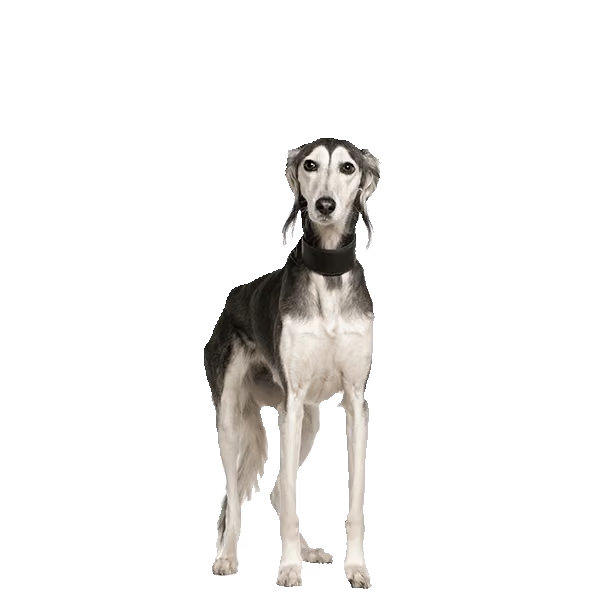
Saluki
The Saluki is an ancient, graceful sighthound known for its remarkable speed and quietly dignified, aloof elegance.
- Size
- Medium
- Lifespan
- 12–14 years
- Origin
- Arabian Peninsula
- Temperament
- Dignified
- Standard colors
- Black, White and Grey and 8 more
Characteristics
Coat and grooming
How the Saluki coat is built, and what that means when you groom it.
- Coat layers
- Single coat
- Coat texture
- Silky
- Coat length
- Short
- Shedding
- Low shedding
Grooming guidance
Information: A Saluki needs clipping every few weeks.
This coat keeps growing rather than shedding out, so it has to be trimmed every few weeks. Left to grow it mats down against the skin and traps moisture, dirt and heat.
Saluki colors and patterns
What each club's breed standard says about every Saluki color and pattern. Point at a ruling to see the club's own wording.
Breed standards describe the Saluki in Black, White, Grey, Blue, Silver, Chocolate, Tan, Red, Gold, Cream and Fawn. Standard patterns: Solid, Tricolour, Brindle, Parti-colour, Sable, Grizzle, Tan point and Reverse brindle.
| Color or pattern | FCI | AKC | UKC | KC | KUSA |
|---|---|---|---|---|---|
| Black | Standard (“Any colour or combination of colours is permissible”) | Standard (“Black”) | Standard (“Any color or combination of colors is permissible”) | Standard (“Black Particolour”) | Standard (“Any colour or combination of colours permissible”) |
| White | Standard (“Any colour or combination of colours is permissible”) | Standard (“White”) | Standard (“Any color or combination of colors is permissible”) | Standard (“White”) | Standard (“Any colour or combination of colours permissible”) |
| Grey | Standard (“Any colour or combination of colours is permissible”) | Standard (“Gray”) | Standard (“Any color or combination of colors is permissible”) | Standard (“Any colour or combination of colours permissible”) | Standard (“Any colour or combination of colours permissible”) |
| Blue | Standard (“Any colour or combination of colours is permissible”) | Not recognised | Standard (“Any color or combination of colors is permissible”) | Not recognised (“brindle, blue or merle which are unacceptable”) | Not recognised (“brindle, blue or merle which are unacceptable”) |
| Silver | Standard (“Any colour or combination of colours is permissible”) | Standard (“Silver”) | Standard (“Any color or combination of colors is permissible”) | Standard (“Silver Grizzle”) | Standard (“Any colour or combination of colours permissible”) |
| Chocolate | Standard (“Any colour or combination of colours is permissible”) | Standard (“Chocolate”) | Standard (“Any color or combination of colors is permissible”) | Standard (“Chocolate & Tan”) | Standard (“Any colour or combination of colours permissible”) |
| Tan | Standard (“Any colour or combination of colours is permissible”) | Standard (“Black & Tan”) | Standard (“Any color or combination of colors is permissible”) | Standard (“Black & Tan”) | Standard (“Any colour or combination of colours permissible”) |
| Red | Standard (“Any colour or combination of colours is permissible”) | Standard (“Red”) | Standard (“Any color or combination of colors is permissible”) | Standard (“Red”) | Standard (“Any colour or combination of colours permissible”) |
| Gold | Standard (“Any colour or combination of colours is permissible”) | Standard (“Golden”) | Standard (“Any color or combination of colors is permissible”) | Standard (“Gold”) | Standard (“Any colour or combination of colours permissible”) |
| Cream | Standard (“Any colour or combination of colours is permissible”) | Standard (“Cream”) | Standard (“Any color or combination of colors is permissible”) | Standard (“Cream”) | Standard (“Any colour or combination of colours permissible”) |
| Fawn | Standard (“Any colour or combination of colours is permissible”) | Standard (“Fawn”) | Standard (“Any color or combination of colors is permissible”) | Standard (“Fawn”) | Standard (“Any colour or combination of colours permissible”) |
| Albino | No ruling | Not recognised | Disqualifying (“Albinism”) | No ruling | No ruling |
| Patterns | |||||
| Solid | Standard (“Any colour or combination of colours is permissible”) | Standard (“White, cream, fawn, golden, red”) | Standard (“Any color or combination of colors is permissible”) | Standard (“Any colour or combination of colours permissible”) | Standard (“Any colour or combination of colours permissible”) |
| Tricolour | Standard (“Any colour or combination of colours is permissible”) | Standard (“tricolor (white, black and tan)”) | Standard (“Any color or combination of colors is permissible”) | Standard (“Black & Tan Tricolour”) | Standard (“Any colour or combination of colours permissible”) |
| Brindle | Fault (“Brindles are undesirable”) | Standard (“Red Brindle”) | Fault (“brindles, which are undesirable”) | Not recognised (“brindle, blue or merle which are unacceptable”) | Not recognised (“brindle, blue or merle which are unacceptable”) |
| Parti-colour | Standard (“Any colour or combination of colours is permissible”) | Standard (“Parti-Color”) | Standard (“Any color or combination of colors is permissible”) | Standard (“Black & White Particolour”) | Standard (“Any colour or combination of colours permissible”) |
| Sable | Standard (“Any colour or combination of colours is permissible”) | Standard (“Sable”) | Standard (“Any color or combination of colors is permissible”) | Standard (“Black Fringed Fawn”) | Standard (“Any colour or combination of colours permissible”) |
| Grizzle | Standard (“Any colour or combination of colours is permissible”) | Standard (“Grizzle Markings”) | Standard (“Any color or combination of colors is permissible”) | Standard (“Black Grizzle”) | Standard (“Any colour or combination of colours permissible”) |
| Tan point | Standard (“Any colour or combination of colours is permissible”) | Standard (“Black & Tan”) | Standard (“Any color or combination of colors is permissible”) | Standard (“Black & Tan”) | Standard (“Any colour or combination of colours permissible”) |
| Reverse brindle | Fault (“Brindles are undesirable”) | Standard (“Red Brindle”) | Fault (“brindles, which are undesirable”) | Not recognised (“brindle, blue or merle which are unacceptable”) | Not recognised (“brindle, blue or merle which are unacceptable”) |
| Merle | No ruling | Not recognised | No ruling | Not recognised (“brindle, blue or merle which are unacceptable”) | Not recognised (“brindle, blue or merle which are unacceptable”) |
| Double merle | No ruling | Not recognised | No ruling | No ruling | No ruling |


| Color or pattern | FCI | AKC | UKC | KC | KUSA |
|---|---|---|---|---|---|
| Dark brown | Standard (“Dark to hazel”) | Standard (“Dark to hazel”) | Standard (“dark to hazel”) | Standard (“Dark to hazel”) | Standard (“Dark to hazel”) |
| Hazel | Standard (“Dark to hazel”) | Standard (“Dark to hazel”) | Standard (“dark to hazel”) | Standard (“Dark to hazel”) | Standard (“Dark to hazel”) |
| Color or pattern | FCI | AKC | UKC | KC | KUSA |
|---|---|---|---|---|---|
| Black | Standard (“Black or liver brown”) | Standard (“Nose black or liver”) | Standard (“black or liver”) | Standard (“Nose black or liver”) | Standard (“Nose black or liver”) |
| Liver | Standard (“Black or liver brown”) | Standard (“Nose black or liver”) | Standard (“black or liver”) | Standard (“Nose black or liver”) | Standard (“Nose black or liver”) |
What the rulings mean
- Standard
- Described by the club's breed standard.
- Fault
- Named by the club's breed standard as a fault: the animal can be shown but is penalised.
- Disqualifying
- The club's breed standard disqualifies an animal of this colour or pattern.
- Not recognised
- The club does not accept this colour or pattern for the breed.
Color changes
How a Saluki's colors can change over its life.
Blackchanges toRust
Coat · With body condition · can change back
Blackchanges toGrey
Coat · Progressive
Blackchanges toBrown
Coat · In the sun · can change back
Whitechanges toRoan
Coat · With age · from 2 weeks
Tan pointchanges toSaddle
Coat · With age · from 6 to 156 weeks
Blackchanges toSnow nose
Nose · With the season · can change back
Blackchanges toPink
Nose · With the season · can change back


Sources
Each ruling comes from the club's published breed standard or color list.
Meet some of our Saluki
A few of the Saluki profiles members have added to United Pet Club.


About the Saluki
The Saluki is an ancient medium-sized sighthound from the Arabian Peninsula, prized for speed and known for a calm, dignified temperament at home.
The Saluki ranks among the oldest sighthound breeds known, developed across the Arabian Peninsula and the wider Middle East long before written history. It's a medium-sized dog built to run down game by sight over open desert and rough ground, relying on stamina and top speed rather than scent work. The frame is light and narrow, with long legs and a deep chest that lets the dog cover ground at a flat gallop.
At home the Saluki is quiet and gentle, though it keeps its own counsel around people it doesn't know. It attaches firmly to its own household while staying aloof with strangers, and that mix of calm indoor manners and serious outdoor drive is what defines the breed.
Salukis carry themselves with a certain dignity rather than the bounce many companion breeds show. They're sensitive to rough handling and do best with owners who understand sighthound behaviour, including a strong urge to chase anything that moves fast.
| Attribute | Detail |
|---|---|
| Origin | Arabian Peninsula |
| Size | Medium |
| Lifespan | 12 to 14 years |
| Group / role | Sighthound, originally a hunting hound |
| Good with | Family members and older kids; needs slow, careful introductions to small pets given the chase instinct |
Who the Saluki suits
The Saluki suits people after a clean, quiet housemate that also needs a decent hard run in a secure, fully fenced yard. It's a good match for owners happy with an independent dog that might not come back when called mid-chase. High, secure fencing is essential, and if there are cats, chooks, or other small pets roaming free, introductions need to be handled with real care.
History and origin
The Saluki is one of the most ancient sighthound types, developed by desert peoples of the Arabian Peninsula and the Middle East over thousands of years as a coursing hound.
The Saluki's origins trace to the Arabian Peninsula and the broader Middle East, where desert and nomadic communities kept lean, fast hounds to run down gazelle, hare, and other game. Slender, long-legged hounds appear in ancient art from the region, and the type is widely regarded as one of the oldest hunting hounds still recognisable today.
The breed grew up alongside a hunting culture where fast hounds worked open ground, at times paired with falcons and horses. Local lines were bred for speed and stamina, and the dogs were often kept as prized members of the household rather than treated as ordinary working stock. Different regions produced both smooth-coated and feathered dogs suited to their own terrain.
Salukis reached Europe through travellers, traders, and diplomatic contact with the Middle East. Interest picked up in Britain through the late nineteenth and early twentieth centuries, and dedicated breeders worked to establish the type in Western kennels.
From there the Saluki gained recognition from major kennel bodies and spread to other countries as a show and companion breed, while keeping a following among people who still run lure coursing and similar speed sports. In Australia the breed is recognised by Dogs Australia, and the Saluki remains a rare sight outside dedicated sighthound circles. Through all of this the core job stayed the same: a sighthound built to spot and run down fast game across distance.
Appearance and breed standard
The Saluki is a slender, graceful sighthound of medium size with long legs, a deep narrow chest, and either a smooth or lightly feathered coat in a wide range of colours.
The Saluki has a light, elegant outline built purely for speed. The body is narrow and deep through the chest, the back rises up at the loin, and the legs are long and fine-boned. The head is long and refined with a smooth skull, and the eyes are large and oval, giving a calm, far-off look. The long tail hangs low with a natural curve and often carries feathering underneath.
Two coat types turn up in the breed: smooth, which is short and close all over, and feathered, which carries longer hair on the ears, the backs of the legs, and the tail.
| Trait | Standard |
|---|---|
| Height | Roughly 58 to 71 cm at the shoulder; females generally smaller |
| Weight | About 18 to 27 kg |
| Coat | Smooth or feathered; soft and silky in texture |
| Colours | Wide range, including cream, fawn, golden, red, grizzle, black and tan, and tricolour |
| Eyes | Large, oval, dark to hazel, with a calm expression |
Coat and colours
The Saluki coat is fine and lies close to the body, so it's low maintenance next to heavier-coated breeds. Feathered dogs carry the extra hair mainly on the ears, legs, and tail. Colour ranges widely and most shades are accepted, from solid cream and red through to grizzle, black and tan, and tricolour. The coat is fairly thin, though, so it gives little protection from the cold, and the breed feels low temperatures more than most.
Temperament and personality
Salukis are gentle, calm, and devoted with their own people but independent and reserved with strangers, with a strong instinct to chase fast-moving animals.
At home the Saluki is typically quiet and gentle, often happy to laze around for long stretches between bursts of exercise. With its own family it can be affectionate and closely bonded, though it tends to show this in a reserved way rather than an over-the-top one. The breed is sensitive and doesn't respond well to rough handling or a raised voice.
With strangers the Saluki usually keeps its distance and doesn't make a fuss either way. It isn't an aggressive breed as a rule, but it may hold back and take its time warming up. Around kids it's often patient, and tends to do best with older children who know how to handle a dog calmly and with respect.
The behaviour that defines the breed is the sighthound chase drive. A cat on the move, a small dog, or a wallaby spotted in the distance can set off an instant flat-out chase, and a Saluki mid-pursuit is next to impossible to call back. Because of this, secure fencing and leashed walks in open or unfenced areas matter, and any introduction to smaller pets in the house needs to be slow and supervised.
| Trait | Rating |
|---|---|
| Affection | 3 |
| Energy | 4 |
| Trainability | 2 |
| Vocalness | 2 |
| Shedding | 2 |
Care and grooming
Salukis need modest grooming but plenty of running in secure spaces, plus warmth, sun protection, and soft resting spots to look after their lean, thin-coated bodies.
Grooming
- Brush the smooth variety weekly; brush the feathered variety two or three times a week to stop tangles forming in the ear, leg, and tail feathering.
- Check and clean the long ears often, since the drooping shape can trap moisture, grass seeds, and other debris.
- Trim nails as needed and check the feet after a run on hard or hot ground.
- Bathe now and then; the coat stays fairly clean and there's not much doggy odour to deal with.
Exercise
- Get in daily exercise, including a chance to run flat out in a securely fenced area.
- Stick to a lead or a fully enclosed space, because off-lead recall isn't reliable once a chase kicks off.
- Lure coursing and similar sighthound sports suit the breed well.
- Balance hard running with the long lie-down time the breed naturally takes indoors.
- In summer, exercise early morning or evening and skip the middle of the day. Hot bitumen and concrete can burn paw pads fast, and the breed's thin coat and low body fat make it prone to overheating.
Environment
The Saluki settles well into a calm home and is generally quiet indoors. Because the coat is thin and there's little body fat to insulate, the breed feels the cold and does well with a coat in winter, warm bedding, and padded spots to lie down that protect bony pressure points. Secure, high fencing is essential, since a Saluki can clear a low fence and cover ground at serious speed. Over an Aussie summer, shade, fresh water, and cooler exercise times matter just as much as warmth does in winter.
Nutrition and feeding
Salukis do well on a complete, balanced diet matched to their lean build and activity level, with portions adjusted to keep the natural sighthound waistline.
The Saluki is naturally lean, and a slim, tucked-up waist is normal and healthy for the breed rather than a sign it's underweight. Feed a complete, balanced diet suited to age and activity, and adjust the amount so ribs are easy to feel but not sharply visible. Dogs doing hard coursing work may need extra food on big training days, while a quiet house dog needs less. Fresh water should always be on hand.
| Life stage | Amount per day | Meals |
|---|---|---|
| Puppy (2 to 6 months) | Per puppy food label, by weight | 3 to 4 |
| Adolescent (6 to 12 months) | Per label, by weight | 2 to 3 |
| Adult | About 2 to 3 cups (500 to 700 g) of quality dry food, split across meals | 2 |
| Senior or less active | Reduced portion to maintain lean weight | 2 |
Treats and supplements
Keep treats to a small slice of the daily food intake so the lean body condition holds. Most Salukis on a complete diet don't need extra supplements as routine; anything added, such as joint support for an older or very active dog, should be run past a vet first. Because the breed is lean and burns through energy fast, any change of diet should happen gradually to avoid an upset tummy.
Health and lifespan
Salukis are generally healthy with a typical lifespan of 12 to 14 years, though owners should watch for heart conditions, certain cancers, and the breed's sensitivity to anaesthesia.
The Saluki is generally a tough, long-lived breed, with a typical lifespan of 12 to 14 years. Being a lean sighthound, it carries very little body fat, which changes how it copes with cold and how it reacts to certain medications. Like every breed it has a handful of health issues worth keeping an eye on, and care from a vet who knows sighthounds is a real advantage.
| Condition | Signs | Note |
|---|---|---|
| Heart disease (including cardiomyopathy) | Tiring easily, cough, fainting, changes in breathing | Periodic cardiac checks are worthwhile in older dogs |
| Cancer | Lumps, weight loss, lethargy | A fairly common cause of illness in ageing sighthounds |
| Anaesthesia sensitivity | Slow or unusual recovery from sedation | Lean body and low fat affect drug handling; tell the vet the dog is a sighthound |
| Hypothyroidism | Weight gain, coat changes, low energy | Diagnosed by blood test and managed with medication |
Preventive care
- Keep vaccinations and parasite control, including tick prevention, up to date.
- Book in regular dental checks and yearly health checks, with more frequent vet visits for older dogs.
- Keep the dog at a lean weight with consistent exercise.
- Use a sighthound-aware vet for anything involving anaesthesia.
- Protect the dog from the cold with bedding and a coat when temperatures drop, and from heat with shade and water over summer.
Training and socialisation
Salukis are clever but independent and sensitive, so they respond best to patient, reward-based training and early socialisation rather than repetition or harsh correction.
The Saluki is intelligent but independent, and it doesn't train in the eager-to-please way of many working breeds. It can pick up commands well enough, but it often decides for itself whether to comply, especially outdoors where the chase instinct competes with any recall command. The breed is sensitive and switches off under harsh handling, so calm, consistent, reward-based methods work far better than pressure. Early socialisation helps a naturally reserved dog grow into a confident one around people, places, and other animals.
Basics
- Start socialisation early, gently exposing the puppy to different people, surfaces, sounds, and safe dogs.
- Teach a solid lead routine, since most exercise will happen on lead in open spaces.
- Build attention and name response with food and praise in quiet, low-distraction settings first.
- Practise recall only in a fully fenced space, and accept that recall around moving prey may never be fully reliable.
- Keep sessions short and upbeat to suit the breed's sensitivity and attention span.
Breeding and raising young
Saluki breeding follows normal canine reproduction with average litters of several puppies, and responsible breeders screen for health and prioritise sound temperament and structure.
Salukis mature slowly, and breeding is best left until both parents are fully grown and health-screened, generally around two years old. Mating, pregnancy, and whelping follow the usual canine pattern, with a pregnancy lasting roughly nine weeks. Litter size varies, averaging several puppies.
Newborn pups depend on their mother for warmth and milk in the first weeks. Since the breed is lean and doesn't carry much natural insulation, a warm, draft-free whelping area matters. Puppies should stay with their mother and littermates through the early socialisation window so they pick up normal dog behaviour, then keep having gentle new experiences once they move to new homes. Responsible breeders screen their breeding stock for heart problems and other known issues, and place puppies only with owners ready for a sighthound's exercise and containment needs.
| Metric | Value |
|---|---|
| Breeding maturity | Around 2 years |
| Gestation | About 63 days (roughly 9 weeks) |
| Average litter size | Several puppies (varies by individual) |
| Weaning | Around 6 to 8 weeks |
| Recommended health screening | Cardiac evaluation and general health checks of parents |
Getting your Saluki registered, chip and all
A free lifetime United Pet Club record for your Saluki, with the microchip registered at no charge and nothing falling due each year.
How to register a Saluki in Australia
Every state and territory keeps its own Companion Animal Register, and council rangers scan as a matter of course, so a Saluki with a current record is home before dinner. Register your dog free with United Pet Club: the profile carries your details beside his photo for his whole life, and no renewal ever turns up.
The vet does the implant and not one thing more; the register entry is yours. Register the microchip free on the lifetime plan: every brand an Aussie vet reaches for qualifies, moving house costs nothing to record, and the number stays searchable round the clock. Create your free account and sort the lot in one go.
How do I register my Saluki in Australia?
Sign up free with United Pet Club, add his name, breed, and a photo, and you're done. The lifetime plan keeps the profile live at no cost, and the chip number can go in whenever the vet's done his bit.
How do I register my Saluki's microchip?
Add the 15-digit number to your free account with your address and mobile. Registration and every update after it are free, and chips from any manufacturer an Australian vet implants are accepted.
Does my Saluki have to be microchipped in Australia?
In most states and territories, yes, chipping is required and the register entry comes with it. The state register and your United Pet Club record do different jobs: one satisfies the council, the other keeps a current phone number one scan away, free.
What does it cost to register a Saluki?
Nothing with United Pet Club. Profile, chip registration, and unlimited updates are covered for his whole life, no annual fee in sight.
Frequently asked questions
Common questions about Saluki size, temperament, care needs, lifespan, suitability, and availability.
How big does a Saluki get?
The Saluki is a medium-sized dog, standing roughly 58 to 71 cm at the shoulder and weighing about 18 to 27 kg. Females are usually smaller than males.
What's the Saluki's temperament like?
Salukis are gentle and quiet at home, independent in how they think, and reserved with strangers. They're devoted to their own family but show it in a calm, low-key way, and they have a strong instinct to chase anything fast-moving.
Is the Saluki hard to look after?
Grooming needs are modest, but the breed needs regular hard running in secure areas and reliable high fencing. The main challenges are containment, unreliable off-lead recall, and sensitivity to heat and cold rather than coat upkeep.
How long do Salukis live?
Salukis typically live 12 to 14 years. They're generally healthy, with heart conditions and certain cancers among the things to watch for as they get older.
Is the Saluki a good family dog?
It can be, in the right home. Salukis are gentle and patient, and they often get on well with older kids. They suit calm households with secure space to run and an understanding of the breed's chase drive around small pets like cats or chooks.
Are Salukis easy to find in Australia?
The Saluki is a rare breed here compared with popular companion dogs, so finding a puppy through a registered breeder can take time and may mean going on a waiting list. Sighthound rescue groups are another option worth looking into.
From the community
Ask about the SalukiNo questions about the Saluki yet. Be the first to ask.
Browse Dog breeds