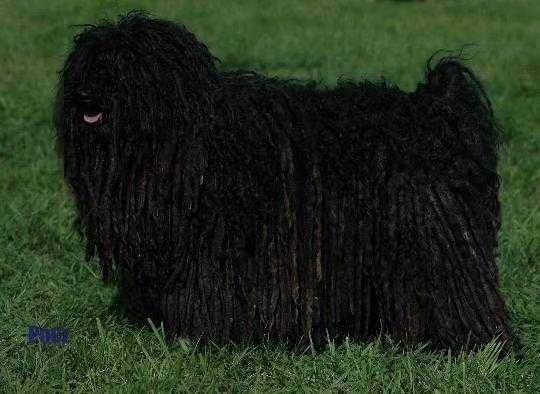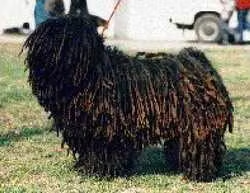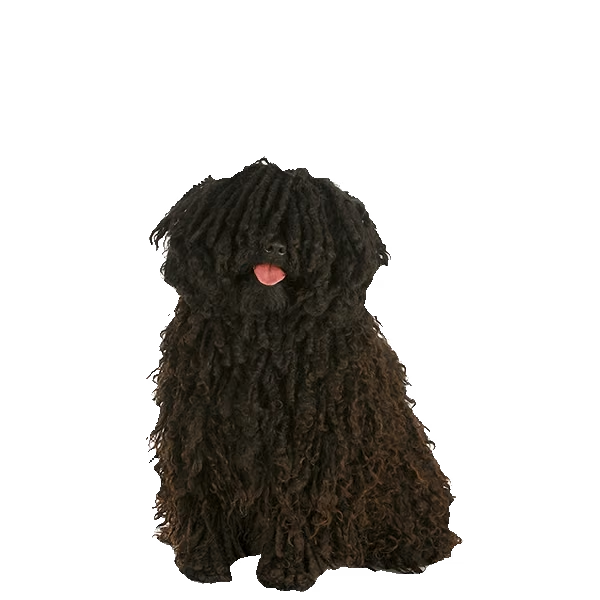
The Puli is a distinctive corded Hungarian herder known for its loyalty, agility, and ever-watchful nature.
How the Puli coat is built, and what that means when you groom it.
Caution: A Puli coat mats easily.
Fine or long hair tangles at the base of the coat, out of sight, where the mats tighten and pull on the skin. Brushing has to reach right down to the roots in sections, not just skim the surface.
A few of the Puli profiles members have added to United Pet Club.
The Puli is a medium-sized Hungarian herding dog known for its corded coat, agility, and close attachment to its family.
The Puli is a medium herding dog from Hungary, spotted most easily by the long corded coat that looks a fair bit like dreadlocks. Under the cords sits a compact, square dog that moves with speed and spring. For centuries it worked beside Hungarian shepherds, gathering and driving flocks of sheep across the open plains.
This is a dog bred to think for itself. The Puli sizes up a situation fast, acts without waiting to be told, and keeps a close eye on anything out of place. That independence sits alongside real loyalty to its people. A Puli usually bonds tightly with its household and will trail family members from room to room.
Energy defines the breed. A Puli that once herded all day needs a job, a decent run, or training to settle at home. Owners tend to call it lively, quick, and a touch cheeky. It makes an affectionate mate for an active household that can keep both body and mind busy.
| Attribute | Detail |
|---|---|
| Origin | Hungary |
| Size | Medium |
| Lifespan | 12 to 16 years |
| Group / role | Herding dog |
| Good with | Family members, older children, and pets it is raised with |
The Puli suits an active owner who can offer daily exercise, regular training, and steady company. It does well with people who enjoy grooming, since the cords need ongoing care. It is less suited to households out at work all day or after a low-energy, low-fuss dog. First-time owners can do well with the breed if they are ready for its independence and drive.
The Puli is an ancient Hungarian herding breed, brought to the Carpathian Basin by Magyar shepherds and refined over centuries of flock work.
The Puli is one of Hungary's old herding breeds. Its ancestors are generally traced to dogs brought into the Carpathian Basin by the Magyar people who settled the region more than a thousand years ago. These dogs worked sheep on the Hungarian plains, where a quick, agile herder was prized for gathering and moving flocks.
On the farm the Puli usually worked as the active herder, driving and turning sheep, while larger livestock guardian breeds such as the Komondor watched the flock at night. The two roles fitted together. The Puli's dark, weatherproof coat helped shepherds pick it out against pale sheep and protected it through long days outdoors.
Numbers fell during periods of upheaval in central Europe, and the breed's history overlapped with other Hungarian herders to the point that types were sometimes blurred. In the early twentieth century, Hungarian breeders set out to define and stabilise the Puli as a distinct breed, fixing its size and coat type and separating it more clearly from related dogs.
From Hungary the Puli spread to other countries, carried by emigrants and dog enthusiasts. In Australia it is registered with the Australian National Kennel Council. It remains a working and companion breed today, still known by the corded coat that shepherds valued.
The Puli is a square, medium-sized dog defined by its dense corded coat, which forms naturally as the soft undercoat and wiry topcoat intertwine.
The Puli is a compact, squarely built dog of medium size. Beneath the coat the body is well muscled and balanced, built for quick turns and steady movement. The head is fine but strong, the eyes are dark and lively, and the tail curls up over the back. The overall impression is of a nimble, sturdy worker hidden inside a curtain of cords.
The coat is the breed's signature. A dense, soft undercoat and a longer, wiry topcoat naturally knit into cords as the dog matures. The cords cover the whole body, including the head, and can reach the ground on a fully coated adult.
| Trait | Standard |
|---|---|
| Height | About 41 to 43 cm at the shoulder |
| Weight | About 11 to 16 kg |
| Coat | Dense double coat that forms cords; soft undercoat with a wiry outer coat |
| Colours | Black, rusty black, grey, and white |
| Eyes | Dark brown, medium-sized, almond shaped |
The most common colour is black, which often weathers to a rusty or faded shade under sun and age. Grey and white also occur. The cords are not present at birth; a pup has a soft, fluffy coat that begins to split into cords through the first year, and the owner usually helps guide that by hand. A corded coat does not shed in the usual way, so loose hair stays inside the cords rather than dropping around the home.
The Puli is loyal, intelligent, and energetic, devoted to its family while staying alert and reserved toward strangers.
The Puli is loyal and strongly attached to its household. It tends to choose its people and stay close, often shadowing family members through the day. With those it knows it is affectionate, playful, and quick to join in.
With strangers the Puli is usually reserved and watchful. Its herding background gives it a protective, alert streak, and it will bark to announce visitors or anything odd. Early and ongoing socialisation helps it judge situations calmly rather than reacting to every change.
The breed is highly intelligent and independent, a mix that makes it both quick to learn and quick to decide things for itself. With other dogs and with pets it is raised alongside, a well-socialised Puli generally does well, though its herding instinct can show as chasing or nudging. It often gets on with older children who understand how to handle an active dog. Its energy and drive mean it is happiest with regular work, exercise, and engagement.
| Trait | Rating |
|---|---|
| Affection | 4 |
| Energy | 5 |
| Trainability | 4 |
| Vocalness | 4 |
| Shedding | 1 |
A Puli needs daily exercise, steady mental work, and regular attention to its corded coat to stay healthy and content.
The Puli adapts to different homes, including units, if it gets enough daily exercise and company. It would rather be with its family than left alone for long stretches and may grow bored or noisy if under-occupied. A securely fenced yard suits its energy, though the coat means it should not be left out in the Australian summer heat without shade and water.
A Puli does well on a complete, balanced diet matched to its life stage and activity level, fed in measured portions to keep it lean.
The Puli does well on a complete, balanced dog food suited to its age, size, and activity. Because the breed is active, its food should supply enough energy for daily work and play while keeping the dog at a lean, athletic weight. The cords can hide weight gain, so owners should feel the ribs and waist regularly rather than going by looks alone.
Fresh water should always be on offer. Portions below are general guidance; the right amount varies with the individual dog, and a vet can confirm targets.
| Life stage | Amount per day | Meals |
|---|---|---|
| Puppy (2 to 6 months) | Per puppy-food label, by weight | 3 to 4 |
| Junior (6 to 12 months) | Per label, by weight | 2 to 3 |
| Adult | About 150 to 220 g of quality dry food | 2 |
| Senior | Adjusted for lower activity | 2 |
Keep treats to a small share of daily kilojoules so they do not unbalance the diet or add weight. Most Pulis on a complete commercial food need no extra supplements. Talk over any joint, coat, or other supplement with a vet before adding it, since needs differ by dog.
The Puli is generally a hardy breed with a typical lifespan of 12 to 16 years, with a few inherited conditions worth screening for.
The Puli is generally a robust, long-lived breed. With good care, regular veterinary attention, and a sound diet, many live 12 to 16 years. Responsible breeders screen breeding dogs for known inherited conditions, which lowers the risk of passing them on.
Like many breeds, the Puli can be affected by a small number of recognised health issues. Knowing the signs helps owners seek care early.
| Condition | Signs | Note |
|---|---|---|
| Hip dysplasia | Stiffness, limping, reluctance to jump or climb | Reduced through screening of breeding stock |
| Eye disorders (including progressive retinal atrophy and cataracts) | Cloudiness, vision loss, bumping into objects | Eye testing recommended for breeding dogs |
| Patellar luxation | Skipping steps, intermittent hind-leg lameness | More common in smaller, agile breeds |
| Ear infections | Head shaking, odour, scratching at ears | Cords near the ears can trap moisture |
The intelligent, independent Puli learns quickly and responds best to consistent, reward-based training that keeps its mind engaged.
The Puli is highly intelligent and learns fast, but its independent, problem-solving nature means it does not always obey simply because it is asked. It works best with an owner who is consistent, patient, and able to keep sessions interesting. Repetitive drilling bores the breed, so short, varied sessions hold its attention far better.
Early socialisation matters. Exposing a young Puli to people, places, sounds, and other animals helps ease its natural wariness of strangers and cuts nuisance barking. Because the breed is alert and vocal, teaching a reliable quiet cue early is worthwhile.
Puli breeding follows the normal canine reproductive cycle, with responsible breeders health-testing parents and producing small to moderate litters.
Breeding a Puli should be approached responsibly, aiming for healthy pups and sound temperament. Females typically reach sexual maturity within the first year, though responsible breeders wait until a bitch is physically and mentally mature, often around two years of age, before breeding. Before any mating, both parents should pass the health screenings recommended for the breed, including hip and eye evaluations.
Mating follows the normal canine cycle. Gestation in dogs lasts about 63 days on average. Litters in the Puli are usually small to moderate. As whelping nears, the dam needs a quiet, clean space, and a vet should be on hand to advise on any complications.
Raising the young is a shared effort between dam and breeder. Puppies are born with a soft coat that has not yet corded; the characteristic cords begin to form later as the dog grows. Early socialisation, gentle handling, and exposure to ordinary household life help pups grow into stable, confident adults. Puppies should stay with the dam and littermates until they are old enough to go to new homes, generally around eight weeks.
| Metric | Value |
|---|---|
| Sexual maturity | Within the first year |
| Recommended breeding age (female) | Around 2 years |
| Gestation | About 63 days |
| Typical litter size | Small to moderate |
| Weaning age | About 6 to 8 weeks |
| Age to new home | Around 8 weeks |
A free lifetime United Pet Club record for your Puli, with the microchip registered at no charge and nothing falling due each year.
Rangers and shelters can only call the number the scan hands them. Give your Puli a free United Pet Club profile and that number is yours: dog registration takes a few minutes, costs nothing for his lifetime, and works with or without a chip in place.
The vet does the implant and not one thing more; the register entry is yours. Register the microchip free on the lifetime plan: every brand an Aussie vet reaches for qualifies, moving house costs nothing to record, and the number stays searchable round the clock. Create your free account and sort the lot in one go.
Sign up free with United Pet Club, add his name, breed, and a photo, and you're done. The lifetime plan keeps the profile live at no cost, and the chip number can go in whenever the vet's done his bit.
Add the 15-digit number to your free account with your address and mobile. Registration and every update after it are free, and chips from any manufacturer an Australian vet implants are accepted.
In most states and territories, yes, chipping is required and the register entry comes with it. The state register and your United Pet Club record do different jobs: one satisfies the council, the other keeps a current phone number one scan away, free.
Nothing with United Pet Club. Profile, chip registration, and unlimited updates are covered for his whole life, no annual fee in sight.
Common questions about the Puli cover its size, temperament, grooming demands, lifespan, suitability, and availability.
The Puli is a medium-sized dog. Adults usually stand about 41 to 43 cm at the shoulder and weigh roughly 11 to 16 kg.
It is loyal, intelligent, energetic, and alert. A Puli bonds closely with its family and is affectionate at home, while staying reserved and watchful with strangers.
The main demand is the corded coat, which needs regular hand separation and careful drying. The breed also needs daily exercise and mental work. With that effort it is otherwise a hardy, manageable dog.
A Puli typically lives 12 to 16 years with good care, a balanced diet, and regular veterinary attention.
Yes, for an active family that can meet its exercise, training, and grooming needs. It does well with older children and with pets it is raised alongside, and it thrives on close company.
Very little loose hair falls around the home. Instead of shedding in the usual way, the coat forms cords that trap shed hair, though this means the cords need ongoing maintenance.
The Puli is a relatively uncommon breed in Australia. Prospective owners may need to wait for a litter from a registered breeder, and rescue dogs of the breed turn up only occasionally.