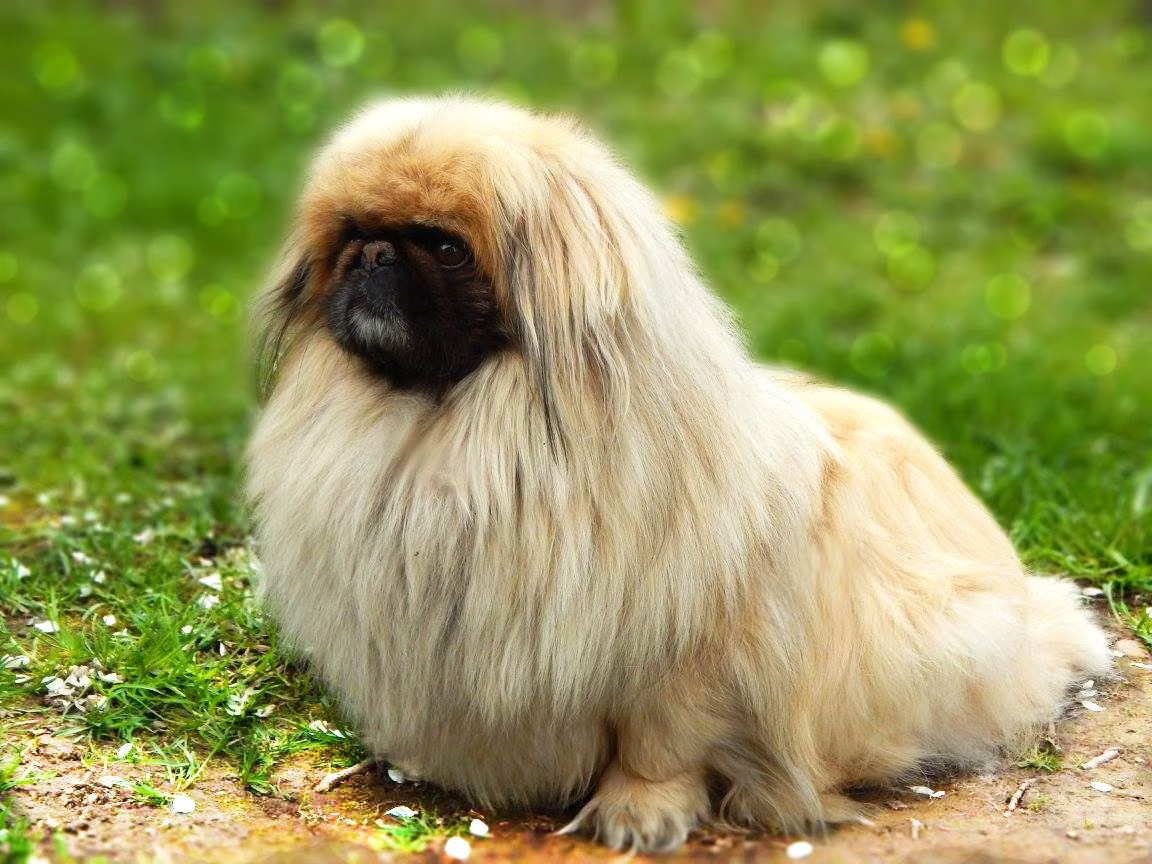
The Pekingese is a dignified, lion-hearted companion known for its regal bearing and devoted loyalty to its people.
How the Pekingese coat is built, and what that means when you groom it.
Critical: A Pekingese should not be shaved.
The undercoat keeps heat out as well as in, and the outer coat shields the skin from sun and insect bites. Clipping the whole coat off removes both. It often grows back patchy, soft or a different colour, and in some animals the guard hairs never return properly. Brush the undercoat out instead of cutting it off.
Caution: A Pekingese coat mats easily.
Fine or long hair tangles at the base of the coat, out of sight, where the mats tighten and pull on the skin. Brushing has to reach right down to the roots in sections, not just skim the surface.
A few of the Pekingese profiles members have added to United Pet Club.
The Pekingese is a small companion dog from China, weighing up to about 6.4 kg, known for its long flowing coat, flat face, and dignified, devoted temperament.
The Pekingese is a small toy dog that originated in imperial China, where it lived as a palace companion. It carries itself with a confident, deliberate manner that many owners describe as regal. The breed is compact and heavy for its size, with a broad chest, short legs, and a full double coat that frames the face like a mane.
Despite its small stature, the Pekingese is bold and self-possessed. It bonds closely with one or two people and tends to be reserved with strangers. The breed is affectionate with its family but keeps a measure of independence, often deciding for itself when it wants attention.
This is a dog suited to indoor life. It needs modest exercise and steady grooming, and its flat face means it copes poorly with heat, a real consideration through an Australian summer. The Pekingese fits calm households and owners who enjoy a devoted, low-energy companion.
| Attribute | Detail |
|---|---|
| Origin | China |
| Size | Small (up to about 6.4 kg) |
| Lifespan | 12 to 14 years |
| Group / role | Toy / companion |
| Good with | Adults, older children, calm households |
The Pekingese works well for flat dwellers, retirees, and anyone who wants a companion that stays close to home. It is not a good match for very active families or homes with rough young children, and the coat demands an owner willing to brush several times a week.
The Pekingese developed over centuries in imperial China as a palace companion, and reached the West in the mid-1800s after foreign troops removed several dogs from Beijing.
The Pekingese is one of the oldest companion breeds, with roots in China that go back well over a thousand years. The dogs were kept within the imperial court and were associated with Chinese royalty. Their lion-like appearance tied them to Buddhist symbolism, and ownership outside the palace was restricted for long periods.
For centuries the breed stayed largely unknown beyond China. The dogs were bred to a small size and a flat-faced look that suited court tastes, and they were treated as treasured palace animals rather than working dogs.
The Pekingese reached Europe in 1860, when British and French forces entered the imperial palaces in Beijing during the Second Opium War. Several dogs were taken back to Britain, and one was presented to Queen Victoria. These dogs formed the basis of the Western breeding population.
The breed gained a following in Britain and later spread across the English-speaking world. In Australia it is registered through the Australian National Kennel Council (ANKC), and it has remained a familiar toy companion since the early twentieth century.
The Pekingese is a small, stocky dog with a flat face, large dark eyes, a long double coat, and a distinctive rolling gait.
The Pekingese has a compact, pear-shaped body that is heavier in front than in the rear. The head is broad and flat between the ears, with a short, wrinkled muzzle and a black nose. The large, dark, round eyes sit well apart and give the breed its open expression. The ears are heart-shaped and carried close to the head, feathered with long hair.
The body is low to the ground and slightly longer than tall. The breed moves with a rolling, unhurried gait that comes from its build. The tail is set high and carried over the back, fringed with long hair.
| Trait | Standard |
|---|---|
| Height | 15 to 23 cm at the shoulder |
| Weight | Up to 6.4 kg |
| Coat | Long, straight double coat with a thick mane around the neck and shoulders |
| Colours | Most colours and patterns, including red, fawn, cream, black, black and tan, and parti-colour |
| Eyes | Large, round, dark, set well apart |
The outer coat is long and coarse, with a soft, dense undercoat beneath it. Feathering appears on the ears, legs, tail, and feet, and a heavier ruff frames the neck. Most colours are accepted, with red, fawn, and cream among the most common. A dark mask on the face is typical in many of the lighter coats.
The Pekingese is affectionate and devoted to its family but independent, reserved with strangers, and confident to the point of stubbornness.
The Pekingese forms a strong attachment to its household and is loyal and affectionate with the people it knows. It tends to choose a favourite person and will follow that person from room to room. At the same time it keeps an independent streak and is content to rest on its own for long stretches.
With strangers the breed is reserved and watchful. It often barks to announce visitors, which makes it an alert if undersized watchdog. Early socialisation helps it accept new people and situations with less wariness.
With children the Pekingese does best around older, gentle ones who understand that a small dog can be hurt by rough handling. It is not always tolerant of teasing. With other pets it can be selective and may stand its ground despite its size, so calm introductions matter. The breed's confidence and self-direction can read as stubbornness during training.
| Trait | Rating |
|---|---|
| Affection | 4 |
| Energy | 2 |
| Trainability | 2 |
| Vocalness | 3 |
| Shedding | 4 |
The Pekingese needs frequent brushing, light daily exercise, and a cool environment because its flat face makes it sensitive to heat.
The long double coat needs regular attention to stay free of mats and tangles.
The Pekingese has modest exercise needs that suit indoor life.
The Pekingese is built for indoor living and does best in a cool, air-conditioned home during warm weather. Its flat face limits its ability to cool itself by panting, so it can overheat quickly, which makes an Australian summer genuinely risky. It adapts well to flats and small spaces and does not need a yard.
The Pekingese needs a measured diet of quality small-breed food, usually split into two meals a day, with careful portion control to prevent weight gain.
The Pekingese does well on a complete, balanced dog food formulated for small or toy breeds. Because the breed is compact and not very active, it gains weight easily, so portions should be measured rather than free-fed. Excess weight adds strain to the joints and worsens breathing problems in a flat-faced dog.
Small kibble or food the dog can pick up easily suits the short muzzle. Fresh water should always be available.
| Life stage | Amount per day | Meals |
|---|---|---|
| Puppy (2 to 6 months) | Per product guide, divided | 3 to 4 |
| Puppy (6 to 12 months) | Per product guide, divided | 2 to 3 |
| Adult | About 55 to 110 g of small-breed food | 2 |
| Senior | Adjusted for lower activity | 2 |
Keep treats to a small share of daily kilojoules to protect against weight gain. Most Pekingese on a complete diet do not need supplements, but a vet may recommend joint or coat support for individual dogs. Introduce any new food gradually to avoid digestive upset.
The Pekingese lives about 12 to 14 years and is prone to breathing, eye, and spinal problems linked to its flat face and long, low body.
The Pekingese generally lives 12 to 14 years. It is a sturdy breed for its size, but its build brings several predictable health concerns. The flat face is the source of brachycephalic airway problems, and the prominent eyes and long back create their own risks. Responsible breeding and a healthy weight reduce the severity of many of these issues.
| Condition | Signs | Note |
|---|---|---|
| Brachycephalic airway syndrome | Noisy breathing, snoring, intolerance of heat and exercise | Linked to the flat face; severe cases may need surgery |
| Eye problems | Tearing, cloudiness, ulcers, irritation | Prominent eyes are exposed to injury and dryness |
| Intervertebral disc disease | Back pain, reluctance to move, weakness in limbs | The long, low back is vulnerable; keep weight down |
| Patellar luxation | Skipping steps, intermittent lameness | A kneecap that slips out of place; common in toy breeds |
| Skin fold dermatitis | Redness or odour in facial wrinkles | Keep folds clean and dry |
The Pekingese is intelligent but independent and stubborn, so it responds best to short, patient, reward-based sessions and early socialisation.
The Pekingese is a smart dog with a strong independent streak. It can learn cues well but often weighs whether it wants to comply, which can look like stubbornness. Harsh methods tend to make the breed shut down or dig in. Calm, consistent, reward-based training produces far better results. Toilet training can take patience, and crate training often helps.
Early socialisation is important. Exposing the puppy to a range of people, sounds, and situations reduces the breed's natural wariness and limits excessive barking later.
Pekingese breeding requires care because of the breed's small size and flat face, and litters are small, often needing veterinary support for whelping.
Breeding the Pekingese calls for experience and veterinary involvement. Females reach maturity in their first year, but responsible breeders wait until a bitch is physically mature and health-screened before mating. The breed's body shape can make natural mating difficult, and the large head of the puppies relative to the dam's size means whelping can be hard.
Gestation runs about 63 days. Litters are small, typically one to four puppies. Because of the risk of difficult births, many Pekingese deliveries are supervised by a vet, and caesarean section is not unusual. Newborns are tiny and need a warm, clean environment and close monitoring in the first weeks.
Responsible breeding includes screening parents for eye, knee, and breathing problems and avoiding the most extreme flat-faced features that worsen the breed's health. Puppies should stay with the dam and litter until at least eight weeks and begin gentle socialisation before going to new homes.
| Metric | Value |
|---|---|
| Female maturity | Around 6 to 12 months (breed later) |
| Gestation | About 63 days |
| Litter size | 1 to 4 puppies |
| Weaning age | About 6 to 8 weeks |
| Whelping note | Difficult births common; caesarean often needed |
A free lifetime United Pet Club record for your Pekingese, with the microchip registered at no charge and nothing falling due each year.
Punch in your Pekingese's name, his date of birth, and a decent photo, attach your mobile, and save. Done: a lifetime record that never bills you. Registering your dog is the easy half of responsible ownership, and the half people skip.
A chipped Pekingese without a registration is carrying a number nobody can use. File it with United Pet Club and the number works for him: free for life, open to every chip brand sold here, searchable from any clinic or pound in the country. Microchip registration now, free account while you're at it.
Sign up free with United Pet Club, add his name, breed, and a photo, and you're done. The lifetime plan keeps the profile live at no cost, and the chip number can go in whenever the vet's done his bit.
Add the 15-digit number to your free account with your address and mobile. Registration and every update after it are free, and chips from any manufacturer an Australian vet implants are accepted.
In most states and territories, yes, chipping is required and the register entry comes with it. The state register and your United Pet Club record do different jobs: one satisfies the council, the other keeps a current phone number one scan away, free.
Nothing with United Pet Club. Profile, chip registration, and unlimited updates are covered for his whole life, no annual fee in sight.
Common questions about Pekingese size, temperament, care needs, lifespan, and suitability as a companion.
The Pekingese is a small toy breed. It stands about 15 to 23 cm at the shoulder and weighs up to about 6.4 kg, with a stocky build that feels heavy for its size.
The Pekingese is affectionate and devoted to its family but independent and reserved with strangers. It is confident and dignified, and that self-direction can make it stubborn during training.
It has moderate to high care needs. The long double coat requires brushing several times a week, the facial folds and eyes need regular cleaning, and the flat face means the dog must be kept cool and protected from heat.
The typical lifespan is 12 to 14 years. Keeping the dog at a healthy weight and managing its breathing and eye health support a longer, more comfortable life.
Yes. The breed has low exercise needs, adapts well to small spaces, and prefers indoor life. It suits flat dwellers, retirees, and calm households.
They do best with older, gentle children and calm introductions to other pets. They can be selective and do not tolerate rough handling, so they are not ideal for homes with very young or boisterous children.
Yes. The thick double coat sheds steadily and more heavily during seasonal changes, so regular brushing is needed to manage loose hair and prevent mats.