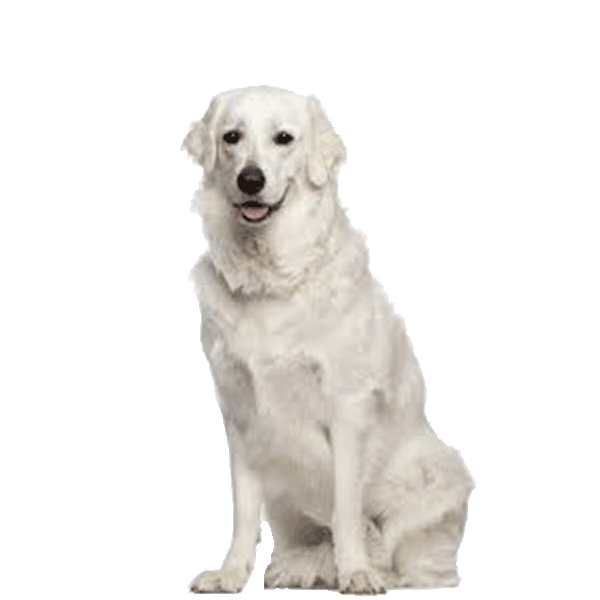
The Kuvasz is a devoted, dignified Hungarian guardian dog known for its loyalty, independent thinking, and bold protective nature.
How the Kuvasz coat is built, and what that means when you groom it.
Critical: A Kuvasz should not be shaved.
The undercoat keeps heat out as well as in, and the outer coat shields the skin from sun and insect bites. Clipping the whole coat off removes both. It often grows back patchy, soft or a different colour, and in some animals the guard hairs never return properly. Brush the undercoat out instead of cutting it off.
Caution: A Kuvasz coat mats easily.
Fine or long hair tangles at the base of the coat, out of sight, where the mats tighten and pull on the skin. Brushing has to reach right down to the roots in sections, not just skim the surface.
Information: A Kuvasz drops its undercoat in heavy bursts.
The undercoat comes out in heavy bursts over a few weeks. An undercoat rake, or a bath followed by a proper blow-dry, clears it far faster than daily brushing. Clipping the coat down is not a shortcut for this.
A large Hungarian livestock guardian known for devotion, independent judgment, and a bold protective instinct. It suits experienced owners with space and a clear role for the dog.
The Kuvasz is a large working dog developed in Hungary to guard livestock and property. Adults typically stand 66 to 76 cm at the shoulder, carry a pure white double coat, and pair size with surprising speed and agility. The breed was bred to live alongside flocks and make its own decisions when no shepherd was present, so independence and watchfulness are built into its character.
With its own family the Kuvasz is affectionate and steady. It bonds strongly with the people it lives with and tends to keep watch over them rather than seek constant attention. Toward strangers it is reserved and slow to warm, a trait that comes straight from its guarding past. This is a dog that thinks before it acts and does not take direction simply because it was given.
The Kuvasz needs an owner who understands large guardian breeds. It does best with room to patrol, a job to do, and consistent boundaries set from puppyhood. In the right home it is a calm, loyal companion. In the wrong one its size, drive, and willingness to act on its own can become hard to manage. It is a serious guardian, not a casual pet.
| Attribute | Detail |
|---|---|
| Origin | Hungary |
| Size | Large |
| Lifespan | 10 to 12 years |
| Group / role | Working dog, livestock and property guardian |
| Good with | Its own family and children it is raised with; reserved toward strangers |
This breed fits a confident, active owner who can commit to early socialisation and steady training. A house with a securely fenced yard is close to a requirement, and a rural block suits it well. The Kuvasz is a poor match for a unit or apartment, first-time owners, or homes that want a dog friendly with every visitor. People who can give it space, structure, and a sense of purpose are rewarded with a deeply loyal guardian.
An ancient Hungarian guardian breed that protected livestock and, later, served the nobility, and nearly vanished after World War II before careful breeding restored it.
The Kuvasz is one of Hungary's oldest breeds. Its ancestors are generally traced to large guardian dogs that reached the Carpathian Basin with migrating peoples more than a thousand years ago. For most of that history the breed worked as a livestock guardian, living with flocks of sheep and protecting them from predators and thieves.
In the late medieval period the Kuvasz became linked with the Hungarian nobility. It was kept at royal courts and large estates, valued both as a guard and as a hunting companion for large game. The white coat helped shepherds tell the dog from predators at night, and that practical preference shaped the breed's look over time.
As the great estates declined, the Kuvasz returned to its older role as a farm and flock guardian across the Hungarian countryside. Formal breed standards were drawn up in the late nineteenth and early twentieth centuries, fixing the type recognised today.
The two world wars were nearly fatal to the breed. Numbers collapsed, and by the end of World War II only a small number of dogs are reported to have remained in Hungary. Dedicated breeders rebuilt the population from those survivors. The Kuvasz remains uncommon outside Hungary but is kept in working and companion homes in several countries, and is recognised by the Australian National Kennel Council.
A large, sturdy white dog with a dense double coat, dark almond eyes, and a powerful yet agile build. The coat is always white, from pure white to ivory.
The Kuvasz is a big, well-muscled dog built for endurance rather than bulk. The body is slightly longer than tall, the chest is deep, and the legs are strong and straight. Despite its size the breed moves with a light, free gait that lets it cover ground quickly. The head is wedge-shaped and counted one of the breed's most distinctive features, with a black nose and dark, expressive eyes.
| Trait | Standard |
|---|---|
| Height | Males about 71 to 76 cm (28 to 30 in); females about 66 to 71 cm (26 to 28 in) |
| Weight | Males about 45 to 52 kg (100 to 115 lb); females about 32 to 41 kg (70 to 90 lb) |
| Coat | Dense double coat, medium length, ranging from wavy to fairly straight |
| Colours | White, from pure white to ivory |
| Eyes | Almond-shaped, dark brown |
The Kuvasz carries a weatherproof double coat. A coarse outer layer sheds dirt and moisture, while a soft undercoat insulates the dog against both cold and heat. Coat length varies across the body, with shorter hair on the head and the front of the legs and longer hair forming a ruff around the neck and feathering on the backs of the legs and tail. The only accepted colour is white, though the skin beneath is darkly pigmented and the nose, lips, and eye rims are black. The double coat handles cold well but can leave the dog warm in an Australian summer, so shade and water matter and the white coat still needs sun-sensible management.
Devoted and protective with its family, independent in its thinking, and naturally reserved toward strangers. A serious guardian rather than an easygoing pet.
The Kuvasz is loyal, courageous, and strongly bonded to its household. Within the family it is gentle and patient, and it is usually careful and tolerant with children it has been raised alongside. Indoors it tends to be a quiet presence, watching over the family rather than demanding play or attention.
With strangers the Kuvasz is wary and slow to accept newcomers. This is normal guardian behaviour, not a fault, but it means visitors should be introduced calmly and on the dog's terms. Early and ongoing socialisation is important so the dog learns to tell a genuine threat from ordinary daily life. Around the regular flow of visitors and tradespeople at a home, a well-socialised Kuvasz learns to sort everyday callers from a genuine intruder.
The breed is independent by design. Centuries of working alone with flocks produced a dog that reads situations and acts on its own judgment. That makes the Kuvasz capable and self-reliant, but it also means it will not follow commands blindly. With other dogs and pets it can do well when raised with them, though same-sex aggression and a protective response to perceived intruders can appear, especially in unneutered adults.
| Trait | Rating |
|---|---|
| Affection (with family) | 4 |
| Energy | 3 |
| Trainability | 3 |
| Vocalness | 3 |
| Shedding | 4 |
Regular brushing for a heavy double coat, daily exercise and space to patrol, and a securely fenced environment. Moderate maintenance with high shedding seasons.
The Kuvasz is a hardy, outdoor-capable breed, but it still relies on consistent grooming, exercise, and a suitable living setup to stay healthy and well-behaved.
The Kuvasz does best with a house and a large, securely fenced yard where it can move and keep watch. It handles cold well thanks to its double coat but needs shade and water in the heat. It is not suited to a unit or to being left alone for long stretches without space or purpose. The breed can be vocal when guarding, so neighbours and local conditions are worth considering.
A complete large-breed diet fed in measured meals to support the frame without pushing fast growth. Adults usually eat split daily portions across two meals.
Feed the Kuvasz a complete, balanced food made for large breeds. Puppies should be on a large-breed puppy formula that supports slow, steady growth, which helps protect developing joints. Because the breed is large and deep-chested, meals should be measured and divided rather than fed as one large portion. Exact amounts depend on age, weight, and activity, so the figures below are general guidance. In warm weather keep water constantly available, as a double-coated dog can dehydrate faster.
| Life stage | Amount per day | Meals |
|---|---|---|
| Puppy (2 to 6 months) | About 3 to 5 cups, by growth and brand | 3 to 4 |
| Puppy (6 to 12 months) | About 4 to 6 cups | 2 to 3 |
| Adult | About 4 to 6 cups | 2 |
| Senior / less active | Reduce portions to match lower needs | 2 |
Keep treats to no more than about ten percent of daily calories so the dog does not gain excess weight. Fresh water should always be available. Many large-breed owners feed two meals a day and avoid heavy exercise right before and after eating, since deep-chested dogs can be prone to bloat. Discuss any joint, coat, or growth supplements with a vet rather than adding them on your own.
Generally healthy with a lifespan of 10 to 12 years, but as a large breed it can face joint, eye, and bloat-related concerns. Screening and preventive care reduce the risks.
The Kuvasz is a robust working breed that often stays sound into older age. Its typical lifespan is 10 to 12 years. As with most large dogs, the main concerns relate to the joints, the digestive system, and a few inherited conditions. Buying from breeders who health-test their stock lowers the chance of passing on hereditary problems. In the Australian heat, a double-coated white dog also needs watching for heat stress.
| Condition | Signs | Note |
|---|---|---|
| Hip dysplasia | Stiffness, limping, trouble rising | Screening of breeding dogs helps reduce incidence |
| Elbow dysplasia | Front-leg lameness, reluctance to exercise | More likely in fast-growing large breeds |
| Bloat (gastric dilatation-volvulus) | Swollen abdomen, retching without bringing anything up, distress | Medical emergency; seek immediate veterinary care |
| Osteochondritis dissecans (OCD) | Joint lameness in young dogs | Linked to rapid growth and overfeeding in puppies |
| Progressive retinal atrophy | Night blindness, declining vision | Inherited eye disease; identified through eye testing |
| Heat stress | Heavy panting, drooling, weakness | A concern for a double-coated white dog in hot weather; keep cool and seek a vet |
Intelligent but independent, so training takes patience, consistency, and respect rather than force. Early socialisation and clear boundaries are essential for this guardian breed.
The Kuvasz is a smart dog bred to think for itself, which shapes how it should be trained. It learns quickly but will question commands that seem pointless, and it does not respond well to harsh or repetitive drilling. The aim is a working partnership built on trust and clear rules. An owner who is calm, fair, and consistent earns the dog's cooperation; one who relies on force usually meets resistance. Start training and socialisation in puppyhood, while the dog is still small and impressionable.
The Kuvasz reaches breeding maturity slowly for a large breed, carries litters of several puppies after a roughly two-month pregnancy, and benefits from health screening of both parents.
The Kuvasz matures slowly, as large breeds often do, and is generally not bred until it is physically and mentally mature, usually around two years of age. Responsible breeding starts with health screening of both parents for hip, elbow, and eye conditions, along with sound temperament, since the breed's guarding character is partly inherited.
The female's pregnancy lasts about 63 days. Litters commonly hold around six to eight puppies, though size varies. Because the breed is large and protective, the mother should have a quiet, secure whelping space where she feels safe. Puppies are born helpless and depend entirely on the dam in the first weeks.
Raising Kuvasz puppies well means early handling and exposure. The weeks between roughly three and sixteen weeks of age are a key socialisation window. Gentle introductions to people, household sounds, and other animals during this time strongly influence how stable and manageable the adult guardian becomes. Puppies usually go to new homes after about eight weeks, by which point they should be weaned and well started on socialisation.
| Metric | Value |
|---|---|
| Breeding maturity | About 2 years |
| Gestation | About 63 days |
| Typical litter size | About 6 to 8 puppies |
| Weaning age | About 6 to 8 weeks |
| Socialisation window | About 3 to 16 weeks |
A free lifetime United Pet Club record for your Kuvasz, with the microchip registered at no charge and nothing falling due each year.
Rangers and shelters can only call the number the scan hands them. Give your Kuvasz a free United Pet Club profile and that number is yours: dog registration takes a few minutes, costs nothing for his lifetime, and works with or without a chip in place.
A chipped Kuvasz without a registration is carrying a number nobody can use. File it with United Pet Club and the number works for him: free for life, open to every chip brand sold here, searchable from any clinic or pound in the country. Microchip registration now, free account while you're at it.
Sign up free with United Pet Club, add his name, breed, and a photo, and you're done. The lifetime plan keeps the profile live at no cost, and the chip number can go in whenever the vet's done his bit.
Add the 15-digit number to your free account with your address and mobile. Registration and every update after it are free, and chips from any manufacturer an Australian vet implants are accepted.
In most states and territories, yes, chipping is required and the register entry comes with it. The state register and your United Pet Club record do different jobs: one satisfies the council, the other keeps a current phone number one scan away, free.
Nothing with United Pet Club. Profile, chip registration, and unlimited updates are covered for his whole life, no annual fee in sight.
Common questions about the Kuvasz cover its size, temperament, care needs, lifespan, suitability as a pet, and how readily it can be found.
It is a large breed. Males stand about 71 to 76 cm and weigh roughly 45 to 52 kg, while females stand about 66 to 71 cm and weigh roughly 32 to 41 kg.
It is devoted and gentle with its own family, protective by nature, and reserved toward strangers. It is independent and thinks for itself, so it is a serious guardian rather than an easygoing companion.
It is moderate to demanding. The double coat needs regular brushing and sheds heavily in season, the dog needs daily exercise and space, and its independent guarding instinct calls for early socialisation and steady training.
Most Kuvasz dogs live about 10 to 12 years, which is typical for a large breed.
It can be an excellent family guardian for experienced owners with space and a securely fenced yard. It is usually careful with children it is raised with, but it is not suited to first-time owners or homes that want a dog friendly with every visitor.
The breed is uncommon outside Hungary. Finding a well-bred puppy often means contacting breed clubs or dedicated breeders and being prepared to wait or travel.
