

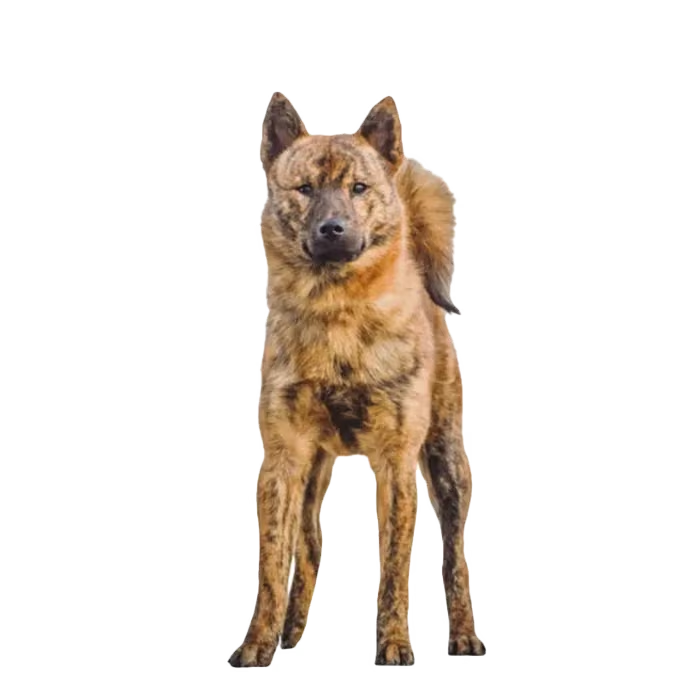
Kai Ken
The Kai Ken is a reserved, intelligent Japanese hunting breed deeply devoted to its owner and a skilled, agile climber.
- Size
- Medium
- Lifespan
- 12–15 years
- Origin
- Japan
- Temperament
- Reserved
- Standard colours
- Black and Red
Characteristics
Coat and grooming
How the Kai Ken coat is built, and what that means when you groom it.
- Coat layers
- Double coat
- Coat texture
- Rough
- Coat length
- Medium
- Shedding
- Seasonal shedding
Grooming guidance
Critical: A Kai Ken should not be shaved.
The undercoat keeps heat out as well as in, and the outer coat shields the skin from sun and insect bites. Clipping the whole coat off removes both. It often grows back patchy, soft or a different colour, and in some animals the guard hairs never return properly. Brush the undercoat out instead of cutting it off.
Information: A Kai Ken drops its undercoat in heavy bursts.
The undercoat comes out in heavy bursts over a few weeks. An undercoat rake, or a bath followed by a proper blow-dry, clears it far faster than daily brushing. Clipping the coat down is not a shortcut for this.
Kai Ken colours and patterns
What each club's breed standard says about every Kai Ken colour and pattern. Point at a ruling to see the club's own wording.
Breed standards describe the Kai Ken in Black and Red. Standard patterns: Brindle and Reverse brindle.
| Colour or pattern | FCI | AKC | UKC |
|---|---|---|---|
| Black | Standard (“Black brindle”) | Standard (“Black Brindle”) | Standard (“All brindle colors are equally acceptable”) |
| Red | Standard (“red brindle”) | Standard (“Red Brindle”) | Standard (“All brindle colors are equally acceptable”) |
| Albino | Not recognised | Not recognised | Disqualifying (“Albinism”) |
| Cream | Not recognised | Disqualifying (“cream”) | No ruling |
| Patterns | |||
| Brindle | Standard (“Black brindle, red brindle and brindle”) | Standard (“Brindle”) | Standard (“All brindle colors are equally acceptable”) |
| Reverse brindle | Standard (“Black brindle, red brindle and brindle”) | Standard (“Brindle”) | Standard (“All brindle colors are equally acceptable”) |
| Solid | No ruling | Disqualifying (“Pinto, cream, or any non-brindle coat”) | No ruling |
| Piebald | Disqualifying (“Pinto colour”) | Disqualifying (“Pinto”) | No ruling |


| Colour or pattern | FCI | AKC | UKC |
|---|---|---|---|
| Dark brown | Standard (“dark brown in colour”) | Standard (“the iris dark brown”) | Standard (“dark brown”) |
| Light brown | Fault (“Light-coloured eyes”) | Fault (“light colored eyes”) | No ruling |
| Yellow | No ruling | No ruling | Fault (“Yellow or bird-of-prey eyes”) |
| Colour or pattern | FCI | AKC | UKC |
|---|---|---|---|
| Black | Standard (“Black”) | Standard (“black”) | Standard (“solid black except in red brindles, where it may be brownish black”) |
| Colour or pattern | AKC | UKC |
|---|---|---|
| Blue-black | No ruling | Standard (“may be ... blue black”) |
| Pink | No ruling | Standard (“may be pink”) |
| Patterns | ||
| Spotted | Standard (“The mouth and tongue is generally spotted”) | Standard (“The tongue is generally spotted”) |

What the rulings mean
- Standard
- Described by the club's breed standard.
- Fault
- Named by the club's breed standard as a fault: the animal can be shown but is penalised.
- Disqualifying
- The club's breed standard disqualifies an animal of this colour or pattern.
- Not recognised
- The club does not accept this colour or pattern for the breed.
Colour changes
How a Kai Ken's colours can change over its life.
Blackchanges toRust
Coat · With body condition · can change back
Blackchanges toGrey
Coat · Progressive
Blackchanges toBrown
Coat · In the sun · can change back
Blackchanges toSnow nose
Nose · With the season · can change back
Blackchanges toPink
Nose · With the season · can change back

Sources
Each ruling comes from the club's published breed standard or colour list.
Kai Ken breed standard
What each club's standard asks of the Kai Ken: size, build and forms. A club speaks only for itself, and a figure no club published is left out.
Measurements


Conformation
Stop
Pronounced
“Stop: Abrupt with slight furrow”
Bite
Scissors bite
“Jaws/Teeth: Strong with a scissor bite”
Bite
UndershotDisqualifying
“Extremely overshot or undershot mouth”
Bite
OvershotDisqualifying
“Extremely overshot or undershot mouth”
Eye shape
Triangular
“EYES: Nearly triangular and dark brown”
Ear carriage
Erect (prick)
“Triangular, slightly inclining forward and firmly pricked”
Topline
Level
“Back: Straight and short”
Chest
Deep
“Chest: Deep, ribs moderately sprung”
Tail length
ShortDisqualifying
“Hanging tail, short tail”
Tail set
High
“TAIL: Set on high, thick”
Tail carriage
Sickle
“vigorously curled or carried curved like a sickle over the back”
Tail carriage
Curled over the back
“vigorously curled or carried curved like a sickle over the back”
Tail carriage
Low (hanging)Disqualifying
“Hanging tail, short tail”


Parts of the body


About the Kai Ken
The Kai Ken is a medium-sized Japanese hunting dog, wary of strangers, fiercely loyal to its family, and a surprisingly capable climber built for mountain game.
The Kai Ken is a medium spitz-type dog from Japan, developed to hunt boar and deer across the steep, timbered mountains of the Yamanashi region. It's one of six native Japanese breeds and one of the rarest. Locals often call it the Tora Inu, or tiger dog, for its distinctive brindle coat.
Kai Ken are sharp and watchful. They form a tight bond with one household and keep their distance from anyone they don't know. They're not typically aggressive with people, but their wariness and strong hunting drive shape how well they slot into family life.
The breed is athletic and remarkably sure-footed. Kai Ken can scale trees and clamber over rock faces while chasing game, and that same knack shows up in pet dogs that hop fences and climb onto furniture at home. An owner needs to understand an independent working dog and be ready to give it a proper outlet, physically and mentally.
| Attribute | Detail |
|---|---|
| Origin | Japan (Yamanashi region) |
| Size | Medium |
| Lifespan | 12 to 15 years |
| Group/role | Hunting and companion (spitz type) |
| Good with | Devoted family; supervised around small pets due to hunting drive |
Who the Kai Ken suits
This breed suits an active owner who values loyalty over affection handed out to every visitor. Kai Ken do well with people who can offer secure fencing, regular exercise, and early socialisation. Anyone with small pets at home needs to plan around the breed's hunting instincts. First-time dog owners might find the Kai Ken's independence and reserve tough going without doing their homework first.
History and origin
The Kai Ken developed in the isolated Kai Province, now Yamanashi, as a mountain hunting dog and was named a Japanese natural monument in 1934.
The Kai Ken traces back to Kai Province, the old name for what is now Yamanashi Prefecture in central Japan. Steep mountains and dense forest kept local dog populations cut off from the outside for generations, which is largely why the breed stayed close to its original type compared with dogs from more accessible parts of the country.
Hunters in the region used these dogs to track and hold boar and deer. The work happened on rough ground, where climbing ability and stamina counted for more than raw speed across open country. That working background is why the breed still carries a strong prey drive and makes its own decisions in the field.
Japan recognised the Kai Ken as a protected natural monument in 1934, around the same time several other native Japanese breeds were being documented and preserved. A breed club, the Kai Ken Aigokai, was set up to maintain the dog's type and keep records.
The breed remains uncommon even at home in Japan and is rare everywhere else. Small numbers have made their way to other countries, where committed breeders work to keep the population healthy while holding on to the original hunting character.
Appearance
The Kai Ken is a medium spitz-type dog with a wedge-shaped head, pricked ears, a curled tail, and a brindle coat ranging from black to red brindle.
The Kai Ken has a balanced, muscular build typical of spitz breeds. The head is wedge-shaped with a moderate stop, the ears stand upright and tip slightly forward, and the eyes are dark and set at a rough triangle. The tail curls or arches over the back. Overall, it reads as a tough, agile mountain dog rather than anything heavy or showy.
| Trait | Standard |
|---|---|
| Height | Around 47 to 53 cm at the shoulder (males larger than females) |
| Weight | About 11 to 18 kg |
| Coat | Double coat: harsh, straight outer coat over a soft, dense undercoat |
| Colours | Black brindle, red brindle, and intermediate brindle |
| Eyes | Dark brown, set roughly triangular |
Coat and colours
The signature feature is the brindle pattern that earns the breed its tiger-dog nickname. Three brindle shades are recognised: black brindle (kuro-tora), red brindle (aka-tora), and an intermediate brindle (chu-tora). Puppies are often born almost solid-coloured and grow into their brindle striping as they mature, sometimes taking a year or more to fully develop. The double coat blows out seasonally and keeps the dog warm through cold mountain winters.
What the Kai Ken standard says, club by club
Height at the withers for the Kai Ken: AKC 47-53.3 cm; FCI under 53 cm; UKC 47-55.9 cm.
Clubs set their own figures for the Kai Ken. These come from each club's published standard: AKC, FCI, UKC.
Size
- Height at the withers, male: AKC 47-53.3 cm; FCI under 53 cm; UKC 47-55.9 cm
- Height at the withers, female: AKC 40-46.4 cm; FCI under 48 cm; UKC 44.5-50.8 cm
- Weight: UKC 11.3-24.9 kg
Sizes that count against it
- Height at the withers, male: Fault: AKC over 53.3 cm, AKC under 47 cm
- Height at the withers, female: Fault: AKC over 46.4 cm, AKC under 40 cm
Build and forms
At least one club accepts each of these:
- Stop: Pronounced, Moderate
- Bite: Scissors bite, Level bite
- Dentition: Full dentition
- Tongue pigment: Spotted, Pink, Blue-black
- Eye shape: Triangular
- Ear carriage: Erect (prick)
- Neck length: Medium
- Topline: Level
- Chest: Deep
- Hocks: Well let down
Forms the clubs penalise
A fault or a disqualification is a judgment under a show standard. It can affect placings and, at some clubs, registration.
- Disqualifying: Bite: Undershot (AKC, FCI); Bite: Overshot (AKC, FCI); Dentition: Missing teeth (UKC); Tail length: Short (FCI); Tail carriage: Low (hanging) (FCI)
- Fault: Muzzle shape: Snipy (AKC, UKC); Bite: Undershot (UKC); Bite: Overshot (UKC); Dentition: Missing teeth (AKC); Neck length: Short (UKC); Feet: Splayed (UKC)
Cropping, docking and other procedures
- Dewclaw removal: Alternate (UKC)
This is each club's stance in the show ring, not the law. The law on these procedures differs by country.
Markings
Each club's ruling on the breed's named marks:
- Star: Alternate (AKC, UKC)
- Socks: Alternate (UKC); Fault (AKC)
See every point side by side: compare the clubs.
Rulings come from each club's published breed standard, and clubs revise their standards. Before a show or a registration, check the current text with the club.
What does each club give for Height at the withers in the Kai Ken?
Height at the withers, male: AKC 47-53.3 cm; FCI under 53 cm; UKC 47-55.9 cm; Height at the withers, female: AKC 40-46.4 cm; FCI under 48 cm; UKC 44.5-50.8 cm.
Which forms do clubs penalise in the Kai Ken?
Disqualifying: Bite: Undershot (AKC, FCI); Bite: Overshot (AKC, FCI); Dentition: Missing teeth (UKC); Tail length: Short (FCI); Tail carriage: Low (hanging) (FCI). Fault: Muzzle shape: Snipy (AKC, UKC); Bite: Undershot (UKC); Bite: Overshot (UKC); Dentition: Missing teeth (AKC); Neck length: Short (UKC); Feet: Splayed (UKC).
Which Kai Ken colours the clubs accept
Every club we track accepts Black, Red for the Kai Ken.
On the Kai Ken, every club we track agrees on Black, Red. Clubs compared: AKC, FCI, UKC.
Patterns listed as standard for the Kai Ken: Brindle, Reverse brindle.
Colours penalised in the show ring
A fault or a disqualification is a judgment under a show standard. It can affect placings and, at some clubs, registration.
- Disqualifying: Solid (AKC), Piebald (AKC, FCI), Albino (UKC), Cream (AKC)
Beyond the main colour
Standards rule on more than the main colour. These are listed as standard:
- Eyes: Dark brown
- Nose: Black
- Tongue: Blue-black, Pink
Rulings come from each club's published breed standard, and clubs revise their standards. Before a show or a registration, check the current text with the club.
Which Kai Ken colours do all the clubs accept?
All of these clubs accept Black, Red: AKC, FCI, UKC.
Which Kai Ken colours are faults or disqualifications?
Disqualifying: Solid (AKC), Piebald (AKC, FCI), Albino (UKC), Cream (AKC).
Temperament
The Kai Ken is devoted and protective with its own family, reserved and standoffish with strangers, sharp-witted, and driven by a strong hunting instinct.
Kai Ken attach strongly to their owner and household. Around family they can be affectionate and playful, and plenty are genuinely gentle with people they trust. With strangers they stay reserved and watchful rather than friendly, which makes them quick to notice anything out of place.
The breed is intelligent and observant. It tends to size up a situation before it acts, a habit left over from its independent hunting work. That can look like stubbornness during training, but it's really a dog thinking things through for itself.
Prey drive runs high. Kai Ken were bred to chase and hold large game, so cats, small dogs, and other small animals can set off a chase. Early, ongoing socialisation helps, but keeping an eye on things around small pets is still sensible. Reactions to other dogs vary between individuals, and tension between dogs of the same sex can crop up.
| Trait | Rating |
|---|---|
| Affection (with family) | 4 |
| Energy | 4 |
| Trainability | 3 |
| Vocalness | 2 |
| Shedding | 3 |
Care and grooming
The Kai Ken needs regular brushing for its double coat, daily hard exercise, climb-proof fencing, and consistent mental stimulation.
Grooming
- Brush once or twice a week to clear loose hair and keep the double coat in good order
- Step up brushing to several times a week during seasonal shedding, when the undercoat lets go all at once
- Bathe only when needed, since the coat mostly cleans itself
- Trim nails regularly and check ears for dirt or dampness after time outdoors
Exercise
- Give at least an hour of solid activity daily, whether that's a bushwalk, a run, or off-lead time in a securely fenced area
- Offer climbing and problem-solving challenges, since the breed genuinely enjoys scrambling and exploring
- Stick to a long line or secure spaces, because strong prey drive makes off-lead recall unreliable around wildlife such as possums or roos
Environment
The Kai Ken suits homes with active owners and does best with a securely fenced yard. Fencing needs to be tall and climb-resistant, since these dogs can get over obstacles that would hold most breeds. The double coat is built for cool and cold climates, so through Australia's hot, dry summers, exercise in the early morning or evening, and make sure there's shade and water on hand.
Grooming a Kai Ken
The Kai Ken coat: Double coat, Rough, Medium, Seasonal shedding. Main grooming rule: Do not shave.
Most of what a Kai Ken needs from grooming follows from its coat.
- Coat layers: Double coat
- Coat texture: Rough
- Coat length: Medium
- Shedding: Seasonal shedding
What this coat asks of you
- A double coat has a soft undercoat beneath longer guard hairs. Brush right down to the undercoat, because that is the layer that packs down and traps loose hair.
- A rough coat stands off the body and collects burrs and debris, so check it after time outdoors.
- Medium-length hair starts to tangle wherever it rubs, so pay attention to those spots.
- Seasonal shedding arrives in bursts when the coat changes, and brushing more often during those weeks keeps it manageable.
What to tell a groomer
Mention these when you book. The coat notes on this page explain each one.
- Do not shave
- Needs seasonal de-shedding
A groomer who knows the breed can adapt all of this to the individual animal. Sore skin, mats pressed against the skin or a sudden change in the coat are worth showing to a vet.
What kind of coat does a Kai Ken have?
On our records: Coat layers: Double coat; Coat texture: Rough; Coat length: Medium; Shedding: Seasonal shedding.
How much does a Kai Ken shed?
Seasonal shedding arrives in bursts when the coat changes, and brushing more often during those weeks keeps it manageable.
What should a groomer know about a Kai Ken?
These grooming rules apply: Do not shave, Needs seasonal de-shedding.
Nutrition and feeding
The Kai Ken does well on a complete, balanced diet matched to its life stage and activity level, fed in measured meals to keep its lean, athletic build.
Feed a complete and balanced diet formulated for the dog's life stage. As an active, working-type breed, the Kai Ken benefits from food with enough protein and fat to support muscle and stamina. Keep the dog lean, since extra weight puts strain on the joints and dulls the agility the breed is known for. Adjust portions to the dog's actual condition rather than going by the bag's guide alone.
| Life stage | Amount per day | Meals |
|---|---|---|
| Puppy (2 to 6 months) | Per puppy formula on label, divided | 3 to 4 |
| Puppy (6 to 12 months) | Per label, adjusted to growth | 2 to 3 |
| Adult | About 300 to 400 g of quality dry food | 2 |
| Senior | Reduced calories for lower activity | 2 |
Treats and supplements
Keep treats to around 10 percent of daily calories to protect the breed's lean build. Use small training treats during sessions and trim the main meal to balance it out. Most Kai Ken on a complete diet don't need supplements; talk to a vet about joint or coat supplements based on the individual dog's needs. Keep fresh water available at all times, especially around exercise.
Health
The Kai Ken is a generally hardy breed with a lifespan of 12 to 15 years and few breed-specific problems, though routine preventive care still matters.
The Kai Ken is considered one of the sturdier, healthier dog breeds, partly thanks to its long isolation and the limited human interference in how it developed. Typical lifespan runs 12 to 15 years. As with any breed, individual dogs can still develop common health issues, and responsible breeders screen their breeding stock.
| Condition | Signs | Note |
|---|---|---|
| Hip dysplasia | Stiffness, limping, trouble getting up | Less common than in many breeds; screening helps |
| Patellar luxation | Skipping gait, occasional hind-leg lameness | Seen in some small to medium breeds |
| Eye conditions | Cloudiness, changes in vision | Routine eye checks recommended |
| Allergies and skin issues | Itching, redness, hair loss | Manage with veterinary guidance |
Preventive care
- Keep vaccinations and parasite prevention current
- Book annual vet check-ups, moving to twice a year once the dog is a senior
- Maintain a healthy weight to protect the joints
- Brush teeth regularly and keep up with dental care
- Keep the dog active to support muscle tone and overall condition
Training
The Kai Ken is smart and capable but independent, so it responds best to early, consistent, reward-based training from an owner it trusts.
Kai Ken pick things up quickly when they're motivated, but their independent streak means they'll question a command that seems pointless. They cooperate most readily with an owner they respect and trust. Harsh handling backfires and damages the bond between dog and owner. Short, varied, rewarding sessions hold their attention far better than long, repetitive drills. Recall is the hardest skill to nail down, since prey drive can override training the moment wildlife shows up.
Basics
- Start socialisation early, exposing the puppy to a range of people, places, and sounds
- Build a solid recall on a long line before trusting the dog off-lead
- Teach the core cues (sit, drop, stay, come) using food and praise as rewards
- Practise calm behaviour around small animals from a young age
- Keep sessions short and finish on a win to keep motivation up
Breeding
Kai Ken reach maturity around one to two years, produce modest litters, and need careful socialisation given the breed's rarity and reserved nature.
Breeding the Kai Ken calls for close attention to health screening and temperament, given how small the worldwide population is. Females generally reach physical and behavioural maturity before they should be bred, often around or after their second year, and breeding decisions should follow veterinary and breed club guidance. Gestation in dogs runs about 63 days. Litters tend to be modest in size.
Early socialisation of puppies matters even more in this breed. Because adults are naturally reserved with strangers, exposing pups to gentle handling and varied experiences in their first weeks helps produce confident, stable dogs. Reputable breeders focus on preserving the breed's hunting character and health while steering clear of excessive shyness.
| Metric | Value |
|---|---|
| Sexual maturity | Around 1 to 2 years |
| Gestation | About 63 days |
| Typical litter size | Roughly 3 to 6 puppies |
| Weaning | Around 6 to 8 weeks |
| Population status | Rare worldwide |
Getting your Kai Ken registered, chip and all
A free lifetime United Pet Club record for your Kai Ken, with the microchip registered at no charge and nothing falling due each year.
How to register a Kai Ken in Australia
Rangers and shelters can only call the number the scan hands them. Give your Kai Ken a free United Pet Club profile and that number is yours: dog registration takes a few minutes, costs nothing for his lifetime, and works with or without a chip in place.
A chipped Kai Ken without a registration is carrying a number nobody can use. File it with United Pet Club and the number works for him: free for life, open to every chip brand sold here, searchable from any clinic or pound in the country. Microchip registration now, free account while you're at it.
How do I register my Kai Ken in Australia?
Sign up free with United Pet Club, add his name, breed, and a photo, and you're done. The lifetime plan keeps the profile live at no cost, and the chip number can go in whenever the vet's done his bit.
How do I register my Kai Ken's microchip?
Add the 15-digit number to your free account with your address and mobile. Registration and every update after it are free, and chips from any manufacturer an Australian vet implants are accepted.
Does my Kai Ken have to be microchipped in Australia?
In most states and territories, yes, chipping is required and the register entry comes with it. The state register and your United Pet Club record do different jobs: one satisfies the council, the other keeps a current phone number one scan away, free.
What does it cost to register a Kai Ken?
Nothing with United Pet Club. Profile, chip registration, and unlimited updates are covered for his whole life, no annual fee in sight.
Frequently asked questions
Common questions about the Kai Ken cover its size, temperament, care needs, lifespan, suitability as a pet, and availability.
How big does a Kai Ken get?
The Kai Ken is a medium breed, standing roughly 47 to 53 cm at the shoulder and weighing about 11 to 18 kg, with males larger than females.
What is the Kai Ken's temperament like?
It's devoted and protective with its family, reserved and standoffish with strangers, intelligent, and driven by a strong hunting instinct. It's alert and watchful rather than openly friendly toward people it doesn't know.
Is the Kai Ken hard to look after?
Care sits in the moderate range. The double coat needs regular brushing with heavier shedding at certain times of year, and the dog needs solid daily exercise. The bigger challenge is managing its climbing ability, prey drive, and independent streak with secure fencing and consistent training.
How long does a Kai Ken live?
Typical lifespan is 12 to 15 years. The breed is generally hardy with relatively few breed-specific health problems.
Is the Kai Ken a good family dog?
It can make an excellent companion for an active, committed household. It bonds closely with its family, though its reserve with strangers and strong prey drive mean it suits owners who can offer socialisation, exercise, and supervision around small pets.
Are Kai Ken easy to find in Australia?
No. The Kai Ken is rare even in Japan and scarce everywhere else, including Australia. Finding a puppy usually means getting on a waiting list with a dedicated breeder, often overseas.
Can a Kai Ken really climb?
Yes. The breed is famously agile and can scramble up rocks, get over fences, and even climb trees while chasing game, which is why secure, climb-resistant fencing matters.
From the community
Ask about the Kai KenNo questions about the Kai Ken yet. Be the first to ask.
Browse Dog breeds