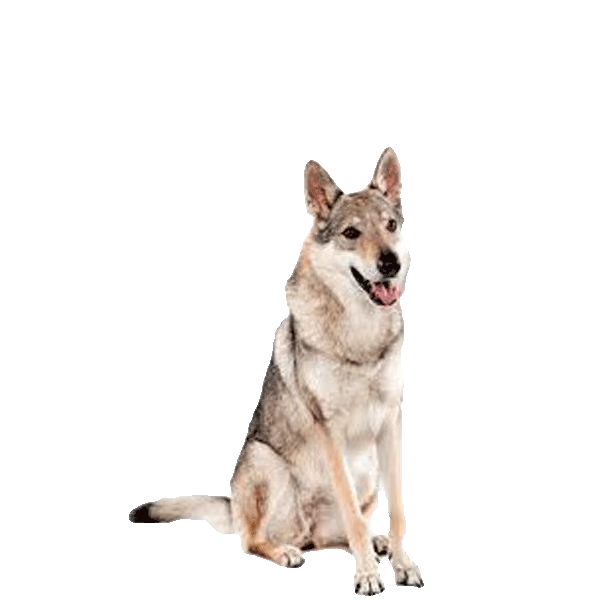
The Czechoslovakian Vlcak is a wolf-like, athletic breed known for its fierce loyalty, independence, and remarkable stamina.
How the Czechoslovakian Vlcak coat is built, and what that means when you groom it.
Critical: A Czechoslovakian Vlcak should not be shaved.
The undercoat keeps heat out as well as in, and the outer coat shields the skin from sun and insect bites. Clipping the whole coat off removes both. It often grows back patchy, soft or a different colour, and in some animals the guard hairs never return properly. Brush the undercoat out instead of cutting it off.
Information: A Czechoslovakian Vlcak drops its undercoat in heavy bursts.
The undercoat comes out in heavy bursts over a few weeks. An undercoat rake, or a bath followed by a proper blow-dry, clears it far faster than daily brushing. Clipping the coat down is not a shortcut for this.
A few of the Czechoslovakian Vlcak profiles members have added to United Pet Club.
The Czechoslovakian Vlcak is a large, wolf-like working breed, prized by experienced Australian owners for its loyalty, drive, and independence.
At first glance, the Czechoslovakian Vlcak could pass for a wild wolf that wandered into a suburban park. The breed carries a grey coat, amber eyes, and a lean, athletic frame that traces straight back to its Carpathian ancestors, plus a long, low trot built to cover ground rather than sprint. It emerged from a military breeding program in Czechoslovakia in the mid-twentieth century and has stayed close to those working roots ever since.
This is an endurance athlete, not a burst-of-speed dog. A Vlcak in good condition holds a steady trot for hours, a trait bred into it from the start, and that stamina means the dog needs a genuine job or a heavy daily workload to settle. A short walk around the block will not come close to meeting that need.
Temperament runs loyal but strongly independent. The Vlcak attaches hard to its own household and tends to hold strangers at arm's length. It makes its own decisions rather than following blindly, which suits an experienced handler and can frustrate a first-time dog owner.
| Attribute | Detail |
|---|---|
| Origin | Czech Republic |
| Size | Large |
| Lifespan | 12 to 16 years |
| Group/role | Working breed, originally developed for military and patrol work |
| Good with | Experienced owners and active households; needs early socialisation with strangers and other pets |
This breed suits owners who can offer firm, consistent guidance, daily physical work, and ongoing socialisation, ideally with access to a bit of acreage or a securely fenced block rather than a small courtyard. It is a strong match for people who already run, hike, or compete in dog sports and want a dog that stays close by choice. It is a poor fit for anyone working long hours away from home, or for a household wanting an easygoing, instantly friendly family pet.
The Czechoslovakian Vlcak was bred in 1955 when Czechoslovak border guards crossed German Shepherd Dogs with Carpathian wolves for endurance and scenting power.
The breed's story starts in 1955, when Czechoslovak authorities set out to test something specific: could the endurance, senses, and hardiness of a wolf be bred into a trainable working dog? Military researchers crossed working German Shepherd Dogs with Carpathian grey wolves at a border-guard facility, and the program ran as a deliberate, controlled experiment rather than an accident of breeding.
A female wolf named Brita produced the first litters with German Shepherd sires, and later generations brought in blood from a handful of other named wolves. Breeders selected hard for stamina, scenting power, night vision, and cold tolerance, exactly the traits a dog patrolling a border fence line would need.
Through the 1960s and 1970s, breeders stopped crossing back to wolves and instead bred the dogs to one another, which locked in a consistent type and a more predictable temperament. The project shifted from a working wolf hybrid toward something closer to a true breed, with traits owners could actually rely on.
Czechoslovakia recognised the breed nationally in 1982, and the Federation Cynologique Internationale later accepted it internationally, with Czechoslovakia recorded as the country of origin. In Australia, Dogs Australia is the national body owners would approach about pedigree registration or showing, though this remains a rare breed here, and most local dogs trace straight back to Czech or Slovak lines. Today the Czechoslovakian Vlcak works mainly as a companion and sport dog rather than a military animal, a long way from the border fences where it began.
The Czechoslovakian Vlcak stands lean and grey-coated with amber eyes, built with the light frame and reaching trot of a dog meant to cover distance, not sprint.
The overall impression is unmistakably wolf. The body reads rectangular and lean, the chest sits deep without being broad, and the legs run long and straight underneath. On the move the head and neck drop low, which only adds to the wild look, and the trot itself is light, far-reaching, and seemingly effortless, the breed's signature gait.
| Trait | Detail |
|---|---|
| Height | Males from 65 cm at the withers; females from 60 cm |
| Weight | Males from about 26 kg; females from about 20 kg |
| Coat | Straight, close double coat that thickens up over winter |
| Colours | Yellow-grey to silver-grey, with a lighter mask |
| Eyes | Amber, small, set obliquely |
The coat is a genuinely weather-resistant double coat, with a winter layer far heavier than the summer one and a dense undercoat that shrugs off the cold. That density is worth flagging for Australian owners: this is a coat built for a Central European winter, not for the middle of an inland heatwave, so exercise timing and shade matter here more than they would in the breed's homeland. Accepted colours run from yellow-grey through to silver-grey, always carrying the breed's characteristic light mask on the face. Hair sits short to medium in length and lies close to the body, while erect triangular ears and a low-carried, bushy tail finish off the wolf-like silhouette.
The Czechoslovakian Vlcak is fiercely loyal to its own household, independent-minded, and reserved with strangers unless socialisation starts early.
The Czechoslovakian Vlcak bonds hard with its family and will stand its ground defending them if it has to. Inside the home it tends to be playful and attentive, sticking close to its owners rather than wandering off to entertain itself. The breed reads body language well and stays tuned in to its handler's mood.
Strangers get a different reception: watchful, aloof, rarely warm on a first meeting. Without early and ongoing socialisation, that reserve can tip into genuine wariness, so exposure to new people and situations needs to start young and keep going.
The independent streak runs deep, a straight inheritance from its working and wolf background. This is a dog that weighs up whether a command is worth following before it complies, rather than obeying on reflex. Prey drive toward small animals can run high, so raising it alongside any resident cat or small dog from puppyhood matters. Left alone for long stretches, whether that is a suburban backyard in Brisbane or a townhouse in Melbourne, it does not settle well. It wants company, human or canine, and plenty of it.
| Trait | Rating |
|---|---|
| Affection | 4 |
| Energy | 5 |
| Trainability | 3 |
| Vocalness | 2 |
| Shedding | 4 |
The Czechoslovakian Vlcak has heavy daily needs: hours of exercise, a securely fenced block, and grooming that ramps up hard during the twice-yearly coat blow.
This is a dog that needs room and a fence it cannot out-jump or out-dig, tall and buried both, because the breed is a genuinely capable escape artist in either direction. The dense coat shrugs off a Victorian or Tasmanian winter without complaint, but it is a real handicap once an Australian summer sets in, so shade and fresh water need to be available at all times, not just on the worst days. This is not a dog for units or apartments, and it copes badly with being left alone for long periods.
The Czechoslovakian Vlcak needs a complete, protein-forward diet sized to its real workload, split across two daily meals once it reaches adulthood.
Feed a complete and balanced diet built for a large, active working breed. Protein needs to support real muscle maintenance, and total calories should track actual workload rather than a fixed number, since a lazy Sunday and a long hike day are not the same dog. Many owners run a quality commercial food, and some feed a carefully balanced raw or fresh diet under professional guidance. Fresh water should be down at all times.
| Life stage | Amount per day | Meals |
|---|---|---|
| Puppy (2 to 6 months) | Per food label, split into small meals | 3 to 4 |
| Adolescent (6 to 18 months) | Per food label for growth | 2 to 3 |
| Adult | About 400 to 600 g dry food, adjusted for activity | 2 |
| Senior | Slightly reduced to hold weight | 2 |
Keep treats to a small slice of daily calories, roughly 10 percent, to head off weight gain. A properly balanced complete diet usually covers what a healthy adult needs without extras. Run any supplement past a vet first, joint support for an older or hard-working dog being the obvious example.
The Czechoslovakian Vlcak is generally hardy with a 12 to 16 year lifespan, though hip dysplasia and a handful of inherited conditions turn up in the breed.
The Czechoslovakian Vlcak is a tough, hardy breed that regularly reaches 12 to 16 years. Its genetics sit close to the wild, and the founder population was small, so responsible breeders screen hard for inherited disease and select for sound structure. A lean, fit dog that stays active tends to hold up well into old age.
| Condition | Signs | Note |
|---|---|---|
| Hip dysplasia | Stiffness, limping, trouble getting up | Choose stock from hip-screened parents |
| Elbow dysplasia | Front-leg lameness, reluctance to exercise | Picked up on veterinary imaging |
| Degenerative myelopathy | Gradual weakness in the hind legs | A genetic test is available |
| Pituitary dwarfism | Stunted growth, coat changes | Carrier testing helps breeders avoid affected litters |
The Czechoslovakian Vlcak is sharp but independent, so training works best with an early start, real consistency, and reward-based methods.
The Czechoslovakian Vlcak is a capable, intelligent dog, but it is not wired for automatic obedience. It questions commands and shuts down under harsh handling or repetitive drilling. Training works when it starts early, stays consistent, and gives the dog an actual reason to cooperate. Short sessions with some variety hold its attention far better than long, repetitive ones. Socialisation with people, other animals, and new places matters just as much as obedience work, and it needs to start in puppyhood.
Czechoslovakian Vlcak females typically cycle once a year, gestation runs about 63 days, and responsible breeding starts from health-tested, mature parents.
Females of this breed often come into season once a year rather than twice, a pattern closer to a wolf's cycle than a typical domestic dog's. Breeding should wait until both parents are fully mature physically and have cleared the relevant health screening, hip evaluation and the available genetic tests included. Mating is timed around the female's fertile window.
Gestation runs about 63 days. Litter sizes tend to sit in the medium range for a large breed. The dam usually whelps and raises the litter with minimal help, though a quiet, secure whelping space and a vet on standby both matter. Puppies open their eyes at roughly two weeks and start weaning from around three to four weeks.
Early socialisation carries real weight here. Because the breed runs naturally reserved, breeders handle the pups daily and expose them to a range of sights, sounds, and people well before they head to new homes, normally no earlier than eight weeks. Matching each puppy with an owner who is ready for an active, independent dog heads off a lot of problems down the track.
| Metric | Value |
|---|---|
| Sexual maturity | Around 1 to 2 years |
| Female cycle | Often once a year |
| Gestation | About 63 days |
| Typical litter | Several puppies (medium litter for a large breed) |
| Weaning | About 6 to 8 weeks |
| Earliest rehoming | 8 weeks or later |
A free lifetime United Pet Club record for your Czechoslovakian Vlcak, with the microchip registered at no charge and nothing falling due each year.
Punch in your Czechoslovakian Vlcak's name, his date of birth, and a decent photo, attach your mobile, and save. Done: a lifetime record that never bills you. Registering your dog is the easy half of responsible ownership, and the half people skip.
A chipped Czechoslovakian Vlcak without a registration is carrying a number nobody can use. File it with United Pet Club and the number works for him: free for life, open to every chip brand sold here, searchable from any clinic or pound in the country. Microchip registration now, free account while you're at it.
Sign up free with United Pet Club, add his name, breed, and a photo, and you're done. The lifetime plan keeps the profile live at no cost, and the chip number can go in whenever the vet's done his bit.
Add the 15-digit number to your free account with your address and mobile. Registration and every update after it are free, and chips from any manufacturer an Australian vet implants are accepted.
In most states and territories, yes, chipping is required and the register entry comes with it. The state register and your United Pet Club record do different jobs: one satisfies the council, the other keeps a current phone number one scan away, free.
Nothing with United Pet Club. Profile, chip registration, and unlimited updates are covered for his whole life, no annual fee in sight.
Common questions about the Czechoslovakian Vlcak cover size, temperament, day-to-day demands, lifespan, family suitability, and how to find one in Australia.
It is a large breed. Males stand from 65 cm at the withers and weigh from about 26 kg, while females stand from 60 cm and weigh from about 20 kg.
The breed is loyal and courageous with its family, independent-minded, and aloof with strangers. It bonds tightly with its own people and needs early socialisation to feel comfortable around unfamiliar humans and animals.
Yes, it is demanding. The breed needs one to two hours of daily exercise, mental work, secure fencing, and consistent training, plus extra care around exercise timing once the weather heats up given its heavy double coat. It is not recommended for first-time owners or for anyone away from home for long hours.
Typical lifespan is 12 to 16 years, and the breed is generally robust when kept fit and fed properly.
It can be devoted to a family it has grown up with, but it suits active, experienced owners best. Prey drive and natural reserve mean it needs early socialisation with kids and other pets.
Not really. The breed is uncommon outside Central Europe, and Australia is no exception. Prospective owners typically go on a waiting list with a responsible breeder who health-tests and properly socialises litters, and many local dogs are imported or trace back to Czech or Slovak bloodlines. Dogs Australia can point prospective owners toward registered breeders and clubs.
Yes. The double coat sheds steadily year-round and blows out hard twice a year, and daily brushing during those two periods is the only way to keep on top of the loose undercoat.



