
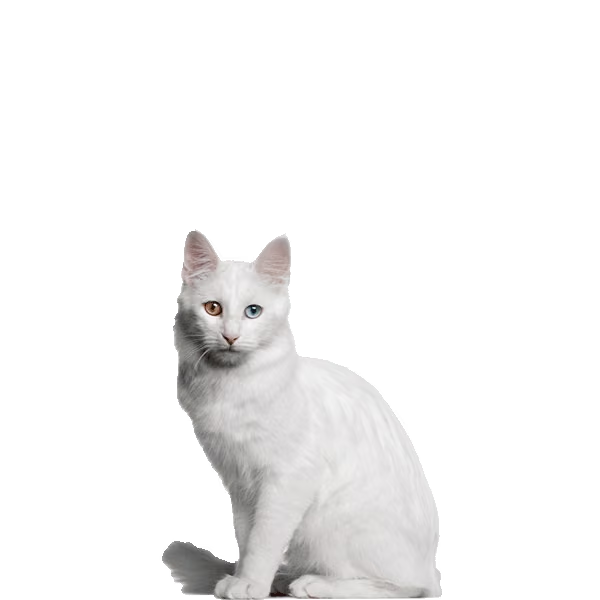
Turkish Vankedisi
The Turkish Vankedisi is the pure-white Van variety, prized for its active, affectionate temperament and loyal bond with its people.
- Size
- Large
- Lifespan
- 12–17 years
- Origin
- Turkey
- Temperament
- Active
- Standard colors
- White
Characteristics
Coat and grooming
How the Turkish Vankedisi coat is built, and what that means when you groom it.
- Coat layers
- Single coat
- Coat texture
- Silky
- Coat length
- Medium
- Shedding
- Seasonal shedding
Grooming guidance
Caution: A Turkish Vankedisi coat mats easily.
Fine or long hair tangles at the base of the coat, out of sight, where the mats tighten and pull on the skin. Brushing has to reach right down to the roots in sections, not just skim the surface.
Information: A Turkish Vankedisi drops its undercoat in heavy bursts.
The undercoat comes out in heavy bursts over a few weeks. An undercoat rake, or a bath followed by a proper blow-dry, clears it far faster than daily brushing. Clipping the coat down is not a shortcut for this.
Turkish Vankedisi colors and patterns
What each club's breed standard says about every Turkish Vankedisi color and pattern. Point at a ruling to see the club's own wording.
Breed standards describe the Turkish Vankedisi in White. Standard patterns: Solid.
| Color or pattern | TICA | GCCF |
|---|---|---|
| White | Standard (“Solid white”) | Standard (“Chalk white”) |
| Patterns | ||
| Solid | Standard (“Solid”) | No ruling |

| Color or pattern | TICA | GCCF |
|---|---|---|
| Blue | Standard (“blue”) | Standard (“Blue-eyed”) |
| Amber | Standard (“amber”) | Standard (“Light to medium amber”) |
| Orange | No ruling | Disqualifying (“Orange”) |
| Copper | No ruling | Disqualifying (“copper”) |
| Patterns | ||
| Odd-eyed | Standard (“odd eyed”) | Standard (“Odd-eyed”) |

| Color or pattern | TICA | GCCF |
|---|---|---|
| Pink | Standard (“pink”) | Standard (“pink”) |
| Color or pattern | TICA | GCCF |
|---|---|---|
| Pink | Standard (“pink”) | Standard (“pink”) |
What the rulings mean
- Standard
- Described by the club's breed standard.
- Disqualifying
- The club's breed standard disqualifies an animal of this colour or pattern.
Color changes
How a Turkish Vankedisi's colors can change over its life.
Whitechanges toShaded
Coat · With age
Whitechanges toChinchilla
Coat · With age
Whitechanges toPointed
Coat · With age · from 1 to 52 weeks
Solidchanges toSmoke
Coat · With age · from 3 to 104 weeks
Bluechanges toGreen
Eyes · With age · from 4 to 17 weeks
Bluechanges toYellow
Eyes · With age · from 4 to 17 weeks
Bluechanges toGold
Eyes · With age · from 4 to 17 weeks
Bluechanges toCopper
Eyes · With age · from 4 to 17 weeks
Bluechanges toOrange
Eyes · With age · from 4 to 17 weeks
Bluechanges toHazel
Eyes · With age · from 4 to 17 weeks
Bluechanges toAmber
Eyes · With age · from 4 to 17 weeks
Pinkchanges toSeal
Nose · With age · from 1 to 52 weeks
Pinkchanges toBlue
Nose · With age · from 1 to 52 weeks
Pinkchanges toChocolate
Nose · With age · from 1 to 52 weeks
Pinkchanges toLilac
Nose · With age · from 1 to 52 weeks
Pinkchanges toSeal
Paw pads · With age · from 1 to 52 weeks
Pinkchanges toBlue
Paw pads · With age · from 1 to 52 weeks
Pinkchanges toChocolate
Paw pads · With age · from 1 to 52 weeks
Pinkchanges toLilac
Paw pads · With age · from 1 to 52 weeks


Sources
Each ruling comes from the club's published breed standard or color list.
Turkish Vankedisi: Australia's rarest all-white cat
The Turkish Vankedisi is an all-white Turkish national treasure, distinct from the Turkish Van, and one of the rarest cat breeds available to Australian enthusiasts. Importing a Vankedisi means navigating DAFF/BICON biosecurity requirements and sourcing from a tiny global breeding population.
The Turkish Vankedisi is not a Turkish Van with missing markings. It is a separate breed, developed and preserved by Turkish universities in Van and Ankara, and recognised as a distinct feline of Turkish national heritage. Its coat is entirely white from head to tail, and that white is not the result of albinism. The pigmentation comes from dominant white or white-spotting genes, which means Vankedisi cats have normal eye development and often display heterochromia, with one blue eye and one amber or green eye.
For Australian cat enthusiasts, the Vankedisi presents a genuine rarity challenge. Very few breeding pairs exist outside Turkey, and importing any cat into Australia means meeting strict DAFF (Department of Agriculture, Fisheries and Forestry) BICON conditions. Declaring the cat's coat genetics correctly matters during the health-declaration stage, since albino cats carry different health concerns than white-coated cats, and customs veterinary officers will ask about this distinction.
ANCCATS (Australian National Cats) does not currently list the Vankedisi as a fully recognised breed, which means registration pathways require assessment and can involve provisional status. Prospective owners should contact ANCATS directly before beginning the import process.
| Characteristic | Detail |
|---|---|
| Origin | Turkey (Van and Ankara regions) |
| Coat | All-white, semi-long, no coloured markings |
| Eye colour | Odd-eyed (heterochromia) most common; blue or amber also occur |
| Size | Medium to large, 4–9 kg |
| Lifespan | 12–17 years |
The Vankedisi is a physically robust cat with a muscular, semi-foreign body type. Adults carry a semi-long coat that lacks the dense undercoat of many northern breeds, which actually suits warmer Australian climates better than some owners expect. The breed is alert, curious, and bonds strongly with its household, though it can be selective about strangers.
History of the Turkish Vankedisi breed
The Turkish Vankedisi was developed from the same Lake Van region of eastern Turkey as the Turkish Van, but Turkish breeders and universities selectively preserved the all-white cats as a distinct national breed.
The Van region of eastern Turkey has been home to distinctive semi-long-haired cats for centuries. The cats that would become the Turkish Van were brought to Britain in the 1950s, selected for their bicolour pattern with coloured head and tail markings. The all-white cats from the same population were not exported in the same wave and remained largely within Turkey.
Turkish breeders, supported by Van University and Ankara University, began formal efforts to document, preserve, and develop the all-white variety as a separate breed. These institutions established breeding programmes to maintain the Vankedisi distinct from the Turkish Van. The Turkish government has at times classified the breed as a protected natural heritage animal, reflecting the cultural importance placed on it.
Outside Turkey, the Vankedisi remains extremely scarce. A small number of breeding cats have been exported to European countries, and an even smaller number have reached North America. Australia has seen virtually no documented importations of Vankedisi cats, making this one of the most genuinely rare breeds an Australian cat fancier could pursue.
The breed's rarity is compounded by the small global gene pool and the complexities of international cat export from Turkey, which has at times imposed restrictions on the export of what it considers nationally significant animals. Any Australian importer must work through Turkish export clearance as well as Australian DAFF/BICON import approvals, making the process lengthy and unpredictable.
Turkish Vankedisi appearance: the all-white coat explained
The Turkish Vankedisi is defined by its entirely white coat, which is not albinism but the result of dominant white or white-spotting pigmentation genetics. The breed is medium to large in size, with a muscular build and striking eye colour.
The defining feature of the Turkish Vankedisi is a coat that is white from root to tip, across every part of the body. Unlike the Turkish Van, no coloured markings appear on the head or tail. This is not a fault or a colour point restriction. The Vankedisi is the all-white variety by breed definition.
The white coat is not produced by albinism. Albino cats lack melanin production entirely, resulting in pink or very pale blue eyes and sensitivity to light. The Vankedisi's white coat comes from dominant white or white-spotting genes that suppress pigmentation in the coat while allowing normal pigmentation in other tissues. This is why the breed so frequently displays heterochromia, where one eye is blue and the other is amber, copper, or green. Odd-eyed Vankedisi are considered the most desirable by Turkish breed standards.
| Feature | Description |
|---|---|
| Body | Medium to large, muscular, semi-foreign build |
| Coat length | Semi-long, silky texture, minimal undercoat |
| Coat colour | Pure white, no markings of any kind |
| Eyes | Odd-eyed most common (one blue, one amber/green); solid blue or amber also accepted |
| Head | Moderately wedge-shaped, broad forehead, medium-length nose |
The Vankedisi coat has a silky, fine texture with less undercoat density than many semi-long breeds. It does not mat as readily as double-coated breeds, though regular grooming remains important. In Australian heat, the lighter undercoat structure means the breed typically manages warm conditions better than breeds developed in cold climates.
The ears are medium-sized, set wide apart, and tufted at the tips. The tail is full and plumed. Overall the cat gives an impression of elegance combined with physical substance, distinct from the delicate look of oriental breeds and the heavy-set appearance of Maine Coons or Norwegian Forest Cats.
Turkish Vankedisi temperament and personality
The Turkish Vankedisi is an intelligent, active, and loyal breed. It forms strong bonds with its primary household but can be cautious with strangers, and it tends to be moderately vocal and playful throughout its life.
The Turkish Vankedisi is not a lap cat that spends its day quietly. It is an engaged, curious animal that wants to be involved in household activity. Owners consistently report that Vankedisi cats follow them from room to room, investigate anything new in the environment, and prefer active interaction to passive proximity.
The breed is known for intelligence and can learn to respond to its name, play fetch with small objects, and open simple latches. This level of engagement means the Vankedisi does not do well when left alone for extended periods without stimulation. A second cat, interactive toys, or regular play sessions are practical requirements rather than optional extras.
With strangers, many Vankedisi cats are initially reserved. They observe before approaching, and trust is built over repeated interactions rather than immediately. This wariness is not aggression and typically softens within a single visit once the cat has assessed the newcomer.
| Trait | Rating / Notes |
|---|---|
| Affection with family | High: bonds closely with household members |
| Tolerance of strangers | Moderate: cautious initially, warms with time |
| Playfulness | High: remains active into adulthood |
| Tolerance of other cats | Moderate to high: introductions should be gradual |
| Suitability for children | Good: tolerates respectful interaction well |
Caring for a Turkish Vankedisi in Australia
The Turkish Vankedisi has moderate grooming needs given its semi-long coat, and its activity level demands consistent exercise and environmental enrichment. Australian owners should also account for sun protection for a white-coated cat in high-UV conditions.
Grooming the Turkish Vankedisi
The Vankedisi coat is semi-long and silky, with less undercoat than many long-haired breeds. This reduces but does not eliminate grooming requirements.
- Brush the coat two to three times per week to prevent tangles and remove loose hair
- During seasonal shedding periods, increase to daily brushing
- Check the ear canals weekly and clean gently with a vet-approved solution if needed
- Trim nails every two to three weeks
- Dental hygiene should be maintained with regular brushing or dental treats approved by your vet
Exercise and enrichment
The Vankedisi is an active breed that requires more than basic indoor access to stay mentally and physically healthy.
- Provide at least two structured play sessions daily of ten to fifteen minutes each
- Wand toys, puzzle feeders, and fetch games suit the breed's natural curiosity
- Cat trees and shelving that allow climbing and observation posts are strongly recommended
- Rotation of toys prevents boredom; the Vankedisi is quick to lose interest in static environments
- If kept as a single cat, interaction with household members must fill the social stimulation gap
Australian climate and sun protection
Australia's UV index is among the highest in the world, and a white-coated cat without pigmentation protection in the skin around the ears and nose is at real risk of solar-related skin damage. White cats, including the Vankedisi, have a well-documented elevated risk of squamous cell carcinoma on unpigmented ear tips and nose leather. Owners in sunny Australian states should limit direct sun exposure during peak UV hours, consider pet-safe sunscreen on vulnerable areas if the cat spends time in direct sun, and schedule annual skin checks with their vet. Indoor living with access to windows that filter UV provides the safest balance.
Turkish Vankedisi nutrition and feeding
The Turkish Vankedisi is a medium-to-large, active cat that does well on a high-protein diet appropriate for its life stage. Weight management is important as indoor cats in Australian households can become sedentary.
The Vankedisi is an active, muscular breed and its diet should reflect that energy requirement. High-quality commercial cat food with named protein sources listed as the primary ingredient is a solid foundation. Both wet and dry food can form part of the diet, though wet food contributes usefully to daily water intake, which is relevant in Australia's warmer climates.
Portion control matters for indoor cats that do not have outdoor hunting opportunities. The Vankedisi can gain weight if free-fed on calorie-dense dry food without adequate exercise to balance intake.
| Life stage | Recommended food type | Feeding frequency |
|---|---|---|
| Kitten (under 12 months) | High-protein kitten formula, wet and dry | Three to four times daily |
| Adult (1–7 years) | High-protein adult formula, balanced wet and dry | Two times daily |
| Senior (7+ years) | Senior formula with joint and kidney support | Two times daily, portion-controlled |
Avoid feeding raw diets without veterinary guidance, particularly given Australian biosecurity regulations around raw meat and the risk of pathogens. Many Australian vets recommend against raw diets for indoor cats or will provide specific safe preparation protocols if an owner prefers this approach. Treats should not exceed ten percent of daily caloric intake.
Turkish Vankedisi health: deafness, skin, and what to test for
The Turkish Vankedisi is generally a healthy breed, but white coat genetics bring a real risk of congenital deafness in blue-eyed cats. Australian owners should also be alert to sun-related skin conditions given the country's high UV exposure.
The Turkish Vankedisi is not an albino breed and does not carry albinism-related health risks. However, the white coat genetics that produce the Vankedisi's characteristic all-white colouring are associated with an elevated risk of congenital deafness, particularly in blue-eyed individuals. This link between the W (dominant white) gene, blue eyes, and deafness is well established in feline genetics.
Odd-eyed Vankedisi cats have intermediate deafness risk compared to blue-eyed cats, and the deaf ear typically corresponds to the side with the blue eye. Cats with two non-blue eyes carry the lowest deafness risk within the breed. Reputable breeders should BAER (Brainstem Auditory Evoked Response) test kittens before sale, and Australian buyers should request proof of this testing.
| Condition | Risk level | Notes |
|---|---|---|
| Congenital deafness | Elevated, especially in blue-eyed cats | BAER testing recommended; manageable with indoor living |
| Squamous cell carcinoma (ear tips, nose) | Elevated in high-UV environments | Annual skin checks; limit direct sun; pet-safe sunscreen |
| Hypertrophic cardiomyopathy | Low to moderate baseline feline risk | Echo screening recommended from age 2; no breed-specific genetic test exists |
| Dental disease | Moderate baseline feline risk | Regular brushing and professional cleans reduce risk |
Deaf cats can live full and happy lives when managed appropriately. Indoor living is strongly recommended for deaf Vankedisi, as they cannot hear approaching dangers such as vehicles or predators. Vibration-based communication (tapping the floor near them, for example) can substitute effectively for voice calls. Some deaf cats are more vocal than hearing cats, as they cannot monitor the volume of their own calls.
Australian owners should establish a relationship with a vet experienced in pedigree cats, as general practice vets may have limited Vankedisi-specific knowledge. Breed clubs and ANCATS can help with referrals.
Training the Turkish Vankedisi
The Turkish Vankedisi is intelligent and responds well to positive reinforcement training. Early socialisation is especially important given the breed's initial wariness toward strangers.
The Vankedisi is among the more trainable of the semi-long-haired breeds. It pays attention, remembers routines, and responds consistently to reward-based training. Clicker training works well with this breed, and many Vankedisi cats learn to respond to their name, sit on cue, and even retrieve small toys within a few short training sessions.
Training is not just about commands. For the Vankedisi, training sessions double as structured mental stimulation, which the breed genuinely needs. A ten-minute training session can be more tiring for the cat than thirty minutes of free play, because the mental engagement is more demanding.
Socialisation should begin as early as possible. Vankedisi kittens exposed to a variety of people, sounds, and environments before twelve weeks of age are significantly more confident as adults. Australian owners who plan to show their cat under ANCATS rules will need a cat that tolerates handling by judges and the noise of show halls, which requires consistent early exposure.
For deaf Vankedisi, training adapts naturally to visual cues. Hand signals replace verbal commands, and the cat's focus on its owner's movements can actually make visual-cue training faster than verbal training in some cases. Patience and consistency are the core requirements.
Breeding Turkish Vankedisi cats: what Australian breeders need to know
The Turkish Vankedisi gene pool outside Turkey is extremely small. Australian breeders face significant challenges sourcing breeding stock, and responsible breeding requires BAER testing and careful management of white coat genetics to avoid compounding deafness risk.
Breeding the Turkish Vankedisi responsibly requires understanding the genetics that produce the all-white coat. The dominant white (W) gene that creates the Vankedisi's white coat is also linked to deafness, particularly when two copies interact. Breeding two blue-eyed white cats together significantly increases the probability of deaf offspring. Responsible breeders introduce odd-eyed or amber-eyed cats into the programme to manage deafness risk across generations.
For Australian breeders, the fundamental challenge is access to breeding stock. The global Vankedisi breeding population outside Turkey is tiny. Any serious breeding programme will likely require international import of at least one founding cat, which means navigating DAFF/BICON import conditions including mandatory quarantine periods. Australian quarantine for cats is strict, and costs including veterinary clearances, export permits from Turkey, airline transport, and quarantine facility fees can be substantial.
Breeders interested in establishing a Vankedisi line in Australia should contact ANCATS about registration pathways for a breed not yet fully listed, consult with established European Vankedisi breeders for guidance on sourcing, and work with an Australian import agent experienced in exotic cat breeds.
| Factor | Detail |
|---|---|
| Deafness risk management | BAER test all kittens; avoid blue-eyed x blue-eyed pairings where possible |
| Coat genetics | Dominant white or white-spotting gene; not albino; no colour variants expected |
| Litter size | Typically 3–5 kittens |
| Breeding age | Females from 18 months; males from 12–18 months |
| Global gene pool | Extremely limited outside Turkey; international cooperation with European breeders recommended |
Registering a Turkish Vankedisi the easy way, microchip included
Free lifetime registration for your Turkish Vankedisi, chip record included, searchable wherever in the country she wanders.
Turkish Vankedisi registration and microchipping in Australia
Set the record up before she needs it: name, colouring, photo, your mobile, save. That is the whole of registering your cat with United Pet Club, and the record stands for life without a bill.
Scanners find chips in seconds; the question is what the number points at. Point your Turkish Vankedisi's chip at a live record: free with the lifetime plan, open to all brands, kept current through every move without charges. Microchip registration plus a free account, and she's covered.
How do I register my Turkish Vankedisi in Australia?
Free with United Pet Club: set up an account, add her name, colouring, and a photo, and the profile's live for her whole life. A chip isn't required to start.
How do I register my Turkish Vankedisi's microchip?
Enter the 15-digit number into your free account with your current details. Registration and updates never cost anything, whatever brand of chip your vet used.
Do cats need to be microchipped in Australia?
Several states and territories require it, and shelters chip before rehoming as standard. Requirement or not, the register entry with your current number is what actually brings a Turkish Vankedisi home.
How much is it to register a Turkish Vankedisi?
Nothing at all. United Pet Club's lifetime plan covers her profile, the chip record, and every update, with no annual renewal.
Turkish Vankedisi frequently asked questions for Australian cat owners
Answers to the questions Australian cat enthusiasts most commonly ask about the Turkish Vankedisi, covering ANCATS registration, biosecurity imports, cost, deafness, and comparison with the Turkish Van.
Is the Turkish Vankedisi registered with ANCATS in Australia?
The Turkish Vankedisi is not currently listed as a fully recognised breed by ANCATS (Australian National Cats). Prospective owners or breeders wishing to register a Vankedisi should contact ANCATS directly about the assessment and provisional registration process for rare breeds not yet on the official list.
What does importing a Turkish Vankedisi into Australia actually involve?
Importing a cat into Australia requires compliance with DAFF (Department of Agriculture, Fisheries and Forestry) BICON conditions. This includes obtaining an import permit, ensuring the cat meets health and vaccination requirements from an approved country, completing a mandatory quarantine period (typically ten days in an approved facility), and paying all associated fees. Turkey is not on the Category 1 approved-country list, which means additional steps may apply. Using an experienced pet import agent is strongly recommended.
Is the Turkish Vankedisi albino? Why does its coat matter for health declarations?
The Turkish Vankedisi is not albino. Its white coat comes from dominant white or white-spotting genes, not from albinism. This distinction matters in health declarations because albino cats have different health profiles, including light sensitivity and different eye conditions. Declaring the correct coat genetics during import health assessments ensures accurate veterinary evaluation. If asked, the coat type is 'white (dominant white gene, non-albino)'.
How much does a Turkish Vankedisi cost in Australia?
Because the breed is extremely rare in Australia and any kitten would likely be sourced through international import, the total cost is far higher than domestic breeds. Import costs alone (permits, transport, quarantine) can run into several thousand AUD before the purchase price is added. A Vankedisi kitten from a reputable Turkish or European breeder may cost AUD 2,000 to 5,000 or more, with import and quarantine adding AUD 3,000 to 8,000 depending on the specifics. Prospective owners should budget realistically for the full process.
What is the difference between a Turkish Vankedisi and a Turkish Van?
The Turkish Van has coloured markings on the head and tail, with the rest of the body white. The Turkish Vankedisi is all-white with no coloured markings anywhere. They originate from the same Lake Van region of Turkey but have been developed as distinct breeds. The Vankedisi was preserved by Turkish universities specifically as the all-white variety. The Turkish Van is significantly more available in Australia than the Vankedisi.
Are white cats like the Vankedisi always deaf?
Not always, but the risk is elevated. The dominant white gene associated with the all-white coat is linked to deafness, particularly in cats with blue eyes. Odd-eyed cats have intermediate risk, and cats with two non-blue eyes have the lowest risk within the breed. BAER testing (Brainstem Auditory Evoked Response) can confirm whether a kitten is deaf, partially deaf, or hearing. Always ask for BAER test results when purchasing a Vankedisi kitten.
Can a white cat like the Vankedisi get sunburned in the Australian climate?
Yes. White cats with unpigmented skin on the ear tips and nose leather are at real risk of solar skin damage and squamous cell carcinoma in Australia's high-UV environment. Limit your Vankedisi's exposure to direct midday sun. Speak with your vet about pet-safe sunscreen for the ear tips and nose, and schedule annual skin checks. This is a genuine health concern in Australia, not a minor precaution.
From the community
Ask about the Turkish VankedisiNo questions about the Turkish Vankedisi yet. Be the first to ask.
Browse Cat breeds