
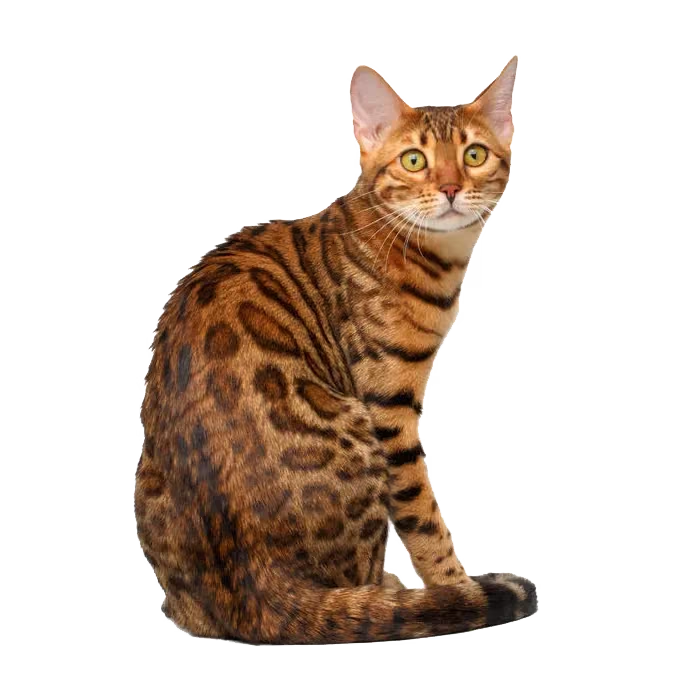
Toyger
The Toyger is a friendly, tiger-striped breed bred for its playful, sociable nature and striking miniature-tiger appearance.
- Size
- Medium
- Lifespan
- 10–15 years
- Origin
- United States
- Temperament
- Friendly
- Standard colors
- Brown
Characteristics
Coat and grooming
How the Toyger coat is built, and what that means when you groom it.
- Coat layers
- Single coat
- Coat texture
- Smooth
- Coat length
- Short
- Shedding
- Moderate shedding
Toyger colors and patterns
What each club's breed standard says about every Toyger color and pattern. Point at a ruling to see the club's own wording.
Breed standards describe the Toyger in Brown. Standard patterns: Mackerel tabby.
| Color or pattern | GCCF | TICA | LOOF |
|---|---|---|---|
| Brown | Standard (“brown”) | Standard (“Brown Mackerel Tabby”) | Standard (“noir”) |
| Lilac | Not recognised (“lilac”) | No ruling | No ruling |
| Chocolate | Not recognised (“chocolate”) | No ruling | No ruling |
| Cinnamon | Not recognised (“cinnamon”) | No ruling | No ruling |
| Fawn | Not recognised (“fawn”) | No ruling | No ruling |
| Patterns | |||
| Mackerel tabby | Standard (“modified mackerel tabby”) | Standard (“Modified mackerel tabby”) | Standard (“mackerel”) |
| Classic tabby | No ruling | Fault (“Classic alignment of mackerel stripes”) | No ruling |
| Solid | Not recognised (“non-agouti pattern”) | No ruling | No ruling |
%22%3E%3Cpath%20d%3D%22M20%2021Q34%2018.8%2048%2022%22%20fill%3D%22none%22%20stroke%3D%22%231C1C1C%22%20stroke-width%3D%222.2%22%20stroke-linecap%3D%22round%22%20stroke-linejoin%3D%22round%22%2F%3E%3Cpath%20d%3D%22M24.5%2021.5q-1.2%208%20.4%2016M28.6%2021q-1.2%208%20.4%2016.6M32.7%2020.7q-1.2%208%20.4%2016.8M36.8%2020.7q-1.2%208%20.4%2016.8M40.9%2021q-1.2%208%20.4%2016.6M45%2021.8q-1%207%20.4%2014%22%20fill%3D%22none%22%20stroke%3D%22%231C1C1C%22%20stroke-width%3D%221.6%22%20stroke-linecap%3D%22round%22%20stroke-linejoin%3D%22round%22%2F%3E%3Cpath%20d%3D%22M15%2044H50M15%2048H50%22%20fill%3D%22none%22%20stroke%3D%22%231C1C1C%22%20stroke-width%3D%221.8%22%20stroke-linecap%3D%22round%22%20stroke-linejoin%3D%22round%22%2F%3E%3Cpath%20d%3D%22M50%2022H62M51%2017H62M52%2012H63%22%20fill%3D%22none%22%20stroke%3D%22%231C1C1C%22%20stroke-width%3D%221.8%22%20stroke-linecap%3D%22round%22%20stroke-linejoin%3D%22round%22%2F%3E%3Ccircle%20cx%3D%2259.8%22%20cy%3D%227.8%22%20r%3D%222%22%20fill%3D%22%231C1C1C%22%2F%3E%3Cpath%20d%3D%22M12.6%2015.5l.6%204.2M15%2015.5l-.2%204.2M9%2025.2l4.6%201M9.6%2027.4l4%20.2%22%20fill%3D%22none%22%20stroke%3D%22%231C1C1C%22%20stroke-width%3D%221.1%22%20stroke-linecap%3D%22round%22%20stroke-linejoin%3D%22round%22%2F%3E%3C%2Fg%3E%3Cuse%20href%3D%22%23s%22%20fill%3D%22none%22%20stroke%3D%22%233B2A20%22%20stroke-opacity%3D%220.6%22%20stroke-width%3D%221%22%20stroke-linejoin%3D%22round%22%2F%3E%3Cpath%20d%3D%22M3.4%2022.3L5.4%2022.5L4.3%2024Z%22%20fill%3D%22%23E8A0B4%22%2F%3E%3Ccircle%20cx%3D%229.6%22%20cy%3D%2221.2%22%20r%3D%221.1%22%20fill%3D%22%231C1C1C%22%2F%3E%3C%2Fsvg%3E)
%22%3E%3Cpath%20d%3D%22M20%2021Q34%2018.8%2048%2022%22%20fill%3D%22none%22%20stroke%3D%22%231C1C1C%22%20stroke-width%3D%222.2%22%20stroke-linecap%3D%22round%22%20stroke-linejoin%3D%22round%22%2F%3E%3Ccircle%20cx%3D%2235%22%20cy%3D%2229.5%22%20r%3D%222.4%22%20fill%3D%22%231C1C1C%22%2F%3E%3Ccircle%20cx%3D%2235%22%20cy%3D%2229.5%22%20r%3D%225.6%22%20fill%3D%22none%22%20stroke%3D%22%231C1C1C%22%20stroke-width%3D%222.2%22%2F%3E%3Ccircle%20cx%3D%2235%22%20cy%3D%2229.5%22%20r%3D%229.4%22%20fill%3D%22none%22%20stroke%3D%22%231C1C1C%22%20stroke-width%3D%222.2%22%2F%3E%3Cpath%20d%3D%22M15%2044H50M15%2048H50%22%20fill%3D%22none%22%20stroke%3D%22%231C1C1C%22%20stroke-width%3D%221.8%22%20stroke-linecap%3D%22round%22%20stroke-linejoin%3D%22round%22%2F%3E%3Cpath%20d%3D%22M50%2022H62M51%2017H62M52%2012H63%22%20fill%3D%22none%22%20stroke%3D%22%231C1C1C%22%20stroke-width%3D%221.8%22%20stroke-linecap%3D%22round%22%20stroke-linejoin%3D%22round%22%2F%3E%3Ccircle%20cx%3D%2259.8%22%20cy%3D%227.8%22%20r%3D%222%22%20fill%3D%22%231C1C1C%22%2F%3E%3Cpath%20d%3D%22M12.6%2015.5l.6%204.2M15%2015.5l-.2%204.2M9%2025.2l4.6%201M9.6%2027.4l4%20.2%22%20fill%3D%22none%22%20stroke%3D%22%231C1C1C%22%20stroke-width%3D%221.1%22%20stroke-linecap%3D%22round%22%20stroke-linejoin%3D%22round%22%2F%3E%3C%2Fg%3E%3Cuse%20href%3D%22%23s%22%20fill%3D%22none%22%20stroke%3D%22%233B2A20%22%20stroke-opacity%3D%220.6%22%20stroke-width%3D%221%22%20stroke-linejoin%3D%22round%22%2F%3E%3Cpath%20d%3D%22M3.4%2022.3L5.4%2022.5L4.3%2024Z%22%20fill%3D%22%23E8A0B4%22%2F%3E%3Ccircle%20cx%3D%229.6%22%20cy%3D%2221.2%22%20r%3D%221.1%22%20fill%3D%22%231C1C1C%22%2F%3E%3C%2Fsvg%3E)

| Color or pattern | GCCF | TICA | LOOF |
|---|---|---|---|
| Hazel | Standard (“hazel”) | No ruling | No ruling |
| Gold | Standard (“gold”) | No ruling | No ruling |
| Green | Standard (“Green”) | No ruling | No ruling |
| Blue | No ruling | Disqualifying (“Blue”) | Disqualifying (“bleu”) |
| Color or pattern | GCCF | TICA | LOOF |
|---|---|---|---|
| Black | Standard (“black”) | Standard (“black”) | Standard (“noir”) |
What the rulings mean
- Standard
- Described by the club's breed standard.
- Fault
- Named by the club's breed standard as a fault: the animal can be shown but is penalised.
- Disqualifying
- The club's breed standard disqualifies an animal of this colour or pattern.
- Not recognised
- The club does not accept this colour or pattern for the breed.
Color changes
How a Toyger's colors can change over its life.
Brownchanges toCopal
Coat · With age · from 0 to 52 weeks
Sources
Each ruling comes from the club's published breed standard or color list.
About the Toyger
The Toyger is a medium-sized domestic cat bred in the United States to carry tiger-like striping -- a living-tiger concept with particular resonance in Australia, a continent that lost its own striped predator to extinction.
Australia is the only continent that had its own striped predator and watched it vanish. The thylacine -- the Tasmanian tiger -- was a marsupial carnivore with a banded coat and a predator's bearing, hunted to extinction by the 1930s. The last confirmed individual died in Hobart Zoo in 1936. Australians have been collectively grieving it, and occasionally claiming to spot it, ever since.
The Toyger is not a thylacine. It is a domestic cat, bred in California from domestic shorthair stock, whose coat carries the bold vertical striping of a Bengal tiger. But in an Australian context the idea of a living striped predator on the lounge room floor has a resonance that goes beyond novelty. This is a continent where the concept of the striped wild animal carries cultural weight.
Judy Sugden began the Toyger project in the 1980s, selecting for branching, vertical stripes on a warm orange ground rather than the flowing lines of an ordinary tabby. No wild cat genetics are involved. TICA recognised the breed at championship level in 2007. In Australia, interested owners and breeders can work through ANCATS (Australian National Cats) or equivalent state bodies, though the breed is rare here by any measure.
The cat itself is friendly, engaged, and trainable. It follows its people, plays enthusiastically well into adulthood, and takes to harness walking with less resistance than most breeds. The short coat sheds only moderately, which is a reasonable feature in a country with significant indoor cat confinement requirements.
| Attribute | Detail |
|---|---|
| Origin | United States |
| Size | Medium (about 3 to 7 kg) |
| Lifespan | 10 to 15 years |
| Group / role | Companion cat |
| Good with | Families, children, other pets, single owners |
Who it suits
The Toyger suits owners who want an engaged, interactive companion rather than a cat that occupies a corner of the house. It does not cope well with long stretches alone, and many Australian local government areas now require cats to be kept indoors or in enclosures, which suits this breed's temperament well. The low-maintenance coat is a practical choice year round, including through the humidity of northern summers and the relative cool of southern winters.
Buying a Toyger in Australia means either joining a waitlist with a domestic breeder -- a short list given the breed's rarity here -- or importing from overseas, which involves Australia's strict biosecurity and quarantine requirements. Both paths take planning. Contact ANCATS or TICA for current breeder listings.
History and origin
Judy Sugden developed the Toyger in California from the 1980s, selecting from domestic shorthair cats for a coat pattern that recalled wild tiger markings, with the deliberate aim of drawing attention to tiger conservation.
The Toyger's creation was deliberate and purpose-driven. Judy Sugden, a California breeder whose mother Jean Mill created the Bengal cat, started the project to make a domestic cat striking enough that people would stop and ask about it -- and then she could talk about tigers.
The raw material was domestic shorthair cats carrying mackerel tabby patterns. Ordinary tabby stripes flow in parallel or break into spots; a wild tiger's markings are broad, vertical, and irregular, branching across an orange-tan ground with high contrast. Selecting for that structure in a domestic cat required identifying the individuals in each generation whose patterns came closest to the target and building from them.
An Indian street cat with unusual marking between the ears contributed to the development of the head pattern, since breeders wanted a circular face rather than the conventional tabby forehead "M." TICA recorded the Toyger as a developing breed in the 1990s and granted championship status in 2007. The breed remains rare worldwide; Australian breeders are a handful at most, and most cats in the country have been imported or trace to imported bloodlines.
Breeders continue to work toward the full written standard -- bolder stripes, higher contrast, a convincing face pattern, and a low-slung body that moves like its namesake. The project is still in progress.
Appearance and breed standard
The Toyger is a muscular, medium-sized shorthair with bold branching vertical stripes on a warm orange ground, built to suggest a scaled-down Bengal tiger in coat and carriage.
The Toyger's body is medium-sized, muscular, and somewhat elongated, with a low, rolling gait that reinforces the large-predator impression at house-cat scale. The head is relatively long with small, rounded ears. The coat lies short and close.
The coat pattern is the primary feature: broad, vertical, branching stripes on a warm orange to tan base, darker than a standard tabby's markings and interrupted into segments rather than flowing in continuous lines. Breeders also aim for a circular facial pattern around the eyes and between the ears -- the feature that most distinguishes an ambitious Toyger from a nicely marked tabby. Some individuals carry a "glitter" quality: a sheen in the hair shaft that gives the coat a slightly luminous look in direct light.
| Trait | Standard |
|---|---|
| Height | About 23 to 33 cm at the shoulder |
| Weight | 3 to 7 kg (males larger) |
| Coat | Short, dense, close-lying; some lines carry a glittered sheen |
| Colours | Brown mackerel tabby: warm orange to tan ground, dark vertical stripes |
| Eyes | Round to slightly almond; gold to brown, deep colour preferred |
Coat and colours
The single recognised colour is the brown mackerel tabby pattern with a warm orange-to-tan base and markings as dark as possible for contrast. Stripes run vertically on the body and are broken into sections rather than solid lines. The spine carries a darker dorsal stripe. Belly and inner legs are lighter. Eye surrounds and whisker pads are paler than the surrounding face. The coat is short, sheds moderately, and needs only weekly attention -- a practical feature for Australian households, whether in the dry heat of inland regions or the humidity of the Queensland coast.
Temperament and personality
The Toyger is confident, playful, and more trainable than average -- a sociable breed that remains engaged with its people well into adulthood.
The Toyger does not adopt the watchful detachment of less social breeds. It stays close to its household, participates in daily activity, and maintains its interest in play and interaction past the kittenhood phase that most cats eventually outgrow. Owners describe it as dog-like in its willingness to learn and its tendency to follow people between rooms.
With families and children it is tolerant and confident rather than easily spooked. With other animals it is sociable when introductions are managed gradually. With strangers it tends toward curiosity. The breed handles the contained indoor lifestyle that Australian regulations increasingly require without the frustrated energy that confinement creates in less adaptable cats.
Trainability is a genuine feature: recall, fetch, simple cues, and harness walking are all accessible with consistent reward-based work. The vocalness is moderate -- chirps and trills rather than the sustained commentary of more demanding breeds.
| Trait | Rating |
|---|---|
| Affection | 5 |
| Energy | 4 |
| Trainability | 5 |
| Vocalness | 3 |
| Shedding | 2 |
Care and grooming
The Toyger has minimal grooming needs but requires daily structured play; Australian councils' indoor-cat requirements suit this breed well.
Grooming
The short coat makes grooming quick.
- Weekly brush with a rubber mitt or soft bristle brush to remove loose hair
- Ear checks every two weeks; clean when needed and watch for wax build-up, which can increase in humid coastal conditions
- Nail trim every two to three weeks
- Dental brushing regularly; dental disease is preventable and common in cats
Exercise
An active cat needs structured daily activity, not just space.
- Two or more interactive sessions daily with wand toys, feather teasers, or balls
- Puzzle feeders and food-finding games to extend mental engagement
- Cat trees or wall shelves at varying heights for climbing and vantage points
- Harness and lead walks in the garden or a quiet outdoor area, which many Toygers learn readily
Environment
The Toyger adapts well to Australian homes, units, and townhouses provided it has activity, climbing space, and company. Council rules across most of Australia now require cats to be kept indoors or in cat-proof enclosures, and the Toyger's temperament is well matched to contained living, provided the indoor environment is enriched. In the tropics and warmer climate zones, air conditioning supports the cat's comfort during the hottest months. In southern states, the breed handles indoor temperatures year round without difficulty.
Nutrition and feeding
Feed the Toyger a complete, meat-based diet with measured portions and consistent meal times; wet food is particularly useful in hot climates to support hydration.
The Toyger is an obligate carnivore and does well on a complete commercial food built around animal protein. Both wet and dry formats are appropriate, but wet food provides meaningful additional hydration -- a consideration worth taking seriously in the drier parts of Australia and through hot summer months across the country. Fresh water should always be available.
Portions need monitoring. An indoor cat with a big personality can still gain weight if food is left out continuously. Weigh daily rations and aim for a lean body condition: ribs palpable without pressing hard, a visible waist from above.
| Life stage | Amount per day | Meals |
|---|---|---|
| Kitten (to 12 months) | Per package, fed to appetite | 3 to 4 |
| Adult (1 to 7 years) | About 30 to 40 g dry, or equivalent wet | 2 |
| Senior (7+ years) | Adjusted down for lower activity; vet-guided | 2 |
Treats and supplements
Keep treats below roughly 10 per cent of daily calorie intake. Cats on a complete commercial food need no supplements unless a vet identifies a specific reason. Transition between foods over about a week to avoid stomach upset.
Health and lifespan
The Toyger is generally healthy with a 10 to 15 year lifespan; hypertrophic cardiomyopathy, dental disease, and obesity are the main concerns, all manageable with screening and routine care.
The Toyger is a healthy breed in general terms, with a typical lifespan of 10 to 15 years. Its small global gene pool makes breeder health testing important: responsible breeders screen for hypertrophic cardiomyopathy before breeding and are willing to show you the results. Most health concerns affecting Toygers are those that affect domestic cats generally.
Anyone importing a Toyger into Australia should be aware that the standard quarantine period for cats is 30 days in an approved post-entry quarantine facility. Health documentation requirements are extensive and must be arranged well in advance through the Department of Agriculture.
| Condition | Signs | Note |
|---|---|---|
| Hypertrophic cardiomyopathy | Laboured breathing, lethargy, reduced activity | Heart muscle thickening; breeding cats should be screened |
| Heart murmurs | Often none; found on exam | May be benign or indicate disease; vet assessment needed |
| Obesity | Weight gain, reduced interest in play | Prevented with measured feeding and daily activity |
| Dental disease | Bad breath, drooling, difficulty eating | Routine brushing and professional cleaning reduce risk |
Preventive care
- Annual wellness exam, increasing to twice yearly from age seven
- Core vaccinations and parasite prevention following state veterinary guidelines; some parasites prevalent in Australia differ from those common elsewhere
- Dental brushing at home; professional cleaning when the vet recommends it
- Weight checks and body-condition scoring at each visit
- Cardiac screening for breeding cats
Training
The Toyger is among the most trainable domestic cat breeds; harness training in particular is accessible and useful for cats in council-regulated outdoor environments.
For Australian owners operating under council cat-curfew rules, harness training opens an option that confinement otherwise closes: supervised outdoor time in the garden or on a walking track. The Toyger accepts harness and lead training more readily than most cats, and the physical and mental stimulation of supervised outdoor access is a useful addition to an otherwise indoor life.
Beyond harness work, the breed learns fetch, recalls reliably, and can be taught simple cue-based behaviours through consistent short sessions. The key is brevity and timing -- three to five minutes per session, reward delivered at the moment the behaviour occurs, and ending while the cat is still engaged rather than after interest has faded.
How to start
- Work in a quiet room with no competing distractions
- Use a small, high-value food reward that the cat does not get at other times
- Reinforce the behaviour immediately; timing is everything
- Add a clicker or verbal cue to mark the correct response
- Build one behaviour fully before introducing another
- For harness work, fit the harness loosely indoors for several days before attaching a lead; begin outdoor time briefly in a calm, enclosed area
Breeding
Toyger breeding in Australia involves working with a very small local gene pool, ANCATS registration, and strict biosecurity requirements for imported bloodlines.
Breeding Toygers in Australia is specialist work on top of an already specialised breed. The gene pool within the country is small, and breeders who want to introduce new bloodlines must work through Australia's quarantine and biosecurity requirements -- a 30-day post-entry quarantine period, extensive pre-departure health certification, and clearance through the Department of Agriculture. This is not unusual for cat importing in Australia, but it is a significant logistical commitment.
Within that constraint, the breeding priorities are the same as elsewhere: bold, broken, vertical stripes; high contrast between stripe and ground; a circular face pattern; and a low, muscular body type. Both parents should be health-tested before mating, with cardiac assessment a minimum.
State-based registration requirements apply to breeders. ANCATS provides a framework for Toyger registration in Australia, though breeders may also work under TICA. Cats should not be bred before they are physically mature and health-tested. Litters typically produce three to five kittens. Markings develop over the first months of life and cannot be fully assessed at birth. Kittens should stay with the queen and litter until at least 12 to 16 weeks.
| Metric | Value |
|---|---|
| Sexual maturity | Around 5 to 10 months |
| Gestation | About 63 to 67 days |
| Average litter | 3 to 5 kittens |
| Weaning age | About 8 weeks |
| Ready for new home | 12 to 16 weeks |
Registering a Toyger the easy way, microchip included
Free lifetime registration for your Toyger, chip record included, searchable wherever in the country she wanders.
Toyger registration and microchipping in Australia
Set the record up before she needs it: name, colouring, photo, your mobile, save. That is the whole of registering your cat with United Pet Club, and the record stands for life without a bill.
If she's already chipped, the register entry is the missing half; the vet's part ended with the needle. Register the microchip free for life with United Pet Club: any brand qualifies, address changes cost nothing, and the record answers scans from any clinic or shelter in the country. Create your free account and knock both jobs over tonight.
How do I register my Toyger in Australia?
Free with United Pet Club: set up an account, add her name, colouring, and a photo, and the profile's live for her whole life. A chip isn't required to start.
How do I register my Toyger's microchip?
Enter the 15-digit number into your free account with your current details. Registration and updates never cost anything, whatever brand of chip your vet used.
Do cats need to be microchipped in Australia?
Several states and territories require it, and shelters chip before rehoming as standard. Requirement or not, the register entry with your current number is what actually brings a Toyger home.
How much is it to register a Toyger?
Nothing at all. United Pet Club's lifetime plan covers her profile, the chip record, and every update, with no annual renewal.
Frequently asked questions
Common questions from Australian buyers about the Toyger's availability, care under council regulations, and temperament.
Why does the Toyger resonate differently in Australia than elsewhere?
Australia is the only country to have had its own striped predator -- the thylacine, or Tasmanian tiger -- and to have lost it. A living domestic cat with bold stripe markings occupies an unusual cultural space here. That said, the Toyger was bred to evoke a Bengal tiger, not the thylacine, which was a marsupial and looked quite different up close.
Are Toygers available in Australia?
The breed is rare here. A small number of breeders operate within Australia, and importing from overseas is possible but involves a 30-day quarantine period and significant biosecurity paperwork. Contact ANCATS or TICA for current breeder listings.
Does the Toyger cope with Australian council cat-curfew rules?
Well. The breed is active indoors, adapts well to confinement, and takes to harness training, which makes supervised outdoor time possible within most council rules. An enriched indoor environment -- climbing structures, puzzle feeders, daily play sessions -- is essential.
Is the Toyger suitable for Queensland's climate?
The short coat is an advantage in warm climates. Air conditioning during peak summer heat is advisable for any indoor cat. The breed tolerates humidity reasonably well but should not be left in hot enclosed spaces without ventilation.
What should I ask a Toyger breeder in Australia?
Ask for health test results for both parents, including cardiac screening. Ask whether the breeder is registered with ANCATS or TICA, what vaccinations the kitten has received, and what socialisation it has had. A responsible breeder will ask about your home situation in return.
Does the Toyger have thylacine or tiger ancestry?
Neither. The Toyger is built entirely from domestic shorthair cats, with no wild cat genetics of any kind. The stripe pattern is the product of selective breeding over many generations.
How long does a Toyger live?
Typically 10 to 15 years, with regular veterinary care, proper nutrition, dental attention, and weight management supporting the longer end of that range.