
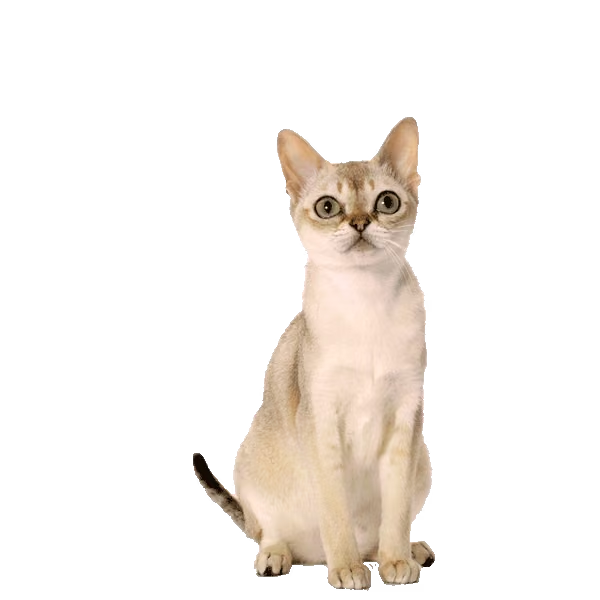
Singapura
The Singapura is one of the smallest cat breeds, prized for its curious, affectionate personality and big-eyed, pixie-like charm.
- Size
- Small
- Lifespan
- 11–15 years
- Origin
- Unknown
- Temperament
- Curious
- Standard colors
- Sable
Characteristics
Coat and grooming
How the Singapura coat is built, and what that means when you groom it.
- Coat layers
- Single coat
- Coat texture
- Smooth
- Coat length
- Short
- Shedding
- Low shedding
Singapura colors and patterns
What each club's breed standard says about every Singapura color and pattern. Point at a ruling to see the club's own wording.
Breed standards describe the Singapura in Sable. Standard patterns: Ticked tabby and Sepia.
| Color or pattern | TICA | CFA | FIFE | GCCF |
|---|---|---|---|---|
| Sable | Standard (“Sable Ticked”) | Standard (“Sepia agouti”) | Standard (“Seal sepia”) | Standard (“sepia brown”) |
| Patterns | ||||
| Ticked tabby | Standard (“Ticked tabby”) | Standard (“agouti”) | Standard (“ticked”) | Standard (“ticked”) |
| Sepia | Standard (“Sepia”) | Standard (“Sepia”) | Standard (“sepia”) | Standard (“sepia”) |


| Color or pattern | TICA | CFA | FIFE | GCCF |
|---|---|---|---|---|
| Hazel | Standard (“hazel”) | Standard (“hazel”) | Standard (“hazel”) | Standard (“hazel”) |
| Copper | Standard (“copper”) | No ruling | No ruling | No ruling |
| Yellow | No ruling | Standard (“yellow”) | No ruling | Standard (“yellow”) |
| Gold | Standard (“gold”) | No ruling | No ruling | No ruling |
| Green | Standard (“Celadon green, green”) | Standard (“green”) | Standard (“brilliant green”) | Standard (“green”) |
| Blue | Disqualifying (“definite blue”) | Disqualifying (“blue”) | No ruling | No ruling |
| Aqua | Disqualifying (“aqua”) | No ruling | No ruling | No ruling |
| Color or pattern | TICA | CFA | FIFE |
|---|---|---|---|
| Pink | Standard (“pale to dark salmon”) | Standard (“pale to dark salmon”) | Standard (“pale to dark salmon”) |
What the rulings mean
- Standard
- Described by the club's breed standard.
- Disqualifying
- The club's breed standard disqualifies an animal of this colour or pattern.
Color changes
How a Singapura's colors can change over its life.
Pinkchanges toSeal
Nose · With age · from 1 to 52 weeks
Pinkchanges toBlue
Nose · With age · from 1 to 52 weeks
Pinkchanges toChocolate
Nose · With age · from 1 to 52 weeks
Pinkchanges toLilac
Nose · With age · from 1 to 52 weeks
Sources
Each ruling comes from the club's published breed standard or color list.
About the Singapura
Australia's biodiversity laws have made indoor cat ownership a community standard, and the Singapura's naturally homebound temperament makes it one of the most fitting breeds for Australian households.
In a country where local councils increasingly mandate cat containment to protect native fauna, the Singapura arrives as if purpose-built for the task. This small, ticked-coat shorthair weighs between 1.8 and 3.6 kilograms as an adult, placing it firmly among the tiniest of all pedigreed cats, yet the body is dense and well-muscled rather than fragile. The wide amber or hazel eyes and oversized ears give it a permanently alert expression that persists long past kittenhood.
Unlike many active breeds that grow restless without outdoor access, the Singapura is genuinely content indoors. It attaches itself to its people rather than to any particular territory. You will find it following household members from one end of the house to the other, positioning itself at the edge of whatever activity is happening, and retiring to the warmest available spot once the action quietens. That combination of engagement and contentment suits the rhythms of Australian family life.
The coat is short and fine, requiring minimal upkeep, which suits owners after an interactive companion without the grooming overhead of longer-haired breeds. ANCATS (Australian National Cats Inc.) and CCCA (Co-ordinating Cat Council of Australia) affiliated breeders work to maintain the breed's health and temperament in this country.
| Attribute | Detail |
|---|---|
| Origin | Unknown (associated with Singapore) |
| Size | Small (1.8 to 3.6 kg) |
| Lifespan | 11 to 15 years |
| Group / role | Shorthaired companion cat |
| Good with | Families, singles, other cats and gentle dogs |
Who it suits
The Singapura suits Australian owners who keep their cats fully contained, whether in a cat-safe enclosure, a screened balcony, or entirely indoors. It thrives in units and houses equally, handles apartment living well, and generally gets on with other cats, which is useful when owners keep multiple pets for company. Households that are frequently empty all day are less suitable, as this breed needs company and interaction to stay settled.
History and origin
The Singapura draws its name from Singapore's Malay identity, though the full story of how the breed came to be registered in the West is contested.
Small ticked cats have roamed Singapore's streets and drainage channels for generations. In the 1970s, an American breeding couple brought cats reportedly sourced from Singapore to the United States and established a programme around that foundation stock. The breed took its name from Singapura, the Malay name for Singapore itself.
What followed was decades of dispute. The original import records were challenged, and evidence emerged suggesting some founding animals may have been cats already residing in North America before the Singapore trip. Because no definitive documentation resolved the matter, official registries settled on listing the verified origin as unknown.
None of this altered the breed's established characteristics. Breeders in the US and later in other countries, including Australia, developed a consistent type recognised by ANCATS and CCCA-affiliated bodies. Australian breeding stock has been imported carefully over the years, and a small cohort of dedicated local breeders maintains the Singapura here.
Litters are typically two to three kittens, which limits how many cats enter the market each year and keeps the breed genuinely uncommon. Prospective Australian owners usually face a waiting period of several months, and starting the search through an ANCATS-registered breeder is the recommended path.
Appearance
The Singapura is a compact, muscular cat with one recognised coat colour, large almond-shaped eyes, and ears that look generous relative to the head.
Pick up a Singapura and the first surprise is the weight. For a cat that appears so dainty, it is solid and firm. The head is rounded, the muzzle short, and the ears wide and deep-set, giving the face its characteristic open, watchful look. The tail tapers to a blunt tip and is slender throughout. The overall impression is of a small animal in excellent condition.
| Feature | Standard |
|---|---|
| Height | Approximately 15 to 20 cm at the shoulder |
| Weight | 1.8 to 3.6 kg |
| Coat | Short, fine, close-lying, ticked tabby |
| Colour | Sepia agouti: warm ivory ground with dark brown ticking |
| Eyes | Large, almond-shaped; hazel, green, or yellow |
Coat and colour
The Singapura carries one recognised coat pattern: sepia agouti ticking. Each individual hair is banded with alternating light and dark, creating a warm ivory base overlaid with brown. The face shows faint tabby lines near the eyes and forehead, and the underside is lighter than the back. This coat sits very close to the body and sheds minimally, a quality Australian owners in warmer states particularly appreciate. Weekly brushing is sufficient maintenance.
Temperament
The Singapura is a quietly sociable, affectionate cat that involves itself in household life without demanding constant attention.
This is a breed that earns the label 'people cat' without overstating it. The Singapura is engaged and attentive without being clingy. It will station itself near you, watch what you are doing with obvious interest, and accept an invitation to your lap readily. What it does not do is make noise about any of this. Singapuras are notably quiet, communicating through soft chirps and trills rather than persistent meowing, a quality appreciated in attached housing.
With visitors the breed is curious rather than cautious. Individual cats vary in how quickly they warm up, but shyness and hissing are not characteristic. With resident cats and calm dogs it is generally easy-going, partly because its small size removes much of the dominance tension that can arise between larger cats.
The playful, kitten-like energy that characterises young Singapuras does not disappear with age. Many owners report that their cat is still enthusiastically chasing toys at eight or nine years old. That sustained engagement is one reason RSPCA Australia and cat welfare groups sometimes recommend pair-keeping for indoor-only cats of this temperament.
| Trait | Rating |
|---|---|
| Affection | 5 |
| Energy | 4 |
| Trainability | 4 |
| Vocalness | 2 |
| Shedding | 2 |
Care and grooming
Grooming demands are low, but the Singapura needs consistent company, daily play, and vertical space to remain happy in an indoor environment.
Grooming
- Run a soft brush through the coat once a week to collect loose hair and maintain condition.
- Clip claws every two to three weeks before they catch on furnishings.
- Check ears weekly and wipe gently with a damp cotton pad when needed.
- Begin tooth brushing early and arrange periodic professional dental cleans at your vet clinic.
- Baths are rarely necessary given the coat's short, self-maintaining nature.
Exercise
- Schedule at least two interactive play sessions daily, using a wand toy or thrown ball.
- Mount a cat tree or wall shelves to give climbing and perching options.
- Swap out toys on rotation so a quick, inquisitive cat does not lose interest.
- During the height of the Australian summer, keep all activity in cool, shaded rooms.
Environment
The Singapura is built for indoor life. It needs vertical space and at least one resident companion, human or feline, to avoid boredom. In the warmer months, ensure a cool room is available and keep fresh water out at all times. Purpose-built cat enclosures or screened verandahs offer enrichment and comply with many council containment by-laws without releasing the cat into the environment.
Nutrition and feeding
The Singapura's small frame makes precise portion control essential, and wet food is a practical tool for maintaining hydration in warmer Australian conditions.
Feeding a Singapura accurately is more important than with larger breeds because there is very little margin before weight becomes noticeable on a 2-kilogram frame. Choose a complete commercial cat food with a named animal protein listed first. Australian regulations require pet foods to meet nutritional adequacy standards, so reputable local and international brands are a sound starting point.
In warmer Australian climates, wet food has a practical advantage: it contributes meaningfully to daily fluid intake. A water fountain placed away from the food bowl encourages additional drinking. Dry food can supplement the diet but works best as part of a mixed feeding approach rather than as the sole source.
| Life stage | Amount per day | Meals |
|---|---|---|
| Kitten (to 12 months) | Per label, fed to appetite | 3 to 4 |
| Adult (1 to 7 years) | Approximately 100 to 150 g wet, or label amount dry | 2 |
| Senior (7 years and older) | Adjust to body condition and activity | 2 |
Treats and supplements
Limit treats to roughly ten percent of daily intake to avoid nutritional imbalance. A cat eating a complete commercial diet does not normally need supplements. If you are considering fish oil, joint support, or anything else, discuss it with your vet clinic first, particularly given the breed's light body weight.
Health and lifespan
Generally robust with an 11-to-15-year lifespan, the Singapura benefits from DNA screening, regular desexing, and consistent vet clinic check-ups.
The Singapura is a healthy breed when bred responsibly. The founding population was narrow, so reputable breeders screen for known inherited conditions before selecting breeding pairs. Routine vet clinic visits, careful weight management, and secure indoor living all contribute to a long life.
Desexing is standard practice in Australia. RSPCA Australia supports early desexing for population control and individual health benefits, including a reduced risk of certain reproductive cancers. Most ANCATS and CCCA-affiliated breeders sell kittens already desexed or with a desexing contract in place.
| Condition | Signs | Note |
|---|---|---|
| Pyruvate kinase deficiency (PKDef) | Lethargy, pale gums, weakness caused by anaemia | Inherited; a DNA test is available; ask breeders for parent results |
| Uterine inertia | Labour stalls or fails to start in queens | Related to small body size; breeders monitor closely |
| Dental disease | Reluctance to eat, drooling, odour | Common across many breeds; managed with regular dental care |
Preventive care
- Maintain the annual core vaccination schedule recommended by your vet clinic.
- Keep flea, tick, and intestinal parasite prevention current.
- Schedule annual health checks and twice-yearly visits from around age seven.
- Brush teeth regularly and book professional dental cleans as advised.
- Request PKDef DNA test certificates for both parents before purchasing any kitten.
Training
Alert and motivated by human attention, the Singapura picks up household rules, simple commands, and tricks more readily than most cats.
Cat owners who assume their pet is untrainable have probably not lived with a Singapura. The breed's combination of intelligence and people-focus means it notices patterns, remembers routines, and responds to consistent cues. Teaching a recall, redirecting scratching to an appropriate post, and conditioning the cat to a carrier all happen faster than many owners expect.
In an Australian household where vet clinic visits and the occasional interstate move are part of life, these practical skills matter. A carrier-trained cat is a far less stressed cat, and a cat that comes when called is easier to locate at curfew time. Training also provides a useful enrichment outlet for a brain that needs stimulation.
Basics
- Set up a clean litter tray in a quiet spot from day one.
- Guide the cat to the scratching post every time it reaches for furniture; reward any use of the post with a treat.
- Say the cat's name before every positive interaction until it reliably turns toward the sound.
- Introduce one new behaviour at a time, keeping each session under ten minutes.
- Leave the carrier open with bedding and a treat inside between trips to build a positive association.
Breeding
The Singapura produces small litters and the queen's slight build can complicate labour, so breeding in Australia demands veterinary preparation and careful genetic management.
Sexual maturity arrives at roughly 7 to 12 months, but breeders registered with ANCATS or CCCA-affiliated bodies generally wait until a female is physically mature before mating her, typically closer to 18 months. Gestation runs 63 to 67 days. Litters are small, commonly two or three kittens, which is the primary reason the breed remains hard to find in Australia despite genuine demand.
The queen's compact frame carries a documented risk of uterine inertia, where labour begins but the uterus lacks the strength to push kittens through. Experienced breeders schedule whelping support with a local vet clinic and have a plan for emergency caesarean if contractions stall. This is not a breed for inexperienced breeding attempts.
DNA testing for pyruvate kinase deficiency must be completed for both cats in any breeding pair. Kittens remain with their mother for at least 12 weeks to ensure proper socialisation. Responsible Australian breeders sell companion kittens already desexed or on a desexing agreement, in line with RSPCA Australia best-practice guidelines.
| Metric | Value |
|---|---|
| Sexual maturity | About 7 to 12 months |
| Gestation | 63 to 67 days |
| Average litter size | 2 to 3 kittens |
| Weaning age | About 8 weeks |
| Recommended rehoming age | 12 weeks or older |
Registering a Singapura the easy way, microchip included
Free lifetime registration for your Singapura, chip record included, searchable wherever in the country she wanders.
Singapura registration and microchipping in Australia
Set the record up before she needs it: name, colouring, photo, your mobile, save. That is the whole of registering your cat with United Pet Club, and the record stands for life without a bill.
Scanners find chips in seconds; the question is what the number points at. Point your Singapura's chip at a live record: free with the lifetime plan, open to all brands, kept current through every move without charges. Microchip registration plus a free account, and she's covered.
How do I register my Singapura in Australia?
Free with United Pet Club: set up an account, add her name, colouring, and a photo, and the profile's live for her whole life. A chip isn't required to start.
How do I register my Singapura's microchip?
Enter the 15-digit number into your free account with your current details. Registration and updates never cost anything, whatever brand of chip your vet used.
Do cats need to be microchipped in Australia?
Several states and territories require it, and shelters chip before rehoming as standard. Requirement or not, the register entry with your current number is what actually brings a Singapura home.
How much is it to register a Singapura?
Nothing at all. United Pet Club's lifetime plan covers her profile, the chip record, and every update, with no annual renewal.
Frequently asked questions
Practical questions from Australian owners about the Singapura's size, temperament, containment, health, and where to find a kitten.
How big does a Singapura get?
Adults typically weigh 1.8 to 3.6 kilograms and stand around 15 to 20 centimetres at the shoulder. Despite the small size, the body is muscular and solid to hold.
Does the Singapura cope with Australian heat?
Yes, provided it has access to a cool, shaded space. These cats naturally seek out warm spots to rest, but extreme heat requires air conditioning, shade, and constant fresh water. Avoid leaving the cat in a hot room or car during summer.
Is this breed suited to council cat-containment requirements?
Very well suited. The Singapura is genuinely content indoors and does not pace or vocalise in protest at being kept in. A cat enclosure or screened area satisfies any remaining outdoor curiosity without releasing it into the environment.
How do I find a registered Singapura breeder in Australia?
Search through ANCATS or your state's CCCA-affiliated registry for registered breeders. Expect a waiting list of several months. A reputable breeder will health-test parents, supply vaccination documentation, and usually desex kittens before sale.
Is the Singapura good with other pets?
Generally yes. The breed is small and sociable rather than territorial, which helps it fit into multi-cat households. It also tolerates calm dogs well. Introductions should still be gradual and supervised.
Are Singapuras hard to find in Australia?
They are uncommon. Small litters and a limited number of registered breeders mean waiting lists are the norm. Contact breeders early and be prepared to wait.
From the community
Ask about the SingapuraNo questions about the Singapura yet. Be the first to ask.
Browse Cat breeds