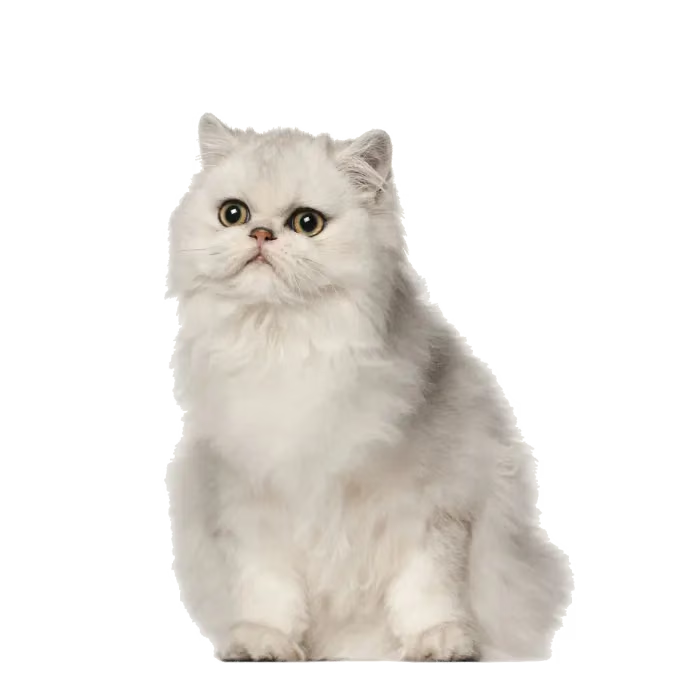
The traditional (doll-face) Persian is a calm, sweet-natured longhaired cat prized for its gentle, even temperament and devoted companionship.
How the Persian (traditional) coat is built, and what that means when you groom it.
Critical: A Persian (traditional) should not be shaved.
The undercoat keeps heat out as well as in, and the outer coat shields the skin from sun and insect bites. Clipping the whole coat off removes both. It often grows back patchy, soft or a different colour, and in some animals the guard hairs never return properly. Brush the undercoat out instead of cutting it off.
Caution: A Persian (traditional) coat mats easily.
Fine or long hair tangles at the base of the coat, out of sight, where the mats tighten and pull on the skin. Brushing has to reach right down to the roots in sections, not just skim the surface.
The traditional or doll-face Persian is a medium longhaired cat from Iran, valued for its placid, affectionate nature and a flowing coat that wants daily grooming.
The traditional Persian, widely known as the doll-face Persian, is a longhaired cat with a mild manner and a heavy coat. It differs from the modern show Persian, whose face is pushed extremely flat. The traditional type holds a moderate muzzle and a nose bridge you can still see. This older head shape is the form the breed wore across most of its history.
These are quiet, settled cats. A busy room unsettles them, and they will happily doze away much of the day in a favoured spot. Their get-up-and-go is minimal, and the breed rarely wrecks the furniture or nags for attention. A Persian attaches firmly to its household and shows fondness by staying near rather than by dashing about.
The coat is what defines the care load. A traditional Persian wears a long, dense double coat that knots fast unless it is seen to every day. Owners who stay on top of grooming are rewarded with a serene, devoted companion that takes readily to life indoors.
| Attribute | Detail |
|---|---|
| Origin | Iran |
| Size | Medium |
| Lifespan | 12 to 17 years |
| Group / role | Longhaired companion cat |
| Good with | Calm households, older children, quiet adults |
The traditional Persian belongs in a settled, indoor home where someone is about for company and prepared to groom daily. It thrives with quiet families, with older children who handle a cat gently, and with people after an affectionate moggy that does not demand endless play. It is a poor fit for a home that cannot commit to coat care, or one that runs loud and full of comings and goings.
The Persian descends from longhaired cats of Iran, once called Persia, that reached Europe in the 1600s and were shaped into a recognised breed in Britain late in the 1800s.
The breed draws its name from Persia, the old name for Iran, where longhaired cats had been established for centuries. The heavy coat is often tied to the colder, mountainous districts of the region, although the earliest record is thin.
Longhaired cats out of the Near East arrived in Europe during the 1600s. Italian and French travellers usually get the credit for carrying early examples westward, where the unusual coats made them sought after among those who could afford them.
Deliberate breeding took shape in Britain late in the 1800s. Persians appeared at the first cat exhibitions, among them the 1871 Crystal Palace show in London, and breeders set about fixing a type. From Britain the breed travelled far, becoming one of the most popular pedigreed cats across North America and Europe through the 1900s.
Across the twentieth century, show-ring selection drove the face ever flatter, giving rise to the modern peke-face Persian. The traditional or doll-face Persian keeps the earlier, more moderate head, and it stays a favourite with owners who prefer the original look and the easier breathing that a longer muzzle allows.
A medium, cobby cat carrying a long flowing double coat, a broad head, large round eyes, and the moderate doll-face muzzle that sets the traditional type apart.
The traditional Persian has a stocky, rounded body on short, sturdy legs. The head is broad and round with full cheeks, small rounded ears, and large expressive eyes. The muzzle is the telling difference from the modern show Persian: the traditional type shows a longer nose with a clear bridge instead of a flat, pushed-in face. The whole cat reads as soft and well padded, borne under a long, full coat.
| Trait | Detail |
|---|---|
| Height | About 25 to 38 cm at the shoulder |
| Weight | 3.5 to 5.5 kg |
| Coat | Long, dense double coat with a full ruff and plumed tail |
| Colours | Wide range, including white, black, blue, cream, red, bicolour, tabby, and colourpoint (Himalayan) |
| Eyes | Large and round; colour varies with coat, from copper and gold to green, blue, or odd-eyed |
The coat is the breed's most demanding feature. It runs long over the whole body, with a thick undercoat, a heavy frill about the neck, and a full, brush-like tail. Persians come in many recognised colours and patterns. Solid colours take in white, black, blue, cream, and red. Patterned variants take in tabby, tortoiseshell, bicolour, smoke, and shaded coats. The colourpoint pattern, with a paler body and darker face, ears, legs, and tail, goes by the name Himalayan in some registries. Eye colour usually matches coat colour, so deep copper eyes are common in solid cats while colourpoints carry blue eyes.
Persians are gentle, placid, and affectionate, with low energy and a soft voice; they bond closely with their people and favour steady, peaceful homes.
The traditional Persian is a placid, even-keeled cat. It is affectionate with the people it knows and likes to stay close, often settling on a lap or beside someone rather than hunting out play. It is not clingy in a noisy way; its attachment comes through as a quiet presence.
With family, Persians are loving and forgiving. They generally take gentle handling in their stride and get on with considerate older children. Around strangers they turn reserved and may keep their distance until a newcomer settles in. The breed usually shares a home peacefully with other calm cats and with dogs that are not pushy, though it has no time for rough or chaotic company.
Energy is low and play is brief. A Persian enjoys a feather toy or a slow game but soon has enough and drifts back to rest. The voice is soft and the cat seldom pipes up, which suits units and quiet households.
| Trait | Rating |
|---|---|
| Affection | 5 |
| Energy | 2 |
| Trainability | 3 |
| Vocalness | 2 |
| Shedding | 5 |
Daily coat grooming is essential, exercise needs are modest, and the breed is best kept indoors in a calm, climate-controlled home.
The long double coat knots fast and wants daily care.
The Persian has modest activity needs.
This is an indoor cat. The long coat picks up dirt and tangles out of doors, and the breed copes poorly with heat because of its dense fur, a real point to weigh in an Australian summer. Keep the home calm and at a comfortable temperature, give it quiet resting spots, and set out a litter tray that is easy to reach, since Persians dislike climbing.
Feed a complete cat food matched to life stage, control portions to head off weight gain in this low-energy breed, and keep fresh water on hand at all times.
Persians need a complete and balanced cat food built around animal protein. Because the breed runs low on energy and tends to pile on weight, portion control counts. Measured meals work better than leaving food down all day. Some owners find that flat-faced or doll-face cats eat more easily from shallow, wide bowls. A mix of wet and dry food helps with hydration, and dry kibble can help with dental wear.
| Life stage | Amount per day | Meals |
|---|---|---|
| Kitten (2 to 12 months) | Follow product label; feed to appetite while growing | 3 to 4 |
| Adult (1 to 7 years) | About 50 to 70 g dry food, or wet equivalent, by body weight | 2 |
| Senior (7+ years) | Adjust to activity and weight; often slightly less | 2 |
Keep treats to a small share of daily kilojoules so they do not throw the diet out of balance or add weight. A healthy cat on a complete food usually needs no supplements. Some owners use a vet-approved hairball or omega-3 supplement to support the coat and cut down hairballs from grooming, but check with a vet before adding anything.
Persians live around 12 to 17 years but are prone to inherited kidney disease, breathing trouble in flatter-faced lines, and eye and coat problems that want monitoring.
The traditional Persian generally lives 12 to 17 years. The doll-face type tends to breathe more easily than the extreme flat-faced Persian, which lowers some risks, but the breed still carries several inherited and structural concerns. Buying from breeders who screen their cats and staying on top of veterinary care both help. Watch the weight closely, since obesity worsens most of these conditions.
| Condition | Signs | Note |
|---|---|---|
| Polycystic kidney disease (PKD) | Increased thirst, weight loss, poor appetite | Inherited; a DNA test exists and responsible breeders screen for it |
| Brachycephalic airway issues | Noisy or laboured breathing, snoring | Less common in doll-face lines than in flat-faced Persians |
| Excess tearing and eye problems | Tear staining, runny eyes, eye irritation | Daily eye cleaning helps; some cases need veterinary care |
| Hypertrophic cardiomyopathy (HCM) | Lethargy, rapid breathing, sudden weakness | Heart muscle disease; vet screening can detect it |
| Skin and coat problems | Matting, dandruff, fungal infection | Linked to coat density and gaps in grooming |
Persians are calm and moderately trainable; they take to short, gentle reward-based sessions for litter habits, handling, and simple cues rather than high-energy tricks.
The Persian is a quiet, easygoing cat that learns at a steady pace. It is not driven to perform like some livewire breeds, but it accepts routine and answers to calm, consistent handling. The most useful training centres on litter use, accepting grooming, and putting up with nail trims and carriers, all of which make daily care easier. Most Persians take to a litter tray readily, helped along by a low-sided box that is simple to step into.
Persian queens mature at several months, carry kittens for about 63 to 67 days, and produce small litters of long-coated kittens that want careful grooming and screening for inherited disease.
Breeding Persians is specialist work, best left to people who can health-test their cats and manage a demanding coat from kittenhood. Females reach sexual maturity from around five to nine months, but responsible breeders wait until a queen is physically mature and fully grown before her first litter. Males are usually mature by around ten months.
Gestation runs about 63 to 67 days. Litters tend to be small, often two to four kittens. Newborn Persians are fragile and need a warm, quiet nest and close attention through the first weeks. Because the breed carries inherited conditions such as PKD and HCM, breeding cats should be screened before mating, and kittens are best placed only after vaccinations and early socialisation.
Kittens arrive with short fluff that grows into the full coat over several months. Early, gentle grooming settles them into the daily combing they will need for life.
| Metric | Value |
|---|---|
| Female sexual maturity | About 5 to 9 months (breed later) |
| Male sexual maturity | About 10 months |
| Gestation | About 63 to 67 days |
| Typical litter size | 2 to 4 kittens |
| Weaning age | About 7 to 9 weeks |
| Recommended health tests | PKD DNA test, HCM screening |
Free lifetime registration for your Persian (traditional), chip record included, searchable wherever in the country she wanders.
Torn flyscreens and doors left ajar send indoor cats to the pound every week, and a fair few states expect pet cats chipped and on the register anyway. A free United Pet Club profile means the scan pulls up your number wherever your Persian (traditional) turns up. Register your cat in a couple of minutes, free for her whole life.
If she's already chipped, the register entry is the missing half; the vet's part ended with the needle. Register the microchip free for life with United Pet Club: any brand qualifies, address changes cost nothing, and the record answers scans from any clinic or shelter in the country. Create your free account and knock both jobs over tonight.
Free with United Pet Club: set up an account, add her name, colouring, and a photo, and the profile's live for her whole life. A chip isn't required to start.
Enter the 15-digit number into your free account with your current details. Registration and updates never cost anything, whatever brand of chip your vet used.
Several states and territories require it, and shelters chip before rehoming as standard. Requirement or not, the register entry with your current number is what actually brings a Persian (traditional) home.
Nothing at all. United Pet Club's lifetime plan covers her profile, the chip record, and every update, with no annual renewal.
Common questions about the traditional Persian cat, covering size, temperament, grooming difficulty, lifespan, suitability, and how to find one.
It is a medium-sized cat, usually weighing 3.5 to 5.5 kg, with a stocky, well-padded build that the long coat makes look larger.
Persians are placid, gentle, and affectionate with low energy. They bond closely with their people, are soft-voiced, and prefer peaceful homes over busy, noisy ones.
The main challenge is the coat, which needs daily combing to prevent knots, plus regular bathing and daily eye cleaning. Their other needs are modest, so the breed suits owners who can commit to grooming.
A traditional Persian typically lives 12 to 17 years with good care, a healthy weight, and regular vet check-ups.
Yes, for calm households. Persians do well with quiet adults and gentle older children, and they get along with other settled pets. They are less suited to loud, high-traffic homes.
The doll-face or traditional Persian keeps a longer muzzle with a visible nose, closer to the breed's original look. The modern show Persian has an extremely flat face, which can add breathing and tearing problems.
Look for registered breeders under the ACF or a CCCA member body who specialise in the doll-face type and health-test for PKD and HCM. Breed-specific rescues also sometimes have Persians needing homes.
