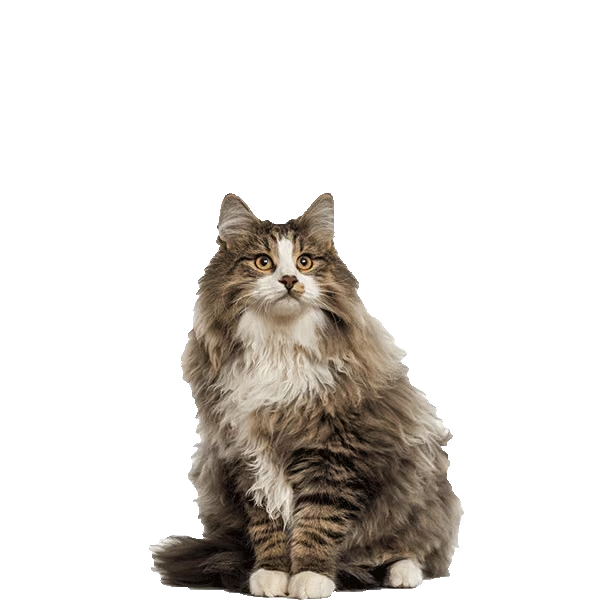
The Norwegian Forest Cat is a hardy, friendly mountain breed with a thick coat and a calm, gentle disposition well suited to family life.
How the Norwegian Forest Cat coat is built, and what that means when you groom it.
Critical: A Norwegian Forest Cat should not be shaved.
The undercoat keeps heat out as well as in, and the outer coat shields the skin from sun and insect bites. Clipping the whole coat off removes both. It often grows back patchy, soft or a different colour, and in some animals the guard hairs never return properly. Brush the undercoat out instead of cutting it off.
Caution: A Norwegian Forest Cat coat mats easily.
Fine or long hair tangles at the base of the coat, out of sight, where the mats tighten and pull on the skin. Brushing has to reach right down to the roots in sections, not just skim the surface.
Information: A Norwegian Forest Cat drops its undercoat in heavy bursts.
The undercoat comes out in heavy bursts over a few weeks. An undercoat rake, or a bath followed by a proper blow-dry, clears it far faster than daily brushing. Clipping the coat down is not a shortcut for this.
The Norwegian Forest Cat is a large, long-haired breed from Norway, prized for its thick weatherproof coat and a calm, friendly nature that suits family homes.
The Norwegian Forest Cat is a large, solidly built breed that developed in the cold forests of Norway. It carries a dense double coat, a full ruff around the neck, and a long bushy tail, all of which evolved to cope with harsh northern winters. Males commonly reach 5.5 to 7.3 kg, and some larger individuals weigh more, which places the breed among the bigger domestic cats.
Despite its rugged frame, the breed is even-tempered and sociable. Owners describe it as friendly, gentle and placid, with steady patience around children. It tends to attach to the whole household rather than fixing on one person, and it usually tolerates other cats and dogs once introductions happen at an unhurried pace.
This is a slow-maturing cat. A Norwegian Forest Cat may not reach full size and coat development until roughly four to five years of age, so the kitten you raise keeps filling out well into adulthood.
| Attribute | Detail |
|---|---|
| Origin | Norway |
| Size | Large |
| Lifespan | 13 to 16 years |
| Group/role | Companion cat, long-haired natural breed |
| Good with | Children, other cats, and cat-friendly dogs |
The Norwegian Forest Cat suits families that want a large, placid companion and can commit to regular coat care. It enjoys climbing and watching from height, so a home with cat trees or sturdy shelving works well for it. Quiet households and busy family homes both suit the breed, since it is adaptable and not overly demanding for attention.
The Norwegian Forest Cat is a natural breed from Norway, present in Scandinavian folklore for centuries and formally recognised as a breed in the twentieth century.
The Norwegian Forest Cat is a natural breed, meaning it developed over a long period through adaptation to its surroundings rather than from deliberate crossing. Long-haired cats turn up in Norwegian folklore and rural life going back centuries, where they were valued as working cats on farms and ships for keeping rodents down.
The cold, wet climate of Norway shaped the breed's physical traits. A dense, water-resistant double coat, tufted ears and large paws helped these cats survive winters out of doors. Many of these features carry through to the modern breed.
For much of its history the breed existed only as a regional farm cat. By the early twentieth century, interest grew in preserving it as a distinct type, though two world wars and crossbreeding with free-roaming domestic cats put its identity at risk. Organised breeding programmes in Norway worked to stabilise the type and keep it from vanishing.
The breed earned formal recognition from European cat registries in the 1970s, and it was later accepted by registries in other countries. The Norwegian Forest Cat is now established internationally while remaining a point of national pride in Norway.
The Norwegian Forest Cat is a large, muscular cat with a dense double coat, a thick neck ruff, tufted ears, and a long bushy tail.
The Norwegian Forest Cat has a strong, athletic build with a long body, substantial bone and powerful legs. The hind legs sit slightly longer than the front legs, which gives the cat a capable climbing stance. The head is shaped like an equilateral triangle, with a straight profile and large, well-tufted ears.
The coat is the breed's most distinctive feature. It consists of a woolly undercoat covered by a long, smooth, water-resistant top coat. A full ruff frames the neck and chest, and the tail is long and heavily furred. Coat thickness shifts with the season, growing heavier in winter and shedding back in the warmer months.
| Trait | Standard |
|---|---|
| Height | 23 to 30 cm at the shoulder |
| Weight | Males 5.5 to 7.3 kg, females 3.6 to 5.5 kg |
| Coat | Long, dense double coat with neck ruff and bushy tail |
| Colours | Most colours and patterns except colourpoint, including tabby, solid, bicolour, and tortoiseshell |
| Eyes | Large, almond-shaped, in shades of green, gold, copper, and blue (blue or odd-eyed in some white cats) |
The breed comes in a wide range of colours and patterns. Brown tabby with white is common, but solids, smokes, silvers and tortoiseshells also appear. Colourpoint patterns are not accepted in the breed standard. Eye colour usually relates to coat colour, with green, gold and copper most frequent, while white cats may have blue or odd-coloured eyes.
The Norwegian Forest Cat is friendly, gentle, and calm, with patience around children and a steady, sociable attitude toward people and other pets.
The Norwegian Forest Cat has a balanced, easygoing personality. It is friendly and affectionate without being clingy, and it tends to stay near family members rather than demanding constant lap time. Many individuals follow their people from room to room and settle nearby to keep an eye on the household.
With children, the breed is gentle and patient, which makes it a reliable family cat when interactions are supervised and respectful. With strangers, most are calm and curious rather than fearful, though a quiet cat may take time to warm to new visitors. The breed usually accepts other cats and cat-friendly dogs after a gradual introduction.
These cats are clever and enjoy climbing, exploring and working things out. They keep a working cat's instinct for hunting and like to perch high to survey their surroundings. They are generally quiet, using a soft voice rather than frequent loud calls.
| Trait | Rating |
|---|---|
| Affection | 4 |
| Energy | 3 |
| Trainability | 3 |
| Vocalness | 2 |
| Shedding | 4 |
The Norwegian Forest Cat needs regular brushing of its double coat, room to climb, and seasonal attention during heavy shedding periods.
The Norwegian Forest Cat adapts to most homes but does best with vertical space and a few quiet retreats. It tolerates cold well thanks to its coat, but it should still live indoors or in a secure outdoor enclosure to protect it from traffic, predators and disease. The breed handles family activity calmly and is comfortable in multi-pet households.
The Norwegian Forest Cat needs a complete, protein-rich diet sized to its large frame, with portions adjusted by life stage and activity to prevent excess weight.
As a large, slow-maturing breed, the Norwegian Forest Cat benefits from a complete and balanced diet built around animal protein. Kittens need extra kilojoules to support long growth that can continue for several years, while adults need controlled portions to avoid weight gain. Always provide fresh water, and choose a food formulated to meet recognised nutritional standards for the cat's life stage.
| Life stage | Amount per day | Meals |
|---|---|---|
| Kitten (2 to 12 months) | Follow product guidance for growth, fed to appetite | 3 to 4 |
| Adult (1 to 7 years) | Roughly 250 to 320 calories, adjusted to weight and activity | 2 |
| Senior (7 years and older) | Adjusted to maintain healthy weight, often slightly less | 2 |
Keep treats to no more than about 10 per cent of daily kilojoules to guard against weight gain in this large breed. Most healthy cats on a complete diet do not need supplements. Speak with a vet before adding any supplement, since needs depend on age, health and the base diet.
The Norwegian Forest Cat is generally healthy with a lifespan of 13 to 16 years, though a few inherited conditions warrant screening and routine veterinary care.
The Norwegian Forest Cat is a robust breed with a typical lifespan of 13 to 16 years, and many cats live well within that range with good care. Like all pedigree cats, it carries some risk of inherited conditions, so buying from breeders who screen their breeding cats reduces the chance of passing on disease. Routine veterinary visits help pick up problems early.
| Condition | Signs | Note |
|---|---|---|
| Hypertrophic cardiomyopathy | Lethargy, rapid breathing, reduced activity | Heart muscle disease; detected by veterinary cardiac screening |
| Glycogen storage disease type IV | Weakness, tremors, failure to thrive in kittens | Inherited metabolic disorder; a DNA test lets breeders avoid affected litters |
| Hip dysplasia | Stiffness, reluctance to jump, altered gait | Joint condition seen in some large breeds; managed with weight control and care |
| Polycystic kidney disease | Increased thirst, weight loss, poor appetite | Kidney condition; screening reduces risk in breeding lines |
The Norwegian Forest Cat is intelligent and responds well to short, reward-based training for litter habits, handling, and simple tricks.
The Norwegian Forest Cat is clever and curious, which makes it receptive to training when sessions are short and rewarding. It learns household routines quickly and can be taught to use scratching posts, accept grooming and come when called. Training also gives this active, climbing-minded cat useful mental work.
The Norwegian Forest Cat matures slowly, with a roughly nine-week gestation and litters that commonly number three to five kittens needing careful early socialisation.
The Norwegian Forest Cat reaches sexual maturity around 7 to 12 months, but breeders often wait until cats are physically and behaviourally mature before mating, given the breed's slow development. Responsible breeding pairs cats that have been health screened for known inherited conditions.
Gestation lasts about 63 to 67 days. Litters commonly include three to five kittens, though size varies. Kittens are born blind and dependent, opening their eyes at around one to two weeks and starting to explore as they grow.
Early socialisation matters. Handling, gentle exposure to household sounds and contact with people during the first weeks help kittens develop into confident, friendly adults. Kittens should stay with the mother and litter until at least 12 weeks so they finish weaning and learn social behaviour. Because this breed matures slowly, full coat and adult size keep developing for several years after kittenhood.
| Metric | Value |
|---|---|
| Sexual maturity | 7 to 12 months |
| Gestation | 63 to 67 days |
| Average litter size | 3 to 5 kittens |
| Eyes open | 1 to 2 weeks |
| Weaning | Around 8 to 10 weeks |
| Recommended rehoming age | 12 weeks or older |
| Full maturity | 4 to 5 years |
Free lifetime registration for your Norwegian Forest Cat, chip record included, searchable wherever in the country she wanders.
A Norwegian Forest Cat does not need to roam to go missing; one open window does it. Her free United Pet Club profile keeps your details, her photo, and her chip number together where a vet or shelter can find them. Cat registration never costs a cent, now or later.
Scanners find chips in seconds; the question is what the number points at. Point your Norwegian Forest Cat's chip at a live record: free with the lifetime plan, open to all brands, kept current through every move without charges. Microchip registration plus a free account, and she's covered.
Free with United Pet Club: set up an account, add her name, colouring, and a photo, and the profile's live for her whole life. A chip isn't required to start.
Enter the 15-digit number into your free account with your current details. Registration and updates never cost anything, whatever brand of chip your vet used.
Several states and territories require it, and shelters chip before rehoming as standard. Requirement or not, the register entry with your current number is what actually brings a Norwegian Forest Cat home.
Nothing at all. United Pet Club's lifetime plan covers her profile, the chip record, and every update, with no annual renewal.
Common questions about the Norwegian Forest Cat cover its size, temperament, grooming needs, lifespan, family suitability, and availability.
It is a large breed. Males commonly weigh 5.5 to 7.3 kg and females 3.6 to 5.5 kg, with some males larger. The breed reaches full size slowly, often by four to five years of age.
It is friendly, gentle and placid. The breed bonds with the whole family, is patient with children, and is generally quiet rather than demanding.
Care is moderate. The main commitment is brushing the double coat two to three times a week, and daily during seasonal moulting. Otherwise the breed is hardy and adaptable.
Most live 13 to 16 years with good nutrition, regular veterinary care and a healthy weight.
Yes. Their gentle, patient nature suits households with children, and they usually get on with other cats and cat-friendly dogs after a gradual introduction.
They shed moderately year-round and heavily during spring and autumn, when the woolly undercoat is released. Regular brushing manages most loose hair.
They are available from registered breeders who health screen their cats, and occasionally through breed-specific rescue. Ask for screening results for cardiac, kidney, and glycogen storage disease type IV before buying.
