
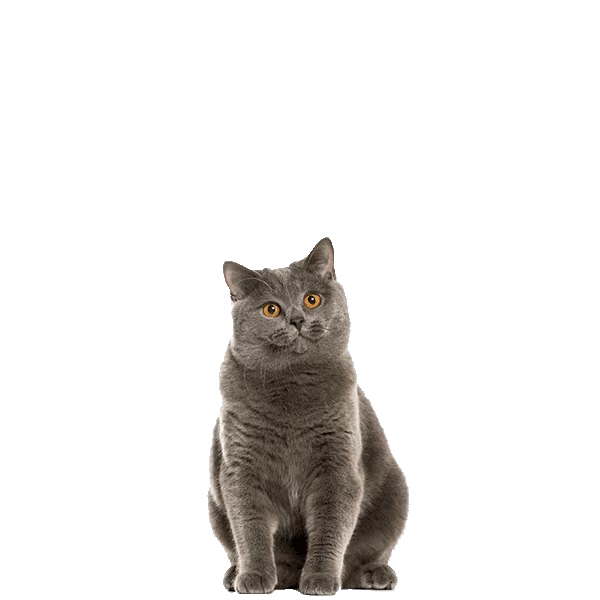
Kinkalow
The Kinkalow is a playful, affectionate dwarf breed charming for its short legs and curled ears paired with a curious, kittenish spirit.
- Size
- Small
- Lifespan
- 12–15 years
- Origin
- United States
- Temperament
- Playful
Characteristics
Coat and grooming
How the Kinkalow coat is built, and what that means when you groom it.
- Coat layers
- Single coat
- Coat texture
- Silky
- Coat length
- Medium
- Shedding
- Low shedding
Grooming guidance
Caution: A Kinkalow coat mats easily.
Fine or long hair tangles at the base of the coat, out of sight, where the mats tighten and pull on the skin. Brushing has to reach right down to the roots in sections, not just skim the surface.
About the Kinkalow
The Kinkalow is a dwarf cat from the United States that combines short legs with backward-curling ears. In Australia, it sits outside CCCA recognition, and the RSPCA has raised welfare concerns about chondrodystrophic breeding. Compact and affectionate, it typically lives 12 to 15 years.
The Kinkalow is a dwarf cat breed developed in the United States by crossing the Munchkin, which carries the gene for short legs, with the American Curl, which carries the gene for backward-curling ears. The result is a small cat with the low-slung body of the Munchkin and the distinctive curled ear tips of the Curl.
In Australia, the breed falls outside the championship classes of the Co-ordinating Cat Council of Australia (CCCA). The only registration available is through TICA, which holds the Kinkalow at an experimental stage, closing off any pathway to CCCA show eligibility. The RSPCA Australia has publicly identified chondrodystrophic cats, those bred for short legs through deliberate gene selection, as a welfare concern under its campaign against breeding for exaggerated physical traits. The Kinkalow inherits this scrutiny from its Munchkin parent, and prospective Australian owners should read the RSPCA position before purchasing.
No established breeders operate in Australia, so any Kinkalow must be imported from the United States and cleared through AQIS biosecurity protocols. Despite the controversy, the breed is affectionate and people-oriented: Kinkalows keep a playful, curious manner well past the kitten stage, and their compact size suits the apartments of Sydney, Melbourne, and Brisbane.
| Attribute | Detail |
|---|---|
| Origin | United States |
| Size | Small (about 3 to 7 lb) |
| Lifespan | 12 to 15 years |
| Group / role | Companion / dwarf breed |
| Good with | Families, children, other pets when socialised |
Who it suits
The Kinkalow works best in compact homes and apartments in Australian cities, where its limited jumping range is rarely a drawback and its sociable temperament suits owners who spend time at home. Before purchasing, buyers should confirm their veterinarian has experience with dwarf cat breeds and ask breeders to supply spine health documentation or X-ray history for the parents. Anyone importing through AQIS should allow several months for biosecurity clearance and associated costs. The breed dislikes long stretches alone and is less suited to households that are away for most of the day.
History and origin
The Kinkalow is a recent American dwarf breed created by crossing the Munchkin with the American Curl, pairing short legs with curled ears. It remains rare and is still being developed.
The Kinkalow originated in the United States during the 1990s. Breeder Terri Harris is credited with the early crosses that defined the breed, pairing the Munchkin, a short-legged cat, with the American Curl, known for ears that curl backward. The aim was a small cat that carried both traits.
The Munchkin, which supplies the short-leg gene, was itself recognised as a breed only in the 1990s. The American Curl, which supplies the curled-ear gene, traces to a single stray cat found in California in 1981. The Kinkalow draws directly on both of these foundation breeds.
The name joins "kink," for the curled ears, with "low," for the short stature. Major cat registries still treat the breed as experimental, and it is bred in small numbers. In Australia, cats of this type sit outside the championship classes of the Co-ordinating Cat Council of Australia (CCCA), and international recognition rests with bodies such as TICA, which lists the Kinkalow at a preliminary stage. Breeding programmes continue to work toward consistent type.
Because the population is small and both parent traits are dominant but variable in expression, litters can include kittens with long legs, straight ears, or both. Responsible breeders track these outcomes and continue outcrossing to maintain health and genetic diversity.
Appearance
The Kinkalow is a small cat with short legs, a long body, and ears that curl backward. Coats vary in length and come in a wide range of colours and patterns.
The Kinkalow has the short legs of its Munchkin parent set on a body that looks long in proportion to its height. The head is rounded with a short muzzle, and the eyes are large and set wide apart. The defining feature is the ear, which curls back from the face. The degree of curl ranges from a slight bend to a firm backward arc.
| Trait | Description |
|---|---|
| Height | About 3 to 7 inches at the shoulder |
| Weight | About 3 to 7 lb |
| Coat | Short to medium length, soft and fine |
| Colours | Most colours and patterns, including solid, tabby, tortoiseshell, and bicolour |
| Eyes | Large, round, colour varies with coat |
Coat and colours
The coat is soft and can be short or medium in length, depending on the parent cats. No single colour is standard for the breed, so Kinkalows appear in a broad range of solid shades, tabby markings, tortoiseshell, and two-colour patterns. Short-haired cats need little coat care, while medium-haired cats benefit from more frequent brushing. Whatever the curl, the ears should feel firm at the base rather than floppy.
Temperament and personality
The Kinkalow is affectionate, playful, and curious, staying kitten-like into adulthood. It is sociable with family and usually friendly toward children and other pets.
The Kinkalow is an affectionate breed that forms close bonds with the people it lives with. It is playful and curious, and many cats keep a kittenish manner throughout their lives, chasing toys and investigating new objects well into adulthood.
With family members the breed is sociable and seeks attention, often following people from room to room and settling on laps. With strangers it is usually confident rather than shy, though early socialisation helps. Kinkalows generally get along with children who handle them gently and with other cats and cat-friendly dogs when introductions are managed slowly.
The short legs do not slow the cat down much. Kinkalows climb and jump, using their back legs to reach favoured perches, and they stay active indoors. They do not tolerate long periods alone well and are happiest in homes where someone is around or where a second pet provides company.
| Trait | Rating |
|---|---|
| Affection | 5 |
| Energy | 4 |
| Trainability | 3 |
| Vocalness | 2 |
| Shedding | 2 |
Care and grooming
The Kinkalow needs routine grooming, daily play, and a safe indoor home with accessible low perches. Australian owners should schedule annual spine checks and follow RSPCA guidance on indoor-only care for dwarf breeds.
Grooming
- Brush short-haired cats once a week and medium-haired cats two or three times a week to remove loose hair.
- Clean the curled ears gently with a vet-approved solution, since the curl traps wax and debris more readily than an upright ear.
- Trim the nails every couple of weeks.
- Brush the teeth regularly; small-mouthed dwarf cats can be prone to dental crowding and disease.
Exercise
- Provide daily interactive play with wand toys, balls, and puzzle feeders to meet the breed's mental and physical needs indoors.
- Set up low cat trees, steps, and ramps so the cat can satisfy its urge to climb without large drops that could strain its spine.
- Rotate the toy selection weekly to keep a curious cat engaged in a fully indoor Australian home.
- Two short play sessions a day is a practical minimum, with longer sessions when the weather keeps everyone inside.
Environment
The Kinkalow is an indoor cat. In Australia, outdoor access brings risks from heat stress in summer, contact with wildlife, and predators, all particularly dangerous for a small, low-mobility dwarf breed. The RSPCA Australia recommends indoor-only management for cats bred for physical extremes. Ask your veterinarian to assess the spine and joints at each annual visit, especially during the first two years of life, to catch any early signs of lordosis. Keep resting spots at low and medium heights so the cat can move about its home comfortably without straining.
Nutrition and feeding
The Kinkalow needs a complete, protein-rich cat food fed in measured portions to avoid weight gain on its small frame. Fresh water should always be available.
The Kinkalow does best on a complete, balanced cat food with animal protein as the main ingredient. Because the breed is small, portion control matters more than it does for a larger cat, since even a little extra weight adds strain to the spine and joints. Choose a food formulated for the cat's life stage and feed by weight rather than by free choice.
| Life stage | Amount per day | Meals |
|---|---|---|
| Kitten (to 12 months) | Per package guidance for body weight, fed to appetite | 3 to 4 |
| Adult (1 to 7 years) | About 1/4 to 1/2 cup dry, or equivalent wet | 2 |
| Senior (7+ years) | Adjusted to maintain a lean body condition | 2 |
Treats and supplements
Keep treats to no more than about 10 percent of daily kilojoules so the cat stays at a healthy weight. A cat on a complete commercial diet usually needs no supplements. Discuss any joint or other supplement with a veterinarian first, especially given the breed's short-legged build. Always keep fresh water available, and offer wet food to support hydration.
Health and common conditions
The Kinkalow generally lives 12 to 15 years but can inherit spinal and joint issues linked to its short legs. Routine veterinary care supports a healthy life.
The Kinkalow generally enjoys a lifespan of 12 to 15 years with good care. As a dwarf breed, it can be prone to skeletal problems connected to the short-leg gene, and the curled ears need monitoring. Buying from a breeder who screens parent cats reduces the risk of inherited conditions.
| Condition | Signs | Note |
|---|---|---|
| Lordosis (spinal curvature) | Dip in the spine, reduced mobility | Linked to the dwarfism gene; severity varies |
| Pectus excavatum (sunken chest) | Breathing difficulty, poor growth | Seen in some dwarf kittens |
| Joint and limb strain | Stiffness, reluctance to jump | Short legs add load to the joints |
| Ear infection | Head shaking, odour, discharge | Curled ears can trap debris |
Preventive care
- Schedule annual veterinary checkups and keep vaccinations current.
- Keep the cat lean to reduce strain on the spine and joints.
- Clean and inspect the ears regularly.
- Maintain parasite control and dental care.
- Buy from breeders who health-screen their breeding cats.
Training
The Kinkalow is curious and food-motivated, so it learns tricks, recall, and harness use through short, reward-based sessions.
The Kinkalow is intelligent and curious, which makes it responsive to training when sessions are short and rewarding. The breed enjoys mental challenges, and clicker training, puzzle feeders, and simple tricks all work well. Litter training is usually straightforward; provide a low-sided tray the short-legged cat can enter easily.
Basics
- Start with one behaviour at a time, such as coming when called.
- Reward the correct action immediately with a small treat or praise.
- Keep sessions to a few minutes and end on a success.
- Repeat daily and add new behaviours only once the first is reliable.
- Introduce a harness gradually if you plan supervised outdoor time.
Breeding
Kinkalow breeding takes care because both the short-leg and curled-ear genes are variable, and pairing two short-legged cats is avoided for health reasons.
Breeding the Kinkalow takes planning because both defining traits are inherited in ways that do not always express fully. The short-leg gene is dominant but can be lethal when a kitten inherits two copies, so two short-legged cats are not bred together. Breeders pair a short-legged cat with a standard-legged or American Curl cat to keep litters healthy.
Females reach sexual maturity at several months of age, but responsible breeders wait until a queen is physically mature before mating. Gestation lasts about 63 to 67 days. Litters are usually small, and a single litter can contain kittens with short or long legs and with curled or straight ears, since neither trait passes to every kitten.
Kittens are born with straight ears that begin to curl in the first weeks of life, then settle into their final shape over several months. Queens raise their kittens with normal maternal care. Breeders should screen for spinal and chest conditions and place only healthy kittens, ideally once the ear curl and limb development have become clear.
| Metric | Value |
|---|---|
| Sexual maturity | Around 5 to 9 months |
| Gestation | About 63 to 67 days |
| Average litter size | 2 to 4 kittens |
| Ears at birth | Straight, begin curling within weeks |
| Weaning age | Around 8 to 10 weeks |
Registering a Kinkalow the easy way, microchip included
Free lifetime registration for your Kinkalow, chip record included, searchable wherever in the country she wanders.
Kinkalow registration and microchipping in Australia
A Kinkalow does not need to roam to go missing; one open window does it. Her free United Pet Club profile keeps your details, her photo, and her chip number together where a vet or shelter can find them. Cat registration never costs a cent, now or later.
If she's already chipped, the register entry is the missing half; the vet's part ended with the needle. Register the microchip free for life with United Pet Club: any brand qualifies, address changes cost nothing, and the record answers scans from any clinic or shelter in the country. Create your free account and knock both jobs over tonight.
How do I register my Kinkalow in Australia?
Free with United Pet Club: set up an account, add her name, colouring, and a photo, and the profile's live for her whole life. A chip isn't required to start.
How do I register my Kinkalow's microchip?
Enter the 15-digit number into your free account with your current details. Registration and updates never cost anything, whatever brand of chip your vet used.
Do cats need to be microchipped in Australia?
Several states and territories require it, and shelters chip before rehoming as standard. Requirement or not, the register entry with your current number is what actually brings a Kinkalow home.
How much is it to register a Kinkalow?
Nothing at all. United Pet Club's lifetime plan covers her profile, the chip record, and every update, with no annual renewal.
Frequently asked questions
Common questions from Australian buyers cover CCCA recognition, the RSPCA welfare position, AQIS import requirements, finding a breeder, and what health documentation to request.
Is the Kinkalow recognised by the CCCA?
No. The Co-ordinating Cat Council of Australia (CCCA) does not recognise the Kinkalow. The breed is held at an experimental stage by TICA only, which means it cannot be entered in CCCA-sanctioned shows and has no pathway to championship status under the national body.
What is the RSPCA Australia's position on the Kinkalow?
The RSPCA Australia has flagged chondrodystrophic cats, which include Munchkin-type breeds like the Kinkalow, as welfare concerns under its campaign against cats bred for exaggerated physical traits. Prospective buyers should read the RSPCA position and discuss spinal health with a veterinarian before purchasing.
How do I import a Kinkalow to Australia?
All cats entering Australia must clear AQIS biosecurity requirements, which include a health certificate from an accredited veterinarian in the country of origin, pre-export testing, and Australian Border Force approval. Import from the United States takes several months and involves significant costs beyond the purchase price.
Can I show a Kinkalow at cat shows in Australia?
Under CCCA rules, no. A TICA experimental listing allows entry at TICA-affiliated shows in Australia where experimental classes are offered, but not at CCCA-sanctioned events.
How long does a Kinkalow live?
With good care, a Kinkalow typically lives 12 to 15 years.
Is the Kinkalow suited to apartment living in Australian cities?
Yes, provided the apartment is set up as a safe indoor environment. The breed's compact size and limited jumping range mean it adapts well to smaller spaces, and it does not need outdoor access if given sufficient daily play and enrichment.
What health checks should I ask a Kinkalow breeder for?
Ask for spine X-ray history or screening results for the parents, documentation of chest conformation to rule out pectus excavatum, and confirmation that the breeder does not pair two short-legged cats, which risks producing kittens with a lethal gene combination.