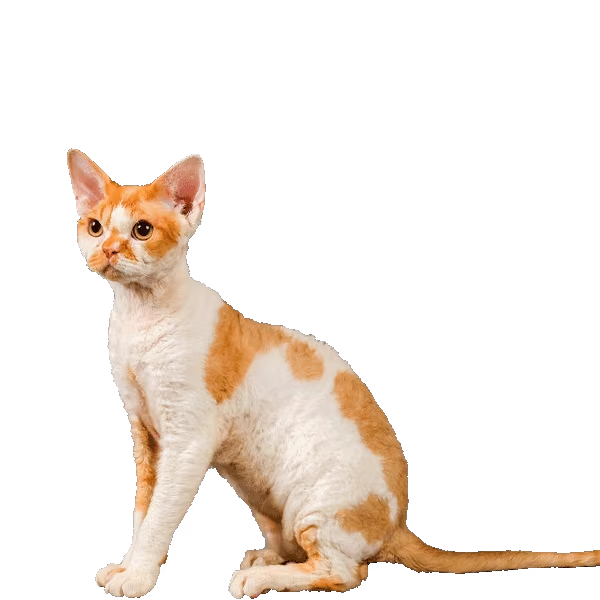
The Devon Rex is a mischievous, playful breed adored for its big ears, wavy coat, and clownish, people-loving antics.
How the Devon Rex coat is built, and what that means when you groom it.
The Devon Rex is a small, people-oriented cat from England, known for its wavy coat, oversized ears and playful, mischievous nature.
The Devon Rex is a small domestic cat, easily picked out by its short wavy coat, broad head with prominent cheekbones, large low-set ears and big expressive eyes. The look is often called elfin or pixie-like. Adults usually weigh between 2.7 and 4 kg, which puts the breed at the smaller end of the cat size range.
This is a cat bred and kept for company rather than any working purpose. Devon Rex cats are active, curious and closely attached to their people. They will follow the household from room to room, settle on shoulders or laps, and take an interest in whatever is going on. Many hold on to their kitten-like playfulness well into adulthood.
The wavy coat comes from a natural genetic mutation first identified in Devon, England, in 1960. The coat is short and soft, and most owners find grooming demands modest, though the breed still sheds and is not hypoallergenic.
| Attribute | Detail |
|---|---|
| Origin | United Kingdom (Devon, England) |
| Size | Small (about 2.7 to 4 kg) |
| Lifespan | 9 to 15 years |
| Group / role | Companion / domestic shorthair-type |
| Good with | Families, children, other pets, attentive single-person homes |
The Devon Rex fits households that want an interactive, affectionate cat and can give it daily attention. It suits families with children, multi-pet homes, and owners who are home often or who can provide company and toys. It is a poor match for anyone wanting an independent, low-contact cat, because the breed can grow bored or unhappy when left on its own for long stretches.
The Devon Rex traces to a single curly-coated kitten born in Devon, England, in 1960, and was developed into a recognised breed over the following decade.
The Devon Rex began in 1960 near Buckfastleigh in Devon, England. A woman named Beryl Cox took in a curly-coated kitten she called Kirlee, born to a stray cat living near a disused tin mine. Kirlee's wavy coat came from a natural genetic mutation.
At first the kitten was thought to share its origin with the Cornish Rex, a curly-coated cat that had turned up in neighbouring Cornwall a decade earlier. Breeders tried mating Kirlee with Cornish Rex cats, but the resulting kittens had straight coats. This showed that the two curls came from different recessive genes, and the Devon line was set up as a separate breed.
Kirlee became the foundation male, crossed with cats carrying the same recessive gene to fix the wavy coat. Because the gene pool started from one cat, early breeding relied on a small number of founders. Outcrossing to other shorthaired cats widened the gene pool while keeping the coat type.
The breed gained championship recognition with major cat registries through the 1960s and 1970s and spread from the United Kingdom to North America, Australia and other regions. In Australia it is registered through bodies affiliated with the Co-ordinating Cat Council of Australia and with TICA, and it remains a recognised pedigree breed today.
The Devon Rex is a small cat with a wedge-shaped face, very large low-set ears, big eyes and a short, soft, wavy coat.
The Devon Rex has a distinctive head shaped like a short wedge, with full cheeks, a strong chin and a clear stop in the nose profile. Its most striking feature is the pair of very large ears set low and wide, which gives the face an open, alert look. The eyes are large, oval and set well apart. The body is slim and hard-muscled with a broad chest and long legs, and the cat often carries itself in a slightly arched, springy posture.
| Trait | Standard |
|---|---|
| Height | About 25 to 30 cm at the shoulder |
| Weight | About 2.7 to 4 kg |
| Coat | Short, soft, wavy (rexed); fine and loose |
| Colours | All colours and patterns, including solid, tabby, tortoiseshell, bicolour and pointed |
| Eyes | Large, oval, wide-set; colour usually matches coat |
The coat is the defining feature. It is short, fine and arranged in soft waves rather than tight curls, and it can feel thin or sparse in places such as the head, neck and chest. Some Devon Rex cats have lighter coverage on the underside and ears. The whiskers and eyebrows are often short, curled or stubbly and may break easily.
The breed is accepted in the full range of cat colours and patterns. This takes in solid shades such as black, white, blue and cream, along with tabby, tortoiseshell, calico, smoke and pointed patterns. Coat colour does not affect the wavy texture, which depends only on the rex gene.
The Devon Rex is affectionate, playful and mischievous, forming strong bonds with people and generally getting on with children and other pets.
The Devon Rex is one of the more people-focused cat breeds. It seeks out human company, perches on shoulders, burrows under blankets and stays close to its owner through the day. Many owners describe the breed as dog-like in its attachment, and some Devon Rex cats learn to come when called or play fetch.
With family members the breed is warm and demonstrative. It usually does well with respectful children who can match its energy and play style. Faced with strangers, most Devon Rex cats are confident and curious rather than shy, though individuals vary. The breed generally tolerates and often enjoys the company of other cats and friendly dogs, which makes it a sensible choice for multi-pet homes.
The playful, mischievous side never really switches off. These cats climb, explore high shelves, open cupboards and investigate any food left out. They are intelligent and active, and they need toys, attention and interaction to stay content. A bored Devon Rex may turn noisy or destructive. The breed is moderately vocal, communicating with chirps and soft calls rather than loud, persistent meowing.
| Trait | Rating |
|---|---|
| Affection | 5 |
| Energy | 5 |
| Trainability | 4 |
| Vocalness | 3 |
| Shedding | 2 |
The Devon Rex needs gentle, minimal coat care plus regular ear cleaning, daily play and a warm indoor home, since its thin coat offers little insulation.
The Devon Rex is an indoor cat. Its thin coat gives little protection from cold, so the home should be kept warm and free of draughts, and the cat will often seek out heated spots, sunny windows and laps. Being social, it does best where it has company for much of the day. Provide warm bedding and safe high perches.
The Devon Rex needs a complete, protein-rich cat food fed in measured daily portions, with fresh water always available and toxic foods kept well away.
As an active cat, the Devon Rex does best on a complete and balanced diet built around animal protein. Choose a quality commercial cat food that meets recognised feline nutrition standards for the cat's life stage. The breed's high energy means it burns through calories quickly, but portions should still be measured to prevent overfeeding. Fresh water should always be available, and a mix of wet and dry food can help with hydration.
| Life stage | Amount per day | Meals |
|---|---|---|
| Kitten (to 12 months) | Feed to appetite per label, growth formula | 3 to 4 |
| Adult (1 to 7 years) | About 115 to 170 g wet or equivalent dry | 2 |
| Senior (8+ years) | Adjusted to weight and activity | 2 |
Treats should stay under about 10 per cent of daily calories. A balanced complete diet usually supplies every required nutrient, so supplements are not needed unless a vet recommends them for a specific condition. Watch the cat's weight at regular checkups and adjust food amounts if it gains or loses condition.
The Devon Rex generally lives 9 to 15 years and is mostly healthy, but the breed has known risks including a muscle disorder, heart disease and patellar luxation.
The Devon Rex is generally a healthy breed with a typical lifespan of 9 to 15 years. Because the modern population descends from a small number of founders, it carries a few inherited conditions that responsible breeders screen for. Buying from a breeder who tests breeding cats and provides health records lowers the risk of passing these on.
| Condition | Signs | Note |
|---|---|---|
| Devon Rex myopathy (spasticity) | Muscle weakness, head bobbing, difficulty swallowing | Inherited muscle disorder; appears in young cats |
| Hypertrophic cardiomyopathy (HCM) | Lethargy, breathing trouble, sudden weakness | Heart muscle thickening; screened by cardiac ultrasound |
| Patellar luxation | Skipping gait, hind-leg lameness | Kneecap slips out of place; varies in severity |
| Hereditary skin and coat issues | Greasy skin, yeast or ear infections | Linked to the sparse coat and ear wax buildup |
The Devon Rex is intelligent and people-oriented, which makes it one of the more trainable cat breeds when taught with patience and rewards.
The Devon Rex learns quickly and enjoys interaction, so it takes to training that many cats simply ignore. Owners often teach this breed to fetch, walk on a harness, use puzzle feeders and follow simple cues. Because the cat is motivated by attention and food, short, frequent sessions work better than long ones. Keep training positive, since cats do not respond to punishment and may withdraw or become stressed.
Devon Rex cats reach breeding maturity within the first year, carry litters for about two months, and typically produce small to average litters that need careful, warm rearing.
Female Devon Rex cats usually reach sexual maturity between 5 and 10 months, though responsible breeders wait until a queen is physically mature, often around one year, before mating. Gestation lasts about 63 to 67 days. Litters are commonly small to average, with three to four kittens being typical.
Newborn kittens depend heavily on warmth because of the breed's thin coat, so the nest must be kept warm and free of draughts. Kittens nurse for the first weeks and begin weaning onto solid food at around four weeks, finishing by about eight weeks. Early, gentle handling helps produce the friendly, people-focused temperament the breed is known for.
Because the breed descends from a small founder group, ethical breeding programmes track pedigrees to limit inbreeding and screen breeding cats for heart disease, the inherited muscle disorder and patellar problems. Kittens usually stay with the mother and litter until at least 12 weeks before going to new homes.
| Metric | Value |
|---|---|
| Sexual maturity | About 5 to 10 months |
| Recommended first breeding | Around 12 months |
| Gestation | About 63 to 67 days |
| Average litter size | 3 to 4 kittens |
| Weaning age | About 8 weeks |
| Ready for new home | 12 weeks or older |
Free lifetime registration for your Devon Rex, chip record included, searchable wherever in the country she wanders.
Set the record up before she needs it: name, colouring, photo, your mobile, save. That is the whole of registering your cat with United Pet Club, and the record stands for life without a bill.
If she's already chipped, the register entry is the missing half; the vet's part ended with the needle. Register the microchip free for life with United Pet Club: any brand qualifies, address changes cost nothing, and the record answers scans from any clinic or shelter in the country. Create your free account and knock both jobs over tonight.
Free with United Pet Club: set up an account, add her name, colouring, and a photo, and the profile's live for her whole life. A chip isn't required to start.
Enter the 15-digit number into your free account with your current details. Registration and updates never cost anything, whatever brand of chip your vet used.
Several states and territories require it, and shelters chip before rehoming as standard. Requirement or not, the register entry with your current number is what actually brings a Devon Rex home.
Nothing at all. United Pet Club's lifetime plan covers her profile, the chip record, and every update, with no annual renewal.
Common questions about the Devon Rex cover its size, personality, care needs, lifespan, suitability and availability in Australia.
The Devon Rex is a small cat. Most adults weigh about 2.7 to 4 kg and stand roughly 25 to 30 cm at the shoulder, with males usually larger than females.
It is affectionate, playful and mischievous. The breed is strongly people-oriented, often following owners around, sitting on laps or shoulders, and keeping a kitten-like energy into adulthood.
Coat grooming is minimal because the wavy coat needs little brushing, but the breed needs regular ear cleaning, a warm draught-free home, and daily play and attention to stay content.
The typical lifespan is 9 to 15 years. Regular veterinary care, screening for inherited conditions and a balanced diet all help support a long, healthy life.
Yes. They generally do well with respectful children, other cats and friendly dogs, which makes them a good fit for active, social households that can give them attention.
No. Although they shed little and have a thin coat, they still produce the allergens found in cat saliva and skin. No cat breed is truly hypoallergenic.
They are a recognised pedigree breed but less common than mainstream cats. Kittens are usually obtained from registered breeders affiliated with the CCCA or TICA, and breed-specific rescues occasionally have cats available.
