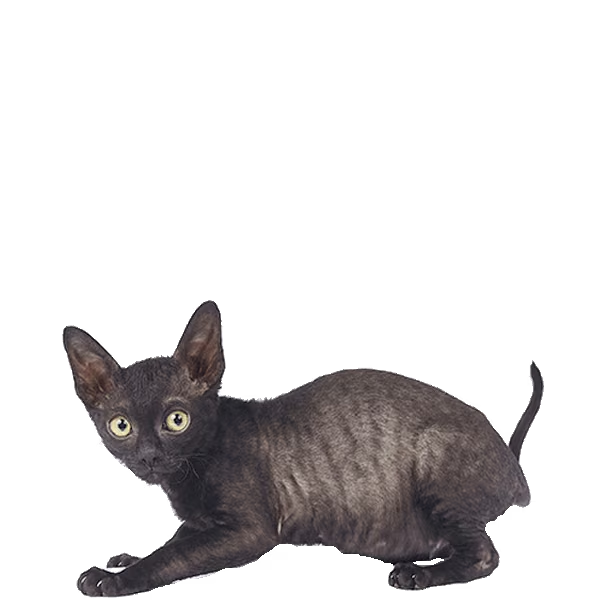
The Cornish Rex is a playful, affectionate breed famous for its soft wavy coat and lively, acrobatic personality.
How the Cornish Rex coat is built, and what that means when you groom it.
The Cornish Rex is a slender, lively cat with a uniquely wavy, velvety coat and the playful spirit of a kitten that never quite grows up. Born from a natural genetic mutation in Cornwall, England, in 1950, this breed is cherished by cat lovers across Australia for its warmth-seeking, people-focused personality.
The Cornish Rex is immediately recognisable by its short, deeply wavy coat — the result of a naturally occurring recessive rex gene mutation first documented in Cornwall, England. Unlike most cats, the Cornish Rex carries only a soft, wavy undercoat; it has no guard hairs and no awn hairs. The result is a coat that feels extraordinarily like velvet or lambswool to the touch. Even the whiskers are wavy or curly.
The breed's physical profile is equally distinctive: an arched, whippet-like body, large ears set high on an egg-shaped head, and impressively large, expressive eyes. Despite this refined silhouette, the Cornish Rex is anything but aloof — it's an endlessly curious, active cat that shadows its favourite people wherever they go.
In Australia, the Cornish Rex has attracted a dedicated following among those who want a highly interactive companion suited to indoor life, particularly in warmer states where the cat's love of warmth is well accommodated.
| Characteristic | Detail |
|---|---|
| Origin | United Kingdom (Cornwall) |
| Size | Small |
| Lifespan | 11 to 15 years |
| Role | Companion cat |
| Good with | Families, children, other cats, dogs |
The Cornish Rex is recognised by the Australian Cat Federation (ACF) and the Australian National Cats (ANCATS), both of which maintain breed standards aligned with international guidelines. The breed was first documented in 1950, and adults typically weigh 2.7 to 4.5 kg (6 to 10 lb) with a coat made up of wavy undercoat only and no guard hairs. Since that offers so little insulation, the Cornish Rex should be kept strictly indoors. Reputable Australian breeders are listed through these bodies and conduct health screening including cardiac assessments.
A chance mutation on a Cornish farm in 1950 gave rise to one of the most distinctive cat breeds in the world.
In the summer of 1950, a tortoiseshell-and-white farm cat named Nina Ennismor gave birth to an unusual kitten on a farm near Bodmin Moor in Cornwall, England. The kitten, named Kallibunker by owner R.C. Böhm, had a distinctive wavy, cream-coloured coat quite unlike any cat previously recorded. Rather than dismissing the kitten as an oddity, Böhm consulted feline geneticist Dr. A.C. Jude, who confirmed the wavy coat resulted from a recessive mutation affecting the hair shaft structure.
To establish the trait, Kallibunker was backcrossed to his mother and later to other domestic shorthairs. Early British breeding lines worked to preserve this unique coat while expanding the gene pool. By the 1960s, the breed had reached the United States, where breeders refined the body type towards the leaner, more angular silhouette recognised in show rings today.
It's worth noting that the Devon Rex, which emerged in Devon in 1960, superficially resembles the Cornish Rex but carries an entirely different recessive gene. The two breeds cannot produce wavy-coated offspring together — a fact confirmed by early genetic crossbreeding trials.
Australian cat fanciers first imported the breed in the latter decades of the twentieth century, and it has since been a consistent, if specialised, presence on the Australian show circuit under both ACF and ANCATS standards.
A lean, arched body, oversized ears, a sculptural egg-shaped head, and a coat like warm velvet — the Cornish Rex is unmistakable.
The body of the Cornish Rex is often described as whippet-like: lean, arched from shoulder to hip, with a deep chest, tucked abdomen, and long slender legs that end in small, oval paws. The tail is long, slender and whip-like, tapering to a fine point. Despite its delicate appearance it is a surprisingly athletic cat.
The head is a medium-length oval, narrowing to a rounded muzzle with a strong chin. High, prominent cheekbones give the face a faintly aristocratic look. The ears are strikingly large, wide at the base, set high on the head, and carried erect — amplifying the cat's alert, curious expression. Eyes are large, oval, and slightly angled at the outer corners, coming in any colour consistent with the coat.
The coat is the breed's signature feature. Short, uniform, and deeply wavy in parallel rows over the entire body, it has the feel of crushed velvet or fine-knit lambswool. Because there are no guard hairs, the coat lies close to the body and does not shed heavily — a quality many Australian households appreciate. The whiskers and eyebrows share the same wavy quality.
| Feature | Description |
|---|---|
| Height | 20 to 30 cm (8 to 12 in) at the shoulder |
| Weight | 2.7 to 4.5 kg (6 to 10 lb); females are smaller |
| Coat | Short, deeply wavy, undercoat only, no guard hairs |
| Colours | All colours and patterns accepted |
| Eyes | Large, oval; any colour consistent with coat |
The Cornish Rex is accepted in all colours and patterns — including solid, tabby, bicolour, tortoiseshell, and colourpoint — making it one of the more visually diverse short-coated breeds on the Australian show bench. There are no colour restrictions in either ACF or ANCATS breed standards.
Affectionate, acrobatic, and addictively entertaining — the Cornish Rex is the quintessential velcro cat.
Few cats match the Cornish Rex for sheer social energy. Owners consistently describe it as a "velcro cat" — one that follows its people from room to room, inserts itself into every activity, and is rarely found more than an arm's length from a warm human.
Beneath the acrobatic playfulness is a genuinely affectionate nature. The Cornish Rex actively seeks out laps, shoulders, and warm spots next to sleeping owners. It retains kitten-like enthusiasm well into adulthood and old age, often retrieving small toys in impromptu games of fetch.
The breed is well suited to active households and gets on admirably with children who handle it respectfully, other cats, and dog companions that are relaxed around cats. It dislikes extended periods alone, and in busy Australian households — especially those with school-aged children who are home much of the day — it tends to thrive. For owners who work long hours, a feline companion is strongly advisable.
| Trait | Rating (1–5) |
|---|---|
| Affection | 5/5, a devoted velcro cat |
| Energy | 5/5, active at every life stage |
| Trainability | 4/5, learns tricks and commands readily |
| Vocalness | 3/5, communicative without being demanding |
| Shedding | 1/5, coat sheds very little |
Minimal grooming but genuine warmth requirements — and particular care needed in Australia's harsh sun.
Grooming
The Cornish Rex's wavy coat is one of the lower-maintenance in the cat world, but it does have specific needs:
Exercise and enrichment
This breed has energy to burn and needs daily outlets:
Environmental needs
Australia's climate presents both advantages and hazards for the Cornish Rex:
A fast metabolism and active lifestyle mean the Cornish Rex needs a high-quality, protein-rich diet fed at regular intervals.
The Cornish Rex has a higher metabolic rate than many breeds — a consequence of its lean body type, active nature, and thin coat (which means the body works slightly harder to maintain temperature). Owners sometimes report that their Cornish Rex seems perpetually hungry; this is normal, but it does not mean free-feeding is appropriate.
A well-balanced diet should prioritise:
| Life stage | Food type | Frequency |
|---|---|---|
| Kitten (0–12 months) | Kitten-formula wet or dry food | 3–4 meals per day |
| Young adult (1–7 years) | Adult maintenance formula | 2–3 meals per day |
| Mature (7+ years) | Senior or low-calorie formula | 2 meals per day |
Australian owners feeding a raw or BARF diet should ensure recipes are nutritionally complete and verified by a veterinary nutritionist. Raw chicken necks and wings provide dental benefit as well as nutrition. Always source protein from human-grade suppliers and freeze raw meat for at least 72 hours before feeding to minimise pathogen risk.
Generally robust and long-lived, the Cornish Rex has a handful of breed-specific conditions worth monitoring.
The Cornish Rex is considered a hardy breed with a typical lifespan of 11–15 years. Many individuals remain active and healthy well into their teens. That said, responsible ownership includes awareness of the breed's known predispositions and regular veterinary check-ups.
| Condition | Description | Management |
|---|---|---|
| Hypertrophic Cardiomyopathy (HCM) | Thickening of the heart muscle; the most significant cardiac risk in the breed | Annual or biennial echocardiogram; buy from HCM-screened parents |
| Patellar luxation | Kneecap slipping out of its groove; can cause intermittent lameness | Orthopaedic assessment; surgical correction if severe |
| Sunburn | Thin coat provides minimal UV protection on ears, nose, and muzzle | Strict sun avoidance; UV window film indoors |
| Dental disease | Tartar build-up and gingivitis common without preventive care | Regular brushing and professional dental cleans |
Preventive care schedule
Clever, food-motivated, and genuinely eager to engage — the Cornish Rex is one of the more trainable cat breeds.
The Cornish Rex responds exceptionally well to reward-based training. Unlike many cats that regard training with indifference, the Cornish Rex actively participates — it enjoys the interaction, the mental challenge, and the treats involved. Australian owners have reported success teaching everything from basic recall to complex trick sequences.
Keep sessions short and positive: five to ten minutes at a time, two or three times a day, produces far better results than a single long session. End every session on a success so the cat associates training with a good outcome.
Foundation training steps
Breeding Cornish Rex requires sound knowledge of recessive rex genetics and a commitment to cardiac health screening.
The Cornish Rex's wavy coat is governed by a recessive rex gene (designated r). Both parents must carry at least one copy of the recessive allele for the possibility of wavy-coated offspring. When both parents are homozygous (rr), all kittens will carry the wavy coat.
Responsible breeders registered with ACF or ANCATS adhere to a code of ethics that typically includes:
| Parameter | Value |
|---|---|
| Gestation period | 63–67 days |
| Average litter size | 3–4 kittens |
| Weaning age | ~8 weeks |
| Minimum rehoming age | 12–13 weeks |
| Female sexual maturity | ~6–9 months |
| Coat gene | Recessive rex (rr) |
Free lifetime registration for your Cornish Rex, chip record included, searchable wherever in the country she wanders.
Set the record up before she needs it: name, colouring, photo, your mobile, save. That is the whole of registering your cat with United Pet Club, and the record stands for life without a bill.
Scanners find chips in seconds; the question is what the number points at. Point your Cornish Rex's chip at a live record: free with the lifetime plan, open to all brands, kept current through every move without charges. Microchip registration plus a free account, and she's covered.
Free with United Pet Club: set up an account, add her name, colouring, and a photo, and the profile's live for her whole life. A chip isn't required to start.
Enter the 15-digit number into your free account with your current details. Registration and updates never cost anything, whatever brand of chip your vet used.
Several states and territories require it, and shelters chip before rehoming as standard. Requirement or not, the register entry with your current number is what actually brings a Cornish Rex home.
Nothing at all. United Pet Club's lifetime plan covers her profile, the chip record, and every update, with no annual renewal.
Answers to the questions Australian cat lovers most commonly ask about the Cornish Rex.
Not entirely. No cat is truly hypoallergenic — all cats produce the Fel d 1 protein that triggers most allergic reactions in people. The Cornish Rex sheds less hair into the environment than double-coated breeds, which can reduce allergen dispersal, but it is not allergen-free. People with mild cat allergies sometimes tolerate the breed better; spending time with a Cornish Rex before committing is the only reliable test.
Less than you might expect. The coat is low-shedding and needs only gentle stroking or a soft brush once or twice a week. The main care requirement is an occasional bath (every four to six weeks) because skin oils build up faster without guard hairs to distribute them.
It adapts well to most Australian climates as an indoor cat. In warmer northern states the cat's love of warmth works in its favour, though air conditioning should be available in extreme heat. In cooler southern states and Tasmania, warm bedding and draught-free environments are important. Sun exposure should be minimised year-round due to UV risk.
Very well in most cases. The Cornish Rex is active, playful, and sociable, and typically enjoys the interaction children provide. Younger children should be taught to handle the cat gently — its lean build means it is less robust than a larger, heavier breed.
Absolutely. The Cornish Rex adapts readily to apartment living provided it has enrichment, vertical space (cat trees, shelving), and companionship. Many Australian owners in inner-city apartments keep Cornish Rex cats very successfully.
Search the breeder directories of the Australian Cat Federation (ACF) or Australian National Cats (ANCATS). Both organisations require registered breeders to meet health and welfare standards. Ask any breeder to show you HCM echocardiogram results for the parents and to demonstrate that kittens are well socialised before leaving.
Though similar in appearance, the two breeds carry different recessive genes — crossing them does not produce wavy-coated kittens. The Devon Rex has a slightly broader head, larger and more bat-like ears, and an even more pronounced pixie-like face. Temperamentally both are playful and people-oriented, though many find the Cornish Rex slightly more active and the Devon Rex slightly softer in build.
