
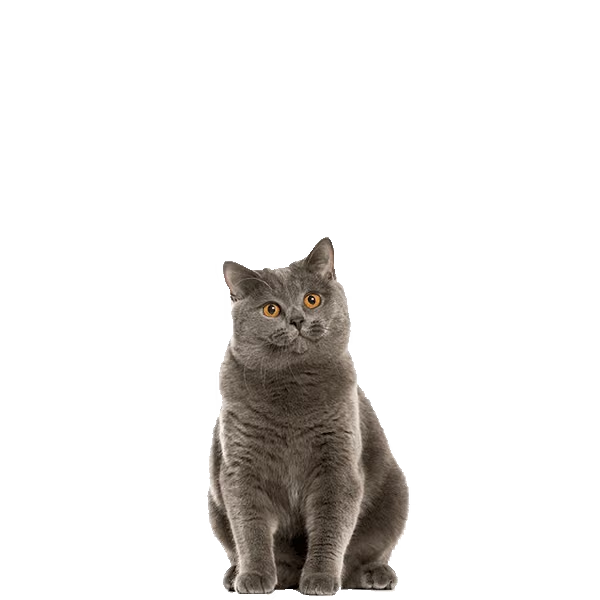
Chartreux
The Chartreux is a calm, gentle breed treasured for its plush blue-grey coat, quiet voice, and devoted, easygoing companionship.
- Size
- Medium
- Lifespan
- 12–15 years
- Origin
- France
- Temperament
- Calm
- Standard colors
- Blue
Characteristics
Coat and grooming
How the Chartreux coat is built, and what that means when you groom it.
- Coat layers
- Double coat
- Coat texture
- Plush
- Coat length
- Short
- Shedding
- Seasonal shedding
Grooming guidance
Critical: A Chartreux should not be shaved.
The undercoat keeps heat out as well as in, and the outer coat shields the skin from sun and insect bites. Clipping the whole coat off removes both. It often grows back patchy, soft or a different colour, and in some animals the guard hairs never return properly. Brush the undercoat out instead of cutting it off.
Information: A Chartreux drops its undercoat in heavy bursts.
The undercoat comes out in heavy bursts over a few weeks. An undercoat rake, or a bath followed by a proper blow-dry, clears it far faster than daily brushing. Clipping the coat down is not a shortcut for this.
Chartreux colors and patterns
What each club's breed standard says about every Chartreux color and pattern. Point at a ruling to see the club's own wording.
Breed standards describe the Chartreux in Blue. Standard patterns: Solid.
| Color or pattern | TICA | CFA | FIFE | GCCF |
|---|---|---|---|---|
| Blue | Standard (“Blue”) | Standard (“blue-gray”) | Standard (“blue”) | Standard (“greyish blue”) |
| Patterns | ||||
| Solid | Standard (“Solid”) | No ruling | Standard (“solid”) | No ruling |
| Pointed | No ruling | No ruling | No ruling | Not recognised (“colourpoint”) |


| Color or pattern | TICA | CFA | FIFE | GCCF |
|---|---|---|---|---|
| Orange | Standard (“orange”) | Standard (“orange”) | No ruling | No ruling |
| Copper | Standard (“copper”) | Standard (“copper”) | Standard (“deep copper”) | Standard (“copper”) |
| Yellow | No ruling | No ruling | Standard (“deep yellow”) | Standard (“yellow”) |
| Gold | Standard (“gold”) | Standard (“gold”) | No ruling | No ruling |
| Green | Disqualifying (“Green”) | Disqualifying (“green”) | Not recognised (“green”) | Disqualifying (“Green”) |
| Color or pattern | TICA | CFA | FIFE | GCCF |
|---|---|---|---|---|
| Blue | No ruling | No ruling | Standard (“blue-grey”) | No ruling |
| Slate | Standard (“slate gray”) | Standard (“slate gray”) | No ruling | Standard (“slate grey”) |
| Color or pattern | TICA | FIFE |
|---|---|---|
| Blue | Standard (“blue with rose-taupe overtones”) | Standard (“blue-grey”) |
What the rulings mean
- Standard
- Described by the club's breed standard.
- Disqualifying
- The club's breed standard disqualifies an animal of this colour or pattern.
- Not recognised
- The club does not accept this colour or pattern for the breed.
Color changes
How a Chartreux's colors can change over its life.
Bluechanges toTortoiseshell
Coat · With age
Tabbychanges toSolid
Coat · With age · from 0 to 104 weeks
Solidchanges toSmoke
Coat · With age · from 3 to 104 weeks


Sources
Each ruling comes from the club's published breed standard or color list.
About the Chartreux
The Chartreux is a rare and ancient French breed renowned for its distinctive blue-grey coat, copper-to-gold eyes, and remarkably quiet, devoted nature. Calm and observant, this cat forms deep bonds with its family while remaining quietly self-possessed.
The Chartreux ranks among France's oldest recognised cat breeds, known for its dense blue-grey coat and eyes that range from deep copper to bright gold. The head is broad and rounded, and the set of the mouth gives many Chartreux what looks like a faint smile.
The breed remains uncommon in Australia, with kittens typically sourced through specialist breeders rather than general catteries. Its calm, self-contained nature suits both flats and houses, and it settles into a steady household routine without fuss. Rather than meowing, most Chartreux communicate through soft chirps and trills, which owners often come to recognise as the cat's main form of conversation.
| Attribute | Detail |
|---|---|
| Origin | France |
| Size | Medium |
| Lifespan | 12–15 years |
| Role | Companion cat |
| Good with | Adults, gentle children, calm pets |
Who suits this breed
The Chartreux fits households after a settled, affectionate cat that will not demand constant handling or make much noise doing it. Its quiet nature suits units and terraces where neighbours are close by. New cat owners generally manage the breed without difficulty, since it is even-tempered and only moderately active, though it still needs daily play and attention to stay content.
History
One of France's most celebrated breeds, the Chartreux has a storied past stretching back centuries, surviving near-extinction during World War II before being carefully revived by dedicated breeders.
The Chartreux appears in French literature and art as far back as the 16th century, and the naturalist Buffon documented the breed in the 18th century. According to popular legend, the cats were kept by Carthusian monks — though historians consider this romanticism rather than documented fact.
The most pivotal chapter in the breed's modern history belongs to the Léger sisters, Christine and Suzanne, who maintained a colony of feral blue cats on the island of Belle-Île-en-Mer off the coast of Brittany in the early 20th century. Their careful stewardship helped establish the breed's standard.
World War II proved catastrophic: the free-roaming colonies were decimated, and breeders had to rebuild the population carefully, at times crossing with British Shorthairs, Persians, and Russian Blues. By the 1960s the breed was on firmer footing, and in the 1970s the first Chartreux arrived in North America. The breed is still quite uncommon in Australia, making a well-bred kitten a genuine find.
Appearance
Solidly built and robustly muscled beneath a short, water-resistant double coat, the Chartreux presents in only one colour: blue-grey, in any shade from pale ash to deep slate.
Beneath the coat, the Chartreux is a solidly built cat with a broad chest and surprisingly fine-boned legs for its bulk, an arrangement sometimes described as primitive in structure. The head is rounded with full cheeks, most pronounced in adult males, and a tapering muzzle that produces the breed's trademark gentle expression. Ears sit fairly high on the head and are medium in size.
Coat texture sets the breed apart from other blue-grey cats. It sits short to medium in length, woolly rather than silky, and stands slightly away from the body so it parts or breaks when the cat moves, not unlike sheepskin. A heavy undercoat gives the fur natural water resistance and a faint sheen along the tips.
| Feature | Standard |
|---|---|
| Height | About 23–28 cm at the shoulder |
| Weight | Males 5–7 kg; females 3–4.5 kg |
| Coat | Short to medium, dense, woolly double coat |
| Colours | Blue-grey only, any shade from ash to slate |
| Eyes | Round, copper to gold |
Coat and colours
Blue-grey is the only colour recognised in the breed, though the exact shade can sit anywhere between a pale ash and a deeper slate. Guard hair tips often carry a light silvery cast that catches the light. Kittens sometimes arrive with faint tabby ghost markings or rings around the tail, which normally disappear as the adult coat comes through. Nose leather is slate grey, and paw pads run from a dusty rose to grey.
Temperament
Quietly devoted and exceptionally calm, the Chartreux forms deep, loyal bonds with its chosen people while maintaining a dignified reserve with strangers. It communicates through chirps and trills rather than meows.
The Chartreux is famously described as 'dog-like' in loyalty: it tends to follow its favourite person from room to room, settle nearby without demanding constant attention, and greet family members at the door. It typically bonds most closely with one or two people, though it is patient and gentle with children and respectful of other household pets.
With strangers it is reserved rather than unfriendly, preferring to observe before approaching. It is almost entirely silent: the rare meow surprises owners who have grown used to soft chirps and trills as its primary means of communication. Its low energy level means it is content with moderate playtime and long periods of calm companionship.
| Trait | Rating |
|---|---|
| Affection | 4 |
| Energy | 2 |
| Trainability | 3 |
| Vocalness | 1 |
| Shedding | 3 |
Care
The Chartreux's dense double coat requires regular but not onerous grooming; its calm disposition makes routine care straightforward for most owners.
Coat care
The Chartreux coat looks harder to manage than it actually is, provided brushing stays gentle. Firm brushing can flatten the woolly texture and spoil the way it naturally breaks, so a wide-toothed comb or a soft rubber brush once or twice a week is generally enough to lift loose hair and stop mats forming. The dense undercoat repels water fairly well, so baths are rarely necessary.
Nails and teeth
Clip nails roughly every two to three weeks. Daily brushing is best for dental health, but where that is not realistic, a dental gel or water additive used consistently still cuts down on tartar.
Exercise and play
The Chartreux is not a high-energy cat, but it still benefits from short bursts of interactive play. Wand toys, puzzle feeders, and brief fetch-style games suit its watchful, food-motivated nature. Ten minutes once or twice a day is usually enough to keep a healthy weight and a settled mind.
Living environment
The breed copes well in a unit as much as a house, provided it has a stable routine and a few favourite resting spots. A window perch or cat tree gives it somewhere to watch the world, which suits its naturally observant streak. Large outdoor space is not essential, though supervised access to a secure yard or a cat run is welcomed where available.
Nutrition
A high-quality diet tailored to the Chartreux's life stage is essential, particularly given the breed's predisposition to obesity and urinary crystals.
The Chartreux is a moderately sized, relatively sedentary cat, meaning it can gain weight easily if overfed. A protein-rich diet, whether premium wet food, dry kibble, or a combination, keeps muscle mass healthy while supporting urinary tract function. Wet food has the added benefit of increasing moisture intake, which helps dilute urine and reduce the risk of struvite crystal formation.
Meals should be portion-controlled rather than free-fed, particularly for indoor cats. Regularly weigh your cat and consult your vet if weight creeps upward.
| Life Stage | Age | Suggested Approach |
|---|---|---|
| Kitten | Up to 12 months | High-protein kitten formula; 3–4 small meals per day; free-feed is acceptable if weight monitored |
| Adult | 1–8 years | Measured adult formula; 2 meals per day; wet food encouraged for hydration |
| Senior | 8+ years | Senior formula with joint support; consider renal-supportive food if advised by vet |
Treats and extras
Keep treats to roughly a tenth of daily kilojoules at most, since it is easy to tip a Chartreux into excess weight. A complete commercial diet already covers nutritional needs, so extra supplements are not usually required unless a vet recommends one for a specific issue. A hairball-control food or the occasional bit of cat grass can help with fur swallowed from that dense coat.
Health
Generally a robust and long-lived breed, the Chartreux is nonetheless predisposed to a handful of conditions that attentive owners and regular veterinary check-ups can help manage.
With a typical lifespan of 12–15 years, the Chartreux is considered a healthy breed overall. Responsible breeders screen breeding stock for known hereditary concerns. Routine annual vet visits, dental check-ups, and weight monitoring are the cornerstones of good preventive care.
| Condition | Description | Management |
|---|---|---|
| Patellar luxation | Kneecap slips out of normal position; can cause lameness | Vet assessment; surgical correction in severe cases |
| Struvite urinary crystals | Mineral crystals form in the bladder; males more at risk | High moisture diet; vet-prescribed urinary diet if required |
| Obesity | Excess weight stresses joints and organs | Measured feeding; regular weigh-ins; active play |
| Dental disease | Tartar build-up and gum disease common in cats generally | Regular brushing; professional dental cleans at the vet |
Preventive care
- Book annual check-ups, and more frequent visits once the cat reaches senior age
- Keep vaccinations and parasite prevention current
- Brush teeth regularly or use a dental aid to slow tartar build-up
- Track body condition and adjust meals if weight starts to shift
- Keep water bowls topped up and consider a fountain to encourage drinking
Training
Intelligent and quietly observant, the Chartreux responds reliably to patient, reward-based training — though it does things on its own terms and won't be rushed.
The Chartreux pays close attention to its household, which makes it more trainable than its laid-back reputation suggests. It learns its name quickly and can pick up sit, come, and even a light retrieve with lightweight toys. Because it dislikes anything abrupt, sessions work best kept short, five to ten minutes, and finishing while the cat is still keen rather than pushing on.
A clicker suits the breed well: the sharp, consistent sound marks the exact moment a behaviour earns a reward, which the Chartreux picks up on quickly. Small pieces of cooked chicken or a favourite kibble work as effective rewards. Litter training is rarely an issue, since the breed is naturally fastidious and generally only needs a clean tray in a quiet corner. It is also perceptive about daily patterns, often waiting by the food bowl at meal times or appearing at the door when someone is due home.
Getting started
- Say the cat's name and reward any glance or step towards you
- Keep treats small and give them the instant the behaviour happens
- Cap sessions at a few minutes and stop while the cat still wants more
- Point scratching toward a post instead of trying to stop it outright
- Keep feeding and litter routines predictable so the cat knows what to expect each day
Breeding
Chartreux breeding requires patience and careful planning, given the breed's slow physical maturity and the importance of maintaining the distinctive blue-grey coat and robust conformation.
Chartreux kittens are born with faint ghost tabby markings that typically fade to solid blue-grey within the first few months. Reputable breeders prioritise health testing, particularly for patellar luxation, before breeding. Because males take three to four years to reach full physical maturity, responsible breeders generally do not use a male at stud until he is sufficiently developed.
In Australia, the Chartreux is registered with bodies such as the Australian Cat Federation (ACF) and the Co-ordinating Cat Council of Australia (CCCA). Reputable breeders will provide pedigree documentation, vet checks, vaccinations, and microchipping before kittens leave the household.
| Parameter | Typical Range |
|---|---|
| Sexual maturity | 6–10 months (varies) |
| Full physical maturity | 3–4 years (males especially) |
| Gestation | 63–67 days |
| Litter size | 3–5 kittens (average 4) |
| Weaning age | 10–12 weeks |
Registering a Chartreux the easy way, microchip included
Free lifetime registration for your Chartreux, chip record included, searchable wherever in the country she wanders.
Chartreux registration and microchipping in Australia
A Chartreux does not need to roam to go missing; one open window does it. Her free United Pet Club profile keeps your details, her photo, and her chip number together where a vet or shelter can find them. Cat registration never costs a cent, now or later.
If she's already chipped, the register entry is the missing half; the vet's part ended with the needle. Register the microchip free for life with United Pet Club: any brand qualifies, address changes cost nothing, and the record answers scans from any clinic or shelter in the country. Create your free account and knock both jobs over tonight.
How do I register my Chartreux in Australia?
Free with United Pet Club: set up an account, add her name, colouring, and a photo, and the profile's live for her whole life. A chip isn't required to start.
How do I register my Chartreux's microchip?
Enter the 15-digit number into your free account with your current details. Registration and updates never cost anything, whatever brand of chip your vet used.
Do cats need to be microchipped in Australia?
Several states and territories require it, and shelters chip before rehoming as standard. Requirement or not, the register entry with your current number is what actually brings a Chartreux home.
How much is it to register a Chartreux?
Nothing at all. United Pet Club's lifetime plan covers her profile, the chip record, and every update, with no annual renewal.
Frequently Asked Questions
Answers to the questions Australian cat lovers most often ask about the Chartreux.
How big does a Chartreux get?
The Chartreux is a medium to medium-large cat. Adult males typically weigh between 5 and 7 kg, while females are more fine-boned at 3 to 4.5 kg. Males take a notably long time — up to four years — to reach their full size and muscle development.
Is the Chartreux a good family cat?
Yes, provided the household is relatively calm. The Chartreux is patient and gentle with older children and is generally tolerant of other pets once properly introduced. It tends to bond most closely with one or two adults, so it suits families where someone is frequently home.
Is the Chartreux difficult to care for?
Not at all. It is one of the more low-maintenance breeds. Grooming is straightforward, it doesn't demand constant entertainment, and its quiet temperament means it integrates easily into most households. The main commitment is quality time — this breed wants companionship, not just company.
How long does a Chartreux typically live?
With good nutrition, regular vet care, and a safe indoor or supervised environment, most Chartreux live between 12 and 15 years. Some reach their late teens.
Can a Chartreux live happily in a flat?
Absolutely. The Chartreux adapts very well to flat living. Its low energy level and quiet disposition mean it doesn't need a large space — a well-enriched flat with a window perch, a scratching post, and daily interactive play is entirely sufficient.
Is the Chartreux really that quiet?
Yes — it is one of the least vocal cat breeds. Rather than meowing, it communicates through soft chirps and trills. Owners often describe it as a 'silent companion.' This makes it particularly well suited to flat living where thin walls might otherwise be an issue with a more vocal breed.
Where can I find a Chartreux kitten in Australia?
The Chartreux is genuinely rare in Australia. A handful of specialist breeders operate primarily on the east coast. The best starting point is the breed registers maintained by the ACF or CCCA. Expect a waiting list — reputable breeders produce small, carefully planned litters. Avoid unregistered sellers or online marketplace listings that seem to have kittens available immediately without any health documentation.
From the community
Ask about the ChartreuxNo questions about the Chartreux yet. Be the first to ask.
Browse Cat breeds