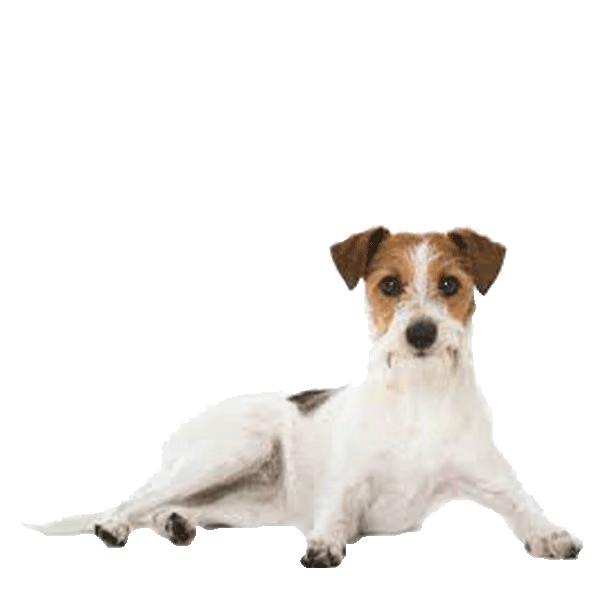
Kromfohrländer je priateľské, láskavé nemecké spoločenské plemeno, ktoré sa darí ako oddaný a dobromyseľný rodinný pes.
Ako je srsť plemena Kromfohrländer stavaná a čo to znamená pri starostlivosti.
Pozor: Srsť plemena Kromfohrländer sa má trimovať ručne, nie strihať strojčekom.
Drsná srsť sa má vytrhávať pri koreni, len čo chlp dozrie a je pripravený sa uvoľniť. Strojček ho namiesto toho prereže v polovici a mäkkú podsadu nechá byť. Výsledkom je srsť, ktorá dorastie ovisnutá a vyblednutá, a odolná štruktúra sa vráti až po ďalšom trimovaní.
The Kromfohrlander is a small German companion breed, known for being friendly, affectionate, and devoted to its family.
The Kromfohrlander is a small companion dog from Germany. It was developed in the years after World War II and has remained primarily a family and house dog rather than a working or sporting breed. Adults are light in build and stand at a small size, which suits homes where a large dog is impractical.
The breed is valued for its character more than any single physical feature. Owners describe it as friendly, affectionate, playful, devoted, and good-natured. It forms close attachments to the people it lives with and tends to follow family members from room to room. The Kromfohrlander is not a kennel dog and does poorly when left isolated for long stretches.
The breed remains uncommon outside continental Europe, and litters are produced in small numbers. People who own one usually choose it for companionship, a moderate activity level, and a temperament that fits indoor family life.
| Attribute | Detail |
|---|---|
| Origin | Germany |
| Size | Small |
| Lifespan | 13 to 15 years |
| Group / role | Companion dog |
| Good with | Families, attentive owners, homes with regular human contact |
The Kromfohrlander fits households that want a small, people-focused dog and can keep it company through most of the day. It works for families with children who handle a dog gently, and for owners who enjoy a companion that stays close. It is less suited to people who are away from home for long hours or who want an independent, low-attention pet.
The Kromfohrlander was developed in Germany after World War II and is named for the Krumme Furche region near Siegen.
The Kromfohrlander traces to Germany in the period following World War II. The breed is associated with Ilse Schleifenbaum of the Siegen area, who is credited with founding the line from a stray dog of mixed background that had been with American or French soldiers during the war.
That foundation dog was bred to a local female, and the resulting puppies showed a consistent appearance and temperament. Schleifenbaum continued selecting for these traits to fix the type across following generations.
The breed takes its name from the local landscape. "Kromfohr" derives from the regional term for the crooked furrow or terrain near Siegen, and "lander" refers to the dog of that area. The Kromfohrlander was recognized by the Federation Cynologique Internationale in the mid twentieth century, which placed it among the companion breeds.
Throughout its history the Kromfohrlander has been kept mainly as a household companion. It never developed as a hunting, herding, or guarding breed, and its numbers have stayed modest, with most breeding concentrated in Germany and neighboring countries.
The Kromfohrlander is a small, lightly built dog that comes in two coat varieties, smooth-haired and wire-haired, usually white with brown or tan markings.
The Kromfohrlander is a small, lightly built dog of balanced proportions. The body is slightly longer than it is tall, the chest is moderate, and the overall impression is of an agile companion rather than a heavy or powerful animal. The head is wedge-shaped with a defined stop, and the ears are set high and drop forward against the head. The tail is carried in a gentle curve.
Two coat types occur within the breed. The wire-haired variety has a rough outer coat with a beard and bushier facial furnishings, while the smooth-haired variety has a shorter, closer coat and a less pronounced beard. Both share the same general shape and size.
| Trait | Standard |
|---|---|
| Height | Approx. 38 to 46 cm (15 to 18 in) at the withers |
| Weight | Approx. 9 to 16 kg (20 to 35 lb) |
| Coat | Two varieties: wire-haired (rough, bearded) and smooth-haired (shorter, close) |
| Colors | White base with brown or tan patches; saddle or patched markings |
| Eyes | Dark, medium-sized, oval, set to give an alert and friendly expression |
The typical pattern is a white ground color marked with patches that range from light tan to deep brown. Markings often appear on the head and over the back as a saddle, though the extent varies between individuals. The coat is weather-resistant enough for normal outdoor activity but is not heavy. The wire-haired coat carries longer furnishings on the muzzle and legs, while the smooth-haired coat lies flatter and shows the body outline more clearly.
The Kromfohrlander is friendly, affectionate, and devoted, gentle with its family while often reserved toward strangers.
The Kromfohrlander is a friendly and affectionate dog that bonds strongly with its household. It is good-natured and playful at home and enjoys taking part in family activity rather than watching from a distance. The breed is sensitive to its people and reads mood and routine closely.
With family members the dog is gentle and devoted, and it usually does well with children who treat it with care. Toward strangers it tends to be reserved at first and may bark to announce a visitor before warming up. It is alert rather than aggressive, and it is not a guard dog.
With other pets the Kromfohrlander is generally sociable, especially when raised alongside them or introduced gradually. Because it attaches so closely to its people, it can struggle with long periods alone and may become unsettled if left isolated. Early socialization helps it stay confident around new people, places, and animals.
| Trait | Rating |
|---|---|
| Affection | 5 |
| Energy | 3 |
| Trainability | 4 |
| Vocalness | 3 |
| Shedding | 2 |
The Kromfohrlander needs moderate grooming that varies by coat type, daily exercise, and an indoor home with regular human company.
Day-to-day care for the Kromfohrlander is moderate. The breed sheds relatively little, but its coat and its need for company both call for steady attention.
The Kromfohrlander is an indoor dog that should live with the family rather than outside. It adapts to apartments or houses as long as it gets daily walks and is not left alone for long stretches. A secure garden is useful but does not replace human company.
The Kromfohrlander does well on a complete, balanced diet portioned to its small size, fed in two meals a day with weight kept in check.
The Kromfohrlander needs a complete and balanced diet suited to a small dog. Choose a food appropriate to its life stage, with quality protein and controlled fat. Because the breed is small and only moderately active, portions should be measured to avoid steady weight gain. Fresh water should always be available.
| Life stage | Amount per day | Meals |
|---|---|---|
| Puppy (2 to 6 months) | Per food label, divided across the day | 3 to 4 |
| Junior (6 to 12 months) | Approx. 100 to 160 g dry food | 2 to 3 |
| Adult | Approx. 90 to 150 g dry food | 2 |
| Senior | Slightly reduced, lower-calorie formula | 2 |
Keep treats to about 10 percent of daily calories, and use small pieces for training so they do not unbalance the diet. A dog on a complete commercial food usually needs no extra supplements; give vitamins or joint products only on veterinary advice. Adjust the total amount if the dog gains or loses weight.
The Kromfohrlander is generally healthy with a lifespan of 13 to 15 years, though a few inherited conditions occur in the breed.
The Kromfohrlander is generally a healthy breed with a lifespan of 13 to 15 years. The small founding population means responsible breeders pay close attention to genetic diversity and screening. A few inherited conditions are recognized within the breed, and informed buyers should ask about health testing of the parents.
| Condition | Signs | Note |
|---|---|---|
| Patellar luxation | Skipping gait, occasional hind-leg lameness | Affects the kneecap; ranges from mild to surgical |
| Hyperkeratosis (foot pad and nose) | Thickened, cracked pads or nose | A breed-associated skin condition managed with care and moisturizers |
| Epilepsy | Seizures of varying frequency | Manageable in many dogs with veterinary treatment |
| Eye conditions | Cloudiness, vision changes | Screening helps identify affected lines |
The Kromfohrlander is intelligent and eager to please, which makes it responsive to calm, reward-based training.
The Kromfohrlander is intelligent and attentive, and it usually wants to please the people it lives with. These traits make it a quick learner with consistent guidance. The breed is sensitive, so harsh corrections tend to backfire and can make a dog anxious or withdrawn. Short, positive sessions hold its attention and build confidence. Early socialization is important because the breed can be reserved with strangers and benefits from calm exposure to new people, dogs, and places while young.
Kromfohrlander breeding is managed carefully because the breed descends from a small founding population, so litters are produced in modest numbers.
Breeding the Kromfohrlander calls for care because the breed comes from a small number of founders. Maintaining genetic diversity is a central concern, and breed clubs track pedigrees and health results to limit close matings. Breeding dogs should be health-screened, of sound temperament, and physically mature before being used.
Females are typically bred once mature rather than at their first season. After a successful mating, gestation in dogs runs about 63 days. Litters in this breed tend to be small. Puppies are born helpless and depend fully on the mother in the first weeks, with eyes opening at around two weeks and weaning beginning at roughly four to six weeks.
Raising young well means keeping puppies with the mother and littermates through the early socialization window, then introducing gentle handling and new experiences before they go to their homes. Responsible breeders place puppies no earlier than about eight weeks and match them to suitable households.
| Metric | Value |
|---|---|
| Sexual maturity | Around 12 to 18 months |
| Gestation | About 63 days |
| Average litter size | Small (often around 3 to 5 puppies) |
| Weaning age | About 4 to 6 weeks |
| Recommended placement age | From about 8 weeks |
Bezplatný doživotný profil pre vášho psa plemena Kromfohrländer v United Pet Club, s registrovaným čipom a bez poplatkov za obnovu.
Sken v útulku je len taký dobrý ako register, na ktorý číslo ukazuje. Dajte psovi plemena Kromfohrländer taký, ktorý odpovie vždy: bezplatná karta s fotkou, údajmi a vaším telefónom, dohľadateľná z ktorejkoľvek ambulancie, celý psí život. Registrácia sa robí raz a ostáva.
Čip vloží veterinár a zápis do štátneho registra vybaví pri tom; aby číslo odpovedalo aj za hranicami, to je už na vás. Zaregistrujte mikročip zadarmo na doživotnom pláne: prijíma čip každej značky, úpravy po sťahovaní nestoja nič a záznam odpovedá na skeny kedykoľvek, doma aj vo svete. Založte si bezplatný účet a vybavte oboje ešte dnes.
Založte si bezplatný účet v United Pet Club, vyplňte údaje psa plemena Kromfohrländer s fotkou a profil uložte. Je zadarmo celý psí život a povinný zápis v Centrálnom registri beží popri tom.
Zapíšte 15-miestne číslo čipu do bezplatného účtu spolu s adresou a telefónom. Doživotný plán prijíma čip každej značky a za úpravy si nikdy nič neúčtuje.
Áno, od roku 2019 musí byť každý pes začipovaný a zapísaný v Centrálnom registri spoločenských zvierat. Záznam United Pet Club to dopĺňa tým, že odpovedá aj mimo Slovenska, zadarmo.
Nič. Bezplatný doživotný plán pokrýva profil, registráciu čipu aj všetky budúce úpravy, bez ročných poplatkov.
Common questions about the Kromfohrlander cover its size, temperament, care needs, lifespan, suitability, and availability.
It is a small breed, standing roughly 38 to 46 cm (15 to 18 in) at the shoulder and weighing about 9 to 16 kg (20 to 35 lb).
It is friendly, affectionate, playful, and devoted. It bonds closely with its family and is usually gentle with children, though it can be reserved with strangers at first.
Care is moderate. It needs weekly brushing (more for the wire-haired type), daily walks, and regular company. Its main need is not being left alone for long periods.
The typical lifespan is 13 to 15 years.
Yes. It suits families and adapts to apartments or houses, as long as it gets daily exercise and regular human contact. It is best for owners who are home much of the day.
No. The breed is uncommon, especially outside continental Europe, and litters are small. Buyers should expect waiting lists and seek breeders who health-test their dogs.
Shedding is relatively low. Regular brushing keeps loose hair under control, and the wire-haired variety benefits from periodic hand-stripping.
