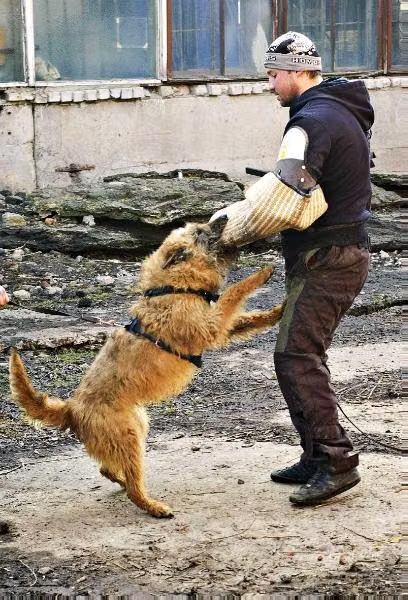
Belgian Laekenois je ochranársky, pracovitý pastiersky pes, najvzácnejší z belgických ovčiakov, oddaný a bdelý voči svojej rodine.
Ako je srsť plemena Belgický ovčiak laekenois stavaná a čo to znamená pri starostlivosti.
Pozor: Srsť plemena Belgický ovčiak laekenois sa má trimovať ručne, nie strihať strojčekom.
Drsná srsť sa má vytrhávať pri koreni, len čo chlp dozrie a je pripravený sa uvoľniť. Strojček ho namiesto toho prereže v polovici a mäkkú podsadu nechá byť. Výsledkom je srsť, ktorá dorastie ovisnutá a vyblednutá, a odolná štruktúra sa vráti až po ďalšom trimovaní.
A few of the Belgický ovčiak laekenois profiles members have added to United Pet Club.
The Belgian Laekenois is a large, protective herding dog from Belgium and the rarest of the four Belgian shepherd varieties, marked by a rough, tousled coat and strong loyalty to its family.
The Belgian Laekenois is one of four closely related Belgian shepherd varieties, alongside the Malinois, Tervuren, and Groenendael. It is distinguished from its cousins by a coarse, wiry, and somewhat disheveled coat rather than a smooth or long one. Among the four, it is the least common, and dogs of this type can be hard to find outside of Belgium and a small number of dedicated breeders elsewhere.
This is a working dog at heart. The breed developed to herd and guard flocks, and those instincts remain strong. A Laekenois is alert, attentive to its surroundings, and naturally protective of the people and property it knows. With its family it tends to be affectionate and closely bonded, often forming a particularly strong attachment to one or two people in the household.
The breed is intelligent and quick to learn, which makes training rewarding but also means an under-stimulated dog can become restless. A Laekenois that has a job to do, whether herding, dog sport, or structured daily activity, is generally a calmer and more settled companion.
| Attribute | Detail |
|---|---|
| Origin | Belgium |
| Size | Large |
| Lifespan | 10 to 12 years |
| Group/role | Herding and guarding |
| Good with | Family members it knows well; benefits from early socialization with strangers and other pets |
This breed fits an active, experienced owner who can give it daily physical exercise and mental work. It does well with people who enjoy training, dog sports, or herding activities. It is less suited to first-time owners, sedentary households, or homes where the dog would be left alone for long stretches. Early and ongoing socialization matters because of the breed's natural wariness toward strangers.
The Belgian Laekenois developed in late 19th century Belgium as one of four shepherd varieties, named for the Laeken district and used to herd flocks and guard linen drying in fields.
The Belgian Laekenois traces back to the farm and herding dogs of Belgium in the late 1800s. During that period, Belgian breeders worked to organize their native shepherd dogs into recognized types. The effort, associated with veterinary professor Adolphe Reul and the Club du Chien de Berger Belge founded in 1891, sorted the dogs largely by coat into the varieties known today.
The Laekenois takes its name from the area of Laeken, near Brussels, where dogs of this rough-coated type were kept. Beyond herding sheep, these dogs were used to guard linen that was laid out to dry in open fields, a task that drew on their protective and watchful nature.
Like the other Belgian shepherds, the breed was used during the World Wars in roles such as messenger and sentry work, which reduced numbers and tested the breeding stock. The rough coat type remained the least numerous of the four throughout the 20th century.
Kennel clubs have classified the four Belgian shepherds differently over time, with some treating them as a single breed split into varieties and others recognizing them separately. The Laekenois has consistently been the rarest of the group, and population numbers remain small compared with the Malinois and Tervuren.
The Belgian Laekenois is a large, square-built shepherd with a coarse, wiry, tousled coat that is usually fawn to reddish with traces of black, mainly on the muzzle and tail.
The Laekenois is a medium to large dog with a square, balanced outline, meaning its body length is roughly equal to its height at the shoulder. It is built for stamina and agility rather than bulk, with a level back, well-developed but not heavy muscling, and an alert, upright carriage. The head is clean-lined with erect, triangular ears and dark, attentive eyes.
What sets the Laekenois apart is its coat. It is rough, harsh to the touch, and somewhat untidy in appearance, never smooth or silky. The fur is shorter on the head and limbs and longer around the body, often with a slightly bearded muzzle.
| Trait | Standard |
|---|---|
| Height | Roughly 56 to 66 cm (22 to 26 in) at the shoulder, males larger than females |
| Weight | Roughly 20 to 30 kg (44 to 66 lb) |
| Coat | Coarse, harsh, wiry, and tousled; medium length |
| Colors | Fawn to mahogany, often with traces of black on the muzzle and tail |
| Eyes | Medium, almond-shaped, dark brown |
The typical color is fawn through reddish fawn to mahogany, frequently with a degree of black overlay or shading. Black is usually most evident on the muzzle, giving a masked look, and sometimes on the tail. Small white markings on the chest or toes may appear. The rough texture gives the breed a rugged, weathered look that distinguishes it clearly from the smooth Malinois and the long-haired Tervuren and Groenendael.
The Belgian Laekenois is loyal, intelligent, and protective, deeply bonded to its family, alert and reserved with strangers, and needs early socialization to live comfortably with other pets.
The Laekenois is a confident, watchful dog with strong protective instincts. With its family it is devoted and affectionate, and it often attaches closely to its household. It thrives on being involved in daily life and does not do well when isolated or ignored.
Toward strangers the breed is naturally reserved and alert. It tends to notice and react to anything out of place, which makes it an effective watchdog. This wariness is normal for the breed but means consistent socialization from puppyhood is important so the dog learns to tell genuine threats from ordinary visitors.
With other animals, behavior depends heavily on early exposure. Its herding background can produce a tendency to chase or nip at moving things, including children and smaller pets, so supervision and training are needed. Raised with other dogs and socialized well, a Laekenois can live peaceably in a multi-pet home. The breed is highly intelligent and energetic, and it needs an outlet for both its body and its mind to stay balanced.
| Trait | Rating |
|---|---|
| Affection (with family) | 5 |
| Energy | 5 |
| Trainability | 5 |
| Vocalness | 3 |
| Shedding | 3 |
The Belgian Laekenois needs a lot of daily exercise and mental work, plus regular brushing of its rough coat, and is best suited to an active home with space to move.
The Laekenois does best in a home with secure outdoor space and an owner who is present and active. It can adapt to various living situations if its exercise and companionship needs are met, but it is not a good fit for small spaces with little activity or for households that are away most of the day.
Feed the Belgian Laekenois a complete diet matched to its life stage and high activity level, split into two daily meals, and keep portions controlled to maintain a lean, athletic build.
The Laekenois is an active, athletic dog, and its diet should reflect the energy it burns. Choose a complete, balanced food appropriate to the dog's age, with adequate protein to support muscle and stamina. Working or sport dogs may need more calories than a companion dog of the same size, so adjust portions to the individual.
Monitor body condition rather than relying on the bag alone. A Laekenois should stay lean, with a visible waist and ribs that are easy to feel. Fresh water should always be available.
| Life stage | Amount per day | Meals |
|---|---|---|
| Puppy | Per product guidance for growth, by weight | 3 to 4 |
| Adult | Roughly 2 to 3.5 cups of dry food, by weight and activity | 2 |
| Senior | Slightly reduced calories to match lower activity | 2 |
Keep treats to no more than about 10 percent of daily calories, and treats are useful as training rewards given the breed's drive to work. Most healthy dogs on a complete diet do not need supplements. Discuss any joint, skin, or other supplement with a veterinarian before adding it, particularly for active dogs and seniors.
The Belgian Laekenois is generally a hardy breed with a lifespan of 10 to 12 years, though it can be prone to hip and elbow issues, eye conditions, and epilepsy.
The Belgian Laekenois is generally a robust, healthy breed, helped in part by its working origins and relatively small, less heavily exploited population. The typical lifespan is 10 to 12 years. As with all breeds, certain inherited conditions appear, and responsible breeders screen their stock to reduce the risk of passing them on.
Because the breed pool is small, choosing a breeder who tests for known issues is especially worthwhile.
| Condition | Signs | Note |
|---|---|---|
| Hip dysplasia | Stiffness, limping, reluctance to rise or jump | Screened by hip scoring in breeding dogs |
| Elbow dysplasia | Foreleg lameness, especially after exercise | Inherited joint malformation |
| Epilepsy | Seizures | Can be managed with veterinary care |
| Progressive retinal atrophy | Night blindness, declining vision | Inherited eye disease; DNA testing available in related breeds |
| Thyroid issues | Weight change, coat and skin changes, low energy | Diagnosed by blood test |
The Belgian Laekenois is highly intelligent and eager to work, which makes it very trainable, but it needs consistent, positive, and early training given its drive and protective instincts.
The Laekenois is among the more trainable dogs, with sharp intelligence and a strong desire to work with its handler. It picks up new tasks quickly and excels in obedience, agility, herding, tracking, and protection sports. That same intelligence means it gets bored with repetition and notices inconsistency, so training should be varied, engaging, and fair.
Early socialization is as important as obedience for this breed. Exposing a puppy to many people, places, animals, and situations helps temper its natural wariness and reduces the chance of fearful or reactive behavior in adulthood. Because the breed is sensitive and bonds closely, harsh methods tend to backfire.
Belgian Laekenois reach breeding maturity at around two years, carry litters of roughly six to ten pups over a gestation near 63 days, and need early socialization of the young given the small gene pool.
Breeding the Belgian Laekenois is undertaken carefully because the breed has a small population and a limited gene pool. Responsible breeders prioritize health testing, sound temperament, and genetic diversity over appearance alone.
Females should not be bred at their first season; most breeders wait until around two years of age, when health and temperament can be properly assessed and screening such as hip, elbow, and eye evaluation is complete. Gestation runs close to 63 days, after which the dam typically delivers a litter of about six to ten puppies.
Raising the young is a significant commitment. Puppies need careful early socialization during the first weeks and months, including gentle exposure to handling, sounds, people, and other animals, to develop into stable adults. Given the breed's wariness and drive, this early foundation has a lasting effect. Puppies generally go to new homes from about eight weeks of age, once weaned and started on socialization.
| Metric | Value |
|---|---|
| Breeding maturity | Around 2 years |
| Gestation | Approximately 63 days |
| Average litter size | 6 to 10 puppies |
| Weaning age | Around 6 to 8 weeks |
| Age puppies leave | From about 8 weeks |
Bezplatný doživotný profil pre vášho psa plemena Belgický ovčiak laekenois v United Pet Club, s registrovaným čipom a bez poplatkov za obnovu.
Vyplňte meno svojho psa plemena Belgický ovčiak laekenois, dátum narodenia a ostrú fotku, pridajte telefón a uložte. To je celé, a nikdy to nič nestojí. Registrácia psa funguje s čipom aj bez neho, takže netreba čakať na termín u veterinára.
Pätnásť číslic pod kožou psa plemena Belgický ovčiak laekenois ukáže na vás až vtedy, keď to povie register. Nechajte to United Pet Club povedať zadarmo: zápis nikdy nevyprší, berie každú značku čipu a každá zmena údajov je bezplatná. Registrácia mikročipu najprv, účet hneď po nej.
Založte si bezplatný účet v United Pet Club, vyplňte údaje psa plemena Belgický ovčiak laekenois s fotkou a profil uložte. Je zadarmo celý psí život a povinný zápis v Centrálnom registri beží popri tom.
Zapíšte 15-miestne číslo čipu do bezplatného účtu spolu s adresou a telefónom. Doživotný plán prijíma čip každej značky a za úpravy si nikdy nič neúčtuje.
Áno, od roku 2019 musí byť každý pes začipovaný a zapísaný v Centrálnom registri spoločenských zvierat. Záznam United Pet Club to dopĺňa tým, že odpovedá aj mimo Slovenska, zadarmo.
Nič. Bezplatný doživotný plán pokrýva profil, registráciu čipu aj všetky budúce úpravy, bez ročných poplatkov.
Common questions about the Belgian Laekenois cover its size, temperament, care needs, lifespan, suitability, and how rare it is to find.
It is a large breed, standing roughly 56 to 66 cm (22 to 26 in) at the shoulder and weighing around 20 to 30 kg (44 to 66 lb), with males larger than females.
It is loyal, intelligent, hardworking, protective, and alert. It bonds closely with its family, is reserved with strangers, and needs early socialization to be comfortable around new people and other pets.
It is a demanding breed for an active, experienced owner. It needs one to two hours of daily exercise plus mental work, along with weekly brushing of its rough coat. It is not suited to sedentary homes or owners away all day.
The typical lifespan is 10 to 12 years. Good nutrition, regular veterinary care, and a lean body weight support a healthy life.
It can be a devoted family dog in an active household, but its herding drive and protectiveness mean it needs training and supervision around young children and other pets. It fits better with experienced owners than first-time ones.
It is the least common of the four Belgian shepherd varieties and has long had a small population. Outside Belgium especially, dogs and breeders can be difficult to find, so prospective owners often face waiting lists.
All four Belgian shepherds share a similar build but differ mainly in coat. The Laekenois has a rough, wiry, tousled coat, the Malinois is short and smooth, and the Tervuren and Groenendael are long-haired.