
The science of positive reinforcement in pet training
The behavioral science behind positive reinforcement, why timing and consistency make it work, and how it compares with punishment based correction.
United Pet Club@UnitedPetClub4 min read
Positive reinforcement training works because of operant conditioning: behavior that is immediately followed by something the animal wants becomes more likely to happen again, while behavior that gets no reward or a worse outcome tends to fade. In practice, that means a treat, a favorite toy, or genuine praise delivered within about a second of the desired behavior teaches a dog or cat faster, and with less stress, than punishing the behavior you do not want.
None of this is folk wisdom. It is the same learning theory, operant conditioning, that the psychologist B.F. Skinner described in the mid twentieth century after studying how consequences shape behavior in animals generally, not just pets. What makes it directly useful for dog and cat owners is that the mechanism does not depend on the animal understanding language or intention: it depends on timing and consistency, both of which are entirely within an owner's control.
Operant conditioning, in plain terms
Skinner's framework describes four ways a consequence can change the odds a behavior repeats: adding something good (positive reinforcement), removing something unpleasant (negative reinforcement), adding something unpleasant (positive punishment), or removing something good (negative punishment). Reward based pet training relies almost entirely on the first of these.
When a dog sits and immediately gets a treat, the brain forms an association between the specific action, sitting, and the reward that followed it. Repeat that pairing enough times in enough contexts and the behavior becomes reliable even without a reward every single time, a process trainers call an intermittent reinforcement schedule. This is the same mechanism that keeps a person checking a phone for notifications: an unpredictable reward is, counterintuitively, often more durable than a guaranteed one.
Why timing matters more than the reward itself
A treat delivered five seconds after a dog sits does not reinforce sitting. It reinforces whatever the dog happened to be doing five seconds later, which might be standing up, sniffing the ground, or looking at you expectantly. Dogs do not connect a consequence backward across time the way people do; the association forms with whatever behavior was happening right as the reward arrived.
This is why a marker, a clicker or a specific word like "yes", solves a timing problem that treats alone cannot. The marker is trained in advance to mean a reward is coming, which lets you mark the exact instant of the correct behavior even if the treat itself takes a second or two to actually reach the animal. The mechanism is similar to a photograph capturing one moment: the click freezes the correct behavior in time, and the treat simply confirms it afterward.
| Factor | Positive reinforcement | Punishment based correction |
|---|---|---|
| Primary emotion involved | Anticipation, confidence | Fear, avoidance |
| Effect on the human and animal bond | Builds trust over time | Can damage trust and increase avoidance |
| Risk of fear based aggression | Low | Documented risk with fear or pain based methods |
| Learning speed for a specific action | Fast with correct timing | Can suppress behavior quickly but does not teach an alternative |
| Works across species (dogs, cats, birds) | Yes, same underlying mechanism | Effects vary, often worse outcomes in fearful animals |
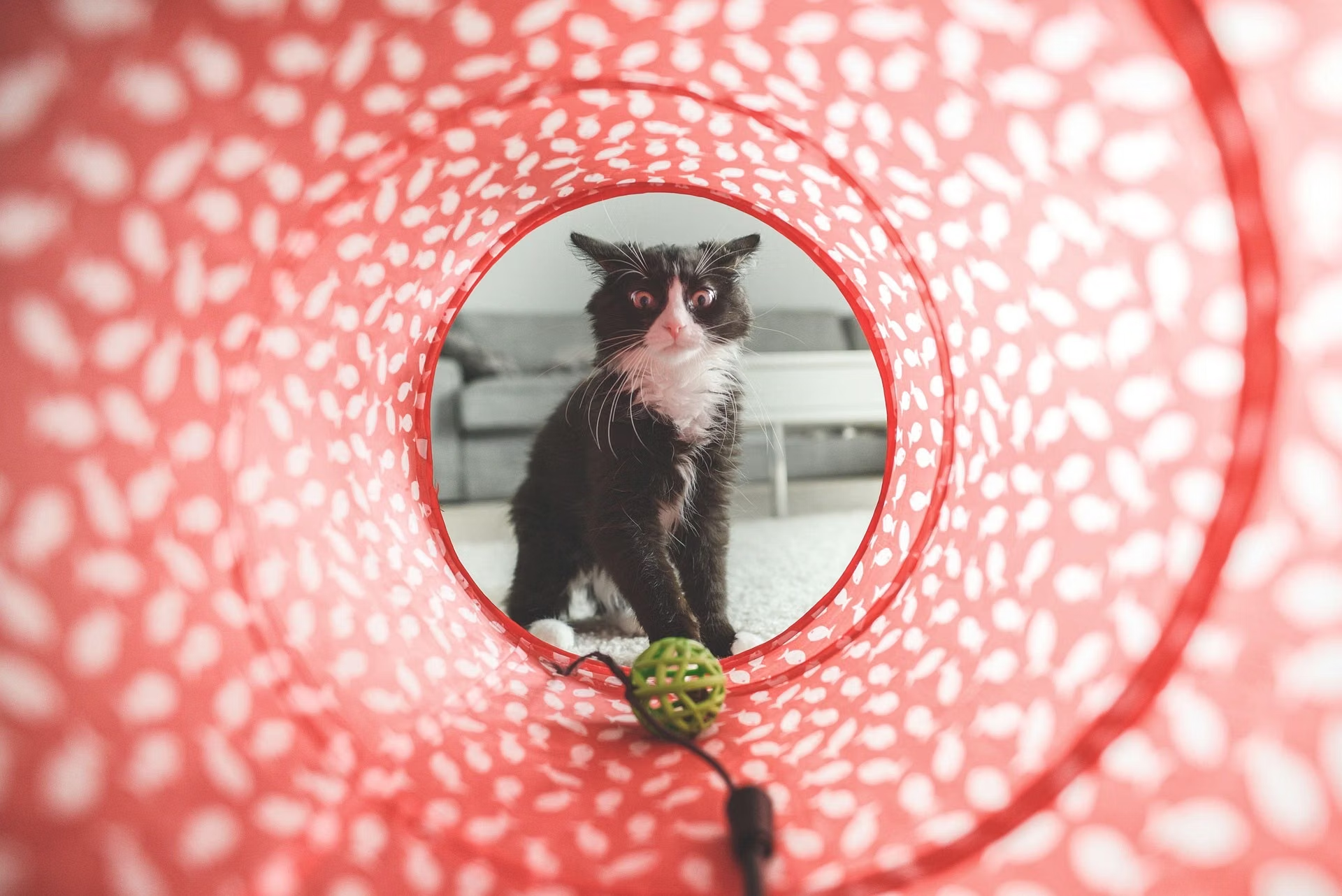
Why the same principle works on cats, birds, and puppies alike
Operant conditioning does not require language, reasoning, or even a particularly complex nervous system: it works because reward strengthens the behavior it follows, a mechanism present across a wide range of species. That is why the same clicker and treat approach used with dogs also works to teach a cat to come when called, use a scratching post instead of the couch, or tolerate nail trims, and why it is standard practice for training parrots and other birds.
The main difference between species is what counts as a genuinely rewarding, high value reinforcer. A dog might work hard for a piece of cheese. A cat is often more motivated by a specific play session with a wand toy than by food, especially if the food on offer is not particularly exciting to that individual cat. Figuring out what your own animal actually finds rewarding, rather than assuming every pet wants the same thing, is one of the more overlooked parts of getting reward based training to work.
What the research actually supports, and what it does not
The core finding, that reinforced behavior repeats more reliably than punished behavior fades, has held up across decades of behavioral research in multiple species. What is less settled, and often oversold, is the idea that reward based methods are always faster than every alternative in every situation. Timing, consistency, and the value of the specific reward to that specific animal all affect how quickly a behavior sticks, and a poorly timed reward based session can be just as ineffective as a poorly executed correction.
What the evidence does support clearly is the downside risk of punishment based methods: an animal that is startled, hurt, or frightened during training is more likely to develop fear responses that generalize beyond the original context, attaching the fear to a person, a room, or an object rather than just the specific unwanted behavior. That is a meaningful difference in outcome, not just a difference in philosophy.
Putting the theory into practice
None of this requires a background in psychology to use at home. In practice it comes down to staying consistent: reward within a second or two of the behavior you want, make the reward genuinely valuable to your particular animal, and repeat it often enough that the association has a chance to form. For the specific steps, session structure, and troubleshooting tips, see our step by step guide to positive reinforcement training.
If your dog is dealing with a specific behavior problem, whether that is jumping, barking, or accidents indoors, the same underlying mechanism applies: reward the behavior you want to see more of rather than only reacting to the one you do not. Our broader guide to dog training techniques covers how to structure sessions and combine methods as your dog's training progresses.
What is positive reinforcement in dog training?
Positive reinforcement means adding something the animal wants right after it performs a behavior you want to see more of, most often a treat, toy, or praise. Over repeated pairings, the dog forms an association between the action and the reward, making the behavior more likely to happen again on its own, even before every repetition earns a reward.
Does positive reinforcement work as fast as punishment based training?
It often works faster for teaching a new behavior, since the animal learns what to do rather than only what not to do. Punishment based correction can suppress an unwanted behavior quickly, but it does not teach an alternative, and it carries a documented risk of fear responses that spread beyond the original situation.
Why do trainers use a clicker instead of just giving treats?
A clicker solves a timing problem. Treats take a second or two to reach the animal, but a clicker marks the exact instant the correct behavior happened, which is the moment the association actually forms. The treat that follows confirms the click was correct, rather than needing to be delivered with perfect timing on its own.
Can positive reinforcement training work on cats and other pets, not just dogs?
Yes. The underlying mechanism, reward strengthens the behavior it follows, is not specific to dogs, and the same approach is used to train cats, birds, and other animals. What changes between species and individual animals is which reward is actually motivating: a wand toy may work better for a cat than any treat does.