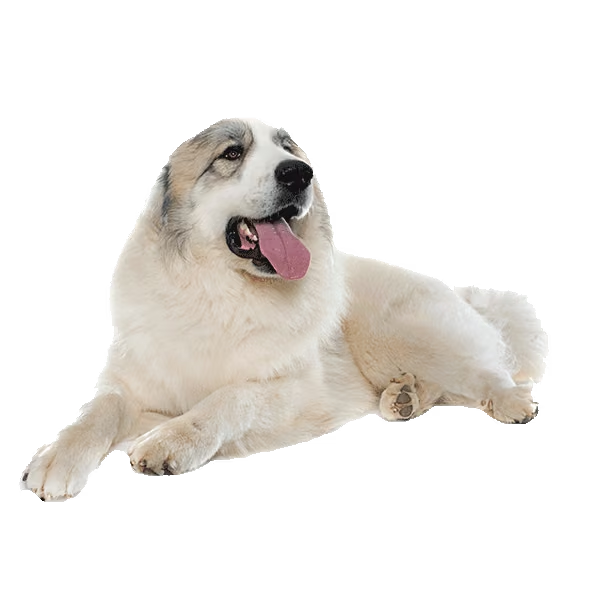
Slovensky Cuvac er en fryktløs hvit buskapsvokter kjent for sin hengivenhet til familie og flokk.
Hvordan pelsen til en Slovakisk tsjuvtsjak er bygget opp, og hva det betyr for stellet.
Kritisk: En Slovakisk tsjuvtsjak bør ikke klippes helt ned.
Underullen holder varmen ute like godt som kulden, og dekkpelsen skjermer huden mot sol og insektbitt. Klipper man av hele pelsen, forsvinner begge deler. Den vokser ofte ut flekkvis, myk eller i en annen farge, og hos noen dyr kommer dekkhåret aldri skikkelig tilbake. Børst ut underullen i stedet for å klippe den bort.
Forsiktig: Pelsen til en Slovakisk tsjuvtsjak floker seg lett.
Fint eller langt hår floker seg nederst i pelsen, utenfor synsvidde, der flokene strammer seg og drar i huden. Børstingen må nå helt ned til roten seksjon for seksjon, ikke bare skumme overflaten.
Til informasjon: En Slovakisk tsjuvtsjak slipper underullen i kraftige perioder.
Underullen løsner i kraftige perioder over noen uker. En underullsrive, eller et bad fulgt av grundig føning, får den ut langt raskere enn daglig børsting. Å klippe ned pelsen er ingen snarvei her.
The Slovensky Cuvac is a large white livestock guardian dog from Slovakia, valued for its devotion to family and flock and its watchful, protective nature.
The Slovensky Cuvac is a large white guardian dog developed in the mountains of Slovakia to protect sheep, cattle, and people. It belongs to the broad family of white European mountain dogs and works in the same role as the Hungarian Kuvasz and the Polish Tatra Sheepdog. The breed is built for endurance in cold, rugged terrain rather than for speed.
Its most recognizable feature is a solid white coat, which historically helped shepherds tell the dog apart from predators at night. Adults are heavy-boned and powerful, with a calm presence that shifts quickly to alert defense when the dog senses a threat. The temperament is steady: devoted to its household, reserved with strangers, and courageous when guarding.
The Slovensky Cuvac bonds closely with the family it lives with and tends to treat livestock and children as part of its charge. It is independent by nature, a trait shaped by generations of working alone with flocks far from human supervision. That independence makes it a thinking guardian rather than an obedient follower.
| Attribute | Detail |
|---|---|
| Origin | Slovakia |
| Size | Large |
| Lifespan | 11 to 13 years |
| Group / role | Livestock guardian dog |
| Good with | Family and children it knows, livestock; reserved with strangers |
This breed fits an owner with space, experience, and a clear job for the dog, such as guarding property or livestock. It needs early socialization and confident, consistent handling. It is not a good match for apartment life, first-time owners, or households that want a biddable companion dog. People who value a calm, protective guardian and can manage an independent, territorial animal will get the most from the breed.
The Slovensky Cuvac descends from white mountain guardian dogs used by Slovak shepherds for centuries and was formally standardized in the 20th century.
The breed comes from the mountain regions of Slovakia, where shepherds kept white guardian dogs to protect flocks of sheep and herds of cattle from wolves and bears. These dogs share ancestry with the wider group of white guardian breeds found across the Carpathian and surrounding mountain ranges. Their work was demanding and dangerous, and only hardy, fearless animals were bred on.
For much of its history the Slovensky Cuvac existed as a working landrace rather than a defined breed. Dogs were selected for ability rather than appearance, and the white coat was a practical preference because it let a shepherd distinguish the dog from a predator in low light.
Formal standardization took place in the 20th century, led by efforts to preserve the type as traditional pastoral life declined. A breeding program centered in Slovakia worked to fix the breed's characteristics, and the type gained recognition as a distinct national breed. The name reflects its Slovak homeland.
Today the Slovensky Cuvac is far less common than the mainstream guardian breeds and is kept both as a working dog and as a property guardian. Dedicated breeders in Slovakia and elsewhere maintain the population, though numbers remain modest compared with more widespread breeds.
The Slovensky Cuvac is a large, solidly built white dog with a dense double coat suited to cold mountain conditions.
The Slovensky Cuvac is a large, strongly built dog with a rectangular outline and heavy bone. The head is broad with a moderately defined stop, and the muzzle is strong. The ears are set fairly high and hang close to the head. The expression is alert and confident. The body is muscular without being bulky, and the tail is carried low at rest and higher when the dog is active or alert.
| Trait | Standard |
|---|---|
| Height | Males about 62 to 70 cm, females about 59 to 65 cm at the withers |
| Weight | Males about 36 to 44 kg, females about 31 to 37 kg |
| Coat | Dense double coat with a thick undercoat; longer on the neck and the back of the legs |
| Colors | Solid white |
| Eyes | Dark brown, oval, set moderately apart |
The coat is always solid white, which is a defining feature of the breed. The double coat has a soft, dense undercoat beneath a longer, slightly wavy outer coat that protects the dog in cold and wet weather. The hair is shorter on the head and the front of the legs and longer around the neck, where males often carry a fuller ruff. The white coat sheds noticeably, with heavier seasonal molts, and requires regular brushing to manage.
The Slovensky Cuvac is devoted, watchful, and protective, deeply loyal to its family while reserved and territorial toward strangers.
The Slovensky Cuvac is a guardian first and a companion second. With its own family it is affectionate, loyal, and gentle, and it usually does well with children it has grown up alongside. The same dog can be aloof or suspicious toward strangers and will announce visitors with a deep, carrying bark. This vigilance is the breed working as intended, not a fault.
The breed is naturally territorial and protective. It tends to patrol and watch over its property and the animals or people in its care. With other pets, early socialization matters: raised alongside livestock or household animals, it generally treats them as part of its charge, but it can be assertive toward unfamiliar dogs, especially of the same sex.
Independence is a core trait. These dogs were bred to make decisions alone while guarding flocks, so they think for themselves rather than waiting for commands. That makes them confident and reliable guardians but also stubborn and slow to comply when they see no reason to. They are not aggressive without cause, but they are serious about their job.
| Trait | Rating |
|---|---|
| Affection (with family) | 4 |
| Energy | 3 |
| Trainability | 2 |
| Vocalness | 4 |
| Shedding | 4 |
The Slovensky Cuvac needs regular brushing for its dense white double coat, daily exercise, and a secure outdoor space with a job to do.
Caring for a Slovensky Cuvac centers on coat maintenance, steady exercise, and an environment that gives the dog room and purpose.
The Slovensky Cuvac is built for cool, open country and tolerates cold far better than heat. It does best on a rural property or smallholding with secure fencing, since it will roam and defend a wide area. It is poorly suited to apartments or small urban homes. In hot weather, provide shade, fresh water, and rest during the warmest hours.
The Slovensky Cuvac needs a balanced large-breed diet fed in measured meals, with portions matched to age, weight, and activity level.
As a large working breed, the Slovensky Cuvac does well on a complete diet formulated for large dogs, with controlled growth during puppyhood to protect developing joints. Feed measured portions twice a day rather than leaving food out, and adjust amounts to the individual dog's weight, age, and workload. Always provide constant access to fresh water, especially for an active outdoor dog.
| Life stage | Amount per day | Meals |
|---|---|---|
| Puppy (2 to 6 months) | Per large-breed puppy food guidelines, divided | 3 to 4 |
| Adolescent (6 to 12 months) | Per food guidelines for projected adult weight | 2 to 3 |
| Adult | About 400 to 600 g of quality dry food, by weight and activity | 2 |
| Senior / less active | Reduced portion to prevent weight gain | 2 |
Keep treats to roughly ten percent of daily calories so they do not unbalance the diet or cause weight gain. Large breeds can benefit from joint support, but introduce any supplement only on veterinary advice. A dog on a complete commercial diet usually needs no extra vitamins. Monitor body condition and adjust food rather than free-feeding.
The Slovensky Cuvac is generally hardy with a lifespan of 11 to 13 years, though as a large breed it can face joint conditions and bloat.
The Slovensky Cuvac is a generally robust breed, a product of generations selected for working soundness in harsh conditions. The typical lifespan is 11 to 13 years. Like other large dogs, it can be prone to certain joint and gastric problems, and responsible breeding with health screening reduces these risks. Choosing a puppy from health-tested parents is the single most useful step a buyer can take.
| Condition | Signs | Note |
|---|---|---|
| Hip dysplasia | Stiffness, limping, reluctance to rise or jump | Common in large breeds; screen breeding stock |
| Elbow dysplasia | Foreleg lameness, especially after exercise | Linked to growth; manage puppy diet and exercise |
| Gastric dilatation-volvulus (bloat) | Swollen abdomen, retching without vomiting, distress | A medical emergency; seek a vet immediately |
| Obesity | Weight gain, low energy | Preventable through measured feeding and exercise |
The Slovensky Cuvac is intelligent but independent and strong-willed, so it needs early, consistent, reward-based training from a confident handler.
The Slovensky Cuvac is intelligent but bred to work and decide on its own, which makes it independent and often stubborn in training. It does not perform tasks simply to please a handler, so motivation and consistency matter. Harsh methods tend to backfire with this sensitive, proud breed and can damage trust. Early socialization is as important as obedience: a guardian this size must learn to read normal situations calmly so its protective instincts stay reliable rather than reactive. Set expectations modestly, since this is a guardian, not a competition obedience dog.
The Slovensky Cuvac is a large, slow-maturing breed that typically produces moderate to large litters and should be bred only from health-screened parents.
As a large breed, the Slovensky Cuvac matures slowly and should not be bred until it is physically and mentally mature, generally around two years of age, when health screening of the parents can be completed. Females come into season roughly twice a year. After mating, gestation lasts about 63 days, the standard length for dogs. Litters are usually moderate to large, in line with the breed's size.
Raising the young takes commitment. Puppies stay with the dam and litter through the early weeks for nursing and social learning, and breeders should begin gentle handling and socialization well before the puppies go to new homes at around eight weeks. Because the breed is uncommon, responsible breeders prioritize temperament, working ability, and screened health over numbers. Breeding should always be undertaken with knowledge of the breed and veterinary support.
| Metric | Value |
|---|---|
| Sexual maturity | Females from about 1 year; breed from about 2 years |
| Seasons per year | About 2 |
| Gestation | About 63 days |
| Typical litter size | Around 5 to 8 puppies |
| Weaning age | About 6 to 8 weeks |
| Recommended pre-breeding checks | Hip and elbow screening, general health and temperament assessment |
En kostnadsfri livstidsprofil for din Slovakisk tsjuvtsjak hos United Pet Club, med chipen registrert uten gebyr og ingenting å fornye.
Et dyremottak kan bare ringe nummeret et oppslag gir dem. Sørg for at din Slovakisk tsjuvtsjak har et oppslag som alltid svarer: den kostnadsfrie profilen samler telefonnummeret ditt, hundens bilde og opplysningene dens for hele hundelivet, uten en krone i gebyr. Registreringen gjør du én gang, så er den på plass.
Veterinæren setter chipen, men ingen registrerer den for deg, og en uregistrert chip identifiserer ingen. Registrer mikrochipen kostnadsfritt på livstidsplanen: alle chipmerker en norsk veterinær bruker godtas, oppdateringer etter flytting koster ingenting, og oppføringen kan slås opp døgnet rundt, hjemme og i utlandet. Opprett den kostnadsfrie kontoen din og få begge deler unnagjort i kveld.
Opprett en kostnadsfri konto hos United Pet Club, legg inn opplysningene om din Slovakisk tsjuvtsjak med et bilde og lagre profilen. Den er gratis hele hundelivet, og en eventuell DyreID-oppføring hos veterinæren lever sitt eget liv ved siden av.
Tast inn det 15-sifrede chipnummeret i den kostnadsfrie kontoen din sammen med adresse og telefonnummer. Livstidsplanen godtar alle chipmerker og tar aldri betalt for oppdateringer.
Norge har ikke noe lovpålagt krav om ID-merking av hunder, men de fleste chippes hos veterinæren likevel. Nytten kommer først med en oppdatert oppføring bak nummeret, og den holder United Pet Club gratis.
Ingenting. Den kostnadsfrie livstidsplanen dekker profilen, chipregistreringen og alle senere endringer, uten fornyelsesgebyr.
Common questions about the Slovensky Cuvac, covering its size, temperament, care needs, lifespan, suitability, and availability.
It is a large breed. Males stand roughly 62 to 70 cm at the withers and weigh about 36 to 44 kg, while females are slightly smaller at about 59 to 65 cm and 31 to 37 kg.
The Slovensky Cuvac is devoted and loyal to its family and reserved, watchful, and protective toward strangers. It is courageous and independent, bred to guard livestock and property.
It is demanding for inexperienced owners. The dense white coat needs regular brushing, the dog requires daily exercise and space, and its independent, territorial nature calls for early socialization and confident handling.
The typical lifespan is 11 to 13 years. Good nutrition, healthy weight, exercise, and routine veterinary care help a dog reach the upper end of that range.
It can be gentle and devoted with a family and children it knows, but it is not suited to apartments. It needs a rural or large property with secure fencing and is best for experienced owners who want a guardian.
Raised with them, the breed is usually protective and gentle toward family children and tolerant of household animals and livestock. It can be wary of strangers and assertive with unfamiliar dogs, so supervision and socialization are important.
No. The breed is uncommon outside Slovakia and neighboring regions, so finding a puppy from a responsible breeder may take time and a waiting list.
