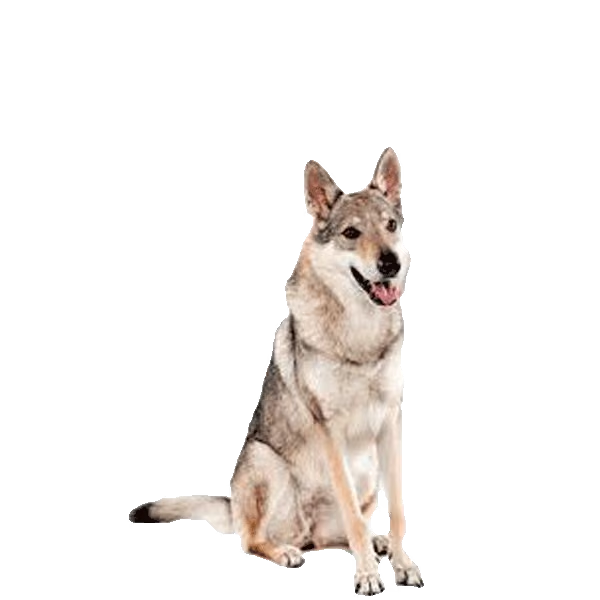
The Czechoslovakian Vlcak is a wolf-like, athletic breed known for its fierce loyalty, independence, and remarkable stamina.
How the Czechoslovakian Vlcak coat is built, and what that means when you groom it.
Kritiška: A Czechoslovakian Vlcak should not be shaved.
Poplaukis neįleidžia karščio lygiai taip pat, kaip ir šalčio, o dengiamasis plaukas saugo odą nuo saulės ir vabzdžių įkandimų. Nukirpus visą kailį, netenkama abiejų. Jis dažnai atauga lopais, minkštas arba kitos spalvos, o kai kuriems gyvūnams dengiamasis plaukas taip ir nebeatauga kaip reikiant. Poplaukį iššukuokite, o ne nukirpkite.
Informacija: A Czechoslovakian Vlcak drops its undercoat in heavy bursts.
Poplaukis išeina stipriais protrūkiais per kelias savaites. Poplaukio grėblys arba maudymas su tinkamu išpūtimu pašalina jį kur kas greičiau nei kasdienis šukavimas. Trumpai nukirpti kailį čia nėra trumpesnis kelias.
A few of the Czechoslovakian Vlcak profiles members have added to United Pet Club.
The Czechoslovakian Vlcak is a large, wolf-like working dog from the Czech Republic, valued for fierce loyalty, independence, and exceptional stamina.
The Czechoslovakian Vlcak is a large working breed that looks much like a wolf. It stands tall, moves with an efficient ground-covering trot, and carries the gray coat and amber eyes that recall its wild ancestry. The breed came out of a military experiment in mid-twentieth-century Czechoslovakia and remains close to its working roots.
This is an athletic dog built for endurance rather than speed alone. A fit adult can cover long distances at a steady pace, and the breed was selected for trotting many kilometers without tiring. Energy levels are high, and the dog needs a job or sustained activity to stay settled.
Temperament is loyal and independent. The Czechoslovakian Vlcak bonds tightly with its own people and tends to be aloof with strangers. It thinks for itself, which makes it rewarding for experienced owners and demanding for first-time dog keepers.
| Attribute | Detail |
|---|---|
| Origin | Czech Republic |
| Size | Large |
| Lifespan | 12 to 16 years |
| Group/role | Working breed, originally bred for military and patrol work |
| Good with | Experienced owners and active households; needs early socialization with strangers and other pets |
The breed suits owners who can give consistent leadership, daily physical work, and steady socialization. It does best with people who enjoy training, hiking, or dog sports and who want a companion that stays close. It is a poor match for owners who are away for long hours or who want an easygoing, immediately friendly family dog.
The Czechoslovakian Vlcak was created in 1950s Czechoslovakia by crossing German Shepherd Dogs with Carpathian wolves for military border work.
The breed began in 1955 in Czechoslovakia as a planned experiment. Working German Shepherd Dogs were crossed with Carpathian gray wolves to test whether wolf traits could be combined with the trainability of a service dog. The early program took place at a military border-guard facility.
The first crosses paired a wolf named Brita with German Shepherd Dogs, and later crosses added further wolf blood from a small number of named wolves. Breeders selected for stamina, scenting ability, night vision, and resistance to cold, all useful for patrol work along borders.
By the 1960s and 1970s the resulting dogs were bred to one another rather than back to wolves, which fixed the type and stabilized temperament. The aim shifted from a working wolf cross toward a recognizable breed with predictable characteristics.
The breed gained national recognition in Czechoslovakia in 1982 and was later accepted internationally by the Federation Cynologique Internationale. Czechoslovakia is recorded as the country of origin. Today the Czechoslovakian Vlcak is kept mainly as a companion and sport dog rather than a military animal.
The Czechoslovakian Vlcak is a large, lean dog with a wolf-gray coat, amber eyes, and a light, athletic frame built for distance trotting.
The overall impression is that of a wolf. The body is rectangular and lean, the chest is deep but not broad, and the limbs are long and straight. The dog carries its head and neck low when trotting, which adds to the wild look. Movement is light and far-reaching, and the breed is known for an effortless, ground-covering gait.
| Trait | Detail |
|---|---|
| Height | Males from 65 cm at the withers; females from 60 cm |
| Weight | Males from about 26 kg; females from about 20 kg |
| Coat | Straight, close double coat that thickens in winter |
| Colors | Yellow-gray to silver-gray, with a lighter mask |
| Eyes | Amber, small, set obliquely |
The coat is a weather-resistant double coat. The winter coat is much heavier than the summer coat, with dense underfur that helps the dog tolerate cold. Accepted colors run from yellow-gray to silver-gray, always with the characteristic light mask on the face. The hair is short to medium in length and lies close to the body. Erect, triangular ears and a bushy tail carried low at rest complete the wolf-like outline.
The Czechoslovakian Vlcak is loyal and courageous with its family, independent in its thinking, and reserved or aloof toward strangers.
The Czechoslovakian Vlcak forms a strong bond with its family and is courageous in defense of its people. Within the home it tends to be playful and attentive, and it likes to stay near its owners. The breed is sensitive to its handler and reads body language closely.
With strangers the dog is aloof and watchful. It is rarely openly friendly on first meeting and needs early, ongoing socialization to be comfortable with unfamiliar people and situations. Without that exposure it can become wary.
The independent streak is strong. This is a thinking dog that decides whether a request makes sense before obeying, a trait inherited from its working and wolf background. With other pets it can have a high prey drive toward small animals, and it generally does best raised alongside any cat or dog from a young age. It is happiest with company, whether human or canine, and does not tolerate long isolation well.
| Trait | Rating |
|---|---|
| Affection | 4 |
| Energy | 5 |
| Trainability | 3 |
| Vocalness | 2 |
| Shedding | 4 |
The Czechoslovakian Vlcak needs heavy daily exercise, secure space, and seasonal coat care, with grooming demands that spike during shedding periods.
The breed needs space and a securely fenced area. Fences should be tall and dug-proof, because the dog is an able jumper and digger. The Czechoslovakian Vlcak tolerates cold well thanks to its dense coat but should have shade and water in heat. It is not suited to apartment life or to being left alone for long stretches.
The Czechoslovakian Vlcak needs a complete, protein-forward diet sized to its high activity level, fed in measured daily portions.
Feed a complete and balanced diet suited to a large, active working dog. Protein should support muscle maintenance, and total calories should track the dog's real workload, which can vary widely between a resting day and a long hiking day. Many owners feed a high-quality commercial food, while some use a carefully formulated raw or fresh diet under guidance. Fresh water should always be available.
| Life stage | Amount per day | Meals |
|---|---|---|
| Puppy (2 to 6 months) | Per food label, split small | 3 to 4 |
| Adolescent (6 to 18 months) | Per food label for growth | 2 to 3 |
| Adult | About 400 to 600 g dry food, varied by activity | 2 |
| Senior | Slightly reduced to hold weight | 2 |
Keep treats to a small share of daily calories, around 10 percent, to prevent weight gain. A balanced complete diet usually supplies the nutrients an adult needs without extras. Discuss any supplement, such as joint support for an older or heavily worked dog, with a veterinarian before adding it.
The Czechoslovakian Vlcak is generally robust with a 12 to 16 year lifespan, though hip dysplasia and a few inherited conditions occur in the breed.
The Czechoslovakian Vlcak is a hardy breed and often lives 12 to 16 years. Its close-to-wild genetics and limited founder base mean responsible breeders screen for inherited disease and select for sound structure. A fit, lean dog with regular activity tends to stay healthy well into older age.
| Condition | Signs | Note |
|---|---|---|
| Hip dysplasia | Stiffness, limping, trouble rising | Choose stock from hip-screened parents |
| Elbow dysplasia | Front-leg lameness, reluctance to exercise | Detected by veterinary imaging |
| Degenerative myelopathy | Gradual hind-limb weakness | A genetic test is available |
| Pituitary dwarfism | Stunted growth, coat changes | Carrier testing helps breeders avoid affected litters |
The Czechoslovakian Vlcak is intelligent but independent, so training works best with early starts, consistency, and reward-based methods.
The Czechoslovakian Vlcak is intelligent and capable, but it is not an automatically obedient breed. It questions commands and responds poorly to harsh handling or repetitive drilling. Training succeeds when it starts early, stays consistent, and gives the dog a reason to cooperate. Short, varied sessions hold attention better than long ones. Socialization with people, places, and other animals is as important as obedience and should begin in puppyhood.
Czechoslovakian Vlcak breeding follows a once-yearly female cycle, a roughly nine-week gestation, and careful selection from health-tested parents.
Females of this breed often come into season once a year rather than twice, a trait closer to the wolf than to most domestic dogs. Breeding should wait until both parents are physically mature and have completed relevant health screening, including hip evaluation and available genetic tests. Mating is timed to the female's fertile window.
Gestation lasts about 63 days. Litters are commonly medium in size for a large breed. The dam usually whelps and raises the pups with little intervention, though a quiet, secure whelping space and veterinary support on hand are important. Puppies open their eyes at around two weeks and begin weaning from roughly three to four weeks.
Early socialization is central. Because the breed is naturally reserved, breeders handle pups daily and expose them to varied sights, sounds, and people well before they go to new homes, normally at eight weeks or later. Matching each puppy to an owner prepared for an active, independent dog helps avoid later problems.
| Metric | Value |
|---|---|
| Sexual maturity | Around 1 to 2 years |
| Female cycle | Often once per year |
| Gestation | About 63 days |
| Typical litter | Several puppies (medium litter for a large breed) |
| Weaning | About 6 to 8 weeks |
| Earliest rehoming | 8 weeks or later |
Nemokamas profilis visam gyvenimui jūsų Czechoslovakian Vlcak veislės šuniui United Pet Club, su užregistruota mikroschema ir be pratęsimo mokesčių.
Įrašykite Czechoslovakian Vlcak veislės šuns vardą, gimimo datą ir ryškią nuotrauką, pridėkite savo telefoną ir išsaugokite. Tiek darbo, ir jis nieko nekainuoja nei dabar, nei vėliau. Šuns registracija veikia su mikroschema ir be jos.
Penkiolika skaitmenų po Czechoslovakian Vlcak veislės šuns oda parodys į jus tik tada, kai tai pasakys registras. Tegul pasako nemokamai: įrašas United Pet Club niekada nesibaigia, priima bet kurios markės mikroschemą, o kiekvienas duomenų pakeitimas nemokamas. Mikroschemos registracija pirmiausia, paskyra iškart po jos.
Susikurkite nemokamą paskyrą United Pet Club, užpildykite Czechoslovakian Vlcak veislės šuns duomenis su nuotrauka ir išsaugokite profilį. Jis nemokamas visą šuns gyvenimą, o privaloma registracija Gyvūnų augintinių registre vyksta atskirai.
Įveskite 15 skaitmenų mikroschemos numerį nemokamoje paskyroje kartu su adresu ir telefonu. Visą gyvenimą galiojantis planas priima bet kurios markės mikroschemą ir niekada neima mokesčio už atnaujinimus.
Taip, nuo 2016 metų šunys privalo būti paženklinti ir įregistruoti Gyvūnų augintinių registre. United Pet Club įrašas papildo valstybinį: atsako į paieškas ir už Lietuvos ribų, nemokamai.
Nieko. Nemokamas visą gyvenimą galiojantis planas apima profilį, mikroschemos registraciją ir visus būsimus atnaujinimus, be metinių mokesčių.
Common questions about the Czechoslovakian Vlcak cover its size, temperament, care demands, lifespan, suitability, and availability.
It is a large breed. Males stand from 65 cm at the withers and weigh from about 26 kg, while females stand from 60 cm and weigh from about 20 kg.
The breed is loyal and courageous with its family, independent in its thinking, and aloof with strangers. It bonds closely with its people and needs early socialization to be comfortable around unfamiliar humans and animals.
It is demanding. The breed needs one to two hours of daily exercise, mental work, secure fencing, and consistent training. It is not recommended for first-time owners or for people who are away for long hours.
The typical lifespan is 12 to 16 years, and the breed is generally robust when kept fit and fed appropriately.
It can be devoted to a family it has grown up with, but it suits active, experienced owners best. Its prey drive and reserve mean it needs early socialization with children and other pets.
The breed is uncommon outside its region of origin. Prospective owners often join a waiting list with a responsible breeder who health-tests and socializes their litters.
Yes. The double coat sheds steadily and goes through two heavy seasonal molts each year, during which daily brushing helps manage the loose undercoat.



