
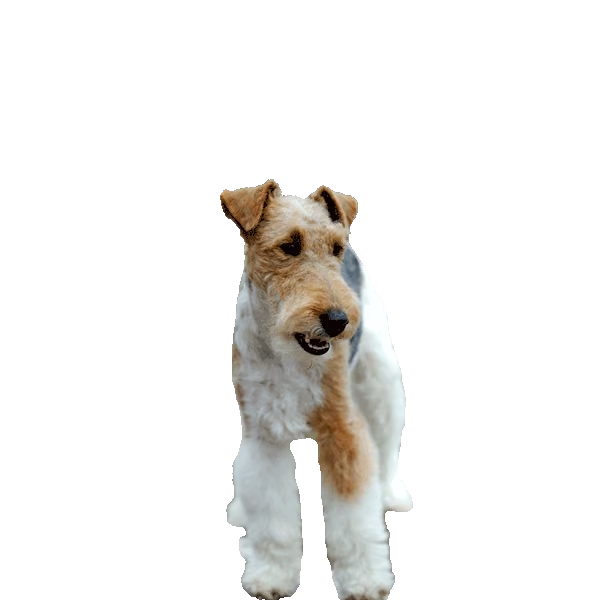
Wire Fox Terrier
The Wire Fox Terrier is a spirited, confident English breed with a dense wiry coat, celebrated for its boundless energy and show-ring flair.
- Size
- Small
- Lifespan
- 12–15 years
- Origin
- England
- Temperament
- Spirited
- Standard colors
- Black, White and Tan
Characteristics
Coat and grooming
How the Wire Fox Terrier coat is built, and what that means when you groom it.
- Coat layers
- Double coat
- Coat texture
- Wire
- Coat length
- Medium
- Shedding
- Low shedding
Grooming guidance
Caution: A Wire Fox Terrier coat should be hand-stripped rather than clipped.
A wire coat is meant to be pulled out at the root once the hair is ready to release. Clippers cut it off part way instead, leaving the soft undercoat behind. The result is a coat that grows back limp and faded, and the weatherproof texture only returns after the hair is stripped out again.
Wire Fox Terrier colors and patterns
What each club's breed standard says about every Wire Fox Terrier color and pattern. Point at a ruling to see the club's own wording.
Breed standards describe the Wire Fox Terrier in Black, White and Tan. Standard patterns: Solid, Bicolour and Tricolour.
| Color or pattern | FCI | AKC | KC | KUSA | UKC |
|---|---|---|---|---|---|
| Black | Standard (“black ... markings”) | Standard (“White & Black”) | Standard (“black ... markings”) | Standard (“black ... markings”) | No ruling |
| White | Standard (“white predominates”) | Standard (“White”) | Standard (“white predominates”) | Standard (“white predominates”) | Standard (“white is the predominant color”) |
| Tan | Standard (“tan markings”) | Standard (“White & Tan”) | Standard (“tan ... markings”) | Standard (“tan ... markings”) | No ruling |
| Blue | Fault (“slate-blue markings undesirable”) | Fault (“slaty blue ... objectionable”) | Fault (“slate-blue marking highly undesirable”) | Fault (“slate-blue marking undesirable”) | Fault (“slate blue”) |
| Liver | Fault (“liver ... markings undesirable”) | Fault (“liver ... objectionable”) | Fault (“liver ... marking highly undesirable”) | Fault (“liver ... marking undesirable”) | Fault (“liver”) |
| Red | Fault (“red ... markings undesirable”) | Fault (“red ... objectionable”) | Fault (“red ... marking highly undesirable”) | Fault (“red ... marking undesirable”) | Fault (“red”) |
| Albino | No ruling | No ruling | Not recognised | Not recognised | Disqualifying (“albinism”) |
| Patterns | |||||
| Solid | No ruling | Standard (“White”) | Not recognised | Not recognised | No ruling |
| Bicolour | Standard (“white predominates with black ... or tan markings”) | Standard (“White & Black”) | Standard (“Black & White”) | Standard (“white predominates with black, tan ... markings”) | Standard (“white is the predominant color”) |
| Tricolour | Standard (“black and tan ... markings”) | Standard (“White Black & Tan”) | Standard (“Tricolour”) | Standard (“black and tan markings”) | No ruling |
| Brindle | Fault (“brindle ... markings undesirable”) | Fault (“brindle ... objectionable”) | Fault (“brindle ... marking highly undesirable”) | Fault (“brindle ... marking undesirable”) | Fault (“brindle”) |
| Reverse brindle | Fault (“brindle ... markings undesirable”) | Fault (“brindle ... objectionable”) | Fault (“brindle ... marking highly undesirable”) | Fault (“brindle ... marking undesirable”) | Fault (“brindle”) |


| Color or pattern | FCI | AKC | KC | KUSA | UKC |
|---|---|---|---|---|---|
| Dark brown | Standard (“dark”) | Standard (“dark in color”) | Standard (“dark”) | Standard (“dark”) | Standard (“dark in color”) |
| Light brown | Fault (“light eyes highly undesirable”) | No ruling | Fault (“light eyes undesirable”) | Fault (“light eyes undesirable”) | Fault (“light eyes”) |
| Yellow | No ruling | Fault (“anything approaching a yellow eye is most objectionable”) | No ruling | No ruling | No ruling |
| Color or pattern | FCI | AKC | KC | KUSA | UKC |
|---|---|---|---|---|---|
| Black | Standard (“black”) | Standard (“nose should be black”) | Standard (“nose black”) | Standard (“nose black”) | Standard (“black and fully pigmented”) |
| Red | No ruling | Disqualifying (“nose ... cherry”) | No ruling | No ruling | No ruling |
| Pink | No ruling | Disqualifying (“nose white”) | No ruling | No ruling | No ruling |
| Dudley | No ruling | No ruling | No ruling | No ruling | Disqualifying (“Dudley nose”) |
| Patterns | |||||
| Butterfly nose | No ruling | Disqualifying (“spotted to a considerable extent”) | No ruling | No ruling | Disqualifying (“butterfly nose”) |

What the rulings mean
- Standard
- Described by the club's breed standard.
- Fault
- Named by the club's breed standard as a fault: the animal can be shown but is penalised.
- Disqualifying
- The club's breed standard disqualifies an animal of this colour or pattern.
- Not recognised
- The club does not accept this colour or pattern for the breed.
Color changes
How a Wire Fox Terrier's colors can change over its life.
Blackchanges toRust
Coat · With body condition · can change back
Blackchanges toGrey
Coat · Progressive
Blackchanges toBrown
Coat · In the sun · can change back
Whitechanges toRoan
Coat · With age · from 2 weeks
Blackchanges toSnow nose
Nose · With the season · can change back
Blackchanges toPink
Nose · With the season · can change back


Sources
Each ruling comes from the club's published breed standard or color list.
Meet some of our Wire Fox Terrier
A few of the Wire Fox Terrier profiles members have added to United Pet Club.


About the Wire Fox Terrier
A compact, wire-coated terrier bred in England to bolt foxes from their dens, now kept across South Africa as an alert companion and competitive show dog.
The Wire Fox Terrier is a small working terrier that England developed to flush foxes out of their dens during a hunt. At the shoulder it stands about 39 cm and carries roughly 6.8 to 8.2 kg, with a hard, dense, wiry coat that is mostly white with black and tan markings.
The breed is alert, quick off the mark, and sure of itself. Underground work called for stamina and nerve, and that same drive shows up at home as a dog with energy and curiosity to spare. A Wire Fox Terrier kept as a pet in a townhouse or a suburban garden needs proper exercise and mental stimulation, not a quick turn around the block.
Owners typically describe the breed as spirited, sharp, energetic, watchful, and self-assured. It has a long show record and remains one of the more successful terriers in the ring under Kennel Union of Southern Africa (KUSA) rules, which has kept its coat and outline consistent across generations.
| Attribute | Detail |
|---|---|
| Origin | England |
| Size | Small (about 6.8 to 8.2 kg) |
| Lifespan | 12 to 15 years |
| Group/role | Terrier; fox bolting and den work |
| Good with | Active adults and older children; supervise around cats and small pets |
Who suits this breed
This terrier suits owners who want an engaged, busy dog and who can commit to exercise every day plus consistent training. Its prey drive is strong, so it may chase cats, guinea fowl, or rodents, and households with small pets need proper management. First-time dog owners can manage well with a Wire Fox Terrier if they are ready for a confident animal that thrives on clear boundaries.
History and origin
The Wire Fox Terrier took shape in nineteenth-century England as a fox-bolting terrier, later sharing a breed standard with the Smooth Fox Terrier before KUSA recognised it separately.
The Wire Fox Terrier comes from England, where terriers were sent into dens during a hunt to drive the fox back out towards the hounds. The wire-coated line is generally traced to rough-coated black-and-tan working terriers from the coal-mining districts of northern England and Wales.
Through the 1800s, breeders treated the Smooth and Wire Fox Terriers as two coat varieties of a single breed and crossed them freely. Later breeders worked to fix the wire coat and the mostly white body, since a white dog was easier for a hunter to pick out from the fox in thick cover.
The two coat types were eventually split into separate breeds, recognised first by England's Kennel Club and later by other kennel bodies worldwide, KUSA among them. The Wire Fox Terrier built a strong reputation in the show ring and has taken top honours at major conformation events, including on the South African show circuit.
As organised fox hunting declined, the breed's role shifted from working dog to companion and show dog. The instinct to dig and give chase, bred into it over generations, is still very much present in the modern dog.
Appearance
The Wire Fox Terrier is a square-built, compact terrier with a hard, wiry double coat that is mostly white with black and tan markings.
The Wire Fox Terrier has a short-backed, square outline, standing as tall at the shoulder as it is long from shoulder to tail base. The head is long and wedge-shaped with a flat skull, small V-shaped folded ears, and dark, deep-set eyes. The overall picture is of an alert dog, balanced and ready to move.
| Trait | Standard |
|---|---|
| Height | About 39 cm at the withers (males); slightly less for females |
| Weight | Roughly 6.8 to 8.2 kg |
| Coat | Dense, hard, wiry outer coat over a softer undercoat |
| Colors | Mostly white with black and tan markings; white predominates |
| Eyes | Dark, small, moderately deep set |
Coat and colour
The coat is the defining feature: a dense, wiry, broken outer layer over a finer undercoat. The texture should feel hard and crinkly, never soft. White is the base colour and should predominate, with black, tan, or black-and-tan markings usually on the head and at the base of the tail. All-white and black-and-white dogs do occur. To keep the correct texture and colour, show dogs are hand-stripped rather than clipped, since clipping softens the coat and dulls the colour.
Temperament
The Wire Fox Terrier is confident, energetic, and sharp-witted, affectionate at home but bold with strangers and quick to chase anything smaller than itself.
The Wire Fox Terrier is a high-spirited, self-assured dog that rarely sits still. With its own family it is affectionate, playful, and attentive, and it likes to be part of whatever is going on in the house. It tends to be alert and quick to bark, which makes it a useful early warning system, though it is not a guard dog in the traditional sense.
With strangers the breed is usually friendly but watchful, and it takes its own time to warm up. Its strong prey drive means cats, guinea fowl, tortoises, and other small pets can set off a chase, so introductions need care and small caged animals should be kept well out of reach. With other dogs it can be assertive, and some individuals are scrappy with dogs of the same sex.
This is a sharp breed with an independent streak. It learns fast but can be stubborn and bores easily, so it suits owners who stay engaged and offer structure, exercise, and games that give the dog a job to do.
| Trait | Rating |
|---|---|
| Affection | 4 |
| Energy | 5 |
| Trainability | 3 |
| Vocalness | 4 |
| Shedding | 2 |
Care and grooming
The Wire Fox Terrier needs regular brushing with periodic hand-stripping, vigorous daily exercise, and a secure garden that contains its urge to dig and give chase.
The wiry coat needs routine upkeep, and the breed's energy needs a daily outlet. Overall effort is moderate but must be consistent.
Grooming
- Brush the coat once or twice a week to clear loose hair and stop matting.
- Hand-strip the coat every few months to keep the hard texture and clear colour (pet dogs are sometimes clipped instead, which softens and lightens the coat over time).
- Trim nails every few weeks and check the folded ears regularly for wax and grass seeds, especially after a walk through long grass or veld.
- Brush teeth several times a week and bathe only when needed, since frequent bathing softens the coat.
Exercise
- Give at least 45 to 60 minutes of vigorous activity daily, split between walks and play.
- Add games that use the nose and the mind, such as scent searches, retrieving games, and earthdog-style digging in a spot where it is allowed.
- Keep the dog on a lead or inside a fenced area, since prey drive overrides recall the moment something bolts.
- On the Highveld, adjust exercise times around the thinner air and summer heat; at the coast, watch for humidity in midsummer.
Environment
The Wire Fox Terrier adapts to a flat or a house as long as it gets exercise every day. A securely fenced garden is ideal, and fences need checking at the base since this breed digs its way under rather than over. Without enough activity it can turn noisy and destructive.
Nutrition and feeding
A Wire Fox Terrier does well on a complete diet formulated for small, active dogs, fed in measured portions to keep its weight in check.
Feed a complete and balanced food suited to the dog's life stage and small frame. Because the breed stays active, it burns energy readily, but portions still need measuring, since small dogs put on weight fast. Match the amount to age, activity, and body condition rather than the top figure on the bag.
| Life stage | Amount per day | Meals |
|---|---|---|
| Puppy (2 to 6 months) | About 120 to 180 g (split) | 3 to 4 |
| Puppy (6 to 12 months) | About 120 to 150 g | 2 to 3 |
| Adult | About 90 to 180 g | 2 |
| Senior | Adjusted down for lower activity | 2 |
Treats and supplements
Keep treats to about 10 percent of daily calories, and use small pieces during training so the total stays low. Most dogs on a complete diet need no extra supplements; check with a vet before adding any. Keep fresh water available at all times.
Health and lifespan
The Wire Fox Terrier is generally healthy with a 12 to 15 year lifespan; eye and joint conditions plus tick-borne biliary need watching in South Africa.
The Wire Fox Terrier is a sturdy breed and usually lives 12 to 15 years. Responsible breeders screen for known inherited conditions, and routine veterinary care supports a long life. As a small, active dog, it stays fit well into its older years when kept at a healthy weight.
Ticks are a real concern for a terrier that digs and explores veld, gardens, and long grass. Canine babesiosis, known locally as biliary, is spread by ticks and can turn serious within a day or two, so year-round tick prevention matters as much as any inherited condition on this list.
| Condition | Signs | Note |
|---|---|---|
| Primary lens luxation | Eye redness, pain, cloudiness, vision change | Inherited eye disorder; DNA testing available through KUSA-recognised labs |
| Cataracts | Cloudy lens, reduced vision | May appear with age; treatable in some cases |
| Patellar luxation | Skipping gait, intermittent hind-leg lameness | Common in small breeds; ranges from mild to needing surgery |
| Deafness | Poor response to sound, startles easily | Linked to coat colour; can be tested for in pups |
| Hip and elbow issues | Stiffness, reluctance to jump | Keep the dog lean to reduce strain on joints |
Preventive care
- Keep core vaccinations and tick and flea prevention up to date year-round, since South Africa's climate keeps ticks active in most regions.
- Have the eyes checked regularly, given the breed's risk of lens luxation.
- Keep up dental care to limit tartar and gum disease.
- Keep the dog at a lean weight and provide steady exercise.
- Book annual vet check-ups, moving to twice yearly once the dog is a senior.
Training
The Wire Fox Terrier is sharp and quick to learn but independent, so it responds best to short, varied, reward-based sessions.
The Wire Fox Terrier picks things up quickly but has its own opinions, a legacy of working alone underground. It can switch off during repetitive drills, so keep sessions short, varied, and upbeat. A watertight recall is hard to guarantee, since prey drive takes over the moment something small runs, so off-lead freedom should stay limited to safe, enclosed spaces. Early, ongoing socialisation with people, dogs, and everyday situations helps the dog stay confident rather than reactive.
Basics
- Start socialisation and gentle handling from puppyhood.
- Teach name response and a reliable sit and down.
- Build recall indoors and in a fenced space, using high-value rewards.
- Work on loose-lead walking, since the breed pulls hard towards a scent.
- Add an outlet such as nose work, trick training, or earthdog games to channel its drive.
- Keep sessions short and frequent rather than long and repetitive.
Breeding
Wire Fox Terriers mature at around one to two years, carry litters of about three to six puppies, and need health-screened parents plus careful early socialisation.
Wire Fox Terriers reach physical and behavioural maturity between roughly one and two years of age. Responsible breeding pairs dogs only after health screening, including eye testing for lens luxation, hearing checks, and patella evaluation, and after confirming a sound temperament. Gestation runs about 63 days, and litters usually number three to six puppies.
The dam typically raises the litter with little help needed, though the breeder keeps an eye on weight gain and health from birth. Puppies are weaned by about seven to eight weeks. Early handling and exposure to sights, sounds, and gentle social experiences matter for this alert breed, since well-socialised pups grow into steadier adults. Breeding is best left to experienced, ethical breeders registered with KUSA who put the dogs' health first.
| Metric | Value |
|---|---|
| Sexual maturity | About 1 to 2 years |
| Gestation | About 63 days |
| Litter size | About 3 to 6 puppies |
| Weaning | About 7 to 8 weeks |
| Pre-breeding screening | Eyes, hearing, patellas, temperament |
Registering your Wire Fox Terrier and its chip in South Africa
No national chip law protects a Wire Fox Terrier here; a free United Pet Club record does, for life, at no cost.
Wire Fox Terrier registration and microchips in South Africa
Load your Wire Fox Terrier's details once and be done with it: name, date of birth, photo, your cell number, save. The profile is free for his whole life, and it takes a chip number the day the vet supplies one. Dog registration is the start of the paper trail.
The chip is a number; the registry entry is the story behind it. Capture your Wire Fox Terrier's 15-digit number in a free United Pet Club account and the story reads: this dog has a home. Every brand is accepted, updates never cost a cent, and the record stays searchable here and abroad. Microchip registration plus a free account does it.
How do I register my Wire Fox Terrier in South Africa?
Create a free United Pet Club account, load your Wire Fox Terrier's details and a photo, and save. The lifetime plan keeps the profile active at no cost for as long as you have him, chip or no chip.
How do I register my Wire Fox Terrier's microchip?
Load the 15-digit chip number into your free account together with your address and cell number. Registration and every later update are free, and chips from any brand a South African vet implants are accepted.
Must a Wire Fox Terrier be microchipped in South Africa?
No national law says so, though the SPCA chips as standard practice and many breeders and welfare groups insist on it. The registration behind the chip is the part that finds you, and with United Pet Club it costs nothing.
What does it cost to register a Wire Fox Terrier?
Nothing at all. The free lifetime plan covers the profile, the chip record, and unlimited updates, with no annual renewal in sight.
Frequently asked questions
Common questions about the Wire Fox Terrier cover its size, temperament, grooming needs, lifespan, suitability, and where to find one in South Africa.
How big does a Wire Fox Terrier get?
It is a small breed, standing about 39 cm at the shoulder and weighing roughly 6.8 to 8.2 kg.
What is the Wire Fox Terrier's temperament like?
Spirited, confident, sharp, and full of energy. It is affectionate with family, watchful around strangers, and has a strong urge to chase small animals.
Is the Wire Fox Terrier hard to look after?
Care is moderate. The coat needs weekly brushing and periodic hand-stripping, and the dog needs vigorous daily exercise and mental work to stay settled.
How long do Wire Fox Terriers live?
Typically 12 to 15 years with good care, a healthy weight, routine vet attention, and year-round tick prevention against biliary.
Is the Wire Fox Terrier a good family dog?
Yes, for active households and older children. Homes with cats or small caged pets need to manage the breed's prey drive carefully.
Does the Wire Fox Terrier shed a lot?
It sheds relatively little. The wiry coat is kept in order mainly through brushing and stripping rather than heavy seasonal shedding.
Are Wire Fox Terriers easy to find in South Africa?
They are less common than some other terriers locally. Expect to contact KUSA-registered breeders or breed-specific rescues, and possibly join a waiting list.
From the community
Ask about the Wire Fox TerrierNo questions about the Wire Fox Terrier yet. Be the first to ask.
Browse Dog breeds