
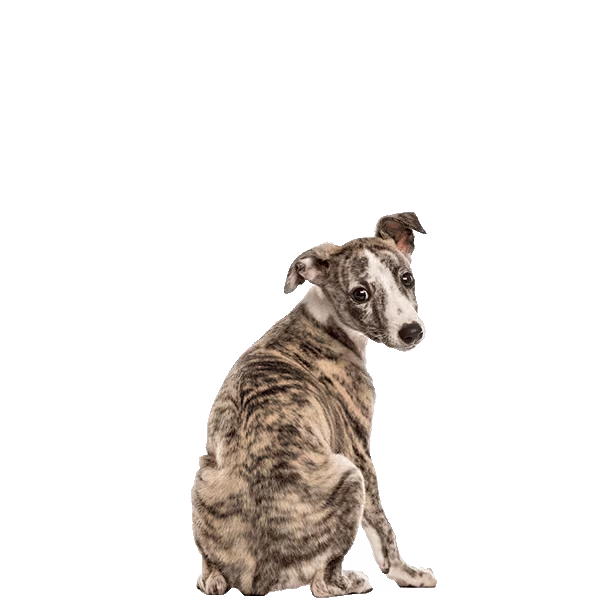
Whippet
The Whippet is a sweet, affectionate sighthound known for its blazing sprint speed paired with a calm, cuddly home life.
- Size
- Medium
- Lifespan
- 12–15 years
- Origin
- England
- Temperament
- Affectionate
- Standard colors
- Black, White and Blue and 5 more
Characteristics
Coat and grooming
How the Whippet coat is built, and what that means when you groom it.
- Coat layers
- Single coat
- Coat texture
- Smooth
- Coat length
- Short
- Shedding
- Low shedding
Whippet colors and patterns
What each club's breed standard says about every Whippet color and pattern. Point at a ruling to see the club's own wording.
Breed standards describe the Whippet in Black, White, Blue, Silver, Seal, Red, Cream and Fawn. Standard patterns: Solid, Brindle, Parti-colour, Sable and Reverse brindle.
| Color or pattern | FCI | AKC | UKC | KC | KUSA |
|---|---|---|---|---|---|
| Black | Standard (“Any colour or mixture of colours”) | Standard (“Black”) | Standard (“Color is inconsequential”) | Standard (“Black”) | Standard (“Any colour or mixture of colours”) |
| White | Standard (“Any colour or mixture of colours”) | Standard (“White”) | Standard (“Color is inconsequential”) | Standard (“White”) | Standard (“Any colour or mixture of colours”) |
| Blue | Standard (“Any colour or mixture of colours”) | Standard (“Blue”) | Standard (“Color is inconsequential”) | Standard (“Blue”) | Standard (“Any colour or mixture of colours”) |
| Silver | Standard (“Any colour or mixture of colours”) | Standard (“Color immaterial”) | Standard (“Color is inconsequential”) | Standard (“Silver Brindle”) | Standard (“Any colour or mixture of colours”) |
| Seal | Standard (“Any colour or mixture of colours”) | Standard (“Seal”) | Standard (“Color is inconsequential”) | Standard (“Any colour or mixture of colours”) | Standard (“Any colour or mixture of colours”) |
| Red | Standard (“Any colour or mixture of colours”) | Standard (“Red”) | Standard (“Color is inconsequential”) | Standard (“Red Fawn”) | Standard (“Any colour or mixture of colours”) |
| Cream | Standard (“Any colour or mixture of colours”) | Standard (“Cream”) | Standard (“Color is inconsequential”) | Standard (“Cream”) | Standard (“Any colour or mixture of colours”) |
| Fawn | Standard (“Any colour or mixture of colours”) | Standard (“Fawn”) | Standard (“Color is inconsequential”) | Standard (“Fawn”) | Standard (“Any colour or mixture of colours”) |
| Patterns | |||||
| Solid | Standard (“Any colour or mixture of colours”) | Standard (“Color immaterial”) | Standard (“Color is inconsequential”) | Standard (“Any colour or mixture of colours”) | Standard (“Any colour or mixture of colours”) |
| Brindle | Standard (“Any colour or mixture of colours”) | Standard (“Fawn Brindle”) | Standard (“Color is inconsequential”) | Standard (“Brindle”) | Standard (“Any colour or mixture of colours”) |
| Parti-colour | Standard (“parti-colour”) | Standard (“Color immaterial”) | Standard (“Color is inconsequential”) | Standard (“Black & White Particolour”) | Standard (“particolours”) |
| Sable | Standard (“Any colour or mixture of colours”) | Standard (“Sable”) | Standard (“Color is inconsequential”) | Standard (“Any colour or mixture of colours”) | Standard (“Any colour or mixture of colours”) |
| Reverse brindle | Standard (“Any colour or mixture of colours”) | Standard (“Fawn Brindle”) | Standard (“Color is inconsequential”) | Standard (“Brindle”) | Standard (“Any colour or mixture of colours”) |
| Merle | Not recognised (“Any colour or mixture of colours, except merle”) | No ruling | No ruling | Not recognised (“Merle unacceptable”) | Not recognised (“Merle unacceptable”) |
| Double merle | No ruling | No ruling | No ruling | No ruling | No ruling |


| Color or pattern | AKC | UKC |
|---|---|---|
| Dark brown | Standard (“dark brown to nearly black”) | Standard (“dark”) |
| Light brown | Fault (“Light eyes are undesirable”) | Fault (“Yellow or light eyes”) |
| Yellow | Fault (“yellow eyes are to be strictly penalized”) | Fault (“Yellow or light eyes”) |
| Blue | Disqualifying (“Blue eye(s)”) | Disqualifying (“Blue or wall eyes”) |
| Patterns | ||
| Odd-eyed | Disqualifying (“both eyes not being of the same color”) | No ruling |
| Sectoral | Disqualifying (“any portion of blue in the eye(s)”) | No ruling |


| Color or pattern | FCI | AKC | UKC | KC | KUSA |
|---|---|---|---|---|---|
| Black | Standard (“Nose black”) | Standard (“black”) | Standard (“entirely black”) | Standard (“Nose black or blue depending on coat colour”) | Standard (“Nose black or blue depending on coat colour”) |
| Blue | Standard (“in blues a bluish colour permitted”) | Standard (“dark blue”) | No ruling | Standard (“Nose black or blue depending on coat colour”) | Standard (“Nose black or blue depending on coat colour”) |
| Liver | Standard (“liver nose in creams and other dilute colours”) | Standard (“dark brown”) | No ruling | Standard (“Nose liver in creams”) | Standard (“Nose liver in creams”) |
| Patterns | |||||
| Butterfly nose | Standard (“in white or parti-colour a butterfly nose is permissible”) | No ruling | No ruling | Standard (“In whites or particolours a butterfly nose is permissible”) | Standard (“In whites or particolours a butterfly nose is permissible”) |

What the rulings mean
- Standard
- Described by the club's breed standard.
- Fault
- Named by the club's breed standard as a fault: the animal can be shown but is penalised.
- Disqualifying
- The club's breed standard disqualifies an animal of this colour or pattern.
- Not recognised
- The club does not accept this colour or pattern for the breed.
Color changes
How a Whippet's colors can change over its life.
Blackchanges toRust
Coat · With body condition · can change back
Blackchanges toGrey
Coat · Progressive
Blackchanges toBrown
Coat · In the sun · can change back
Whitechanges toRoan
Coat · With age · from 2 weeks
Blackchanges toSnow nose
Nose · With the season · can change back
Blackchanges toPink
Nose · With the season · can change back


Sources
Each ruling comes from the club's published breed standard or color list.
Meet some of our Whippet
A few of the Whippet profiles members have added to United Pet Club.


About the Whippet
The Whippet is a medium-sized English sighthound, affectionate and easygoing at home, capable of sprinting at close to 35 miles per hour.
The Whippet is a medium-sized sighthound developed in England, and it combines two qualities that rarely sit together in one dog. On a coursing field or a lure track it ranks among the fastest breeds alive for its size, reaching speeds of around 35 miles per hour over short distances. Back home it turns into one of the most easygoing dogs you could ask for, content to spend most of the day asleep on the sofa.
The build is smooth and aerodynamic: a deep chest, a tucked waist, long legs and a fine coat that lies close to the skin. Adults typically stand 18 to 22 inches at the shoulder and weigh roughly 25 to 40 pounds. The frame carries very little excess weight, which is normal condition for the breed rather than a sign of underfeeding.
Whippets bond closely with their people and tend to be sensitive to harsh handling. They are gentle with children and generally get along well with other dogs. Because the chase instinct runs deep, small, fast-moving animals can set a Whippet off in pursuit, so a securely fenced garden and a lead when walking in open spaces both matter.
| Attribute | Detail |
|---|---|
| Origin | England |
| Size | Medium (25 to 40 lb) |
| Lifespan | 12 to 15 years |
| Group / role | Sighthound, sprinter and companion |
| Good with | Children, other dogs, calm households |
Who the breed suits
The Whippet suits owners who want an affectionate, low-fuss companion that is calm indoors but needs regular hard running outdoors. It settles equally well into a house with a garden or a flat in town, provided it gets its daily exercise and a warm, soft place to sleep. The thin coat and low body fat mean the breed feels the cold quickly, so a coat for winter is often needed. A home with small caged pets running loose, or with no safe enclosed space to sprint, is a poorer match.
History and origin of the Whippet
The Whippet was developed in northern England during the 1800s as a small, fast coursing and racing dog for working-class households.
The Whippet took its modern shape in the north of England during the nineteenth century. It descends from Greyhounds bred down in size, with input from smaller terrier-type dogs and other fast breeds. The aim was a sighthound that could hunt rabbit and compete in races but cost far less to keep than a full-sized Greyhound.
The breed became closely tied to working-class communities in the mining and mill districts of northern England. Owners raced their dogs over straight tracks for prize money, a pastime that earned the Whippet its old nickname, the poor man's racehorse. Rag racing, in which dogs sprinted toward a cloth waved by their owner, was a regular weekend event.
Formal recognition followed the growth of organised dog showing. The Kennel Club in England recognised the Whippet in 1891, and the American Kennel Club recognised the breed in 1888. Standardisation gradually fixed the size, outline and temperament that define the breed today. In South Africa, Whippets are registered in the sighthound group under the Kennel Union of Southern Africa (KUSA), the country's governing body for pedigree dogs.
Through the twentieth century the Whippet moved well beyond its industrial roots to become a popular show dog, companion and competitor in lure coursing and amateur racing. Its speed, clean lines and easy household manners have kept demand for the breed steady across Europe and North America.
Whippet appearance and breed standard
The Whippet is a sleek, fine-coated sighthound with a deep chest, arched loin and tucked waist, standing 18 to 22 inches tall.
The Whippet looks like a scaled-down Greyhound, built for speed and balance. The outline runs in one smooth curve after another: a long head, an arched neck flowing into the back, a deep chest reaching to the elbow, a defined waist and a strongly arched loin. The legs are long and lean, the feet neat and well cushioned. At rest the dog often curls into a tight ball.
The coat is short, fine and close lying, offering little insulation. Skin shows easily over the ribs and hips, which is correct for the breed.
| Trait | Standard |
|---|---|
| Height | Males 19 to 22 in, females 18 to 21 in |
| Weight | About 25 to 40 lb |
| Coat | Short, fine, smooth, close lying |
| Colours | Any colour or combination, including fawn, brindle, blue, black, white and parti-colour |
| Eyes | Oval, dark, alert expression |
Coat and colours
The Whippet standard sets no limit on colour, so the breed turns up in a wide range of solids and combinations. Common shades include fawn, cream, blue grey, black, red and brindle, often broken up with white markings on the chest, feet or face. The short coat needs very little grooming but gives almost no protection against cold or rough ground, so many owners fit a coat in winter and check the thin skin for scrapes after energetic play.
Whippet temperament and personality
Whippets are affectionate, gentle and calm indoors, friendly with people and other dogs, with a strong but manageable chase instinct.
The Whippet has a quiet, gentle character. Indoors it is calm and undemanding, often described as a couch dog that sleeps away much of the day. It forms strong attachments to its household and prefers to stay near its people, sometimes leaning or curling up against them on the sofa. The breed is sensitive by nature and responds poorly to shouting or rough correction.
With family members, including children, Whippets are patient and affectionate, though very young children should be supervised, since the dog is slim and can be hurt if handled roughly. With strangers most are reserved at first rather than wary, and warm up quickly once properly introduced. They are not natural guard dogs and rarely bark much.
With other dogs the breed is generally sociable and settles well into multi-dog homes. The main caution is the sighthound's chase drive. Sudden movement from a cat, rabbit, squirrel or small pet can trigger an instant, high-speed pursuit, so a dependable recall, a securely fenced garden and a lead in open spaces are all important.
| Trait | Rating |
|---|---|
| Affection | 5 |
| Energy | 3 |
| Trainability | 3 |
| Vocalness | 1 |
| Shedding | 2 |
Caring for a Whippet
Whippets need minimal grooming but daily hard exercise, warmth and soft bedding to stay healthy and comfortable.
Day to day care of a Whippet is straightforward. The coat asks for little effort, but the breed's thin build and chase drive shape its real needs: regular bursts of fast running, protection from the cold, and a warm, padded place to rest.
Grooming
- Brush weekly with a soft brush or grooming mitt to lift out loose hair
- Bath only when needed, since the coat carries little odour
- Trim nails every two to three weeks, since overlong nails affect the gait
- Check teeth and brush several times a week
- Inspect the thin skin for cuts or scrapes after boisterous play
Exercise
- Give one to two walks a day, plus a chance to sprint at full speed
- Use a securely fenced area or a long line for exercise off the lead
- Favour short, intense bursts over long, slow distance work
- Try lure coursing or a flirt pole to work the chase instinct
- Avoid strenuous exercise in extreme heat or on icy ground
Living environment
Whippets suit houses and flats about equally well, since they are quiet and settled indoors. They feel the cold quickly and seek out warm spots, so a soft bed away from draughts and a coat for winter both help. A secure garden, or reliable access to a safe place to run, matters far more than the size of the home. South Africa's climate ranges from Mediterranean conditions around the Cape to the drier, colder Highveld, so owners inland should take particular care to keep a Whippet warm overnight.
Feeding a Whippet
Whippets do well on a complete diet fed in measured meals, with care taken to keep them lean and avoid overfeeding their light frame.
The Whippet does well on a complete, balanced dog food suited to its life stage and activity level. The breed is naturally lean, so visible ribs and a clear waist are normal and not a reason to add more food. A dog actively racing or coursing may need extra energy in its diet, while a couch-bound pet needs less. Split the daily amount into two meals and adjust it by body condition rather than by the bowl.
| Life stage | Amount per day | Meals |
|---|---|---|
| Puppy (2 to 6 months) | Per product guide, divided | 3 to 4 |
| Junior (6 to 12 months) | About 1.5 to 2 cups | 2 to 3 |
| Adult (1 year and older) | About 1.5 to 2.5 cups | 2 |
| Senior / less active | Reduced to hold lean weight | 2 |
Treats and supplements
Keep treats to around 10 percent of daily calories so the dog stays lean. Most Whippets on a complete diet need no added supplements. Keep fresh water available at all times, especially around hard exercise. Because deep-chested breeds can be prone to bloat, avoid a heavy meal immediately before or after intense exercise and let the dog settle around active periods.
Whippet health and lifespan
Whippets are generally healthy and live 12 to 15 years, with a few breed concerns including heart conditions and sensitivity to anaesthesia.
The Whippet is one of the healthier pedigree breeds and typically lives 12 to 15 years. It carries fewer inherited problems than many similarly sized dogs, but a handful of concerns are worth knowing about. The lean build and short coat also mean the breed copes poorly with cold and bruises or cuts more easily than a heavier dog.
| Condition | Signs | Note |
|---|---|---|
| Heart disease (including murmurs) | Reduced stamina, cough, fainting | Screen with regular vet heart checks |
| Sensitivity to anaesthesia | Slow recovery from sedation | Low body fat affects drug clearance; tell the vet the breed |
| Eye conditions | Cloudiness, vision changes | Periodic eye exams help catch early signs |
| Skin cuts and tears | Wounds after rough play | Thin skin injures easily; inspect after running |
| Cold sensitivity | Shivering, seeking warmth | Use a coat in winter and provide warm bedding |
Preventive care
- Keep vaccinations and parasite prevention current
- Book an annual vet exam, including heart and eye checks
- Maintain dental hygiene with regular brushing
- Keep the dog lean to protect the joints and heart
- Tell any vet treating the dog about the breed's sensitivity to anaesthesia before a procedure
Training a Whippet
Whippets are intelligent and willing but sensitive, so they do best with short, gentle, reward-based sessions, with recall the main challenge.
Whippets are intelligent and eager to please, but they are also sensitive and can lose interest during repetitive drills. They learn quickly when sessions stay short, positive and varied. Harsh correction damages the bond and tends to shut the dog down rather than improve its behaviour. Recall is the hardest thing to train, because the chase instinct can override learned commands once the dog is at full sprint. For this reason many owners keep a Whippet on the lead in unfenced areas, however good the recall looks at home.
The basics
- Start socialisation early, with people, dogs and everyday sights and sounds
- Teach name response and a reliable sit before moving on
- Build recall in a fenced area first, rewarding every return generously
- Add a solid stay and leave it to help manage the chase drive
- Practise calm lead walking, since the breed pulls hard toward movement
- Keep each session short and end on a success
Breeding Whippets
Whippet breeding follows standard canine reproduction, with litters of around four to eight puppies after a gestation of about 63 days.
Whippets reach sexual maturity in roughly the same range as other medium-sized dogs, with females typically having their first season between six and twelve months old. Responsible breeders wait until a dog is physically and mentally mature, usually around two years old, and have both parents screened for heart and eye conditions before mating. Pregnancy lasts about 63 days from conception, and litters average four to eight puppies, though smaller and larger litters both occur.
Puppies are born helpless, with their eyes closed, and depend entirely on the dam for the first weeks of life. Weaning begins at around three to four weeks, and the structured socialisation that follows in this early period shapes the calm, confident adult temperament the breed is known for. Because Whippets are lean and fine boned, whelping and puppy rearing should take place in a warm space free of draughts. Breeding decisions are best left to experienced breeders who can provide veterinary support and take responsibility for placing puppies for life; prospective breeders in South Africa should work within the requirements set by KUSA.
| Metric | Value |
|---|---|
| Female first season | 6 to 12 months |
| Recommended breeding age | About 2 years |
| Gestation | About 63 days |
| Average litter size | 4 to 8 puppies |
| Weaning age | 3 to 4 weeks |
Registering your Whippet and its chip in South Africa
No national chip law protects a Whippet here; a free United Pet Club record does, for life, at no cost.
Whippet registration and microchips in South Africa
When a Whippet lands at an SPCA branch, the scanner comes out first, and everything then rides on what the number returns. Make sure it returns you. Register your dog free with United Pet Club and the profile answers every scan with your name and number, from now until the end of his days.
The chip is a number; the registry entry is the story behind it. Capture your Whippet's 15-digit number in a free United Pet Club account and the story reads: this dog has a home. Every brand is accepted, updates never cost a cent, and the record stays searchable here and abroad. Microchip registration plus a free account does it.
How do I register my Whippet in South Africa?
Create a free United Pet Club account, load your Whippet's details and a photo, and save. The lifetime plan keeps the profile active at no cost for as long as you have him, chip or no chip.
How do I register my Whippet's microchip?
Load the 15-digit chip number into your free account together with your address and cell number. Registration and every later update are free, and chips from any brand a South African vet implants are accepted.
Must a Whippet be microchipped in South Africa?
No national law says so, though the SPCA chips as standard practice and many breeders and welfare groups insist on it. The registration behind the chip is the part that finds you, and with United Pet Club it costs nothing.
What does it cost to register a Whippet?
Nothing at all. The free lifetime plan covers the profile, the chip record, and unlimited updates, with no annual renewal in sight.
Whippet frequently asked questions
Common questions about Whippet size, temperament, care, lifespan, suitability for flat living and where to find one.
How big does a Whippet get?
Whippets are a medium-sized breed. Most adults stand 18 to 22 inches at the shoulder and weigh about 25 to 40 pounds, with males typically a touch larger than females.
Are Whippets good family dogs?
Yes. They are affectionate, gentle and calm indoors, and they are patient with children and friendly toward other dogs. Very young children should be supervised, since the dog is slim and can be hurt by rough handling.
Are Whippets easy to care for?
The coat is low maintenance and the breed is quiet at home, which keeps daily care simple. The main demands are giving the dog a chance to sprint regularly and keeping it warm, since it feels the cold easily.
How long do Whippets live?
Whippets typically live 12 to 15 years and are among the healthier pedigree breeds of their size.
Can a Whippet live in a flat?
Yes. Whippets are calm and rarely bark, so they adapt well to flat living as long as they get daily walks and access to a safe place to run at full speed.
Do Whippets need a lot of exercise?
They need short bursts of intense running rather than long endurance work. A couple of daily walks plus a chance to sprint in a secure area usually keeps a Whippet content, after which it is happy to rest.
Are Whippets safe around cats and small pets?
Some caution is needed. The breed has a strong chase instinct, so small, fast-moving animals can trigger pursuit. Careful introductions help, but a securely fenced garden and a lead in open spaces remain important.
From the community
Ask about the WhippetNo questions about the Whippet yet. Be the first to ask.
Browse Dog breeds