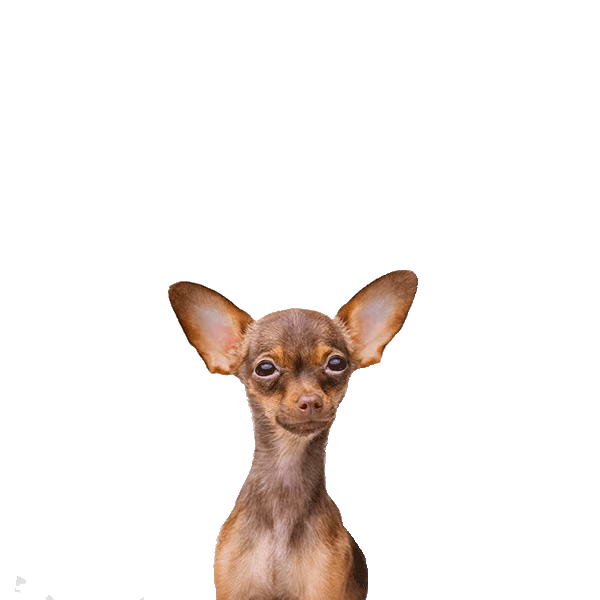
The Russian Toy is a tiny, elegant lapdog devoted to its owner, lively and affectionate yet alert and reserved with strangers.
How the Russian Toy coat is built, and what that means when you groom it.
The Russian Toy is one of the world's smallest lapdogs, a devoted one-owner companion that stays lively indoors but keeps its distance from strangers.
The Russian Toy is amongst the smallest dog breeds anywhere, a fine-boned companion developed in Russia and now a familiar sight in South African toy-breed circles. A grown dog usually weighs under 3 kilograms and stands roughly 20 to 28 centimetres at the shoulder. For all that, it is anything but delicate on its feet: the long legs relative to its slight body give it a light, quick gait.
The breed comes in two coat types under one standard: a smooth, short coat, and a long coat with fringing on the ears and legs. Both share the same square, compact outline and the wide-set, prominent eyes that give the Russian Toy its alert look. It fixes its loyalty on one or two people in the household and will happily trail them from the lounge to the kitchen and back.
A flat or a small house suits the Russian Toy well, provided it is not left on its own for hours at a stretch. It is warm and playful with its own family, properly reserved with strangers, and it will let the household know, loudly, when someone unfamiliar is at the gate.
| Attribute | Detail |
|---|---|
| Origin | Russia |
| Size | Toy breed (under 3 kg) |
| Lifespan | 12 to 14 years |
| Group/role | Toy companion dog |
| Good with | Calm adults, older children, and other small, settled dogs |
This is a breed for someone who wants a small, devoted companion and has the time to give it proper attention. It suits quiet adults and retirees particularly well. A household with toddlers or boisterous young children is a poor fit, because the Russian Toy's fine bones fracture easily if the dog is dropped or trodden on.
The Russian Toy developed from English Toy Terriers brought into Russia, bred down into a small companion over generations and later formalised as one breed with smooth and long coat varieties.
The Russian Toy's roots lie with small terrier-type lapdogs kept by the Russian aristocracy. English Toy Terriers and similar diminutive dogs reached Russia in the 1800s, where fashionable city households kept them as companions.
Once foreign imports into Russia largely dried up after the early twentieth century, breeders worked with the dogs already in the country, refining them into a consistent small companion type. That isolation set the Russian Toy on its own path, distinct from its English forebears.
A long-coated variety emerged alongside the original smooth coat in the mid-twentieth century. Breeders developed and showed both types under a single breed programme rather than splitting them into separate breeds.
International recognition followed, and the Russian Toy is registered today by the major kennel bodies, South Africa's Kennel Union of Southern Africa (KUSA) included, under one breed standard that covers both the smooth and long coat forms.
The Russian Toy is a tiny, square-built dog with long legs, large upright ears, and prominent round eyes, shown in smooth and long coat varieties.
The Russian Toy is small and elegant, built on light, dry bone with lean muscle rather than any bulk. The body is square: the height at the shoulder is close to the length of the body. Long legs relative to the dog's size give it a high-stepping, agile way of moving. The head is small with a short muzzle, and the large, pointed ears are set high and stand upright.
| Trait | Standard |
|---|---|
| Height | 20 to 28 cm at the shoulder |
| Weight | Up to 3 kg |
| Coat | Two types: smooth (short and close) or long (with fringing on ears and legs) |
| Colours | Black and tan, brown and tan, blue and tan, and shades of red |
| Eyes | Large, round, dark, and set well apart |
The smooth type carries a short, glossy coat that lies flat against the body with no bald patches. The long type has moderate length over the body, with longer feathering on the ears, the backs of the legs, and the tail. Typical colours are black and tan, brown and tan, blue and tan, and various shades of red. Long-coated dogs are often admired for well-developed ear fringing once the adult coat comes through.
The Russian Toy is affectionate and loyal to its own people, playful and alert, but naturally wary of strangers until it decides they can be trusted.
The Russian Toy commits itself to its family, usually settling its strongest bond on one or two people in the household. Within that circle it is affectionate, playful, and always keen to be nearby. The breed is lively and inquisitive, happiest with short games and quick bursts of activity rather than long, sustained exercise.
Around strangers it is watchful and holds back. It tends to size up unfamiliar visitors before deciding they are no threat, and it barks readily at new sounds, gates opening, or anyone it does not recognise, which makes it a surprisingly alert little watchdog. Gentle, early exposure to different people and situations keeps that natural wariness from tipping over into anxiety.
With other pets the Russian Toy generally gets on with other small, settled dogs and can live comfortably with cats it grows up alongside. Its size puts it at real risk around large, boisterous dogs, so introductions need supervision and common sense.
| Trait | Rating |
|---|---|
| Affection | 5 |
| Energy | 3 |
| Trainability | 3 |
| Barking | 4 |
| Shedding | 2 |
The Russian Toy needs light grooming, modest daily exercise, and a warm, secure home, since South Africa's swings in climate and altitude call for real protection against cold and injury.
South Africa's climate varies sharply by region and altitude, and the Russian Toy needs to be managed accordingly. On the Highveld, winter nights drop well below freezing, and this breed has almost no tolerance for cold; a jersey or coat indoors and out is not optional in those months. On the coast and in the Lowveld, humidity and heat bring their own management needs, including shade and fresh water at all times. Keep stairs, balconies, and high furniture off-limits or supervised, since a fall from even modest height can injure a dog this small.
The Russian Toy needs a small amount of high-quality food across two or three meals a day, with care to prevent low blood sugar in puppies and weight gain in adults.
The Russian Toy needs a complete, balanced diet formulated for small or toy breeds. Because its stomach is tiny, the food needs to be calorie-dense enough to meet its needs in small portions. Fresh water should be available at all times. Exact portions depend on the individual dog's weight, age, and activity level, so treat the amounts below as a starting point to fine-tune with a vet.
| Life stage | Amount per day | Meals |
|---|---|---|
| Puppy (2 to 6 months) | Per the product guide for the puppy's weight, without long gaps between meals | 3 to 4 |
| Adult | Roughly 30 to 60 g of dry food, by weight | 2 |
| Senior | Slightly reduced, adjusted for activity | 2 |
Keep treats to a small share of the day's calories to avoid weight gain. Toy-breed puppies can develop low blood sugar if they go too long between meals, so frequent small feeds matter in the first months. A healthy dog on a complete diet rarely needs supplements; check with a vet before adding anything.
The Russian Toy typically lives 12 to 14 years but is prone to dental disease, slipping kneecaps, fracture injuries, and, in South Africa, tick-borne biliary.
The Russian Toy is generally a healthy breed with a typical lifespan of 12 to 14 years. Most concerns trace back to its very small size: crowded teeth, slipping kneecaps, and a real risk of fractures from falls or rough handling. Responsible breeders screen their dogs for these known issues before mating them.
| Condition | Signs | Note |
|---|---|---|
| Dental disease | Bad breath, tartar, loose teeth | Crowded toy jaws need regular brushing and professional cleaning |
| Patellar luxation | Skipping gait, hopping on a hind leg | Common in toy breeds; ranges from mild to needing surgery |
| Fractures | Sudden lameness, pain after a fall | Fine bones break easily; guard against jumps and falls |
| Retained baby teeth | A double row of teeth in a young dog | May need extraction to stop crowding and decay |
The Russian Toy is intelligent and eager to please but sensitive, so it does best with short, gentle, reward-based sessions and early socialisation to ease its wariness and barking.
The Russian Toy is sharp and closely bonded to its people, which makes it responsive to training when sessions stay short and upbeat. The breed is sensitive, and it does not take well to harsh corrections; firmness without warmth tends to make it shut down rather than learn. Consistency and patience get further than pressure ever will. Early socialisation matters, both to soften the natural reserve around strangers and to keep the barking within reason.
The Russian Toy matures slowly for breeding and produces small litters that need close, careful attention because the newborn puppies are tiny and fragile.
Breeding the Russian Toy takes real care, given its small size. A bitch should be fully mature before she is mated, generally not on her first season, and breeding stock should be checked for patellar and dental issues, among other concerns, beforehand. Mating itself is usually straightforward, but whelping can carry higher risk in such a small dog, so arrange veterinary support well in advance.
Litters are small, often only one to three puppies. The newborns are extremely tiny and vulnerable to chilling and low blood sugar, so the whelping area needs to stay warm and the puppies need close watching for steady nursing and weight gain. Puppies should stay with the dam and their littermates through the early weeks to develop properly, moving on to gentle handling and early socialisation once they are strong enough.
| Metric | Value |
|---|---|
| Gestation | About 58 to 68 days |
| Average litter size | 1 to 3 puppies |
| Weaning age | About 4 to 7 weeks |
| Recommended first breeding | After full maturity, not the first season |
No national chip law protects a Russian Toy here; a free United Pet Club record does, for life, at no cost.
Load your Russian Toy's details once and be done with it: name, date of birth, photo, your cell number, save. The profile is free for his whole life, and it takes a chip number the day the vet supplies one. Dog registration is the start of the paper trail.
The chip is a number; the registry entry is the story behind it. Capture your Russian Toy's 15-digit number in a free United Pet Club account and the story reads: this dog has a home. Every brand is accepted, updates never cost a cent, and the record stays searchable here and abroad. Microchip registration plus a free account does it.
Create a free United Pet Club account, load your Russian Toy's details and a photo, and save. The lifetime plan keeps the profile active at no cost for as long as you have him, chip or no chip.
Load the 15-digit chip number into your free account together with your address and cell number. Registration and every later update are free, and chips from any brand a South African vet implants are accepted.
No national law says so, though the SPCA chips as standard practice and many breeders and welfare groups insist on it. The registration behind the chip is the part that finds you, and with United Pet Club it costs nothing.
Nothing at all. The free lifetime plan covers the profile, the chip record, and unlimited updates, with no annual renewal in sight.
Common questions about the Russian Toy's size, temperament, care, lifespan, suitability, and coat varieties.
It's one of the smallest dog breeds around. Adults stand roughly 20 to 28 cm at the shoulder and weigh up to about 3 kg.
Affectionate, loyal, and playful with its own family, but alert and reserved around strangers. It bonds tightly with one or two people and barks readily at new sounds.
Day-to-day care is light: brushing anywhere from weekly to several times a week depending on coat type, short daily walks, and regular dental care. The main job is protecting such a small, fine-boned dog from falls and rough handling.
The typical lifespan is 12 to 14 years, and many dogs reach the upper end of that with good care.
It suits adults, older people, and households with older, gentle children. Toddlers and young children are a poor match, since the breed's light bones injure easily under rough handling.
Yes. Both varieties fall under the same breed and are covered by a single standard.
It can be vocal and is quick to sound the alarm at noises and visitors. Early socialisation and rewarding quiet moments help keep the barking manageable.
