

Rough Collie
The Rough Collie is a graceful, gentle family dog known for its intelligence, loyalty, and flowing coat made famous by Lassie.
- Size
- Large
- Lifespan
- 12–14 years
- Origin
- Scotland
- Temperament
- Gentle
- Standard colors
- Black, White, Blue and Tan
Characteristics
Coat and grooming
How the Rough Collie coat is built, and what that means when you groom it.
- Coat layers
- Double coat
- Coat texture
- Rough
- Coat length
- Long
- Shedding
- Seasonal shedding
Grooming guidance
Critical: A Rough Collie should not be shaved.
The undercoat keeps heat out as well as in, and the outer coat shields the skin from sun and insect bites. Clipping the whole coat off removes both. It often grows back patchy, soft or a different colour, and in some animals the guard hairs never return properly. Brush the undercoat out instead of cutting it off.
Caution: A Rough Collie coat mats easily.
Fine or long hair tangles at the base of the coat, out of sight, where the mats tighten and pull on the skin. Brushing has to reach right down to the roots in sections, not just skim the surface.
Information: A Rough Collie drops its undercoat in heavy bursts.
The undercoat comes out in heavy bursts over a few weeks. An undercoat rake, or a bath followed by a proper blow-dry, clears it far faster than daily brushing. Clipping the coat down is not a shortcut for this.
Rough Collie colors and patterns
What each club's breed standard says about every Rough Collie color and pattern. Point at a ruling to see the club's own wording.
Breed standards describe the Rough Collie in Black, White, Blue and Tan. Standard patterns: Solid, Tricolour, Merle, Piebald, Sable and Tan point.
| Color or pattern | FCI | AKC | UKC | KC | KUSA |
|---|---|---|---|---|---|
| Black | Standard (“Tricolour: predominantly black”) | Standard (“Black White & Tan”) | Standard (“Tri-color: predominately black”) | Standard (“Tricolour: predominantly black”) | Standard (“Tricolour: predominantly black”) |
| White | Standard (“All should carry typical white Collie markings”) | Standard (“White”) | Standard (“White: predominately white”) | Standard (“All should carry typical white Collie markings”) | Standard (“All should carry typical white Collie markings”) |
| Blue | Standard (“Blue Merle: predominantly clear, silvery blue”) | Standard (“Blue Merle”) | Standard (“blue merle”) | Standard (“Blue Merle: predominantly clear, silvery blue”) | Standard (“Blue Merle: predominantly clear, silvery blue”) |
| Tan | Standard (“rich tan markings about legs and head”) | Standard (“Black White & Tan”) | Standard (“rich tan markings on the head and legs”) | Standard (“rich tan markings about legs and head”) | Standard (“rich tan markings about legs and head”) |
| Slate | Fault (“Large black markings, slate colour, or rusty tinge either of top or undercoat are highly undesirable”) | Not recognised | Not recognised | Fault (“Large black markings, slate colour, or rusty tinge either of top or undercoat are highly undesirable”) | Fault (“Large black markings, slate colour, or rusty tinge either of top or undercoat are highly undesirable”) |
| Rust | Fault (“A rusty tinge in top coat highly undesirable”) | Not recognised | Not recognised | Fault (“A rusty tinge in top coat highly undesirable”) | Fault (“A rusty tinge in topcoat highly undesirable”) |
| Cream | Fault (“Light straw or cream coloured highly undesirable”) | Not recognised | Not recognised | Fault (“Light straw or cream coloured highly undesirable”) | Fault (“Light straw or cream coloured highly undesirable”) |
| Albino | Not recognised | Not recognised | Disqualifying (“Albinism”) | Not recognised | Not recognised |
| Patterns | |||||
| Solid | Fault (“All white or predominantly white is highly undesirable”) | Standard (“predominantly white, preferably with sable, tri-color or blue merle markings”) | Standard (“predominately white, preferably with sable, tri-color or blue merle markings”) | Fault (“All white or predominantly white is highly undesirable”) | Fault (“All white or predominantly white is highly undesirable”) |
| Tricolour | Standard (“Tricolour”) | Standard (“Black White & Tan”) | Standard (“tri-color”) | Standard (“Tricolour”) | Standard (“Tricolour”) |
| Merle | Standard (“Blue Merle”) | Standard (“Blue Merle”) | Standard (“blue merle”) | Standard (“Blue Merle”) | Standard (“Blue Merle”) |
| Piebald | Fault (“All white or predominantly white is highly undesirable”) | Standard (“White”) | Standard (“predominately white, preferably with sable, tri-color or blue merle markings”) | Fault (“All white or predominantly white is highly undesirable”) | Fault (“All white or predominantly white is highly undesirable”) |
| Sable | Standard (“Sable: any shade of light gold to rich mahogany or shaded sable”) | Standard (“Sable”) | Standard (“sable”) | Standard (“Sable: any shade of light gold to rich mahogany or shaded sable”) | Standard (“Sable: any shade of light gold to rich mahogany or shaded sable”) |
| Tan point | Standard (“rich tan markings about legs and head”) | Standard (“Black & Tan Markings”) | Standard (“rich tan markings on the head and legs”) | Standard (“rich tan markings about legs and head”) | Standard (“rich tan markings about legs and head”) |
| Double merle | No ruling | No ruling | No ruling | No ruling | No ruling |


| Color or pattern | FCI | AKC | UKC | KC | KUSA |
|---|---|---|---|---|---|
| Blue | Standard (“blue merles when eyes are frequently (one or both, or part of one or both) blue”) | Standard (“either or both eyes may be merle or china in color without specific penalty”) | Standard (“the Blue Merle, which may have blue, or blue flecked, eyes (one or both)”) | Standard (“blue merles when eyes are frequently (one or both, or part of one or both) blue”) | Standard (“blue merles when eyes are frequently (one or both, or part of one or both) blue”) |
| Dark brown | Standard (“dark brown colour”) | Standard (“The color is dark”) | Standard (“dark brown in color”) | Standard (“dark brown colour”) | Standard (“dark brown colour”) |
| Patterns | |||||
| Marbled | Standard (“blueflecked”) | Standard (“either or both eyes may be merle”) | Standard (“blue flecked”) | Standard (“blue-flecked”) | Standard (“blue-flecked”) |
| Odd-eyed | Standard (“one or both”) | Standard (“either or both eyes may be merle or china”) | Standard (“(one or both)”) | Standard (“one or both”) | Standard (“one or both”) |
| Sectoral | Standard (“part of one or both”) | No ruling | No ruling | Standard (“part of one or both”) | Standard (“part of one or both”) |


| Color or pattern | FCI | AKC | UKC | KC | KUSA |
|---|---|---|---|---|---|
| Black | Standard (“black nose”) | Standard (“the black nose”) | Standard (“Must be black”) | Standard (“Nose always black”) | Standard (“Nose always black”) |
What the rulings mean
- Standard
- Described by the club's breed standard.
- Fault
- Named by the club's breed standard as a fault: the animal can be shown but is penalised.
- Disqualifying
- The club's breed standard disqualifies an animal of this colour or pattern.
- Not recognised
- The club does not accept this colour or pattern for the breed.
Color changes
How a Rough Collie's colors can change over its life.
Blackchanges toRust
Coat · With body condition · can change back
Blackchanges toGrey
Coat · Progressive
Blackchanges toBrown
Coat · In the sun · can change back
Whitechanges toRoan
Coat · With age · from 2 weeks
Tan pointchanges toSaddle
Coat · With age · from 6 to 156 weeks
Bluechanges toDark brown
Eyes · With age · from 2 weeks
Bluechanges toBrown
Eyes · With age · from 2 weeks
Bluechanges toLight brown
Eyes · With age · from 2 weeks
Bluechanges toAmber
Eyes · With age · from 2 weeks
Bluechanges toHazel
Eyes · With age · from 2 weeks
Bluechanges toYellow
Eyes · With age · from 2 weeks
Blackchanges toSnow nose
Nose · With the season · can change back
Blackchanges toPink
Nose · With the season · can change back


Sources
Each ruling comes from the club's published breed standard or color list.
Rough Collie breed standard
What each club's standard asks of the Rough Collie: size, build and forms. A club speaks only for itself, and a figure no club published is left out.
Measurements


Conformation
Stop
Slight
“Stop: Slight, but perceptible.”
Bite
Scissors bite
“A perfect, regular and complete scissor bite”
Eye shape
Almond
“of almond-shape and dark brown colour”
Ear carriage
Semi-erect
“carried semi-erect, that is, with approximately two-thirds of ear standing erect”
Neck shape
Arched
“Muscular, powerful, of fair length, well arched.”
Hocks
Well let down
“Hock joint: well let down and powerful.”
Feet
Oval
“Forefeet: Oval; soles well padded.”
Tail length
Long
“Long with bone reaching at least to hock joint.”
Tail carriage
Low (hanging)
“Carried low when quiet”


Markings
- Collar“Following markings are favourable – white collar, full or part”


Parts of the body


Health
Conditions recorded as more common in the Rough Collie than in its species as a whole. A higher risk is not a diagnosis: many never develop any of them, and your vet can say which screening tests are worth doing.
High risk
- Eyes & vision
Collie eye anomaly
Strong evidenceHereditaryInheritance: Autosomal recessive - Nervous system
MDR1 (ABCB1) drug sensitivity
Strong evidenceHereditaryInheritance: Autosomal recessiveGene: ABCB1OMIA entry
This content is for educational purposes and is not a substitute for professional veterinary advice. If you are worried about your pet, contact your veterinarian.
All health conditionsMeet some of our Rough Collie
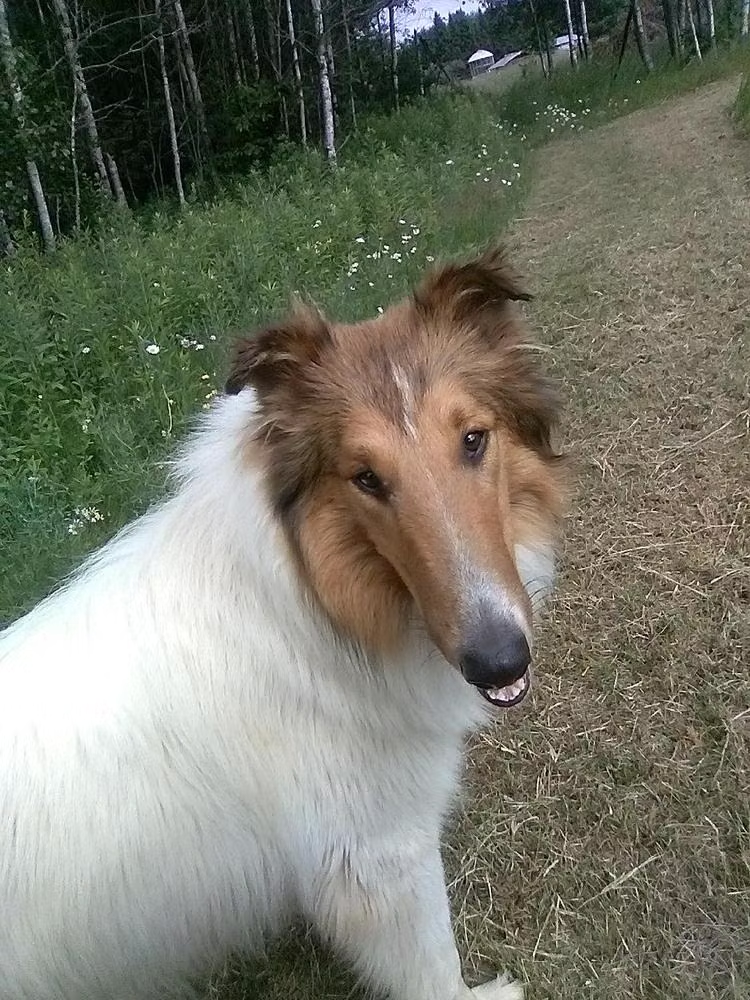
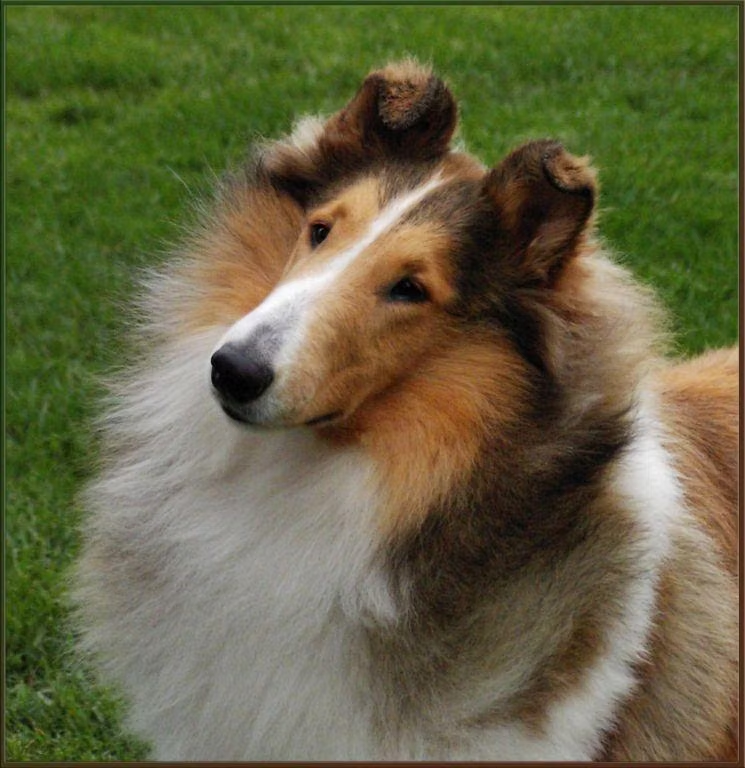
A few of the Rough Collie profiles members have added to United Pet Club.




About the Rough Collie
The Rough Collie is a large, gentle Scottish herding breed with a flowing double coat, known in South Africa for its sensitivity and devotion to children.
The Rough Collie is a large herding dog that originated in Scotland, easily recognised by its long double coat, its narrow, wedge-shaped head, and its soft, almond-shaped eyes. The breed became a household name through the Lassie films and television series, which fixed its image worldwide as a devoted family companion.
Adult dogs typically stand between 56 and 66 cm at the shoulder and weigh in the region of 23 to 34 kg. Despite this size, the temperament is soft and biddable. In South African homes, Rough Collies tend to settle calmly indoors, stay attentive to family members, and pick up quickly on tone of voice and household mood.
The breed retains the working intelligence of its herding background. Collies learn fast, watch their owners closely, and often respond to the subtlest of cues. That same sensitivity means a heavy hand tends to backfire rather than help.
| Attribute | Detail |
|---|---|
| Origin | Scotland |
| Size | Large (23 to 34 kg) |
| Lifespan | 12 to 14 years |
| Group / role | Herding |
| Good with | Children and families |
Who the breed suits
The Rough Collie suits households that can offer daily company, moderate exercise, and regular grooming. The breed gets on well with children and tends to stay close to its people rather than wander the garden alone. Owners who travel frequently, or who leave a dog on its own for long stretches, may find the breed's attachment hard to satisfy.
History and origin
The Rough Collie developed as a working herding dog in the Scottish Highlands and rose to worldwide fame after Queen Victoria took a liking to the breed in the 1860s.
The Rough Collie traces its roots to herding dogs used across the Scottish Highlands and northern England. These working dogs moved sheep over rough, open country, and breeders prized stamina, biddability, and a coat that stood up to wet, cold weather.
Royal attention came in the 1860s, when Queen Victoria saw Collies during a visit to Balmoral and went on to keep several at Windsor. That royal interest lifted the breed's profile considerably and helped shift it from farm work toward the show ring and companion homes.
The dog shows of the late nineteenth century shaped the modern type. Breeders refined the long, narrow head and the heavy double coat, and the Collie was among the breeds recorded in the earliest kennel club registers in Britain and the United States.
Through the twentieth century, the Lassie books, films, and television series carried the breed to audiences the world over, South Africa included. The fictional dog cemented the Rough Collie's reputation as a loyal, intelligent rescuer and drove decades of strong demand.
Appearance and breed standard
The Rough Collie is a large, elegant dog with a long double coat, a refined wedge-shaped head, and almond eyes that give it a soft expression.
The Rough Collie has a lean, balanced frame built for movement rather than bulk. The head is long and refined, narrowing to the nose in a smooth wedge, and the ears are semi-erect with the tips folding forward. The almond-shaped eyes give the breed its gentle, watchful expression, recognised under the Kennel Union of Southern Africa (KUSA) breed standard.
| Trait | Standard |
|---|---|
| Height | 56 to 66 cm at the shoulder |
| Weight | 23 to 34 kg |
| Coat | Long, straight outer coat over a dense undercoat |
| Colours | Sable and white, tricolour, blue merle, white |
| Eyes | Almond-shaped, dark (merles may have blue or flecked eyes) |
Coat and colours
The double coat is the breed's most recognisable feature. A coarse, straight outer coat lies over a soft, dense undercoat, with a heavy mane and frill around the neck and chest. Recognised colours are sable and white, tricolour (black, white, and tan), blue merle, and predominantly white with coloured markings. The coat sheds throughout the year and blows out heavily during seasonal moults, something South African owners with hot summers notice more than most.
What the Rough Collie standard says, club by club
Height at the withers for the Rough Collie: AKC 61-66 cm; CKC 61-66 cm; FCI 56-61 cm; KC 56-61 cm; UKC 61-66 cm.
Clubs set their own figures for the Rough Collie. These come from each club's published standard: AKC, CKC, FCI, KC, UKC.
Size
- Height at the withers, male: AKC 61-66 cm; CKC 61-66 cm; FCI 56-61 cm; KC 56-61 cm; UKC 61-66 cm
- Height at the withers, female: AKC 55.9-61 cm; CKC 56-61 cm; FCI 51-56 cm; KC 51-56 cm; UKC 55.9-61 cm
- Weight, male: AKC 27.2-34 kg; CKC 27.2-34 kg; UKC 27.2-34 kg
- Weight, female: AKC 22.7-29.5 kg; CKC 22.8-29.5 kg; UKC 22.7-29.5 kg
- Skull to muzzle: AKC 1; CKC 1; FCI 1; KC 1; UKC 1
Build and forms
At least one club accepts each of these:
- Stop: Slight
- Bite: Scissors bite
- Eye shape: Almond
- Ear carriage: Semi-erect
- Neck shape: Arched
- Topline: Level
- Hocks: Well let down
- Feet: Oval
- Tail length: Long
- Tail carriage: Low (hanging)
Forms the clubs penalise
A fault or a disqualification is a judgment under a show standard. It can affect placings and, at some clubs, registration.
- Fault: Bite: Overshot (AKC, CKC, UKC); Bite: Undershot (AKC, CKC, UKC); Ear carriage: Erect (prick) (AKC, UKC); Ear set: Low (AKC, UKC); Hocks: Cow-hocked (UKC)
See every point side by side: compare the clubs.
Rulings come from each club's published breed standard, and clubs revise their standards. Before a show or a registration, check the current text with the club.
What does each club give for Height at the withers in the Rough Collie?
Height at the withers, male: AKC 61-66 cm; CKC 61-66 cm; FCI 56-61 cm; KC 56-61 cm; UKC 61-66 cm; Height at the withers, female: AKC 55.9-61 cm; CKC 56-61 cm; FCI 51-56 cm; KC 51-56 cm; UKC 55.9-61 cm.
Which forms do clubs penalise in the Rough Collie?
Fault: Bite: Overshot (AKC, CKC, UKC); Bite: Undershot (AKC, CKC, UKC); Ear carriage: Erect (prick) (AKC, UKC); Ear set: Low (AKC, UKC); Hocks: Cow-hocked (UKC).
Which Rough Collie colours the clubs accept
Every club we track accepts Black, White, Blue, Tan for the Rough Collie.
On the Rough Collie, every club we track agrees on Black, White, Blue, Tan. Clubs compared: AKC, FCI, KC, KUSA, UKC.
Patterns listed as standard for the Rough Collie: Solid, Tricolour, Merle, Piebald, Sable, Tan point.
Where the clubs split
At least one club accepts each of these, and at least one other penalises or refuses it.
- Solid: Standard (AKC, UKC); Fault (FCI, KC, KUSA)
- Piebald: Standard (AKC, UKC); Fault (FCI, KC, KUSA)
Colours penalised in the show ring
A fault or a disqualification is a judgment under a show standard. It can affect placings and, at some clubs, registration.
- Disqualifying: Albino (UKC)
- Fault: Solid (FCI, KC, KUSA), Piebald (FCI, KC, KUSA), Slate (FCI, KC, KUSA), Rust (FCI, KC, KUSA), Cream (FCI, KC, KUSA)
Beyond the main colour
Standards rule on more than the main colour. These are listed as standard:
- Eyes: Blue, Dark brown
- Nose: Black
Rulings come from each club's published breed standard, and clubs revise their standards. Before a show or a registration, check the current text with the club.
Which Rough Collie colours do all the clubs accept?
All of these clubs accept Black, White, Blue, Tan: AKC, FCI, KC, KUSA, UKC.
Do clubs disagree about Rough Collie colours?
Yes. Clubs rule differently on Solid, Piebald.
Which Rough Collie colours are faults or disqualifications?
Disqualifying: Albino (UKC). Fault: Solid (FCI, KC, KUSA), Piebald (FCI, KC, KUSA), Slate (FCI, KC, KUSA), Rust (FCI, KC, KUSA), Cream (FCI, KC, KUSA).
Temperament and personality
Rough Collies are gentle, loyal, and sensitive dogs that bond closely with their families, get on well with children, and tend to be reserved rather than aggressive with strangers.
The Rough Collie is gentle and devoted. The breed forms strong attachments to its household and prefers to stay close to its people rather than range off on its own. With children, the temperament is patient and tolerant, which is part of the reason the breed has such a long-standing reputation as a family dog.
Around strangers, Collies are usually reserved rather than hostile. Many will bark to announce visitors, then settle once the household accepts the newcomer. The breed generally gets on well with other dogs and household pets, helped along by a herding background that favours managing a situation rather than confronting it.
The breed is sensitive. Rough Collies read tone and mood closely, and they respond poorly to shouting or rough correction. Some lines are vocal, and the herding instinct can show up as following, or gentle gathering, of children and other animals around the home.
| Trait | Rating |
|---|---|
| Affection | 5 |
| Energy | 3 |
| Trainability | 5 |
| Vocalness | 4 |
| Shedding | 5 |
Care and grooming
The Rough Collie needs frequent brushing for its heavy double coat, daily moderate exercise, and steady company, as the breed is prone to loneliness when left on its own.
Grooming
- Brush the coat two to three times a week, and more often during seasonal shedding.
- Work through the dense areas behind the ears, under the legs, and around the frill, where mats tend to form.
- Bathe every six to eight weeks or as needed.
- Trim nails monthly and check ears weekly for debris.
- Avoid shaving the double coat, as this can damage the regrowth and reduce insulation.
Exercise
- Provide 45 to 60 minutes of activity daily, split between walks and play.
- Include mental work such as scent games, training, or herding-style activities.
- Use secure, fenced spaces, since the herding drive can prompt chasing, particularly near a busy suburban street.
- Adjust intensity in the heat, as the heavy coat raises the risk of overheating, an important consideration in the highveld summer sun or on the humid KwaZulu-Natal coast.
Environment
The Rough Collie adapts to house or flat living when given daily exercise and company, though more space suits its size. The breed copes well with cold thanks to its double coat, but needs shade and fresh water during warm weather, and owners in hotter parts of the country should watch for signs of heat stress. The breed does best with regular human contact and can struggle with long hours left alone at home.
Grooming a Rough Collie
The Rough Collie coat: Double coat, Rough, Long, Seasonal shedding. Main grooming rule: Do not shave.
Most of what a Rough Collie needs from grooming follows from its coat.
- Coat layers: Double coat
- Coat texture: Rough
- Coat length: Long
- Shedding: Seasonal shedding
What this coat asks of you
- A double coat has a soft undercoat beneath longer guard hairs. Brush right down to the undercoat, because that is the layer that packs down and traps loose hair.
- A rough coat stands off the body and collects burrs and debris, so check it after time outdoors.
- Long hair mats from the base up. Work through it in sections and keep the areas around the eyes and the rear clean.
- Seasonal shedding arrives in bursts when the coat changes, and brushing more often during those weeks keeps it manageable.
What to tell a groomer
Mention these when you book. The coat notes on this page explain each one.
- Do not shave
- Mats easily
- Needs seasonal de-shedding
A groomer who knows the breed can adapt all of this to the individual animal. Sore skin, mats pressed against the skin or a sudden change in the coat are worth showing to a vet.
What kind of coat does a Rough Collie have?
On our records: Coat layers: Double coat; Coat texture: Rough; Coat length: Long; Shedding: Seasonal shedding.
How much does a Rough Collie shed?
Seasonal shedding arrives in bursts when the coat changes, and brushing more often during those weeks keeps it manageable.
What should a groomer know about a Rough Collie?
These grooming rules apply: Do not shave, Mats easily, Needs seasonal de-shedding.
Nutrition and feeding
Rough Collies do well on a balanced diet sized for a large breed, fed as two daily meals, with portions adjusted to keep the dog lean.
The Rough Collie needs a complete, balanced diet formulated for large breeds. Choose a food with a named protein source, and feed amounts based on the dog's weight, age, and activity level. Because the heavy coat can hide weight gain, check body condition by feel rather than by appearance alone.
| Life stage | Amount per day | Meals |
|---|---|---|
| Puppy (2 to 6 months) | 240 to 360 g, growth formula | 3 to 4 |
| Adult | 300 to 420 g | 2 |
| Senior | 240 to 360 g, adjusted for activity | 2 |
Treats and supplements
Keep treats to about 10 percent of daily calories. Many owners support coat and joint health with omega-3 fatty acids, though supplements should only be added on veterinary advice. Provide fresh water at all times, especially after exercise in the heat.
Health and common conditions
The Rough Collie typically lives 12 to 14 years and is generally a healthy breed, though it is prone to inherited eye disorders, MDR1 drug sensitivity, and tick-borne biliary.
The Rough Collie is generally a sound breed with a lifespan of 12 to 14 years. Responsible breeding and screening reduce the most common inherited problems. The breed carries a well-documented drug sensitivity linked to the MDR1 gene, which affects how some dogs process certain medications, including ivermectin-based tick and parasite treatments that are widely used in South Africa.
| Condition | Signs | Note |
|---|---|---|
| Collie eye anomaly | Often no visible signs; picked up on an eye exam | Inherited; screen breeding dogs |
| Progressive retinal atrophy | Night blindness, loss of vision | Inherited; DNA testing available |
| MDR1 drug sensitivity | Severe reaction to certain drugs | DNA test; inform your vet |
| Hip dysplasia | Stiffness, reduced activity | Screen breeding stock |
Preventive care
- Book annual veterinary check-ups and keep vaccinations up to date.
- Test or confirm MDR1 status and share the results with your vet.
- Arrange periodic eye examinations.
- Maintain a lean body weight to protect the joints.
- Keep tick and parasite prevention current, given the real risk of biliary (canine babesiosis) in much of South Africa.
Training
Rough Collies are highly trainable and quick to learn, responding best to patient, reward-based methods suited to the breed's sensitive nature.
The Rough Collie is intelligent and keen to cooperate, so most owners find training straightforward. The breed picks up commands quickly and enjoys having a job to do. Because Collies are sensitive, harsh corrections tend to cause the dog to withdraw rather than improve, so calm, consistent handling works far better.
Basics
- Start socialisation early, exposing the puppy to people, sounds, and other animals.
- Teach foundation cues such as sit, stay, come, and leash manners.
- Add structured mental work, including scent games and trick training.
- Channel the herding instinct into approved games to reduce chasing.
- Address barking early with clear, consistent responses.
Breeding
Rough Collies reach breeding maturity at one to two years, carry a litter for about 63 days, and typically produce six to eight puppies that need careful early socialisation.
Rough Collies reach physical maturity between one and two years of age, and responsible breeders wait until a dog is fully grown and health-screened before breeding from it. Gestation lasts about 63 days, and litters commonly run to six or eight puppies.
Before breeding, dams and sires should be tested for inherited conditions, including MDR1 status and eye disorders, so that affected genes are not passed on. Early handling and socialisation of the puppies lay the foundation for the breed's gentle adult temperament. Puppies usually go to their new homes at around eight weeks old, once weaned and started on their vaccinations.
| Metric | Value |
|---|---|
| Breeding maturity | 12 to 24 months |
| Gestation | About 63 days |
| Average litter size | 6 to 8 puppies |
| Weaning age | Around 6 to 8 weeks |
| Recommended health tests | MDR1, eye exam, hip screening |
Registering your Rough Collie and its chip in South Africa
No national chip law protects a Rough Collie here; a free United Pet Club record does, for life, at no cost.
Rough Collie registration and microchips in South Africa
When a Rough Collie lands at an SPCA branch, the scanner comes out first, and everything then rides on what the number returns. Make sure it returns you. Register your dog free with United Pet Club and the profile answers every scan with your name and number, from now until the end of his days.
The chip is a number; the registry entry is the story behind it. Capture your Rough Collie's 15-digit number in a free United Pet Club account and the story reads: this dog has a home. Every brand is accepted, updates never cost a cent, and the record stays searchable here and abroad. Microchip registration plus a free account does it.
How do I register my Rough Collie in South Africa?
Create a free United Pet Club account, load your Rough Collie's details and a photo, and save. The lifetime plan keeps the profile active at no cost for as long as you have him, chip or no chip.
How do I register my Rough Collie's microchip?
Load the 15-digit chip number into your free account together with your address and cell number. Registration and every later update are free, and chips from any brand a South African vet implants are accepted.
Must a Rough Collie be microchipped in South Africa?
No national law says so, though the SPCA chips as standard practice and many breeders and welfare groups insist on it. The registration behind the chip is the part that finds you, and with United Pet Club it costs nothing.
What does it cost to register a Rough Collie?
Nothing at all. The free lifetime plan covers the profile, the chip record, and unlimited updates, with no annual renewal in sight.
Frequently asked questions
Common questions about the Rough Collie cover its size, temperament, grooming needs, lifespan, suitability for families, and availability in South Africa.
How big does a Rough Collie get?
Rough Collies are a large breed. Adults stand about 56 to 66 cm at the shoulder and weigh roughly 23 to 34 kg, with males generally bigger than females.
Are Rough Collies good family dogs?
Yes. The breed is gentle, loyal, and patient with children, and it tends to bond closely with the whole household, which is a big part of its long-standing reputation as a family companion.
How much work is a Rough Collie to look after?
The care load is moderate. The main demands are frequent brushing of the heavy double coat, daily exercise, and steady company, since the breed dislikes being left on its own for long periods.
How long do Rough Collies live?
The typical lifespan is 12 to 14 years. Regular veterinary care, a lean weight, and health screening of breeding dogs all support a long, healthy life.
Do Rough Collies shed a lot?
Yes. The double coat sheds throughout the year and blows out heavily during seasonal moults. Brushing two to three times a week, more often during shedding season, helps keep loose hair under control.
Are Rough Collies easy to train?
Very. The breed is intelligent and keen to cooperate, and it learns quickly with patient, reward-based methods. Its sensitivity means gentle handling gets the best results.
Are Rough Collies easy to find in South Africa?
The breed is well established here and available through reputable KUSA-registered breeders, with rescue organisations also placing adult dogs. Health-tested puppies from screened parents may involve a waiting list.
From the community
Ask about the Rough CollieNo questions about the Rough Collie yet. Be the first to ask.
Browse Dog breeds