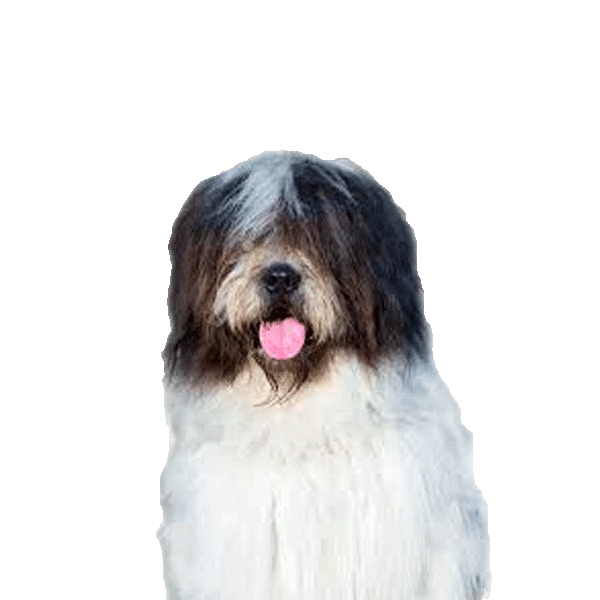
The Romanian Mioritic Shepherd Dog is a protective, devoted livestock guardian, courageous in defense yet affectionate with its family.
How the Romanian Mioritic Shepherd Dog coat is built, and what that means when you groom it.
Critical: A Romanian Mioritic Shepherd Dog should not be shaved.
The undercoat keeps heat out as well as in, and the outer coat shields the skin from sun and insect bites. Clipping the whole coat off removes both. It often grows back patchy, soft or a different colour, and in some animals the guard hairs never return properly. Brush the undercoat out instead of cutting it off.
Caution: A Romanian Mioritic Shepherd Dog coat mats easily.
Fine or long hair tangles at the base of the coat, out of sight, where the mats tighten and pull on the skin. Brushing has to reach right down to the roots in sections, not just skim the surface.
Information: A Romanian Mioritic Shepherd Dog drops its undercoat in heavy bursts.
The undercoat comes out in heavy bursts over a few weeks. An undercoat rake, or a bath followed by a proper blow-dry, clears it far faster than daily brushing. Clipping the coat down is not a shortcut for this.
The Romanian Mioritic Shepherd Dog is a large livestock guardian from Romania's Carpathians, watchful with strangers and devoted to its own family.
The Romanian Mioritic Shepherd Dog is a large guardian breed that grew up working the Carpathian Mountains of Romania. For generations it walked behind flocks with shepherds, keeping watch against wolves and bears. That job built the dog's character. On open ground, far from a handler, it had to decide for itself when to act, and it had to be strong enough to face something much bigger than itself.
At home the Mioritic settles into a calm, attached companion. It forms close bonds with its own people and is usually gentle with children it knows well. With strangers it holds back and watches, and if it reads a real threat it can turn firmly territorial. That contrast, soft with the family and serious on duty, is what defines the breed.
The coat is long, dense, and mostly white or pale, a colour that once let the dog blend in among the sheep. Adults are heavy in the bone and built for stamina in cold, wet mountain conditions rather than for speed, which owners in the colder inland regions will recognise as a genuine asset come winter.
| Attribute | Detail |
|---|---|
| Origin | Romania (Carpathian Mountains) |
| Size | Large |
| Lifespan | 12 to 14 years |
| Group / role | Livestock guardian / flock protection |
| Good with | Family and known children; reserved with strangers |
This breed suits an experienced owner with space, secure fencing, and time for early socialisation. It fits a household that wants a steady guardian rather than a high-drive sport dog, and it does well on a farm or large plot registered with a body such as the Kennel Union of Southern Africa. It is a poor fit for flat or townhouse living, for a first-time dog owner after something low-maintenance, or for a home that cannot manage a large, independent animal with strong protective instincts.
The Romanian Mioritic Shepherd Dog developed over centuries in Romania's Carpathian Mountains as a flock guardian, later recognised as a formal breed in the modern era.
The breed's home ground is the Carpathian Mountains, the range that curls through Romania. Shepherds there practised transhumance, herding large flocks between high summer grazing and lower winter pasture. Wolves and brown bears were a constant risk, so the shepherds needed dogs able to live alongside the flock and defend it without anyone standing over them.
The name comes from Mioriţa, an old Romanian pastoral ballad, and from the shepherding culture that poem describes. Breeding aimed at working ability rather than looks. Selection favoured size, a heavy weatherproof coat, a level temperament around livestock, and enough courage to face down a large predator.
For most of its history the Mioritic stayed a regional working dog, well known across the Romanian highlands but barely documented beyond them. A written breed standard was drawn up during the twentieth century, and the type later gained international recognition from the Fédération Cynologique Internationale, grouped among the sheepdogs and cattle dogs.
The breed remains scarce outside Romania and its neighbours, and scarcer still in Southern Africa, where importers and KUSA-registered breeders are few. Many dogs still do the job they were bred for, while a growing number live as family companions and property guardians, a role that also suits a South African smallholding.
The Romanian Mioritic Shepherd Dog is a large, heavy-boned guardian with a long, thick, mostly white coat suited to cold, wet conditions.
The Mioritic is a large, solidly built dog with substantial bone and a broad frame. The body runs slightly longer than it is tall, and the overall look is one of power and staying power rather than refinement. The head is large with a broad skull, and the long coat often gives the face and body a shaggy outline. The tail carries a full brush of fur and hangs low at rest.
| Trait | Standard |
|---|---|
| Height | Males about 70 to 75 cm; females about 65 to 70 cm at the withers |
| Weight | Roughly 50 to 65 kg, varying with sex and build |
| Coat | Long, thick, slightly wavy double coat with a dense undercoat |
| Colours | Usually white or whitish; may show grey or light patches |
| Eyes | Dark, medium sized, with an alert and steady expression |
The double coat is the breed's most practical feature. A coarse outer layer sheds rain and snow, while a dense undercoat holds warmth through Carpathian winters, and it does the same job on a cold Free State or Drakensberg morning. The most common colour is white or a pale off white, which once kept the working dog visible among the sheep and harder for a predator to single out. Some dogs carry grey or light shaded markings. The coat runs long over the whole body and needs regular attention to stay free of mats, particularly in the humid coastal air of KwaZulu-Natal where damp hair tangles faster.
The Romanian Mioritic Shepherd Dog is devoted to its family, calm and confident at home, and watchful or territorial toward strangers and threats.
The Mioritic is loyal, brave, and protective by nature. Inside the home it tends to be calm, affectionate, and patient, and it attaches strongly to the people it lives with. Many are gentle and tolerant with children they have grown up alongside, though given the dog's size, young children should always be supervised around it.
With strangers the breed holds back and sizes people up. It does not warm to new faces quickly and may stay standoffish until it has decided a visitor poses no risk. This wariness is part of the guardian temperament rather than aggression on its own. Faced with a genuine threat, though, the dog can turn firm and territorial, and it will act to protect its family and property.
How it gets on with other animals depends largely on how it was raised. Brought up with livestock or household pets, the Mioritic usually guards them and treats them as part of its own patch. Without early exposure it can be wary of unfamiliar dogs. The breed is independent by nature, a trait that served it well alone on the mountainside but that calls for consistent leadership and thorough socialisation from puppyhood, much as it would for any large guarding breed kept on a farm or plot.
| Trait | Rating |
|---|---|
| Affection (with family) | 4 |
| Energy | 3 |
| Trainability | 3 |
| Vocalness | 4 |
| Shedding | 4 |
The Romanian Mioritic Shepherd Dog needs regular coat care, daily moderate exercise, and a home with secure outdoor space rather than a flat.
The long double coat is the main grooming job, and the breed's size and guarding instinct shape the rest of its care. This is, at heart, an outdoor working dog, and it is happiest with room to patrol and something to keep an eye on.
The Mioritic suits a house on a securely fenced property and copes well with cold thanks to its coat, which matters on the Highveld and in the Drakensberg foothills where winter nights drop well below freezing. It is not built for flat or townhouse living, and in a hotter Lowveld or Karoo summer it needs shade and water at all times. A bored or under-exercised dog of this size can grow restless, so daily activity and a clear role matter.
The Romanian Mioritic Shepherd Dog needs a balanced large-breed diet with controlled growth in puppyhood and portions matched to its size and activity.
As a large breed, the Mioritic does best on a complete, balanced diet formulated for big dogs. Puppies need controlled growth to protect developing joints, so a large-breed puppy food and steady portions matter more than rapid weight gain. Adults need enough food to stay lean and muscular without carrying extra weight, which puts strain on the joints.
| Life stage | Amount per day | Meals |
|---|---|---|
| Puppy (2 to 6 months) | Per large-breed puppy food label, by weight | 3 to 4 |
| Junior (6 to 12 months) | Per label, adjusted for growth | 2 to 3 |
| Adult | About 4 to 6 cups of large-breed food, by weight and activity | 2 |
| Senior | Reduced calories to match lower activity | 2 |
Keep treats to a small share of daily calories so they do not unbalance the diet or pile on weight. Because this is a large, deep-chested breed, splitting food into two meals and skipping hard exercise straight after eating can lower the risk of bloat. Joint supplements are sometimes used in large breeds, but check with a vet before adding one. Fresh water should always be on hand.
The Romanian Mioritic Shepherd Dog is generally hardy with a lifespan of 12 to 14 years, though as a large breed it can face joint, bloat, and tick-borne risks.
The Mioritic is a generally hardy working breed with a typical lifespan of 12 to 14 years, which is long for a dog of its size. Good breeding, sensible feeding, and routine veterinary care all support that. As with most large breeds, the main concerns involve the joints, the risk of bloat, and the dense coat. Owners in Southern Africa also need to stay alert to tick-borne biliary, known locally as canine babesiosis, which is common across much of the country and can turn serious within a day or two if left untreated.
| Condition | Signs | Note |
|---|---|---|
| Hip and elbow dysplasia | Stiffness, limping, trouble getting up | Screen breeding dogs; control puppy growth and weight |
| Gastric dilatation-volvulus (bloat) | Swollen belly, retching, restlessness | An emergency; large deep-chested breeds are at higher risk |
| Obesity | Weight gain, low stamina | Adds load to the joints; manage portions and exercise |
| Ear infections | Head shaking, odour, scratching | The coat and ear folds trap moisture; check regularly |
The Romanian Mioritic Shepherd Dog is intelligent but independent, so it responds best to early, consistent, reward-based training and broad socialisation.
The Mioritic is intelligent and capable, but also independent, a trait bred into a dog that once made its own calls on the mountainside. It will not work just to please someone, so training depends on consistency, fairness, and a handler the dog actually respects. Harsh methods tend to backfire with a sensitive guarding breed and can damage the trust it has in its owner.
Early socialisation is the single most important task. Exposing the puppy to plenty of people, places, animals, and situations, from a busy Saturday market to visitors at the gate, helps it tell an ordinary caller from a genuine threat, which keeps the protective instinct measured rather than trigger-happy in adulthood.
The Romanian Mioritic Shepherd Dog matures slowly as a large breed, with litters raised over a roughly two-month gestation under health-screened parents.
Like most large breeds, the Mioritic matures slowly. Bones, joints, and temperament all need time to settle, so responsible breeders wait until a dog is fully grown, physically and behaviourally, before breeding from it. Health screening of the parents, especially for hip and elbow dysplasia, helps cut down on inherited problems in the puppies.
Gestation in dogs runs to around 63 days. The dam needs a quiet, warm whelping area, good nutrition through pregnancy and nursing, and close watching during and after the birth. Large breeds can have difficult labours, so a vet should be on call.
The first weeks shape the adult dog. Puppies do best with gentle handling, exposure to everyday household sounds, and the start of socialisation before they head off to new homes. Given the breed's size and guarding drive, matching puppies to suitable, prepared owners is part of breeding responsibly, and locally that often means placing pups with KUSA-registered breeders or on properties with the space and fencing the breed needs.
| Metric | Value |
|---|---|
| Sexual maturity | Reached in the first year, but breeding is best left until full maturity |
| Gestation | About 63 days |
| Typical litter size | Several puppies, varying by dam and line |
| Weaning | Around 6 to 8 weeks |
| Recommended pre-breeding checks | Hip and elbow screening, general health |
No national chip law protects a Romanian Mioritic Shepherd Dog here; a free United Pet Club record does, for life, at no cost.
When a Romanian Mioritic Shepherd Dog lands at an SPCA branch, the scanner comes out first, and everything then rides on what the number returns. Make sure it returns you. Register your dog free with United Pet Club and the profile answers every scan with your name and number, from now until the end of his days.
A chipped Romanian Mioritic Shepherd Dog still needs the number loaded into a registry, because the vet's job ends with the implant. Register the microchip on the free lifetime plan: any brand a local vet uses qualifies, updates stay free when you relocate between provinces, and the record answers the lookups SPCA branches run daily. Create your free account and settle both records today.
Create a free United Pet Club account, load your Romanian Mioritic Shepherd Dog's details and a photo, and save. The lifetime plan keeps the profile active at no cost for as long as you have him, chip or no chip.
Load the 15-digit chip number into your free account together with your address and cell number. Registration and every later update are free, and chips from any brand a South African vet implants are accepted.
No national law says so, though the SPCA chips as standard practice and many breeders and welfare groups insist on it. The registration behind the chip is the part that finds you, and with United Pet Club it costs nothing.
Nothing at all. The free lifetime plan covers the profile, the chip record, and unlimited updates, with no annual renewal in sight.
Common questions about the Romanian Mioritic Shepherd Dog's size, temperament, care needs, lifespan, suitability, and availability.
It is a large breed. Males typically stand about 70 to 75 cm at the withers and females about 65 to 70 cm, with weights roughly between 50 and 65 kg depending on sex and build.
With its own family it is devoted and affectionate, and often gentle with children it has grown up around. It is reserved with strangers and protective by nature, so it suits a family that wants a guardian and can provide supervision and proper socialisation.
It is a higher-commitment breed. The long double coat needs brushing two to three times a week, the dog needs space and daily exercise, and its independent, protective nature calls for an experienced, consistent owner.
The typical lifespan is 12 to 14 years, which is fairly long for a dog this size, especially with good nutrition, weight control, and routine veterinary care, including tick prevention against biliary.
It is generally not recommended for first-time owners or flat or townhouse living. It does best with an experienced handler, a house, and a securely fenced property where it has room to patrol.
The breed is uncommon outside Romania and its neighbours, and rare in Southern Africa. Finding a puppy from a responsible, health-screening, ideally KUSA-registered breeder may take time and a spot on a waiting list.
The thick double coat is built for cold Carpathian winters, so the breed handles cold very well but needs help in the heat. In a hot Lowveld or Karoo summer it needs shade, water, and care to avoid overheating.
