
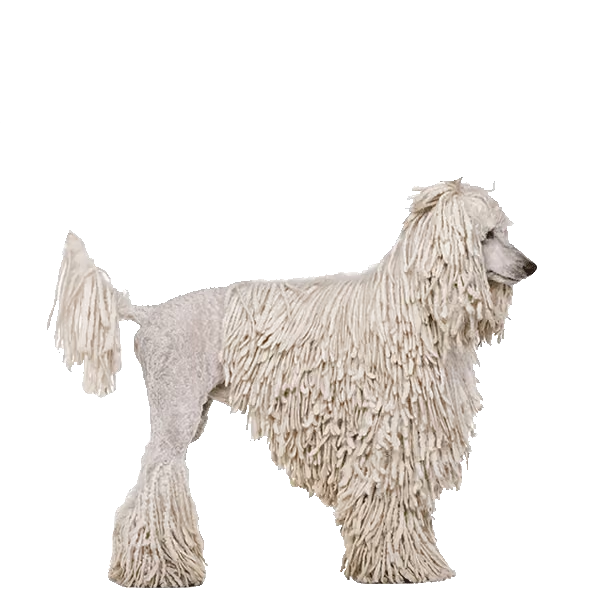
Poodle (Standard)
The Standard Poodle is a highly intelligent, athletic dog that excels at training and water retrieving while remaining a devoted family companion.
- Size
- Large
- Lifespan
- 12–15 years
- Origin
- Germany
- Temperament
- Intelligent
- Standard colors
- Black, White and Grey and 8 more
Characteristics
Coat and grooming
How the Poodle (Standard) coat is built, and what that means when you groom it.
- Coat layers
- Single coat
- Coat texture
- Curly
- Coat length
- Medium
- Shedding
- Low shedding
Grooming guidance
Caution: A Poodle (Standard) coat mats easily.
Fine or long hair tangles at the base of the coat, out of sight, where the mats tighten and pull on the skin. Brushing has to reach right down to the roots in sections, not just skim the surface.
Information: A Poodle (Standard) needs clipping every few weeks.
This coat keeps growing rather than shedding out, so it has to be trimmed every few weeks. Left to grow it mats down against the skin and traps moisture, dirt and heat.
Poodle (Standard) colors and patterns
What each club's breed standard says about every Poodle (Standard) color and pattern. Point at a ruling to see the club's own wording.
Breed standards describe the Poodle (Standard) in Black, White, Grey, Blue, Silver, Brown, Tan, Red, Cream, Apricot and Beige. Standard patterns: Solid, Tricolour, Brindle, Parti-colour, Tuxedo, Mantle, Tan point and Reverse brindle.
| Color or pattern | FCI | AKC | UKC | KC | KUSA |
|---|---|---|---|---|---|
| Black | Standard (“Black”) | Standard (“Black”) | Standard (“black”) | Standard (“Black”) | Standard (“All solid colours”) |
| White | Standard (“white”) | Standard (“White”) | Standard (“white”) | Standard (“White”) | Standard (“All solid colours”) |
| Grey | Standard (“Grey”) | Standard (“Gray”) | Standard (“gray”) | Standard (“All solid colours”) | Standard (“All solid colours”) |
| Blue | Standard (“Blue/grey and white”) | Standard (“Blue”) | Standard (“blue”) | Standard (“Blue”) | Standard (“All solid colours”) |
| Silver | Not recognised | Standard (“Silver”) | Standard (“silver”) | Standard (“Silver”) | Standard (“All solid colours”) |
| Brown | Standard (“brown”) | Standard (“Brown”) | Standard (“brown”) | Standard (“Brown”) | Standard (“All solid colours”) |
| Tan | Standard (“Black with fawn markings”) | Disqualifying (“Black & Tan”) | Disqualifying | Not recognised (“Black & Tan”) | Not recognised |
| Red | Standard (“red fawn”) | Standard (“Red”) | Standard (“red”) | Standard (“Red”) | Standard (“All solid colours”) |
| Cream | Standard (“pale fawn”) | Standard (“Cream”) | Standard (“cream”) | Standard (“Cream”) | Standard (“All solid colours”) |
| Apricot | Standard (“orange fawn (apricot)”) | Standard (“Apricot”) | Standard (“apricot”) | Standard (“Apricot”) | Standard (“All solid colours”) |
| Beige | Not recognised (“Beige and its paler derivatives are not admitted”) | Standard (“Cafe Au Lait”) | Standard (“café-au-lait, and silver beige”) | Standard (“All solid colours”) | Standard (“All solid colours”) |
| Albino | Not recognised | No ruling | Disqualifying (“Albinism”) | Not recognised | Not recognised |
| Patterns | |||||
| Solid | Standard (“Solid colours”) | Standard (“an even and solid color at the skin”) | Standard (“Coat color is solid and even”) | Standard (“All solid colours”) | Standard (“All solid colours”) |
| Tricolour | Standard (“Tricoloured: Black, white and marked with fawn”) | Disqualifying | No ruling | Not recognised | Not recognised |
| Brindle | Standard (“Brindle and white; Brindle”) | Disqualifying | No ruling | Not recognised | Not recognised |
| Parti-colour | Standard (“Parti-coloured dogs, two colours”) | Disqualifying (“Parti-colored dogs shall be disqualified”) | No ruling | Not recognised (“Particolour”) | Not recognised |
| Tuxedo | Standard (“dogs with mantle, tuxedo”) | Disqualifying | No ruling | Not recognised | Not recognised |
| Mantle | Standard (“dogs with mantle, tuxedo”) | Disqualifying | No ruling | Not recognised | Not recognised |
| Tan point | Standard (“Brown with fawn markings; Black with fawn markings”) | Disqualifying (“Black & Tan”) | No ruling | Not recognised (“Black & Tan”) | Not recognised |
| Reverse brindle | Standard (“Brindle and white; Brindle”) | Disqualifying | No ruling | Not recognised | Not recognised |
| Merle | Not recognised | Disqualifying | Disqualifying (“merle coloring”) | Not recognised | Not recognised |
| Sable | Not recognised | Disqualifying | No ruling | Not recognised (“Sable”) | Not recognised |
| Double merle | Not recognised | Disqualifying | No ruling | Not recognised | Not recognised |


| Color or pattern | FCI | AKC | UKC | KC | KUSA |
|---|---|---|---|---|---|
| Black | Standard (“Black or dark brown colour”) | No ruling | No ruling | No ruling | No ruling |
| Dark brown | Standard (“Black or dark brown colour”) | Standard (“very dark eyes”) | Standard (“dark brown”) | Standard (“dark eyes”) | Standard (“dark eyes”) |
| Amber | Standard (“In brown subjects, the colour may be dark amber”) | Standard (“dark amber eyes”) | Standard (“dark brown to dark amber for dogs with liver pigment”) | Standard (“Browns to have dark amber eyes”) | Standard (“Browns: To have dark amber eyes”) |
| Light brown | Fault (“not dark enough”) | No ruling | Fault (“very light eyes”) | No ruling | No ruling |
| Blue | No ruling | No ruling | Disqualifying (“Any variation of blue eyes”) | No ruling | No ruling |
| Patterns | |||||
| Marbled | No ruling | No ruling | Disqualifying (“Any variation of blue eyes, including ... marbling”) | No ruling | No ruling |
| Sectoral | No ruling | No ruling | Disqualifying (“Any variation of blue eyes, including flecks”) | No ruling | No ruling |


| Color or pattern | FCI | AKC | UKC | KC | KUSA |
|---|---|---|---|---|---|
| Black | Standard (“Black nose in black, white and grey subjects”) | Standard (“black noses”) | Standard (“black pigment”) | Standard (“black nose”) | Standard (“black nose”) |
| Liver | Standard (“brown nose in brown subjects”) | Standard (“liver-colored noses”) | Standard (“Nose leather is liver”) | Standard (“dark liver nose”) | Standard (“dark liver nose”) |
| Pink | Disqualifying (“Nose completely depigmented”) | No ruling | No ruling | No ruling | No ruling |
| Patterns | |||||
| Butterfly nose | Fault (“Partially depigmented nose”) | Fault (“color of nose, lips and eye-rims incomplete”) | Fault (“Incomplete nose pigment”) | No ruling | No ruling |

What the rulings mean
- Standard
- Described by the club's breed standard.
- Fault
- Named by the club's breed standard as a fault: the animal can be shown but is penalised.
- Disqualifying
- The club's breed standard disqualifies an animal of this colour or pattern.
- Not recognised
- The club does not accept this colour or pattern for the breed.
Color changes
How a Poodle (Standard)'s colors can change over its life.
Blackchanges toRust
Coat · With body condition · can change back
Blackchanges toGrey
Coat · Progressive
Blackchanges toBlue
Coat · Progressive
Blackchanges toSilver
Coat · Progressive
Brownchanges toBeige
Coat · Progressive
Creamchanges toWhite
Coat · With age
Blackchanges toBrown
Coat · In the sun · can change back
Whitechanges toRoan
Coat · With age · from 2 weeks
Tan pointchanges toSaddle
Coat · With age · from 6 to 156 weeks
Blackchanges toSnow nose
Nose · With the season · can change back
Blackchanges toPink
Nose · With the season · can change back


Sources
Each ruling comes from the club's published breed standard or color list.
Health
Conditions recorded as more common in the Poodle (Standard) than in its species as a whole. A higher risk is not a diagnosis: many never develop any of them, and your vet can say which screening tests are worth doing.
Moderate risk
- Gastrointestinal system
Gastric dilatation-volvulus
Moderate evidence
This content is for educational purposes and is not a substitute for professional veterinary advice. If you are worried about your pet, contact your veterinarian.
All health conditionsMeet some of our Poodle (Standard)
A few of the Poodle (Standard) profiles members have added to United Pet Club.
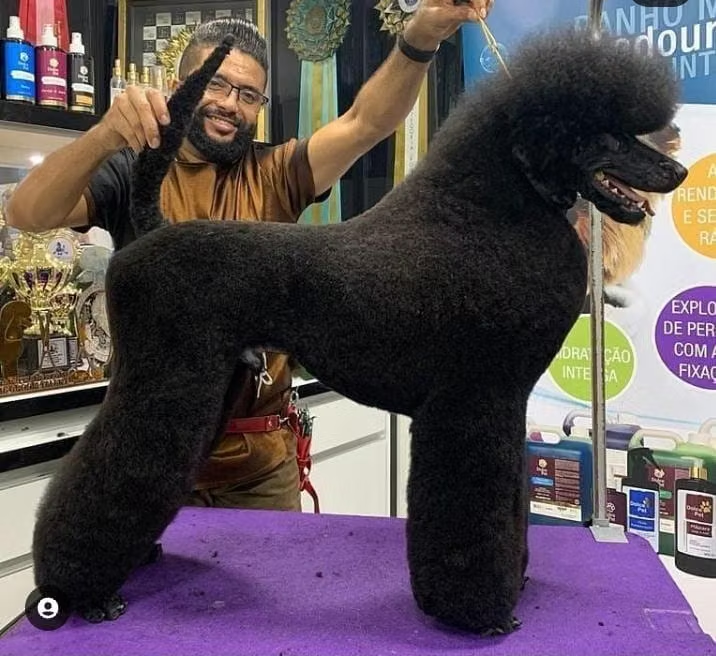
About the Standard Poodle
The Standard Poodle is a large, highly intelligent dog from Germany, a popular low-shedding family companion in South African homes and estates.
The Standard Poodle is the largest of the three Poodle varieties and one of the most trainable dogs you'll come across. Most people picture the elaborate show clip, but the breed actually started out as a working water retriever. The athletic build, dense curly coat, and sharp mind all come from that original job.
Standard Poodles are friendly and keen to please. They form close bonds with their family and prefer to stay involved in whatever's happening around the house rather than off on their own. That combination of intelligence and willingness to work makes the breed a strong candidate for obedience, agility, scent work, and assistance roles, disciplines with an active following through KUSA-affiliated clubs.
The coat sheds very little, one reason the breed suits owners after a large dog without hair all over the house. That low-shedding coat comes at a cost, though: the dense curls mat quickly without routine brushing.
| Attribute | Detail |
|---|---|
| Origin | Germany |
| Size | Large |
| Lifespan | 12 to 15 years |
| Group / role | Non-sporting (originally a water retriever) |
| Good with | Families, children, and other dogs when socialised |
Who it suits
The Standard Poodle suits an active household able to offer both physical exercise and mental work. Owners who enjoy training get the most from the breed, since a Poodle left under-stimulated can become bored and difficult. The low-shedding coat suits families managing allergies, provided someone commits to grooming every few weeks or budgets for a professional groomer. It's a solid match for a committed first-time owner and just as rewarding for an experienced handler after a dog that learns fast.
History and origins
The Poodle developed in Germany as a water retriever, its name from the German word for splashing, before France made it a national favourite.
The Poodle's history starts in Germany. Hunters bred the dog to retrieve waterfowl from lakes and rivers after a shot, and its name reflects that job directly: 'pudel' is German for splashing in water. The thick, curly coat was functional rather than decorative, built to keep the dog warm while it worked in cold water.
The show clip has the same practical background. Coat was trimmed away from the hindquarters and legs to stop it dragging in the water, while hair stayed longer over the chest and joints for insulation. The elaborate styles seen at shows today grew out of that working haircut, not the other way around.
France later took the breed in a different direction. French breeders developed the smaller Miniature and Toy sizes and shifted the dog's role toward companionship rather than retrieving, which is where the nickname French Poodle comes from. The Standard, as the largest and original size, stayed closest to that early working type.
The three sizes are now recognised as varieties of a single breed rather than separate breeds. The Standard remains the original form, and it still works in retrieving, assistance roles, and dog sports, popular disciplines at clubs under the Kennel Union of Southern Africa.
Appearance and breed standard
The Standard Poodle is a tall, square-built dog with a dense, curly single coat that comes in a range of solid colours.
Square, balanced proportions define the Standard Poodle's build, and the dog carries itself upright with real presence. Athletic rather than heavy is the general idea: a deep chest, a level back, and legs with enough angle to drive both a strong swim and a fast run. The head is long and refined, set off by long drop ears and dark, oval eyes that give the breed its alert look.
| Trait | Standard |
|---|---|
| Height | Over 38 cm (15 inches) at the shoulder; many stand 46 to 61 cm (18 to 24 inches) |
| Weight | Roughly 18 to 32 kg (40 to 70 pounds) |
| Coat | Dense, curly, single coat; low shedding |
| Colours | Solid colours including black, white, apricot, cream, brown, silver, blue, and red |
| Eyes | Dark, oval shaped, alert |
Coat and colours
A single dense layer of curling hair makes up the coat, with no soft undercoat underneath it at all. That's the reason behind both the low shedding and the quick matting when grooming is skipped. Only solid colours are allowed under the breed standard, spanning black and white through apricot, cream, brown, silver, blue, and red. Because the hair keeps growing rather than shedding out with the seasons, a clip is routine maintenance, not an occasional extra. A short, no-fuss pet clip suits most South African households, though some owners take on the more elaborate show trims for the ring, at the cost of far more upkeep.
Temperament and personality
Standard Poodles are friendly, intelligent, and eager to please, bonding closely with their families and generally getting on with children and other pets.
Sociable is the word that best describes the Standard Poodle. It attaches strongly to its family and prefers staying close over being left on its own for long periods. That well-known intelligence comes through in how quickly it settles into a routine, picks up on its owner's mood, and learns new commands.
Children generally get along well with a properly socialised Standard Poodle, which tends to be patient and playful around them, though supervision with very young kids still makes sense given the dog's size. Strangers are met with initial caution rather than open friendliness, and the dog typically relaxes once it has judged the situation safe, a trait that makes an alert bark at the gate genuinely useful in a home behind walls. With other dogs and household pets, the breed usually gets on fine, especially when raised together from puppyhood.
The trade-off for all that intelligence is a real need for engagement. Without enough mental and physical work, a Standard Poodle can become anxious or develop habits nobody asked for. Regular training and daily exercise keep the dog settled and genuinely content.
| Trait | Rating |
|---|---|
| Affection | 5 |
| Energy | 4 |
| Trainability | 5 |
| Vocalness | 3 |
| Shedding | 1 |
Care and grooming in South Africa
Standard Poodles need regular grooming, daily exercise, and tick prevention to stay healthy across South Africa's varied climate.
Grooming
- Brush through the coat several times a week, daily where possible, to stop the curls matting down to the skin.
- Arrange a clip every four to six weeks, whether at home or with a professional groomer.
- Bathe around clipping time as needed, using a shampoo that won't strip the coat.
- Check and clean the drop ears on a regular basis, since their shape traps moisture and can lead to infection.
- Keep nails trimmed every few weeks and brush teeth several times a week.
Exercise
- Aim for a minimum of 60 minutes of activity daily, split between walks and play.
- Running, fetch, and swimming are all worth including, since the breed genuinely enjoys each one.
- Work in training games or a dog sport such as agility or obedience to exercise the mind as well as the body.
- Long stretches of nothing to do tend to bring on restlessness, so keep the dog occupied.
- Check the coat for ticks after walks through long grass, and steer clear of the midday sun during a Highveld summer.
Environment
The Standard Poodle adapts to a house with a garden or to a townhouse in a security complex, as long as it gets enough daily exercise and company. It's an indoor dog that wants to live with its family rather than be left outside. Many South African homes rely on walls, electric fencing, or estate security, and a well-fenced garden also keeps a curious Poodle from wandering off. Weather varies sharply by region: Highveld summers bring strong afternoon thunderstorms and hot days, while a Cape Town winter is wet and cool, so adjust exercise timing and shelter to wherever you live.
Nutrition and feeding
Standard Poodles do well on a complete diet suited to a large, active dog, fed in measured meals to maintain a lean build.
A large, active breed like the Standard Poodle needs a diet built to match, complete and properly balanced rather than assembled from whatever's on special. Quality protein supports muscle on an athletic frame, fat covers the energy the dog burns, and calories should stay controlled enough to keep the dog lean. Two meals a day beats one large serving for this breed, both because it suits the dog and because it lowers bloat risk in a deep-chested breed. Keep fresh water available at all times. From there, tailor the amount to your dog's own age, weight, and activity level, and judge by body condition rather than following the bag's feeding chart to the letter.
| Life stage | Amount per day | Meals |
|---|---|---|
| Puppy (2 to 12 months) | Per puppy-food label, by age and weight | 3 to 4 |
| Adult (1 to 7 years) | Roughly 2 to 3 cups of dry food | 2 |
| Senior (7+ years) | Slightly reduced to match lower activity | 2 |
Treats and supplements
Keep treats to roughly 10 percent of daily calories so they don't throw the diet off balance or add unwanted weight. Most Standard Poodles on a complete commercial food don't need extra supplements, so only introduce them on veterinary advice. Given how eager the breed is to learn, treats also work well as training rewards, so count them into the daily total rather than adding them on top.
Health and lifespan
Standard Poodles typically live 12 to 15 years and are generally healthy, though tick-borne illness and a few inherited conditions are worth watching.
Overall the Standard Poodle is a sturdy, long-lived breed, with most dogs reaching 12 to 15 years old. Like other large breeds, though, it carries a short list of inherited and size-related conditions, and responsible breeders test for these before mating. Choosing a breeder who health tests both parents cuts the odds of running into the most common problems, and in South Africa, staying on top of tick prevention matters just as much as watching for the inherited conditions listed below.
| Condition | Signs | Note |
|---|---|---|
| Hip dysplasia | Stiffness, limping, trouble rising | More common in large breeds; parents should be hip-screened |
| Gastric dilatation-volvulus (bloat) | Swollen abdomen, retching, restlessness, distress | Emergency; deep-chested dogs are at higher risk |
| Progressive retinal atrophy | Night blindness, declining vision | Inherited; eye screening of breeding dogs helps |
| Sebaceous adenitis | Patchy hair loss, scaly skin | Skin condition seen in the breed |
| Addison's disease | Weakness, vomiting, low energy | Hormonal; manageable once diagnosed |
Preventive care
- Keep vaccinations and parasite control up to date, with reliable tick prevention. Biliary (tick bite fever) is common and serious in dogs across South Africa, so check the coat after time in long grass and act quickly if your dog seems off.
- Book a veterinary checkup once a year, moving to twice yearly once your dog is a senior.
- Keep the dog's weight lean to protect the joints.
- Brush teeth regularly and book dental cleans as your vet advises.
- Clean the ears on a regular basis to prevent infection.
Training the Standard Poodle
The Standard Poodle is one of the most trainable breeds and responds best to consistent, reward-based training that keeps its sharp mind busy.
Few breeds are as straightforward to train as the Standard Poodle. Commands get picked up fast, retained well, and the dog clearly enjoys the process of working alongside its handler. The same sharp intelligence means bad habits stick just as quickly as good ones, though, so starting early and staying consistent really does matter. Keep sessions short and varied enough to hold the dog's attention, and put in the work to socialise the puppy widely, different people, dogs, and situations, so its natural reserve around strangers settles into balance rather than tipping into suspicion.
Basics
- Begin with name recognition and short attention exercises in the first weeks at home.
- Use small food rewards to teach sit, down, and stay.
- Practise recall in a safe, low-distraction space before testing it somewhere busier.
- Start loose-leash walking early, since this dog grows into a large, strong adult fast.
- Build up calm crate time and short spells alone to prevent separation anxiety.
- Once the basics are solid, bring in a dog sport such as agility, obedience, or scent work for extra mental exercise.
Breeding
Standard Poodles reach breeding maturity at one to two years, typically carry around seven puppies, and need both parents health screened first.
Responsible breeding of Standard Poodles starts before mating is even on the table, with both the dam and sire screened for the hip and eye conditions known in the breed. While dogs can reach sexual maturity earlier, most reputable breeders hold off until the dam is physically mature, usually around two years old, so she can safely carry and raise a litter.
Gestation runs close to 63 days. Litters in this breed tend to be large, often around seven puppies, though the number varies quite a bit between individual dams. Most dams whelp without assistance, but a vet should still be reachable in case a first litter or a difficult birth needs support.
Raising the puppies well matters just as much as the mating itself. In the early weeks, puppies need to stay with the dam and littermates, where they learn bite inhibition and basic dog-to-dog manners. Gentle early handling and exposure to household sounds and new people build the confident, friendly temperament the breed is known for. Puppies are usually ready to move to new homes from around eight weeks of age.
| Metric | Value |
|---|---|
| Breeding maturity | About 1 to 2 years (breed at full maturity) |
| Gestation | Roughly 63 days |
| Average litter size | Around 7 puppies |
| Weaning | About 6 to 8 weeks |
| Ready for new homes | From about 8 weeks |
Registering your Poodle (Standard) and its chip in South Africa
No national chip law protects a Poodle (Standard) here; a free United Pet Club record does, for life, at no cost.
Poodle (Standard) registration and microchips in South Africa
South Africa has no single national law forcing microchips on dogs, though the SPCA chips as standard and rabies vaccination is required by law. What actually reunites a lost Poodle (Standard) with you is a record, and that part is free: a United Pet Club profile carries your details beside the dog's photo for as long as you have him. Registering your dog takes a few minutes, with no fee attached.
The chip is a number; the registry entry is the story behind it. Capture your Poodle (Standard)'s 15-digit number in a free United Pet Club account and the story reads: this dog has a home. Every brand is accepted, updates never cost a cent, and the record stays searchable here and abroad. Microchip registration plus a free account does it.
How do I register my Poodle (Standard) in South Africa?
Create a free United Pet Club account, load your Poodle (Standard)'s details and a photo, and save. The lifetime plan keeps the profile active at no cost for as long as you have him, chip or no chip.
How do I register my Poodle (Standard)'s microchip?
Load the 15-digit chip number into your free account together with your address and cell number. Registration and every later update are free, and chips from any brand a South African vet implants are accepted.
Must a Poodle (Standard) be microchipped in South Africa?
No national law says so, though the SPCA chips as standard practice and many breeders and welfare groups insist on it. The registration behind the chip is the part that finds you, and with United Pet Club it costs nothing.
What does it cost to register a Poodle (Standard)?
Nothing at all. The free lifetime plan covers the profile, the chip record, and unlimited updates, with no annual renewal in sight.
Frequently asked questions
Common questions South African owners ask about the Standard Poodle's size, temperament, grooming, lifespan, and fit as a family dog.
How big does a Standard Poodle get?
The Standard Poodle is a large dog. It stands over 38 cm (15 inches) at the shoulder, with many between 46 and 61 cm (18 to 24 inches), and weighs roughly 18 to 32 kg (40 to 70 pounds).
Are Standard Poodles good family dogs?
Yes. They're friendly, devoted, and bond closely with their families. Well-socialised Poodles are patient with children, and their size means supervision around very young kids is still sensible.
Do Standard Poodles shed a lot?
No, they shed very little because the coat is a single curly layer with no soft undercoat. The trade-off is regular grooming, including brushing several times a week and a clip every four to six weeks.
Are Standard Poodles hard to care for?
Care is moderate to demanding. The dog is easy to train but needs daily exercise, mental work, and steady grooming. A Poodle left under-stimulated can become bored and restless.
How long do Standard Poodles live?
A typical Standard Poodle lives 12 to 15 years. Good nutrition, a lean weight, regular veterinary care, and choosing a breeder who health tests the parents all support a longer life.
Are Standard Poodles easy to train?
Very. It's one of the most trainable breeds around, intelligent and eager to please. It does best with consistent, reward-based methods and early socialisation.
Are ticks a big risk for Standard Poodles in South Africa?
Yes, enough that most owners treat prevention as routine. Tick bite fever, or biliary, is common in dogs across the country, so regular tick treatment and a quick check of the coat after walks through long grass are worth the habit. The Standard Poodle's dense curls make ticks easy to miss, so run your hands through the coat rather than just checking by eye.
From the community
Ask about the Poodle (Standard)No questions about the Poodle (Standard) yet. Be the first to ask.
Browse Dog breeds