
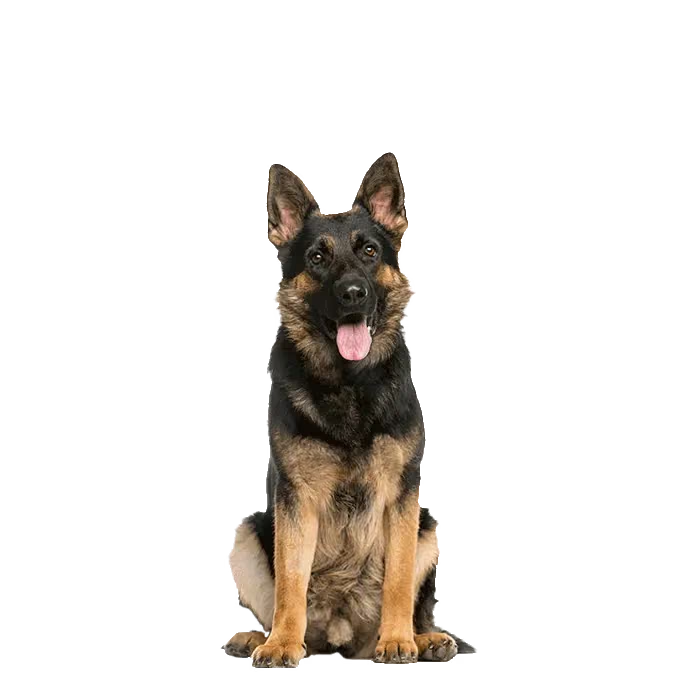
German Shepherd
The German Shepherd is a loyal, intelligent working dog renowned for its courage, versatility, and unwavering devotion.
- Size
- Large
- Lifespan
- 9–13 years
- Origin
- Germany
- Temperament
- Loyal
- Standard colors
- Black, White and Grey and 5 more
Characteristics
Coat and grooming
How the German Shepherd coat is built, and what that means when you groom it.
- Coat layers
- Double coat
- Coat texture
- Plush
- Coat length
- Medium
- Shedding
- Heavy shedding
Grooming guidance
Critical: A German Shepherd should not be shaved.
The undercoat keeps heat out as well as in, and the outer coat shields the skin from sun and insect bites. Clipping the whole coat off removes both. It often grows back patchy, soft or a different colour, and in some animals the guard hairs never return properly. Brush the undercoat out instead of cutting it off.
German Shepherd colors and patterns
What each club's breed standard says about every German Shepherd color and pattern. Point at a ruling to see the club's own wording.
Breed standards describe the German Shepherd in Black, White, Grey, Silver, Tan, Red, Gold and Cream. Standard patterns: Solid, Bicolour, Sable and Tan point.
| Color or pattern | FCI | AKC | UKC | KC | KUSA |
|---|---|---|---|---|---|
| Black | Standard (“single-coloured black”) | Standard (“Black”) | Standard (“Black”) | Standard (“all black”) | Standard (“single-coloured black”) |
| White | Disqualifying (“white hair colour (also with dark eyes and nails)”) | Disqualifying (“White”) | Standard (“pure white”) | Fault (“whites (i.e. almost pure white dogs with black noses) and near whites highly undesirable”) | Disqualifying (“white hair colour (also with dark eyes and nails)”) |
| Grey | Standard (“grey with darker shading”) | Standard (“Gray”) | Standard (“Sable (gray ... with black tips)”) | Standard (“all grey”) | Standard (“grey, with darker shading”) |
| Silver | Standard (“black with ... light grey markings”) | Standard (“Black & Silver”) | Standard (“Black and Silver”) | Standard (“gold to light grey markings”) | Standard (“black with ... light grey markings”) |
| Tan | Standard (“black with reddish-brown, brown and yellow to light grey markings”) | Standard (“Black & Tan”) | Standard (“Black and Tan”) | Standard (“black or black saddle with tan”) | Standard (“black with reddish-brown, brown, and yellow, to light grey markings”) |
| Red | Standard (“black with reddish-brown ... markings”) | Standard (“Black & Red”) | Standard (“Black and Red”) | No ruling | Standard (“black with reddish-brown ... markings”) |
| Gold | Standard (“black with ... yellow to light grey markings”) | Standard (“most colors are permissible”) | Not recognised | Standard (“Black & Gold”) | Standard (“black with ... yellow, to light grey markings”) |
| Cream | Standard (“black with ... yellow to light grey markings”) | Standard (“Black & Cream”) | Standard (“Black and Cream”) | Standard (“gold to light grey markings”) | Standard (“black with ... yellow, to light grey markings”) |
| Isabella | Not recognised | Fault (“pale, washed-out colors ... are serious faults”) | Disqualifying (“pale, washed-out colors”) | Alternate (“Isabella”) | Not recognised |
| Albino | Disqualifying (“albinism”) | No ruling | Disqualifying (“albinism”) | Fault (“albinos ... highly undesirable”) | Disqualifying (“albinism”) |
| Blue | Not recognised | Fault (“Blue”) | Disqualifying (“blue”) | Fault (“blues ... highly undesirable”) | Not recognised |
| Liver | Not recognised | Fault (“Liver”) | Disqualifying (“liver”) | Fault (“livers ... highly undesirable”) | Not recognised |
| Patterns | |||||
| Solid | Standard (“single-coloured black”) | Standard (“Black”) | Standard (“Black ... or pure white”) | Standard (“all black, all grey”) | Standard (“single-coloured black”) |
| Bicolour | No ruling | Standard (“Bi-Color”) | Standard (“Bi-color (Black with tan markings)”) | Standard (“Bi-colour: predominantly black, may have tan or gold markings”) | No ruling |
| Sable | Standard (“grey with darker shading”) | Standard (“Sable”) | Standard (“Sable (gray, tan, red, or silver with black tips)”) | Standard (“with lighter or brown markings referred to as Sables”) | Standard (“grey, with darker shading”) |
| Tan point | Standard (“black with reddish-brown, brown and yellow to light grey markings; black saddle”) | Standard (“Black & Tan”) | Standard (“Black and Tan”) | Standard (“black or black saddle with tan, or gold to light grey markings”) | Standard (“black with reddish-brown, brown, and yellow, to light grey markings”) |
| Brindle | No ruling | No ruling | Disqualifying (“brindle”) | No ruling | No ruling |
| Piebald | No ruling | No ruling | Disqualifying (“Panda (characterized by white markings on the muzzle, chest, legs, neck and tip of the tail) ... piebald”) | No ruling | No ruling |
| Reverse brindle | No ruling | No ruling | Disqualifying (“brindle”) | No ruling | No ruling |


| Color or pattern | FCI | AKC | UKC | KC | KUSA |
|---|---|---|---|---|---|
| Dark brown | Standard (“as dark as possible”) | Standard (“as dark as possible”) | Standard (“as dark as possible”) | Standard (“dark brown preferred”) | Standard (“as dark as possible”) |
| Light brown | Fault (“light, piercing eyes are undesirable”) | No ruling | Fault (“light eyes”) | Standard (“lighter shade tolerated”) | Fault (“light, piercing eyes are undesirable”) |
| Color or pattern | FCI | AKC | UKC | KC | KUSA |
|---|---|---|---|---|---|
| Black | Standard (“the nose must be black”) | Standard (“nose black”) | Standard (“the nose must be black”) | Standard (“nose black”) | Standard (“nose must be black”) |
What the rulings mean
- Standard
- Described by the club's breed standard.
- Alternate
- Registrable with the club but not described by its breed standard, such as an AKC alternate colour.
- Fault
- Named by the club's breed standard as a fault: the animal can be shown but is penalised.
- Disqualifying
- The club's breed standard disqualifies an animal of this colour or pattern.
- Not recognised
- The club does not accept this colour or pattern for the breed.
Color changes
How a German Shepherd's colors can change over its life.
Blackchanges toRust
Coat · With body condition · can change back
Blackchanges toGrey
Coat · Progressive
Blackchanges toBrown
Coat · In the sun · can change back
Whitechanges toRoan
Coat · With age · from 2 weeks
Tan pointchanges toSaddle
Coat · With age · from 6 to 156 weeks
Tan pointchanges toSaddle
Coat · With age · from 6 to 156 weeks
Blackchanges toSnow nose
Nose · With the season · can change back
Blackchanges toPink
Nose · With the season · can change back


Sources
Each ruling comes from the club's published breed standard or color list.
Health
Conditions recorded as more common in the German Shepherd than in its species as a whole. A higher risk is not a diagnosis: many never develop any of them, and your vet can say which screening tests are worth doing.
High risk
- Musculoskeletal system
Canine elbow dysplasia
Strong evidenceHereditaryInheritance: Polygenic - Musculoskeletal system
Canine hip dysplasia
Strong evidenceHereditaryInheritance: PolygenicOMIA entry - Gastrointestinal system
Exocrine pancreatic insufficiency
Strong evidenceHereditaryInheritance: Autosomal recessive
Moderate risk
- Nervous system
Canine degenerative myelopathy
Strong evidenceHereditaryInheritance: Autosomal recessive
This content is for educational purposes and is not a substitute for professional veterinary advice. If you are worried about your pet, contact your veterinarian.
All health conditionsMeet some of our German Shepherd
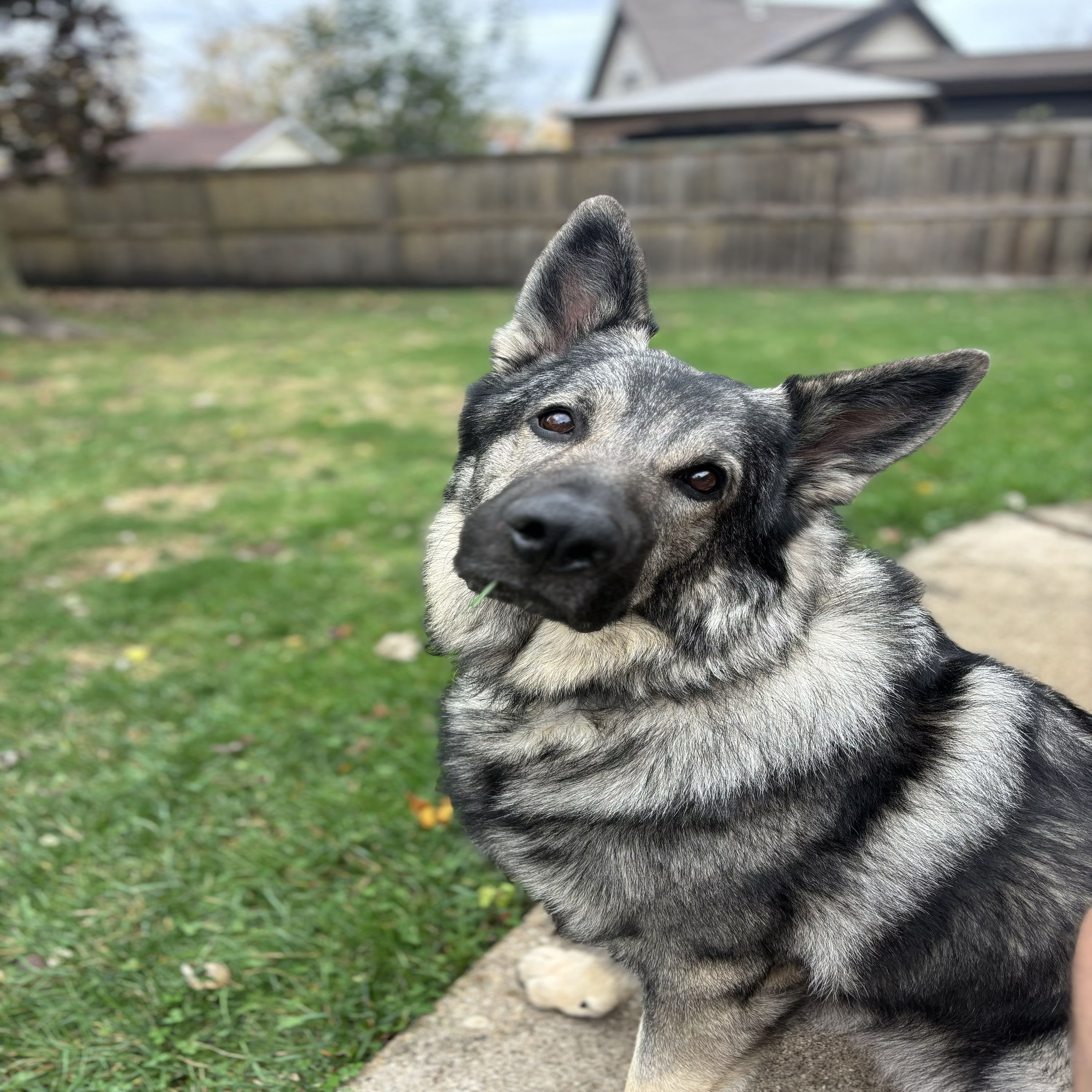
A few of the German Shepherd profiles members have added to United Pet Club.


About the German Shepherd
The German Shepherd is a large working breed from Germany, registered with the Kennel Union of Southern Africa (KUSA), and one of the most widely kept dogs in South Africa for family companionship, property security, and service work. Adults stand 55 to 65 cm at the shoulder and live about 9 to 13 years.
Few breeds are as closely associated with working life in South Africa as the German Shepherd. You find it in South African Police Service (SAPS) dog units, in private security patrols, in search-and-rescue teams, and on the stoep of suburban homes where it keeps an eye on the property. Its role here has always been practical.
The breed was developed in Germany in the late 1890s from regional herding stock, selected above all for intelligence and working ability. Adults are large and strongly built, with a deep chest, erect ears, and a far-reaching trot that was bred for covering ground all day. The standard colour is black and tan, though sable, solid black, and bicolour dogs also occur. Two main lines exist today: working lines selected for drive and temperament, and show lines bred for conformation. The two can differ considerably in energy level and build.
German Shepherds form close bonds with their households. They need genuine company, daily exercise, and regular mental work. A dog left alone in the yard day after day without activity or engagement will develop problems quickly.
| Item | Detail |
|---|---|
| Origin | Germany (1899) |
| Size | Large (55 to 65 cm at the shoulder) |
| Lifespan | 9 to 13 years |
| Group / role | Herding group; working, police, military, security, and service roles |
| Good with | Families and children when raised and socialised well; can live with other pets if introduced gradually |
Who this breed suits
The German Shepherd suits active owners who are home for a meaningful part of the day and prepared to commit to training, socialisation, and daily exercise. It is a reasonable choice for a household that also wants a watchful, deterrent dog on the property. It is not suited to owners who are away from home most of the day, who want a low-maintenance breed, or who live in a flat without yard access.
History and origin
Max von Stephanitz standardised the German Shepherd in Germany in 1899, combining regional herding dogs into a single working breed selected for intelligence and drive. After both World Wars the breed spread across the Commonwealth, including South Africa, where it has long been central to police and security work.
In the second half of the 19th century, working dogs across German-speaking regions were highly local in character, shaped by the particular terrain and stock of each area. During the 1890s a group of breeders set out to change this, selecting a unified type on working merit rather than regional appearance.
Max von Stephanitz, a former cavalry officer, was the driving figure. In 1899 he acquired a dog named Hektor Linksrhein, renamed him Horand von Grafrath, registered him as the founding German Shepherd Dog, and in the same year established the Verein für Deutsche Schäferhunde (SV), the breed club that still governs the German standard.
As sheep herding declined, von Stephanitz repositioned the breed for police and military work. German Shepherds were already in police service in Germany by the early 1900s. During the First World War they served as messenger, guard, and rescue dogs with German forces. Soldiers from Britain, Australia, South Africa, and other Allied nations encountered the breed during the war years, and many brought dogs home or lobbied for breeding stock. The breed spread rapidly through the Commonwealth in the 1920s and 1930s.
In South Africa, the German Shepherd became established in police and military service during this period and has remained a fixture in working-dog roles ever since. Over the 20th century, breeding diverged into working lines emphasising drive and nerve, and show lines emphasising structure and appearance. Both are present in South Africa today.
Appearance and breed standard
The German Shepherd stands 55 to 65 cm at the shoulder and weighs 22 to 40 kg, with large erect ears, a wedge-shaped head, a dense double coat most commonly coloured black and tan, and a long bushy tail.
The German Shepherd's most distinctive feature in motion is its gait: a smooth, low, far-reaching trot that covers ground with minimal effort. This was not an accident of breeding but a deliberate selection for the long days of herding and patrol work the breed was created to do. At rest, the body is longer than it is tall, with a deep chest and a wedge-shaped head. The ears are large and upright. The tail is bushy and hangs in a gentle downward curve. Males are noticeably larger and heavier than females.
| Trait | Detail |
|---|---|
| Height | Males 60 to 65 cm; females 55 to 60 cm at the shoulder |
| Weight | Males 30 to 40 kg; females 22 to 32 kg |
| Coat | Double coat with a dense outer layer over a soft, thick undercoat. Standard coat is short to medium length; a long-coated variety also occurs |
| Colours | Black and tan, black and red, sable, solid black, and bicolour. White is recognised by some registries but not all |
| Eyes | Medium-sized, almond-shaped, dark brown preferred |
Coat and colours
The standard coat has a thick undercoat that sheds heavily during the two annual moults, typically autumn and spring. Black and tan is the most common colour, usually with a dark saddle marking across the back. Sable dogs carry banded hairs that give a grizzled grey-brown appearance. Solid black and bicolour dogs also occur. The long-coated variety has feathering on the legs, ears, and tail and is accepted under KUSA's standard.
In South Africa's warmer regions, particularly KwaZulu-Natal and the Lowveld, the dense undercoat requires active management during summer months and increases the importance of regular grooming to prevent overheating and skin problems.
Temperament and behaviour
German Shepherds are alert, loyal, and strongly attached to their household. Their natural wariness with strangers makes them effective guard dogs, but this instinct must be shaped through early socialisation and consistent training to produce a reliable and manageable dog.
The German Shepherd's temperament is defined by a combination of high intelligence, close attachment to its people, and a strong territorial instinct. In South Africa, where property security is a practical concern for many households, the breed's alertness and natural reserve around strangers is often a deliberate reason for choosing it.
That guarding instinct works best when the dog is also well socialised. A German Shepherd that has been properly exposed to different people, environments, and situations from puppyhood can distinguish a familiar visitor from an actual threat. One that has been under-exposed tends to become indiscriminately reactive, barking at the delivery driver, the domestic worker, and any child who walks past the gate. This is not a temperament fault but a training gap, and it is avoidable.
With family members, including children, the breed is affectionate and attentive. Supervision is still sensible given the dog's size and its herding instinct, which can show up as chasing or nipping at running children. With other pets it generally coexists well if introduced gradually, though prey drive can be a factor with cats or smaller animals. A dog that is under-exercised and under-stimulated will find outlets in barking, digging, or destructive behaviour.
| Trait | Rating |
|---|---|
| Affection | 4 |
| Energy | 5 |
| Trainability | 5 |
| Vocalness | 3 |
| Shedding | 5 |
Care and grooming
German Shepherds need one to two hours of exercise daily, brushing several times a week, and reliable containment. South African owners need to account for regional climate differences, year-round tick prevention, and the effect of load-shedding on electric fencing.
Climate and environment
South Africa's climate varies considerably from one part of the country to another, and this affects day-to-day care. On the Highveld, summer afternoons bring intense heat and sudden thunderstorms; the dog needs shade, fresh water, and shelter from severe weather. In the Western Cape, cold, wet winters mean the sleeping area should be dry and draught-free. In KwaZulu-Natal and the Lowveld, subtropical humidity makes heat management and tick prevention ongoing year-round priorities.
The German Shepherd's double coat gives reasonable insulation in cold conditions and some heat tolerance, but exercise should be avoided in the middle of the day during summer, particularly in warmer regions. The dog always needs access to shade and water.
Containment is worth thinking through carefully, especially for a dog kept partly for security. Physical fencing is the most reliable option. Electric fencing is widely used in South African suburbs, but load-shedding takes the system offline for hours at a time. A dog that senses the fence is off may test the boundary, or intruders may take advantage of it. A solid physical perimeter as a backup is more dependable than electric fencing alone.
Tick prevention must be applied year-round. Dogs that spend time in the garden, near veld, or in areas with long grass are at risk from brown and yellow dog ticks, which carry biliary. See the health section for more on this.
Grooming
- Brush two to three times a week, increasing to daily during the heavy seasonal moults
- Bathe only when the dog is genuinely dirty, roughly every few months, to preserve natural coat oils
- Trim nails every three to four weeks
- Clean and check the ears regularly, particularly after the dog has been in long grass or bush
- Brush teeth several times a week
Exercise
- Provide at least one to two hours of activity daily
- Combine walks or runs with training sessions, fetch, or scent work
- Mental stimulation through obedience work, puzzle feeders, or tracking is as necessary as physical exercise
- The breed suits dog sports including agility, tracking, and protection sport
Nutrition and feeding
German Shepherds need a complete, protein-based diet fed in two daily meals to reduce bloat risk. Adults typically eat about 2.5 to 3.5 cups of dry food a day, adjusted to age, body condition, and how active the dog is.
Feed a complete and balanced food suited to the dog's life stage and activity level. As a large, active breed, the German Shepherd benefits from quality animal protein and moderate fat. Puppies need a large-breed puppy formula, which controls calcium and energy density to protect developing joints and keep growth at a safe rate. Split the daily ration into two meals: deep-chested breeds face a higher risk of gastric dilatation-volvulus (bloat), and two meals a day, together with avoiding hard exercise directly before or after eating, lowers that risk. Fresh water must be available at all times. Monitor body condition regularly, since excess weight stresses hips and elbows that are already at genetic risk in this breed.
| Life stage | Amount per day | Meals per day |
|---|---|---|
| Puppy (2 to 6 months) | Per large-breed puppy formula label, by weight | 3 to 4 |
| Puppy (6 to 12 months) | Per label, by weight | 2 to 3 |
| Adult | About 2.5 to 3.5 cups of dry food | 2 |
| Senior or less active | About 2 to 3 cups, reduced for activity | 2 |
Treats and supplements
Keep treats to roughly 10 percent of the daily calorie total and count them as part of the overall ration. Using a portion of the dog's regular dry food as training rewards is a practical way to avoid overfeeding. Joint supplements such as glucosamine and omega-3 fatty acids are sometimes used for this breed given its known susceptibility to hip and elbow problems, but discuss any supplement with a vet before adding it.
Health and common conditions
German Shepherds live about 9 to 13 years and are prone to hip and elbow dysplasia, degenerative myelopathy, and bloat. In South Africa, biliary (tick-borne babesiosis) is an additional and serious risk that requires consistent year-round tick prevention and prompt veterinary attention if signs appear.
South African owners face one health risk not covered in most international breed guides: biliary, the local term for tick-borne babesiosis. The disease is caused by Babesia parasites carried mainly by the yellow dog tick (Haemaphysalis leachi) and the brown dog tick (Rhipicephalus sanguineus), both of which are widespread across South Africa. Biliary destroys red blood cells and can be fatal within 24 to 48 hours if not treated. Pale or yellow gums, dark brown or reddish urine, sudden severe lethargy, and loss of appetite are the warning signs. There is no reliable vaccine available in South Africa, so year-round tick prevention using a registered product is the main defence.
Beyond biliary, the German Shepherd carries a set of hereditary and structural conditions tied to its size and genetics. Buying from KUSA-registered breeders who screen their dogs for hip and elbow scores and known genetic conditions reduces the risk of the most serious inherited problems significantly.
| Condition | Signs | Note |
|---|---|---|
| Biliary (tick-borne babesiosis) | Pale or yellow gums, dark or reddish urine, sudden severe lethargy, loss of appetite | Serious SA concern; carried by dog ticks; can be fatal in 24 to 48 hours; year-round tick prevention essential |
| Hip dysplasia | Stiffness, limping, reluctance to climb stairs or jump, difficulty rising | Hereditary; screened by hip scoring before responsible breeding |
| Elbow dysplasia | Front-leg lameness, particularly after exercise | Hereditary joint malformation; managed with weight control and appropriate treatment |
| Degenerative myelopathy | Progressive hind-limb weakness and loss of coordination | Incurable spinal cord disease; a DNA test for genetic risk is available |
| Bloat (GDV) | Swollen hard abdomen, retching without result, restlessness, collapse | Life-threatening emergency; needs immediate veterinary care and usually surgery |
| Exocrine pancreatic insufficiency | Weight loss despite eating well, pale or loose stools | Managed with lifelong enzyme supplementation |
Preventive care
- Apply a vet-recommended tick and flea prevention product every month without interruption
- Check for ticks after the dog has been in grass, bush, or veld
- Keep vaccinations current according to your vet's schedule
- Schedule annual vet checkups, and more frequent ones for senior dogs
- Maintain a lean body weight to protect hips and elbows
- Feed two meals a day and avoid vigorous exercise directly before or after eating
- Source puppies from KUSA-registered breeders who provide hip, elbow, and genetic screening results
Training the German Shepherd
German Shepherds are among the most trainable breeds, learning quickly and engaging closely with their handler. Early socialisation and reward-based training from puppyhood produce a reliable, well-adjusted dog and prevent the over-guarding behaviour that develops in under-socialised dogs.
The German Shepherd's trainability is genuinely high. It picks up new commands quickly, retains them, and engages actively with whoever is working with it. This is why the breed dominates police, army, and private security dog units in South Africa. That same drive also means a dog without training and mental occupation will generate its own activity, and that rarely ends well.
In South Africa, where the breed is often kept partly for property security, socialisation is as important as obedience training. A well-socialised German Shepherd can distinguish a familiar visitor from an actual threat. One that has not been properly exposed to people and situations treats the delivery driver, the garden worker, and the neighbour arriving for a braai with the same suspicion as a stranger testing the gate at midnight. Training alongside early and consistent social exposure produces a dog that is both a useful deterrent and a manageable member of the household.
Training steps
- Begin socialisation from the first weeks of puppyhood: varied people, vehicles, sounds, dogs, and environments
- Establish name recognition and a reliable recall first
- Build the core commands: sit, down, stay, come, and loose-lead walking
- Keep training sessions short and frequent, around 5 to 15 minutes, ending each on a behaviour the dog gets right
- Add structured outlets such as obedience classes, tracking, or protection sport as the dog matures
- Apply the same rules consistently across everyone in the household so the dog cannot read contradictions
Breeding and raising puppies
Female German Shepherds first come into heat between 6 and 12 months, but responsible breeders wait until around two years of age when health testing is complete. Gestation lasts about 63 days and litters average 6 to 8 puppies.
Female German Shepherds usually have their first heat between 6 and 12 months of age. Responsible breeders registered with KUSA do not breed at this stage; they wait until the bitch is around two years old, by which point hip and elbow scores can be obtained and genetic test results assessed. Mating is timed to the fertile window within the heat cycle, often confirmed through progesterone testing. Gestation lasts approximately 63 days, and litters typically contain 6 to 8 puppies, though the range can be wider.
Newborn puppies are blind and deaf and depend entirely on their mother for warmth and nutrition in the first two weeks. Eyes open at around 14 days and weaning begins at about three to four weeks. The window from roughly 3 to 14 weeks is the critical socialisation period. Breeders who handle their puppies consistently and expose the litter to normal household sounds, different people, and varied surfaces during this time give the puppies a significant advantage. Puppies should not leave for new homes before 8 weeks.
| Metric | Value |
|---|---|
| Female sexual maturity | First heat around 6 to 12 months |
| Recommended breeding age | Around 2 years, after health testing |
| Gestation | About 63 days |
| Average litter size | 6 to 8 puppies |
| Eyes open | Around 14 days |
| Weaning | About 3 to 4 weeks |
| Go to new homes | 8 weeks or later |
Registering your German Shepherd and its chip in South Africa
No national chip law protects a German Shepherd here; a free United Pet Club record does, for life, at no cost.
German Shepherd registration and microchips in South Africa
South Africa has no single national law forcing microchips on dogs, though the SPCA chips as standard and rabies vaccination is required by law. What actually reunites a lost German Shepherd with you is a record, and that part is free: a United Pet Club profile carries your details beside the dog's photo for as long as you have him. Registering your dog takes a few minutes, with no fee attached.
A chipped German Shepherd still needs the number loaded into a registry, because the vet's job ends with the implant. Register the microchip on the free lifetime plan: any brand a local vet uses qualifies, updates stay free when you relocate between provinces, and the record answers the lookups SPCA branches run daily. Create your free account and settle both records today.
How do I register my German Shepherd in South Africa?
Create a free United Pet Club account, load your German Shepherd's details and a photo, and save. The lifetime plan keeps the profile active at no cost for as long as you have him, chip or no chip.
How do I register my German Shepherd's microchip?
Load the 15-digit chip number into your free account together with your address and cell number. Registration and every later update are free, and chips from any brand a South African vet implants are accepted.
Must a German Shepherd be microchipped in South Africa?
No national law says so, though the SPCA chips as standard practice and many breeders and welfare groups insist on it. The registration behind the chip is the part that finds you, and with United Pet Club it costs nothing.
What does it cost to register a German Shepherd?
Nothing at all. The free lifetime plan covers the profile, the chip record, and unlimited updates, with no annual renewal in sight.
Frequently asked questions
Common questions from South African owners about German Shepherd size, shedding, biliary risk, suitability as a guard dog, temperament with children, and how demanding the breed is to keep.
How big does a German Shepherd get?
Males stand 60 to 65 cm at the shoulder and weigh 30 to 40 kg. Females are smaller at 55 to 60 cm and 22 to 32 kg.
Do German Shepherds shed a lot?
Yes, considerably. The double coat sheds year-round and very heavily during the two seasonal moults. Expect to brush two to three times a week at minimum, and daily during the moult periods.
What is biliary and how serious is it in South Africa?
Biliary is tick-borne babesiosis, a disease carried by brown and yellow dog ticks that is widespread across South Africa. It attacks red blood cells and can kill a dog within 24 to 48 hours without treatment. Signs include pale or yellow gums, very dark or reddish urine, and sudden severe lethargy. Year-round tick prevention applied monthly is essential, and any dog showing these signs needs emergency veterinary care immediately.
Are German Shepherds good guard dogs for South African homes?
They are well suited to a property security role. The breed is naturally alert and reserved with strangers, and its size and presence act as a deterrent. A well-trained and well-socialised dog is far more reliable in this role than an untrained one. Bear in mind that load-shedding can disable electric perimeter fencing, so physical containment as a backup is important.
Are German Shepherds good with children?
When raised and socialised well, yes. They are generally affectionate and watchful with children in their own household. Their size and herding instinct mean supervision is sensible with young children, and children should be taught how to behave around the dog from the start.
How long do German Shepherds live?
About 9 to 13 years on average. Genetics, body weight, exercise, consistent veterinary care, and effective tick prevention all affect how long the dog stays healthy.
Are German Shepherds hard to keep?
They are a high-maintenance breed. They need one to two hours of exercise every day, consistent training, regular brushing, and company throughout the day. Owners who are away from home for most of the working day will find the breed difficult to manage well without a clear plan for exercise and occupation.
From the community
Ask about the German ShepherdNo questions about the German Shepherd yet. Be the first to ask.
Browse Dog breeds