

Dalmatian
The Dalmatian is an energetic, athletic breed famous for its unmistakable spotted coat and its history as a loyal carriage and coaching dog.
- Size
- Large
- Lifespan
- 11–13 years
- Origin
- Croatia
- Temperament
- Energetic
- Standard colors
- Black, White and Liver
Characteristics
Coat and grooming
How the Dalmatian coat is built, and what that means when you groom it.
- Coat layers
- Single coat
- Coat texture
- Smooth
- Coat length
- Short
- Shedding
- Heavy shedding
Dalmatian colors and patterns
What each club's breed standard says about every Dalmatian color and pattern. Point at a ruling to see the club's own wording.
Breed standards describe the Dalmatian in Black, White and Liver. Standard patterns: Piebald and Spotted.
| Color or pattern | FCI | AKC | UKC | KC | KUSA |
|---|---|---|---|---|---|
| Black | Standard (“Black spotted variety with black spots”) | Standard (“White & Black”) | Standard (“In black-spotted dogs, the spots are dense black”) | Standard (“Black spotted having dense black spots”) | Standard (“Black-spotted dogs having dense black spots”) |
| White | Standard (“The ground colour is pure white”) | Standard (“White & Black”) | Standard (“The ground color is pure white”) | Standard (“Ground colour pure white”) | Standard (“Ground colour pure white”) |
| Liver | Standard (“liver spotted variety with brown spots”) | Standard (“White & Liver Brown”) | Standard (“In liver-spotted dogs, the spots are liver brown”) | Standard (“liver spotted, liver brown spots”) | Standard (“liver-spotted dogs, liver brown spots”) |
| Albino | Not recognised | Disqualifying | Disqualifying (“Albinism”) | Not recognised | Not recognised |
| Blue | Disqualifying (“blue spots”) | Disqualifying | Disqualifying | Not recognised | Not recognised |
| Tan | Not recognised | Disqualifying (“White Black & Tan”) | Disqualifying (“Tri-color”) | Not recognised (“Tricolours and spotting other than black or liver unacceptable”) | Not recognised (“Tricolours and spotting other than black or liver unacceptable”) |
| Orange | Disqualifying (“orange coloured spots”) | Disqualifying (“White & Orange”) | Disqualifying (“Any color markings other than black or liver”) | Not recognised (“White with Orange Spots”) | Not recognised (“spotting other than black or liver unacceptable”) |
| Lemon | Disqualifying (“lemon coloured spots”) | Disqualifying (“White & Lemon”) | Disqualifying (“Lemon-colored spots”) | Not recognised (“White with Lemon Spots”) | Not recognised (“spotting other than black or liver unacceptable”) |
| Patterns | |||||
| Piebald | Disqualifying (“Monocle (patching around one or both eyes) or patching elsewhere”) | Disqualifying (“Patches are a disqualification”) | Standard (“Some limited patching around the eyes (monocle) and on or around ears is acceptable but not preferred”) | Standard (“Some patching on ears or head not to be penalised”) | Standard (“Some patching on ears or head not to be penalised”) |
| Spotted | Standard (“distinctively spotted”) | Standard (“a distinctively spotted dog”) | Standard (“a distinctively spotted short coat”) | Standard (“A distinctively spotted dog”) | Standard (“A distinctively spotted dog”) |
| Solid | Disqualifying (“pure white colour without spots”) | No ruling | No ruling | Not recognised | Not recognised |
| Tricolour | Disqualifying (“Tricolour (black and brown spots on the same dog)”) | Disqualifying (“Tri-color”) | Disqualifying (“Tri-color”) | Not recognised (“Tricolours and spotting other than black or liver unacceptable”) | Not recognised (“Tricolours and spotting other than black or liver unacceptable”) |
| Brindle | Disqualifying (“brindle coloured spots”) | No ruling | No ruling | Not recognised | Not recognised |
| Tan point | No ruling | Disqualifying (“tan markings found on the head, neck, chest, leg or tail”) | No ruling | Not recognised | Not recognised |
| Reverse brindle | Disqualifying (“brindle coloured spots”) | No ruling | No ruling | Not recognised | Not recognised |


| Color or pattern | FCI | AKC | UKC | KC | KUSA |
|---|---|---|---|---|---|
| Blue | Disqualifying (“blue eyes”) | Standard (“Eye color is brown or blue, or any combination thereof”) | Disqualifying (“Blue eyes”) | No ruling | No ruling |
| Brown | No ruling | Standard (“Eye color is brown or blue, or any combination thereof”) | No ruling | No ruling | No ruling |
| Dark brown | No ruling | Standard (“the darker the better”) | Standard (“dark brown in black spotted”) | Standard (“dark brown in black spotted”) | Standard (“dark brown in black-spotted”) |
| Light brown | No ruling | No ruling | Standard (“light brown to amber in liver spotted dogs”) | No ruling | No ruling |
| Amber | No ruling | No ruling | Standard (“light brown to amber in liver spotted dogs”) | Standard (“amber in liver spotted”) | Standard (“amber in liver-spotted”) |
| Patterns | |||||
| Odd-eyed | Disqualifying (“eyes of different colours (heterochromia)”) | Standard (“Eye color is brown or blue, or any combination thereof”) | Disqualifying (“Eyes of two different colors”) | No ruling | No ruling |
| Sectoral | Disqualifying (“partially blue coloured iris”) | Standard (“Eye color is brown or blue, or any combination thereof”) | No ruling | No ruling | No ruling |


| Color or pattern | FCI | AKC | UKC | KC | KUSA |
|---|---|---|---|---|---|
| Black | Standard (“The colour must be in accordance to the colour of the spotting”) | Standard (“black in black-spotted dogs”) | Standard (“black in black-spotted dogs”) | Standard (“Nose in black-spotted variety always black”) | Standard (“Nose in black-spotted variety always black”) |
| Liver | Standard (“The colour must be in accordance to the colour of the spotting”) | Standard (“brown in liver-spotted dogs”) | Standard (“brown in liver-spotted dogs”) | Standard (“in liver variety always brown”) | Standard (“in liver variety always brown”) |
| Pink | Disqualifying (“Lack of nose pigment”) | No ruling | No ruling | No ruling | No ruling |
| Patterns | |||||
| Butterfly nose | No ruling | Fault (“Incomplete nose pigmentation is a major fault”) | Fault (“Incomplete nose pigmentation”) | No ruling | No ruling |

What the rulings mean
- Standard
- Described by the club's breed standard.
- Fault
- Named by the club's breed standard as a fault: the animal can be shown but is penalised.
- Disqualifying
- The club's breed standard disqualifies an animal of this colour or pattern.
- Not recognised
- The club does not accept this colour or pattern for the breed.
Color changes
How a Dalmatian's colors can change over its life.
Blackchanges toRust
Coat · With body condition · can change back
Blackchanges toGrey
Coat · Progressive
Blackchanges toBrown
Coat · In the sun · can change back
Blackchanges toBrown
Coat · In the sun · can change back
Whitechanges toRoan
Coat · With age · from 2 weeks
Whitechanges toSpotted
Coat · With age · from 2 weeks
Bluechanges toDark brown
Eyes · With age · from 2 weeks
Bluechanges toBrown
Eyes · With age · from 2 weeks
Bluechanges toLight brown
Eyes · With age · from 2 weeks
Bluechanges toAmber
Eyes · With age · from 2 weeks
Bluechanges toHazel
Eyes · With age · from 2 weeks
Bluechanges toYellow
Eyes · With age · from 2 weeks
Blackchanges toSnow nose
Nose · With the season · can change back
Blackchanges toPink
Nose · With the season · can change back


Sources
Each ruling comes from the club's published breed standard or color list.
Health
Conditions recorded as more common in the Dalmatian than in its species as a whole. A higher risk is not a diagnosis: many never develop any of them, and your vet can say which screening tests are worth doing.
High risk
- Ears & hearing
Hereditary congenital deafness
Strong evidenceHereditaryInheritance: Complex / multifactorial - Urinary system
Hyperuricosuria
Strong evidenceHereditaryInheritance: Autosomal recessive
This content is for educational purposes and is not a substitute for professional veterinary advice. If you are worried about your pet, contact your veterinarian.
All health conditionsMeet some of our Dalmatian
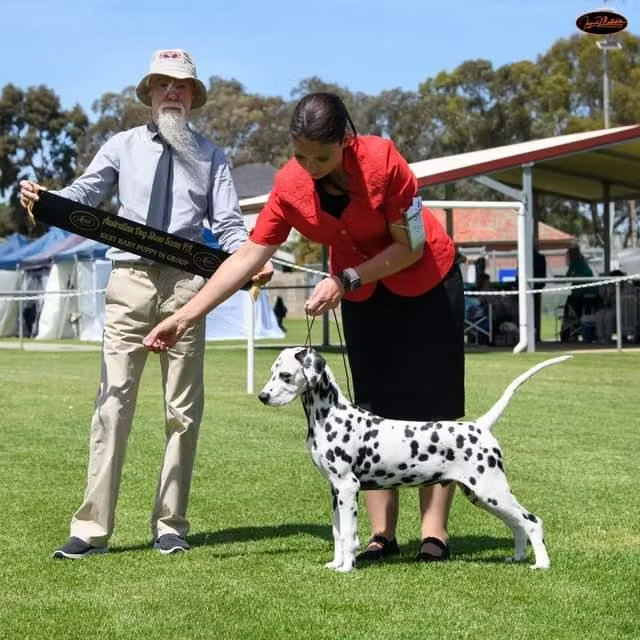
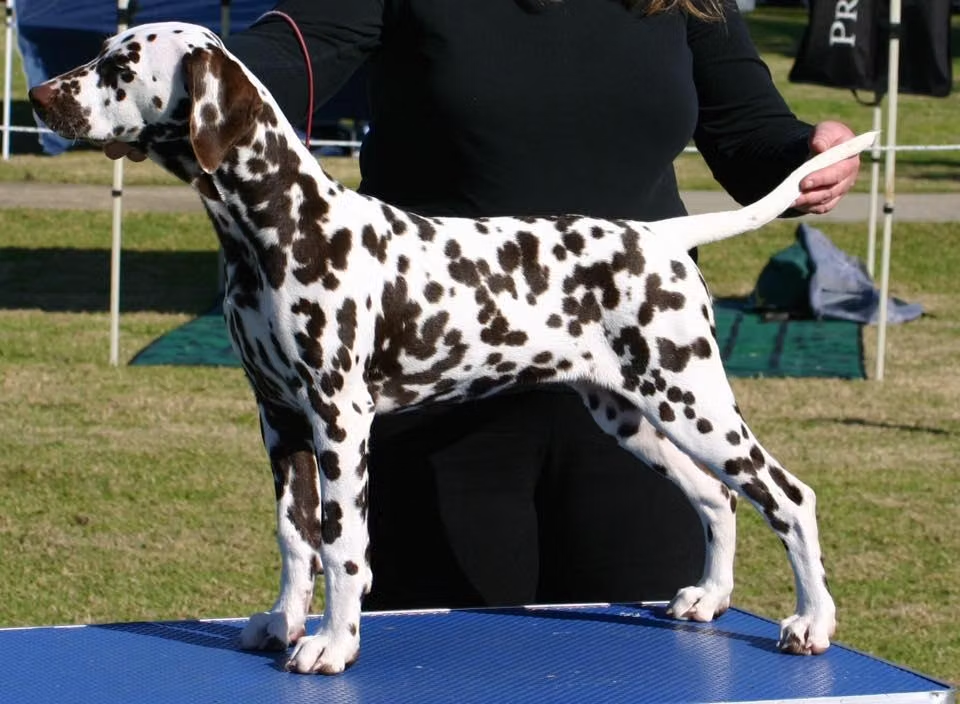
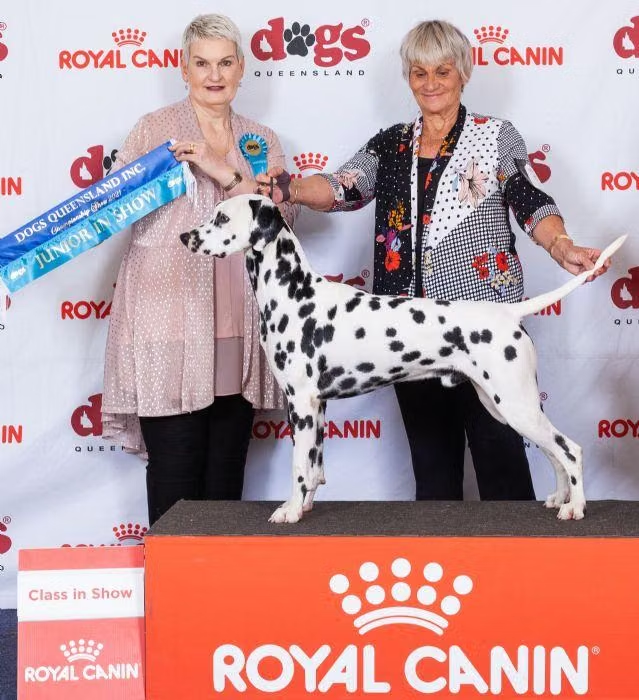
A few of the Dalmatian profiles members have added to United Pet Club.








About the Dalmatian
The Dalmatian is a large, athletic dog with a white coat marked in black or liver spots, known for a long history trotting beside horse-drawn carriages.
The Dalmatian is a medium to large dog, instantly recognisable by its short white coat covered in round black or liver spots. A grown dog usually stands 19 to 24 inches at the shoulder and weighs between 45 and 70 pounds, with a lean, muscular build suited to covering long distances. The breed's name comes from Dalmatia, the historical region on the Adriatic coast that today forms part of Croatia.
This is an alert, energetic dog that attaches itself firmly to its family. Dalmatians were originally bred to trot alongside horse-drawn carriages for hours at a stretch, and that stamina has never really left the breed. A Dalmatian that is short on daily exercise tends to become fidgety and can pick up destructive habits around the house.
Toward people it knows, the breed is affectionate and loyal, while it tends to hang back a little with strangers until it has sized them up. Given proper socialisation from puppyhood, most Dalmatians get on well with children and other dogs. The breed suits owners who can commit to daily exercise and steady, consistent training rather than an occasional walk around the block.
| Attribute | Detail |
|---|---|
| Origin | Dalmatia (present-day Croatia) |
| Size | Large (45 to 70 lb) |
| Lifespan | 11 to 13 years |
| Group / role | Companion dog and historic carriage dog |
| Good with | Families, older children, other dogs with socialisation |
Who the breed suits
The Dalmatian is best suited to active households able to provide an hour or more of solid exercise every day. Runners, hikers and people involved in dog sport tend to get along well with the breed. It is not a good fit for owners who are out of the house for long stretches, or anyone hoping for a low-energy companion.
History and origin of the Dalmatian
The Dalmatian takes its name from the Dalmatia region and became known across Europe as a coaching dog that ran alongside horse-drawn carriages.
The breed takes its name from Dalmatia, a region on the eastern Adriatic coast that lies within modern Croatia. Spotted dogs resembling today's Dalmatian turn up in European paintings and written records from the 1600s and 1700s, although the breed's earliest development is not fully documented.
The Dalmatian earned its lasting reputation as a coaching dog. It ran beside or underneath horse-drawn carriages, watching over the horses and the cargo both on the road and at rest stops. The work called for real stamina, a calm temperament around horses and a natural ease with travel, qualities that still show up in the breed today.
During the 1800s the Dalmatian became closely associated with firefighting in a number of countries. Back when fire engines were horse-drawn, the dogs ran out ahead to help clear a path and stayed close to the horses once the crew arrived on scene. That history is why the breed still turns up as a fire station mascot.
Kennel bodies formally recognised the Dalmatian as breed standards were drawn up in the late 1800s and early 1900s. In South Africa the breed is registered through the Kennel Union of Southern Africa (KUSA), the country's governing body for pedigree dogs. Over the decades the Dalmatian has moved from working road dog to companion and show dog, though it has kept the drive and endurance of its coaching days.
Appearance and coat
The Dalmatian is a lean, muscular dog with a short white coat and clearly defined black or liver spots spread evenly across the body.
The Dalmatian has a well-balanced, athletic build, with a deep chest, a level back and a long tail that tapers to a point. The head is clean-cut and the ears sit fairly high, carried close to the skull. On the whole the dog gives an impression of strength and stamina without any hint of bulk.
| Trait | Detail |
|---|---|
| Height | 19 to 24 inches at the shoulder |
| Weight | 45 to 70 pounds |
| Coat | Short, dense, fine and smooth |
| Colours | White with black spots, or white with liver (brown) spots |
| Eyes | Round, dark brown in black-spotted dogs and amber in liver-spotted dogs |
Coat and colour
The spotting pattern is what sets the breed apart. Puppies are born pure white, and the spots come through gradually over the first few weeks. Spots are round and well defined, ranging from roughly the size of a coin up to about two inches across, with smaller spots on the head, legs and tail. Two colour varieties are recognised, black-spotted and liver-spotted, and the two never appear together on one dog. The short coat sheds steadily right through the year.
Temperament and personality
Dalmatians are friendly, loyal and high-energy dogs that bond closely with their families and stay alert to their surroundings.
The Dalmatian is outgoing and thoroughly people-oriented. It wants to be part of whatever the family is doing and does not cope well with being left alone for long periods. Within its own household the breed is affectionate and playful, and it often shadows its favourite person from room to room.
Around people it does not know, a Dalmatian is usually watchful and a touch reserved to start with, which makes it a decent watchdog. It is not typically aggressive, but it will notice and announce anything out of place. Early and consistent socialisation helps the dog stay self-assured rather than wary.
The breed is generally good-natured with children, though its size and drive mean it suits households with older children who can keep up with an active dog. With other dogs, most Dalmatians are sociable, particularly when raised together or introduced with care. The breed is clever and independent-minded, a combination that can look like stubbornness unless handling stays firm and patient.
| Trait | Rating |
|---|---|
| Affection | 5 |
| Energy | 5 |
| Trainability | 3 |
| Vocalness | 3 |
| Shedding | 4 |
Care and grooming
Dalmatians need substantial daily exercise and steady coat care to manage shedding that continues right through the year.
Grooming
- Brush once or twice a week with a rubber curry brush or grooming mitt to lift out loose hair
- Expect steady shedding all year round, with heavier bouts in spring and autumn
- Bath only when needed, since the coat carries very little odour
- Trim nails every few weeks and check the ears for wax build-up
- Brush teeth several times a week
Exercise
- Aim for at least 60 to 90 minutes of vigorous activity daily
- Running, jogging alongside a bicycle and long hikes all suit the breed well
- Add mental work such as training games or scent activities
- A securely fenced garden lets the dog run safely off the lead
Environment
The Dalmatian copes with house or flat life only if its exercise needs are properly met. It is very much an indoor dog that wants to be with its family and does not do well left outside or on its own for long stretches. The short coat gives little insulation, so the dog needs shelter and protection in cold weather. This matters in South Africa, where conditions swing from the Mediterranean-style winters of the Cape to the far drier, more extreme highveld climate, and owners should adjust bedding and shelter to suit their own region.
Nutrition and feeding
Dalmatians do well on a complete, balanced diet, and owners should pay particular attention to hydration and urinary health.
Feed a complete and balanced diet formulated for the dog's life stage and activity level. Active adult Dalmatians burn through a fair amount of energy, so portion sizes should keep the dog in lean condition, where the ribs are easy to feel but not visible. Splitting the daily amount into two meals helps keep energy steady and lowers the risk of bloat.
| Life stage | Amount per day | Meals |
|---|---|---|
| Puppy (2 to 6 months) | Per puppy food label, divided | 3 to 4 |
| Puppy (6 to 12 months) | Per puppy food label, divided | 2 to 3 |
| Adult | About 1.5 to 2.5 cups dry food | 2 |
| Senior / less active | Reduced to hold lean weight | 2 |
Treats and supplements
Keep treats to around 10 percent of daily calories. Most Dalmatians on a complete commercial diet need no extra supplements, though a vet may suggest specific support for urinary health. Constant access to fresh water is important for this breed.
Health and lifespan
Dalmatians typically live 11 to 13 years and are generally hardy, though the breed is prone to congenital deafness and urinary stones.
The Dalmatian is generally a hardy, long-lived breed, with a typical lifespan of 11 to 13 years. Responsible breeding and routine vet care go a long way toward limiting the impact of the conditions known in the breed. Two health issues are particularly linked to the Dalmatian: congenital deafness and a tendency toward urinary stones.
| Condition | Signs | Note |
|---|---|---|
| Congenital deafness | No response to sound, in one or both ears | Common in the breed; puppies can be hearing tested (BAER) early |
| Urinary (urate) stones | Straining to urinate, blood in urine, frequent attempts | Linked to the breed's uric acid metabolism; needs prompt vet care |
| Hip dysplasia | Stiffness, reduced activity, difficulty rising | Screen breeding dogs; keep weight controlled |
| Skin allergies | Itching, redness, recurring irritation | Manage with vet guidance and diet review |
Preventive care
- Keep vaccinations and parasite prevention up to date
- Have puppies hearing tested where possible
- Provide constant fresh water and watch urination to catch stone problems early
- Keep the dog at a lean weight to protect the joints
- Book annual check-ups, with more frequent visits for older dogs
Training
Dalmatians are intelligent, capable learners that respond best to patient, reward-based training and early socialisation.
The Dalmatian is sharp and picks things up quickly, but it also has an independent streak that can turn training into something of a negotiation. Sessions work best kept short, varied and engaging, since a bored Dalmatian switches off fast. Consistency across everyone in the household matters, because the breed is quick to notice and exploit mixed signals. Deaf Dalmatians can be trained just as successfully using hand signals and vibration-based cues.
The basics
- Start socialisation early, exposing the puppy to people, dogs and new places
- Teach core cues such as sit, stay, come and lead manners from a young age
- Use clear, consistent signals, adding hand signals especially for deaf dogs
- Keep sessions short and finish on a success
- Channel the breed's energy into structured activities such as running, agility or scent work
Breeding
Dalmatian breeding centres on health screening, particularly hearing tests and selection to reduce inherited deafness and urinary problems.
Dalmatians reach sexual maturity somewhere around 6 to 12 months, though responsible breeders wait until a dog is physically and mentally mature, usually around two years old, before breeding from it. Females generally come into season about twice a year. Once mating has been successful, gestation runs to roughly 63 days.
Litters tend to be large, commonly running from about 6 to 9 puppies, though bigger litters do happen. Puppies are born white, with their spots coming through over the following weeks. Newborns rely entirely on the mother for warmth and nutrition in the first weeks, weaning generally starts around 3 to 4 weeks of age, and puppies are usually ready to move to new homes from about 8 weeks.
Because congenital deafness and urate stones both run in the breed, responsible breeding involves hearing testing of breeding stock and puppies, plus attention to lines with better urinary and joint histories. Prospective owners in South Africa are generally better served by breeders registered with the Kennel Union of Southern Africa (KUSA), who follow health-testing protocols for the breed. Raising the litter well includes early handling and gentle socialisation to support a stable temperament.
| Metric | Value |
|---|---|
| Sexual maturity | 6 to 12 months |
| Recommended breeding age | Around 2 years |
| Gestation | About 63 days |
| Typical litter size | 6 to 9 puppies |
| Weaning | About 6 to 8 weeks |
Registering your Dalmatian and its chip in South Africa
No national chip law protects a Dalmatian here; a free United Pet Club record does, for life, at no cost.
Dalmatian registration and microchips in South Africa
When a Dalmatian lands at an SPCA branch, the scanner comes out first, and everything then rides on what the number returns. Make sure it returns you. Register your dog free with United Pet Club and the profile answers every scan with your name and number, from now until the end of his days.
A chipped Dalmatian still needs the number loaded into a registry, because the vet's job ends with the implant. Register the microchip on the free lifetime plan: any brand a local vet uses qualifies, updates stay free when you relocate between provinces, and the record answers the lookups SPCA branches run daily. Create your free account and settle both records today.
How do I register my Dalmatian in South Africa?
Create a free United Pet Club account, load your Dalmatian's details and a photo, and save. The lifetime plan keeps the profile active at no cost for as long as you have him, chip or no chip.
How do I register my Dalmatian's microchip?
Load the 15-digit chip number into your free account together with your address and cell number. Registration and every later update are free, and chips from any brand a South African vet implants are accepted.
Must a Dalmatian be microchipped in South Africa?
No national law says so, though the SPCA chips as standard practice and many breeders and welfare groups insist on it. The registration behind the chip is the part that finds you, and with United Pet Club it costs nothing.
What does it cost to register a Dalmatian?
Nothing at all. The free lifetime plan covers the profile, the chip record, and unlimited updates, with no annual renewal in sight.
Frequently asked questions
Common questions about the Dalmatian cover its size, temperament, exercise needs, lifespan and suitability for different homes.
How big does a Dalmatian get?
Dalmatians are a large breed, standing around 19 to 24 inches at the shoulder and weighing roughly 45 to 70 pounds once fully grown.
What is the Dalmatian's temperament like?
Dalmatians are friendly, loyal and full of energy. They bond closely with their families, stay watchful around strangers, and are generally good with children and other dogs when socialised early.
Are Dalmatians difficult to look after?
They ask for a fair amount. Grooming itself is simple, but the breed needs plenty of daily exercise and steady training, and it sheds heavily all year round, so it suits active owners who are committed to the routine.
How long do Dalmatians live?
A healthy Dalmatian typically lives 11 to 13 years. Routine vet care, a lean weight and attention to hearing and urinary health all support a full lifespan.
Are Dalmatians good with families?
Yes, for active families. They do best in homes with older children, plenty of exercise on offer, and people around often, since they dislike being left alone for long.
Why are some Dalmatians deaf?
Congenital deafness is common in the breed and is linked to the genetics behind its coat pattern. Puppies can be hearing tested early, and deaf dogs can still live full lives once trained using hand signals.
Where can I get a Dalmatian in South Africa?
Dalmatians are available through reputable breeders registered with the Kennel Union of Southern Africa (KUSA), who health and hearing test their dogs, as well as through breed-specific rescues and shelters.
From the community
Ask about the DalmatianNo questions about the Dalmatian yet. Be the first to ask.
Browse Dog breeds