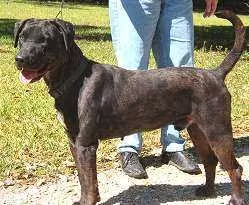
The Catahoula Leopard Dog is a striking, independent working breed known for its versatility, protectiveness, and tireless energy.
How the Catahoula Leopard Dog coat is built, and what that means when you groom it.
A few of the Catahoula Leopard Dog profiles members have added to United Pet Club.
The Catahoula Leopard Dog is a large American working breed valued for its versatility, protectiveness, and high energy, originally developed to herd and hunt in the forests and swamps of Louisiana.
The Catahoula Leopard Dog is a medium-to-large working dog from the United States, most closely tied to the state of Louisiana, where it is the official state dog. It was bred to work livestock and to hunt across difficult terrain, and those jobs shaped a dog that is athletic, hardy, and self-directed.
This is a breed built for purpose. Catahoulas are loyal to their own people and naturally protective of home and family, but they tend to be reserved or wary with strangers. They think for themselves, a useful trait in a dog expected to make decisions far from its handler, which also means they need an owner who can provide clear structure.
Coats often carry a mottled or merle pattern with patches of color, and many dogs have one or two pale, glass-blue eyes. The look is distinctive, but the breed was developed for function first, so working ability and stamina remain its defining qualities.
| Attribute | Detail |
|---|---|
| Origin | United States (Louisiana) |
| Size | Large |
| Lifespan | 10 to 14 years |
| Group/role | Working and herding dog |
| Good with | Its own family; needs early socialization with strangers and other pets |
The Catahoula fits an active household that can give it a job and daily physical and mental work. It does well with experienced owners, people who hike, run, or work livestock, and homes with secure space to move. It is a poor match for apartment living without heavy exercise, for owners who are away long hours, or for first-time owners who want an easygoing companion. Its independence and guarding instinct call for firm, consistent handling and steady socialization from puppyhood.
The Catahoula Leopard Dog developed in northern Louisiana from dogs kept by Native Americans and stock brought by European settlers, becoming a working herder and hunter and later the Louisiana state dog.
The breed takes its name from Catahoula Parish in northern Louisiana. Its exact origins are not recorded in detail, but the common account holds that it descends from dogs kept by Native Americans in the region, later crossed with dogs brought by Spanish and French settlers from the 16th century onward. The result was a hardy working dog suited to the forests, swamps, and bottomlands of the area.
Catahoulas were put to work herding semi-wild cattle and hogs that roamed the woods. The dogs used a forceful, close-working style, often operating in groups to control animals that were difficult to drive. The same toughness made them useful for hunting wild boar and other game across rough ground.
The breed remained largely a regional working dog for generations, valued by ranchers and hunters rather than by show breeders. Its appearance varied because selection focused on ability rather than a fixed standard.
In 1979 Louisiana named the Catahoula Leopard Dog the official state dog. It is recognized today by working-dog and breed registries, though it remains far more common as a ranch and hunting dog than as a household pet.
The Catahoula is a muscular, athletic large dog with a short, dense coat, often patterned in merle or mottled markings, and frequently has pale blue or differently colored eyes.
The Catahoula is a powerful, well-muscled dog with a deep chest, strong legs, and a frame built for endurance over hard terrain. The body is slightly longer than it is tall, and the overall impression is of an agile athlete rather than a heavy guard dog. The head is broad and the ears hang down and taper. Movement is smooth and ground-covering.
| Trait | Detail |
|---|---|
| Height | Approximately 20 to 26 inches (51 to 66 cm) at the shoulder |
| Weight | Approximately 50 to 95 pounds (23 to 43 kg) |
| Coat | Short to medium, dense, close-lying, single coat |
| Colors | Merle and mottled patterns, solid colors, and patches; blue, red, black, brown, and brindle tones |
| Eyes | Often pale blue (glass eyes); may be amber, brown, or green, and two different colors (heterochromia) are common |
The coat is short and tight, which suits the breed for warm, humid climates and offers limited protection in cold weather. The most recognized pattern is the leopard or merle pattern, a mottled mix of darker patches over a lighter base, which gives the breed its name. Solid-colored dogs and dogs with white trim or points also occur. Many Catahoulas have striking light-blue eyes, and it is not unusual for a single dog to have eyes of two different colors, or eyes that are partly two colors.
Catahoulas are loyal, intelligent, and highly energetic dogs that bond closely with their family while remaining independent and protective, traits that call for early socialization and confident handling.
The Catahoula is loyal and deeply attached to its own people. With family it is affectionate and watchful, and it often takes on a protective role around the home, alerting to anything unfamiliar. With strangers it tends to be reserved and may be standoffish until it judges the situation, which is part of what makes it a capable guardian.
Independence is a core part of the breed. These dogs were bred to work at a distance and make their own decisions, so they can be strong-willed and are not naturally inclined to follow commands without reason. They are highly intelligent and learn quickly, but they need a handler who is consistent and fair rather than harsh.
With other pets the picture is mixed. Properly socialized Catahoulas can live with other dogs, though same-sex tension and a strong prey drive are common. Cats and small animals may trigger chasing. Early, ongoing socialization is the single most important factor in how a Catahoula turns out around people and other animals.
| Trait | Rating |
|---|---|
| Affection (with family) | 4 |
| Energy | 5 |
| Trainability | 3 |
| Vocalness | 3 |
| Shedding | 2 |
Catahoulas have low grooming needs but very high exercise requirements, and they need a secure home with space, mental work, and a confident owner to stay balanced.
The short, single coat is easy to maintain.
This is one of the breed's most demanding areas. A bored or under-exercised Catahoula often becomes destructive or difficult.
The Catahoula does best in a house with a securely fenced yard rather than an apartment. Fencing should be tall and solid, because these dogs are athletic and determined. They tolerate heat well thanks to the short coat but need shelter and warmth in cold weather. They are not suited to being left alone for long stretches.
Active Catahoulas need a complete, protein-rich diet matched to their working energy level, fed in measured meals to support muscle and avoid weight gain.
Catahoulas are athletic dogs that benefit from a complete, balanced diet with quality animal protein to support muscle and stamina. Working dogs and very active dogs need more calories than companion dogs, so feeding should be matched to each dog's activity, age, and body condition rather than to a fixed number. You should be able to feel the ribs easily and see a clear waist from above.
| Life stage | Amount per day | Meals |
|---|---|---|
| Puppy (2 to 6 months) | Per puppy-food label, by weight | 3 to 4 |
| Puppy (6 to 12 months) | Per label, by growth | 2 to 3 |
| Adult | Approximately 2.5 to 4 cups of quality dry food | 2 |
| Senior or less active | Reduced calories to hold weight | 2 |
Keep treats to about 10 percent of daily calories so they do not unbalance the diet. Most Catahoulas on a complete commercial food need no supplements, though joint support or fish oil may help older or heavily worked dogs. Ask your veterinarian before adding any supplement, and provide fresh water at all times, especially after exercise in heat.
Catahoulas are generally a hardy breed with a lifespan of 10 to 14 years, but they are prone to hip dysplasia and to deafness linked to the merle coat pattern.
The Catahoula is a relatively healthy, robust working breed with a typical lifespan of 10 to 14 years. As with most large, active dogs, joint health and weight management matter over the long term. The main breed-specific concern is deafness associated with the merle pattern, particularly in dogs bred from two merle parents, which can also produce vision problems.
| Condition | Signs | Note |
|---|---|---|
| Hip dysplasia | Stiffness, limping, trouble rising | Common in large breeds; screen breeding dogs |
| Deafness | No response to sound, hard to wake | Linked to merle coloring; can affect one or both ears |
| Eye problems | Cloudiness, vision loss, eye abnormalities | More likely in double-merle dogs |
| Bloat (gastric torsion) | Swollen abdomen, retching, distress | Emergency in deep-chested dogs |
Catahoulas are intelligent and quick to learn but independent and strong-willed, so they respond best to early, consistent, reward-based training from a confident handler.
The Catahoula is intelligent and capable, but it is also independent and was bred to act on its own judgment. That combination means it learns fast yet will test boundaries and ignore commands it sees no reason to follow. Training works best when it starts early, stays consistent, and gives the dog a sense of purpose. Harsh corrections tend to backfire and can damage trust with a sensitive, headstrong dog. Socialization with people, places, and other animals is as important as obedience, given the breed's wariness of strangers and strong prey drive.
Catahoulas reach breeding maturity around 18 to 24 months, carry litters of roughly six to ten puppies after a normal canine gestation, and require careful pairing to avoid the health risks of double-merle matings.
Responsible Catahoula breeding centers on health and temperament rather than appearance. Females should not be bred at their first season; waiting until about 18 to 24 months allows the dog to mature and to complete hip and hearing screening. The most important rule specific to this breed is to avoid breeding two merle dogs together, because double-merle puppies have a high risk of deafness and serious eye defects.
Gestation runs about 63 days from conception, similar to other dogs. Litters are commonly six to ten puppies. The dam usually whelps without help, but a quiet, clean whelping area and a veterinarian on call are sensible precautions for a large breed.
Puppies need early handling, gentle exposure to new sights and sounds, and BAER hearing testing where deafness is a concern. Because the breed is independent and protective by nature, socialization that begins with the breeder and continues in the new home strongly shapes the adult dog.
| Metric | Value |
|---|---|
| Breeding maturity | About 18 to 24 months |
| Gestation | Approximately 63 days |
| Average litter size | 6 to 10 puppies |
| Weaning | Around 6 to 8 weeks |
| Key precaution | Do not breed merle to merle (double-merle health risks) |
No national chip law protects a Catahoula Leopard Dog here; a free United Pet Club record does, for life, at no cost.
When a Catahoula Leopard Dog lands at an SPCA branch, the scanner comes out first, and everything then rides on what the number returns. Make sure it returns you. Register your dog free with United Pet Club and the profile answers every scan with your name and number, from now until the end of his days.
A chipped Catahoula Leopard Dog still needs the number loaded into a registry, because the vet's job ends with the implant. Register the microchip on the free lifetime plan: any brand a local vet uses qualifies, updates stay free when you relocate between provinces, and the record answers the lookups SPCA branches run daily. Create your free account and settle both records today.
Create a free United Pet Club account, load your Catahoula Leopard Dog's details and a photo, and save. The lifetime plan keeps the profile active at no cost for as long as you have him, chip or no chip.
Load the 15-digit chip number into your free account together with your address and cell number. Registration and every later update are free, and chips from any brand a South African vet implants are accepted.
No national law says so, though the SPCA chips as standard practice and many breeders and welfare groups insist on it. The registration behind the chip is the part that finds you, and with United Pet Club it costs nothing.
Nothing at all. The free lifetime plan covers the profile, the chip record, and unlimited updates, with no annual renewal in sight.
Common questions about the Catahoula Leopard Dog cover its size, temperament, care demands, lifespan, suitability as a family dog, and how to find one.
It is a large breed, standing roughly 20 to 26 inches at the shoulder and weighing about 50 to 95 pounds, with males typically larger than females.
Catahoulas are loyal and protective with family, reserved with strangers, and highly intelligent but independent. They are energetic working dogs that need a job and firm, fair handling.
Grooming is easy thanks to the short coat, but exercise and training are demanding. They need 1 to 2 hours of activity daily plus mental work, so they suit active, experienced owners rather than first-timers.
Most live about 10 to 14 years. Keeping them at a healthy weight and screening for hip and hearing problems helps support a long, sound life.
They can be devoted family dogs in an active home with older, respectful children, given early socialization. Their guarding instinct and high energy make them a poor fit for sedentary households or homes that are empty most of the day.
With early socialization they can, but a strong prey drive and same-sex tension are common. Introductions should be careful, and small animals may trigger chasing.
They are most common in the southern United States, especially Louisiana, through working-dog and ranch breeders. Breed-specific rescues also place dogs. Choose a breeder who screens for hip and eye health and avoids double-merle litters.