
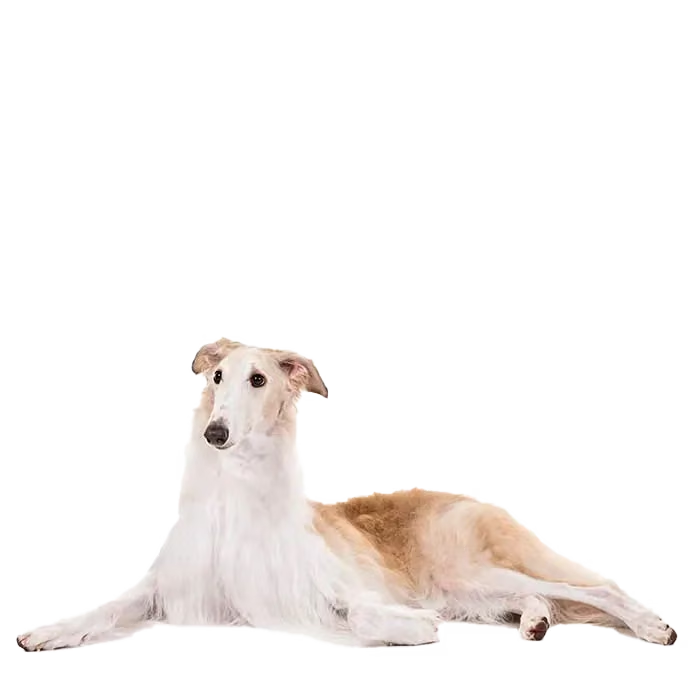
Borzoi
The Borzoi is an elegant, dignified Russian sighthound known for its quiet grace, gentle nature, and remarkable speed.
- Size
- Large
- Lifespan
- 9–14 years
- Origin
- Russia
- Temperament
- Dignified
- Standard colors
- Black, White and Grey and 12 more
Characteristics
Coat and grooming
How the Borzoi coat is built, and what that means when you groom it.
- Coat layers
- Single coat
- Coat texture
- Silky, Wavy
- Coat length
- Long
- Shedding
- Seasonal shedding
Grooming guidance
Caution: A Borzoi coat mats easily.
Fine or long hair tangles at the base of the coat, out of sight, where the mats tighten and pull on the skin. Brushing has to reach right down to the roots in sections, not just skim the surface.
Information: A Borzoi drops its undercoat in heavy bursts.
The undercoat comes out in heavy bursts over a few weeks. An undercoat rake, or a bath followed by a proper blow-dry, clears it far faster than daily brushing. Clipping the coat down is not a shortcut for this.
Borzoi colors and patterns
What each club's breed standard says about every Borzoi color and pattern. Point at a ruling to see the club's own wording.
Breed standards describe the Borzoi in Black, White, Grey, Blue, Silver, Brown, Tan, Mahogany, Red, Gold, Lemon, Cream, Fawn, Apricot and Isabella. Standard patterns: Solid, Tricolour, Brindle, Piebald, Roan, Sable, Agouti, Spotted, Tan point and Reverse brindle.
| Color or pattern | FCI | AKC | UKC | KC | KUSA |
|---|---|---|---|---|---|
| Black | Standard (“black”) | Standard (“Black”) | Standard (“Any color or combination of colors is acceptable”) | Standard (“Self Black”) | Standard (“Black”) |
| White | Standard (“White”) | Standard (“White”) | Standard (“Any color or combination of colors is acceptable”) | Standard (“White”) | Standard (“White”) |
| Grey | Standard (“grey (from ashy to yellowish-grey)”) | Standard (“Any color, or combination of colors, is acceptable”) | Standard (“Any color or combination of colors is acceptable”) | Standard (“Grey”) | Standard (“Grey (from ashy to yellowish-grey)”) |
| Blue | Disqualifying (“blue”) | Standard (“Blue”) | Standard (“Any color or combination of colors is acceptable”) | Standard (“Blue”) | Disqualifying (“blue”) |
| Silver | Standard (“Any colours from white to black in any combination are acceptable”) | Standard (“Silver”) | Standard (“Any color or combination of colors is acceptable”) | Standard (“Silver”) | Standard (“Any colours from white to black in any combination are acceptable”) |
| Brown | Disqualifying (“brown (including cocoa, coffee, chocolate)”) | Standard (“Brown”) | Standard (“Any color or combination of colors is acceptable”) | Standard (“Any colour, except merle”) | Disqualifying (“brown (including cocoa, coffee, chocolate)”) |
| Tan | Standard (“with tans”) | Standard (“Black & Tan”) | Standard (“Any color or combination of colors is acceptable”) | Standard (“Tricolour”) | Standard (“with tans”) |
| Mahogany | Standard (“Any colours from white to black in any combination are acceptable”) | Standard (“Mahogany Red”) | Standard (“Any color or combination of colors is acceptable”) | Standard (“Mahogany”) | Standard (“Any colours from white to black in any combination are acceptable”) |
| Red | Standard (“red”) | Standard (“Red”) | Standard (“Any color or combination of colors is acceptable”) | Standard (“Self Red”) | Standard (“Red”) |
| Gold | Standard (“Any colours from white to black in any combination are acceptable”) | Standard (“Gold”) | Standard (“Any color or combination of colors is acceptable”) | Standard (“Self Gold”) | Standard (“Any colours from white to black in any combination are acceptable”) |
| Lemon | Standard (“Any colours from white to black in any combination are acceptable”) | Standard (“Any color, or combination of colors, is acceptable”) | Standard (“Any color or combination of colors is acceptable”) | Standard (“Lemon”) | Standard (“Any colours from white to black in any combination are acceptable”) |
| Cream | Standard (“Any colours from white to black in any combination are acceptable”) | Standard (“Cream”) | Standard (“Any color or combination of colors is acceptable”) | Standard (“Cream”) | Standard (“Any colours from white to black in any combination are acceptable”) |
| Fawn | Standard (“pale of different shadings (red-fawn, grey-fawn, silver-fawn)”) | Standard (“Fawn”) | Standard (“Any color or combination of colors is acceptable”) | Standard (“Self Fawn”) | Standard (“Pale, of different shadings (red-fawn, grey-fawn, silver-fawn)”) |
| Apricot | Standard (“Any colours from white to black in any combination are acceptable”) | Standard (“Apricot”) | Standard (“Any color or combination of colors is acceptable”) | Standard (“Any colour, except merle”) | Standard (“Any colours from white to black in any combination are acceptable”) |
| Isabella | Disqualifying (“isabella (lilac)”) | Standard (“Any color, or combination of colors, is acceptable”) | Standard (“Any color or combination of colors is acceptable”) | Standard (“Any colour, except merle”) | Disqualifying (“isabella (lilac)”) |
| Patterns | |||||
| Solid | Standard (“All the colours may be solid”) | Standard (“Any color, or combination of colors, is acceptable”) | Standard (“Any color or combination of colors is acceptable”) | Standard (“Self Black”) | Standard (“All the colours may be solid”) |
| Tricolour | Standard (“Any colours from white to black in any combination are acceptable”) | Standard (“Any color, or combination of colors, is acceptable”) | Standard (“Any color or combination of colors is acceptable”) | Standard (“Tricolour”) | Standard (“Any colours from white to black in any combination are acceptable”) |
| Brindle | Standard (“brindle: pale, or red, or grey main colour with dark stripes”) | Standard (“Brindle”) | Standard (“Any color or combination of colors is acceptable”) | Standard (“Brindle”) | Standard (“Brindle: pale, or red, or grey main colour with dark stripes”) |
| Piebald | Standard (“All the colours may be ... pied”) | Standard (“Any color, or combination of colors, is acceptable”) | Standard (“Any color or combination of colors is acceptable”) | Standard (“Any colour, except merle”) | Standard (“All the colours may be ... pied”) |
| Roan | Fault (“Abundant flecks on the body of the same shade as the base colour”) | Standard (“Spotted On White, Ticked”) | Standard (“Any color or combination of colors is acceptable”) | Standard (“Any colour, except merle”) | Fault (“Abundant flecks on the body of the same shade as the base colour”) |
| Sable | Standard (“red with black overlay hair often combined with dark muzzle (sable)”) | Standard (“Sable”) | Standard (“Any color or combination of colors is acceptable”) | Standard (“Sable”) | Standard (“Red with black overlay, hair often combined with dark muzzle (sable)”) |
| Agouti | Standard (“Any colours from white to black in any combination are acceptable”) | Standard (“Any color, or combination of colors, is acceptable”) | Standard (“Any color or combination of colors is acceptable”) | Standard (“Wolf Sable”) | Standard (“Any colours from white to black in any combination are acceptable”) |
| Spotted | Standard (“Any colours from white to black in any combination are acceptable”) | Standard (“Spotted On White”) | Standard (“Any color or combination of colors is acceptable”) | Standard (“Any colour, except merle”) | Standard (“Any colours from white to black in any combination are acceptable”) |
| Tan point | Standard (“with tans”) | Standard (“Black & Tan”) | Standard (“Any color or combination of colors is acceptable”) | Standard (“Any colour, except merle”) | Standard (“with tans”) |
| Reverse brindle | Standard (“brindle: pale, or red, or grey main colour with dark stripes”) | Standard (“Brindle”) | Standard (“Any color or combination of colors is acceptable”) | Standard (“Brindle”) | Standard (“Brindle: pale, or red, or grey main colour with dark stripes”) |
| Merle | No ruling | No ruling | No ruling | Not recognised (“merle which is unacceptable”) | No ruling |
| Double merle | No ruling | No ruling | No ruling | No ruling | No ruling |


| Color or pattern | FCI | AKC | UKC | KC | KUSA |
|---|---|---|---|---|---|
| Brown | Standard (“dark brown to brown”) | No ruling | No ruling | No ruling | Standard (“dark brown to brown”) |
| Dark brown | Standard (“dark brown to brown”) | Standard (“dark in color”) | Standard (“dark In color”) | Standard (“Dark”) | Standard (“dark brown to brown”) |
| Light brown | No ruling | No ruling | Fault (“Light-colored eyes”) | No ruling | No ruling |
| Hazel | Fault (“light (all shades of hazelnut)”) | No ruling | No ruling | No ruling | Fault (“light (all shades of hazelnut)”) |
| Yellow | Fault (“Eyes small; yellow”) | No ruling | No ruling | No ruling | Fault (“Eyes small; yellow”) |
| Grey | Disqualifying (“of all shades of grey, green, blue”) | No ruling | No ruling | No ruling | Disqualifying (“of all shades of grey, green, blue”) |
| Blue | Disqualifying (“of all shades of grey, green, blue”) | No ruling | No ruling | No ruling | Disqualifying (“of all shades of grey, green, blue”) |
| Green | Disqualifying (“of all shades of grey, green, blue”) | No ruling | No ruling | No ruling | Disqualifying (“of all shades of grey, green, blue”) |
| Patterns | |||||
| Odd-eyed | Disqualifying (“eyes of different colours”) | No ruling | No ruling | No ruling | Disqualifying (“eyes of different colours”) |

| Color or pattern | FCI | AKC | UKC | KC | KUSA |
|---|---|---|---|---|---|
| Black | Standard (“always black in any coat colour”) | Standard (“Nose large and black”) | Standard (“The black nose”) | Standard (“nose large and black”) | Standard (“always black in any coat colour”) |
| Pink | Disqualifying (“Completely depigmented (pink) nose”) | No ruling | No ruling | No ruling | Disqualifying (“Completely depigmented (pink) nose”) |
| Patterns | |||||
| Butterfly nose | Fault (“Partly depigmented (pink) nose”) | No ruling | No ruling | No ruling | Fault (“Partly depigmented (pink) nose”) |

What the rulings mean
- Standard
- Described by the club's breed standard.
- Fault
- Named by the club's breed standard as a fault: the animal can be shown but is penalised.
- Disqualifying
- The club's breed standard disqualifies an animal of this colour or pattern.
- Not recognised
- The club does not accept this colour or pattern for the breed.
Color changes
How a Borzoi's colors can change over its life.
Blackchanges toRust
Coat · With body condition · can change back
Blackchanges toGrey
Coat · Progressive
Blackchanges toBrown
Coat · In the sun · can change back
Whitechanges toRoan
Coat · With age · from 2 weeks
Tan pointchanges toSaddle
Coat · With age · from 6 to 156 weeks
Blackchanges toSnow nose
Nose · With the season · can change back
Blackchanges toPink
Nose · With the season · can change back


Sources
Each ruling comes from the club's published breed standard or color list.
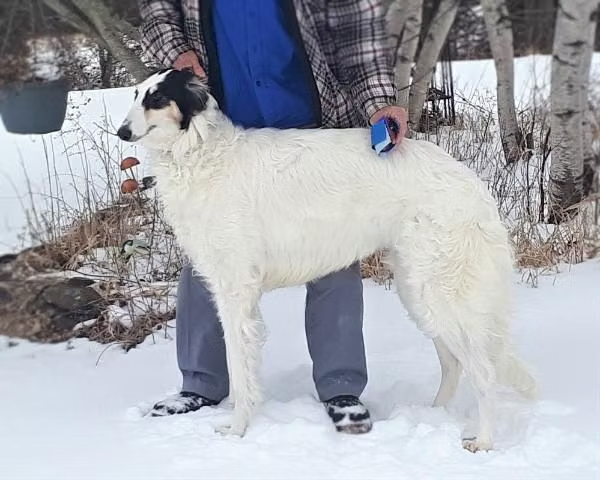
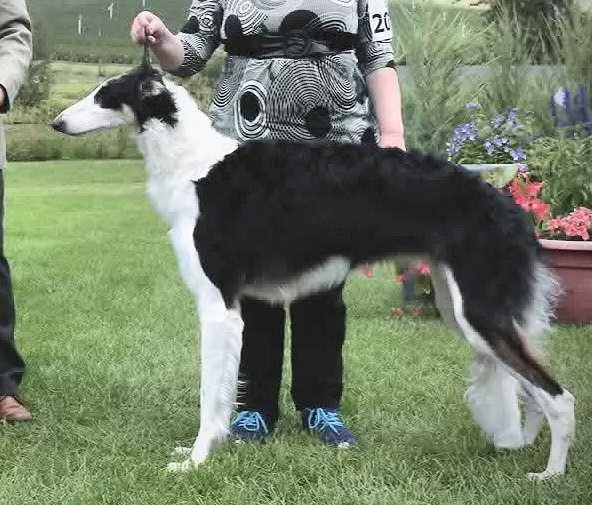
Meet some of our Borzoi
A few of the Borzoi profiles members have added to United Pet Club.


About the Borzoi
The Borzoi is a big Russian sighthound built for coursing over open ground, quiet and reserved indoors but explosively fast the moment something runs.
The Borzoi is a tall, rangy sighthound out of Russia, built to hunt by sight rather than scent. Standing well over 70 cm at the shoulder, it carries a long, elegant head, a deep but narrow chest, and a silky coat that softens its angular frame. At a walk it moves with a light, springy stride, and it needs only a few strides to hit full speed.
Indoors this is a calm, undemanding dog. It settles for long stretches and is not one for barking or pacing about. Give it open space, though, and the same dog switches on: fast, focused, and quick to lock onto anything that moves. That contrast between a placid house dog and a driven runner is what defines the breed.
The Borzoi is affectionate with people it knows and cool towards strangers. It bonds closely with its own household but is not a dog that fusses or fawns; it keeps a dignified, measured air about it. Owners often compare it to a cat in its independence and its habit of deciding for itself when to engage.
| Attribute | Detail |
|---|---|
| Origin | Russia |
| Size | Large |
| Lifespan | 9 to 14 years |
| Group / role | Sighthound, bred to course game by sight |
| Good with | Familiar family members; calm older children; other sighthounds |
Who the Borzoi suits
This breed suits a quiet household with secure space for safe, fast running, and owners happy with a dog that is affectionate but independent rather than clingy. Solid fencing matters, because a Borzoi off the lead in open ground, whether that is a large garden, a smallholding, or the veld, may chase and simply outrun any recall. Anyone wanting a constantly demonstrative companion, or a dog reliably safe off lead around cats and small pets, will likely find this the wrong breed. Owners who want a calm, low-maintenance housemate with a serious athletic streak tend to get on well with it.
History of the Borzoi
The Borzoi took shape in Russia as an aristocratic coursing hound used to hunt hare, fox, and wolf across open country, reaching the West only in the late nineteenth century.
The Borzoi was developed in Russia as a sighthound for coursing game across open country. Its name comes from a Russian word meaning fast or swift, which sums up the dog's main working trait. For centuries it was tied to the Russian nobility, who kept large kennels and used the hounds to hunt hare, fox, and, in organised hunts, wolf.
Wolf coursing was a formal sport on the estates of wealthy landowners. Hounds usually worked in groups, released to chase and hold a wolf until the handlers caught up. That work produced a dog with speed over distance plus enough size and strength to tackle large quarry, while staying manageable around the people handling it.
The breed reached western Europe and North America in the late nineteenth century, valued there for its looks and its elegant way of moving. Early imports came out of Russian kennels, and English speakers sometimes called the dog the Russian Wolfhound, a name that has since given way to Borzoi.
Social and political upheaval in Russia in the early twentieth century broke up the large estate kennels that had sustained the breed. Populations established abroad helped keep the Borzoi going through that period, and today the dog continues mainly as a companion and show animal while still carrying its coursing instincts.
Borzoi appearance
The Borzoi is a tall, narrow sighthound with a long head, deep chest, a slight arch over the loin, and a long silky coat in a wide range of colours.
The Borzoi has the classic sighthound build made for speed: long legs, a deep, fairly narrow chest, a tucked-up waist, and a back that rises in a gentle arch over the loin. The head is long and lean, with a slight rise at the muzzle and dark, almond-shaped eyes that give it a calm, far-off expression. The ears are small and fold back along the neck, lifting when the dog is alert. The tail is long, set low, and carried in a smooth curve.
| Trait | Description |
|---|---|
| Height | Roughly 71 cm and over at the shoulder for males; about 66 cm and over for females |
| Weight | About 34 to 48 kg for males; about 27 to 38 kg for females |
| Coat | Long, silky, flat to wavy or curly, with feathering on the chest, legs, and tail |
| Colours | Many, including white, cream, gold, red, brindle, black, and combinations with white |
| Eyes | Dark, almond-shaped, set well into the skull |
Coat and colours
The coat is silky in texture, ranging from flat to wavy or curly, with longer feathering on the underside, the back of the legs, and the tail. A heavier ruff often frames the neck. Almost any colour or pattern is accepted, so a single litter can turn out solid whites, golds, and reds alongside sable, brindle, and black, often broken up with white markings. For its length, the coat is only moderate work to keep, though it does shed, with a heavier blow-out once or twice a year as the seasons change.
Borzoi temperament
The Borzoi is gentle, quiet, and independent at home, affectionate with its family, reserved with strangers, and quick to chase anything that runs outdoors.
The Borzoi carries itself with a calm, dignified temperament. Indoors it is quiet, often fairly inactive, happy to lie about for long periods, and it rarely barks without good reason. With its own family it is gentle and affectionate, though it tends not to be demonstrative and keeps a measure of reserve rather than demanding attention.
Around strangers the breed is usually polite but aloof: neither instantly friendly nor aggressive. It is not a guard dog by nature, though its size alone can put people off. With children it is generally tolerant and gentle, and does best with older kids who handle it calmly; boisterous, rough play can rattle a dog this sensitive.
The trait that defines the breed's behaviour is a strong prey drive. As a sighthound, the Borzoi is wired to chase anything that runs, and a sprinting cat, a jackal on the smallholding, or a small dog can set off a chase even in an otherwise placid individual. It usually lives peacefully alongside other large dogs, especially fellow sighthounds, but small pets need careful management around it. The breed is independent and fairly self-directed, and that shapes how it takes to training.
| Trait | Rating |
|---|---|
| Affection | 3 |
| Energy | 3 |
| Trainability | 2 |
| Vocalness | 1 |
| Shedding | 3 |
Caring for a Borzoi
A Borzoi needs regular coat brushing, daily exercise with safe space to sprint, and a secure, tick-aware home to manage its strong chase instinct.
Grooming
- Brush the silky coat two or three times a week to stop tangles and mats forming, paying particular attention to the feathering behind the legs and on the tail.
- Step up brushing during the seasonal shed, when the coat comes out more heavily.
- Bath the dog occasionally as needed; the coat is fairly easy to keep clean between baths.
- Trim nails regularly and check the long ears and skin folds for ticks and debris, especially after a walk through long grass or bush.
Exercise
- Give it a daily walk plus the chance to run flat out in a securely fenced area.
- Let it sprint in short bursts rather than expecting sustained endurance work; this is a dog built for a fast course, not a long jog.
- Keep it on lead in open or unfenced ground, since recall goes out the window once a chase starts.
- Lure coursing, or similar sighthound activities where these are available, suits the breed's instincts well.
Home and environment
The Borzoi settles into home life as a quiet indoor companion, provided its exercise needs are met. It appreciates soft bedding to cushion its lean frame and bony points. A secure, tall fence matters, because the breed can clear a low wall or fence and will chase anything that passes, from a neighbour's cat to small buck on a smallholding. As a large but calm-indoors dog, it can manage in a smaller home if it gets enough exercise, but it must have safe outdoor space to run, and owners in tick country should check it over after time spent in long grass or bush.
Borzoi nutrition
A Borzoi needs a complete diet sized for its large frame and lean build, fed in measured meals to keep muscle without extra weight.
The Borzoi is a large but lean dog, and its diet should keep good muscle tone over a slender frame rather than add bulk. A complete commercial diet formulated for large breeds, or a balanced diet worked out with a vet, suits most dogs. Amounts vary with age, activity level, and metabolism, and a dog that is actively coursing or working needs noticeably more than a sedentary house companion.
Like other deep-chested breeds, the Borzoi carries some risk of bloat, so feeding habits matter. Splitting the daily ration into two meals and avoiding hard exercise straight after eating are both sensible precautions.
| Life stage | Amount per day | Meals |
|---|---|---|
| Puppy (2 to 6 months) | Per the puppy food label, split across the day | 3 to 4 |
| Adolescent (6 to 14 months) | Adjust to growth and body condition | 2 to 3 |
| Adult | Roughly 500 g to 950 g of quality dry food, depending on size and activity | 2 |
| Senior | Slightly reduced calories to match lower activity | 2 |
Treats and supplements
Keep treats to a small share of daily calories so the dog stays lean. Good options include small pieces of plain cooked meat or dog-safe vegetables. Most Borzois on a complete diet need no extra supplements; discuss joint or other supplements with a vet rather than adding them as a matter of course. Make sure fresh water is available at all times, especially around exercise, given how quickly a dog can dehydrate in South African heat.
Borzoi health
The Borzoi is generally healthy with a typical lifespan of 9 to 14 years, but is prone to bloat and, like other sighthounds, needs care with anaesthesia and tick-borne disease.
The Borzoi is, on the whole, a healthy breed with fewer inherited problems than many large dogs. Typical lifespan runs from about 9 to 14 years. The most urgent concern is gastric dilatation-volvulus, or bloat, a sudden, life-threatening condition seen in deep-chested breeds. Sighthounds, the Borzoi included, also tend to be sensitive to certain anaesthetic agents because of their low body fat, worth raising with a vet before any procedure. In much of South Africa, tick-borne biliary (canine babesiosis) is a further genuine risk, since ticks stay active across most of the year in warmer regions, and owners should know the early signs and keep tick prevention current.
| Condition | Signs | Note |
|---|---|---|
| Bloat (gastric torsion) | Swollen abdomen, retching without bringing anything up, restlessness, collapse | A medical emergency; get to a vet immediately |
| Anaesthesia sensitivity | Slow recovery or an adverse reaction during surgery | Tell the vet about the breed's sighthound sensitivity beforehand |
| Cardiac issues | Reduced stamina, coughing, fainting | Periodic heart checks help catch problems early |
| Bone or joint conditions | Lameness, stiffness, reluctance to move | Keep the dog lean to reduce strain |
Preventive care
- Keep core vaccinations and parasite prevention, including tick and biliary prevention, up to date year-round.
- Keep the dog at a lean body condition to protect the joints and heart.
- Learn the signs of bloat and have an emergency plan ready, since speed matters.
- Tell any vet about sighthound anaesthesia sensitivity before procedures.
- Book regular dental care and routine wellness checks.
Training a Borzoi
The Borzoi is clever but independent and does best with patient, reward-based training; recall is the hardest skill to install because of its chase instinct.
The Borzoi is intelligent but independent, shaped by centuries of working at a distance from its handler. It learns quickly when it is motivated, but it does not have the eager-to-please streak of some working breeds, and it switches off during repetitive drilling. Short, varied, upbeat sessions hold its attention far better than long or forceful ones. Heavy-handed methods tend to make a sensitive Borzoi shut down rather than fall into line.
Recall is the hardest command to make solid, because the urge to chase can override anything it has learned once a fast-moving target appears. Most owners manage this with secure fencing and lead control rather than banking on perfect off-lead obedience. Early, gentle socialisation helps the breed grow into a confident, well-mannered adult.
Basics
- Start socialisation and handling in puppyhood, exposing the dog calmly to people, places, and other animals.
- Teach name response and attention first, rewarding it for checking in on its own.
- Bring in sit, down, and stay through short sessions with high-value food rewards.
- Practise lead walking early, since an adult Borzoi is large and strong.
- Work on recall inside a fenced area, but never rely on it around running animals in open ground.
Borzoi breeding
Borzoi breeding involves a roughly two-month pregnancy and often large litters, with responsible programmes screening for health and temperament.
Borzois mature slowly, and breeders generally wait until a dog is fully grown and health-screened before considering a litter, often around two years old. As with dogs generally, the female comes into season about twice a year, and mating is timed to her cycle. Pregnancy runs to roughly 63 days, a little over two months.
Litter size in this breed tends to run large for a sighthound, and bigger litters place real demands on both the dam and the breeder. Newborn puppies are helpless and need warmth, frequent nursing, and a quiet whelping area. Early, gentle handling and socialisation in the first weeks help build the calm, confident temperament the breed is known for. Responsible breeding puts sound health, good structure, and stable temperament first, with attention to heart health and the breed's known sensitivities, including its reaction to certain anaesthetics. Anyone thinking about breeding should work with a vet and experienced mentors, and register litters through KUSA.
| Metric | Value |
|---|---|
| Breeding maturity | Typically around 2 years, after health screening |
| Heat cycle | About twice a year |
| Gestation | Approximately 63 days |
| Litter size | Often large for a sighthound |
| Weaning | Around 6 to 8 weeks |
Registering your Borzoi and its chip in South Africa
No national chip law protects a Borzoi here; a free United Pet Club record does, for life, at no cost.
Borzoi registration and microchips in South Africa
When a Borzoi lands at an SPCA branch, the scanner comes out first, and everything then rides on what the number returns. Make sure it returns you. Register your dog free with United Pet Club and the profile answers every scan with your name and number, from now until the end of his days.
A chipped Borzoi still needs the number loaded into a registry, because the vet's job ends with the implant. Register the microchip on the free lifetime plan: any brand a local vet uses qualifies, updates stay free when you relocate between provinces, and the record answers the lookups SPCA branches run daily. Create your free account and settle both records today.
How do I register my Borzoi in South Africa?
Create a free United Pet Club account, load your Borzoi's details and a photo, and save. The lifetime plan keeps the profile active at no cost for as long as you have him, chip or no chip.
How do I register my Borzoi's microchip?
Load the 15-digit chip number into your free account together with your address and cell number. Registration and every later update are free, and chips from any brand a South African vet implants are accepted.
Must a Borzoi be microchipped in South Africa?
No national law says so, though the SPCA chips as standard practice and many breeders and welfare groups insist on it. The registration behind the chip is the part that finds you, and with United Pet Club it costs nothing.
What does it cost to register a Borzoi?
Nothing at all. The free lifetime plan covers the profile, the chip record, and unlimited updates, with no annual renewal in sight.
Borzoi frequently asked questions
Common questions about the Borzoi cover its size, temperament, care needs, lifespan, suitability, and availability in South Africa.
How big does a Borzoi get?
It is a large sighthound. Males typically stand about 71 cm and over at the shoulder and weigh roughly 34 to 48 kg, while females are a bit smaller, at around 66 cm and over and about 27 to 38 kg.
What is the Borzoi's temperament like?
At home it is calm, quiet, and gentle, affectionate with its family but reserved with strangers. Outdoors it has a strong urge to chase anything that runs, which is its single most important behavioural trait.
Is a Borzoi hard to look after?
Care is moderate. The silky coat needs brushing a few times a week, and the dog needs daily exercise with safe space to run. The real challenges are managing its prey drive and keeping fencing secure, rather than heavy day-to-day upkeep.
How long do Borzois live?
The typical lifespan is about 9 to 14 years.
Is the Borzoi a good family dog?
It can suit a calm household and is usually gentle with older children. It is less suited to homes with small pets it might chase, or to owners wanting a constantly demonstrative or reliably off-lead dog.
Are Borzois easy to find in South Africa?
They are an established but not very common breed here. Availability varies by region, and reputable KUSA-registered breeders often have waiting lists, so finding a well-bred puppy can take patience.
From the community
Ask about the BorzoiNo questions about the Borzoi yet. Be the first to ask.
Browse Dog breeds