
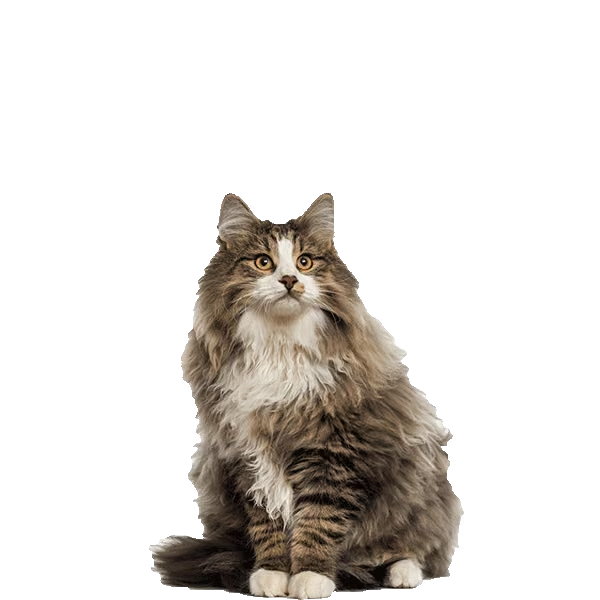
Norwegian Forest Cat
The Norwegian Forest Cat is a hardy, friendly mountain breed with a thick coat and a calm, gentle disposition well suited to family life.
- Size
- Large
- Lifespan
- 13–16 years
- Origin
- Norway
- Temperament
- Friendly
- Standard colors
- Black, White and Blue and 10 more
Characteristics
Coat and grooming
How the Norwegian Forest Cat coat is built, and what that means when you groom it.
- Coat layers
- Double coat
- Coat texture
- Silky
- Coat length
- Long
- Shedding
- Seasonal shedding
Grooming guidance
Critical: A Norwegian Forest Cat should not be shaved.
The undercoat keeps heat out as well as in, and the outer coat shields the skin from sun and insect bites. Clipping the whole coat off removes both. It often grows back patchy, soft or a different colour, and in some animals the guard hairs never return properly. Brush the undercoat out instead of cutting it off.
Caution: A Norwegian Forest Cat coat mats easily.
Fine or long hair tangles at the base of the coat, out of sight, where the mats tighten and pull on the skin. Brushing has to reach right down to the roots in sections, not just skim the surface.
Information: A Norwegian Forest Cat drops its undercoat in heavy bursts.
The undercoat comes out in heavy bursts over a few weeks. An undercoat rake, or a bath followed by a proper blow-dry, clears it far faster than daily brushing. Clipping the coat down is not a shortcut for this.
Norwegian Forest Cat colors and patterns
What each club's breed standard says about every Norwegian Forest Cat color and pattern. Point at a ruling to see the club's own wording.
Breed standards describe the Norwegian Forest Cat in Black, White, Blue, Lilac, Silver, Brown, Chocolate, Cinnamon, Red, Amber, Gold, Cream and Fawn. Standard patterns: Solid, Bicolour, Tricolour, Harlequin, Tabby, Mackerel tabby, Classic tabby, Spotted tabby, Ticked tabby, Tortoiseshell, Calico, Torbie, Van, Smoke, Shaded, Chinchilla and Caliby.
| Color or pattern | TICA | CFA | FIFE | GCCF | WCF |
|---|---|---|---|---|---|
| Black | Standard | Standard (“Black”) | Standard (“black”) | Standard (“Black”) | Standard |
| White | Standard | Standard (“White”) | Standard (“white”) | Standard (“White”) | Standard (“pure white”) |
| Blue | Standard | Standard (“Blue”) | Standard (“blue”) | Standard (“Blue”) | Standard |
| Lilac | Standard | Disqualifying (“lavender, lilac”) | Not recognised (“lilac”) | Not recognised (“Lilac”) | Not recognised (“lilac”) |
| Silver | No ruling | Standard (“Silver”) | Standard (“silver”) | Standard (“Silver”) | No ruling |
| Brown | Standard | Standard (“Brown Tabby”) | Standard (“black tabby”) | Standard (“Brown Tabby”) | No ruling |
| Chocolate | Standard | Disqualifying (“chocolate”) | Not recognised (“chocolate”) | Not recognised (“Chocolate”) | Not recognised (“chocolate”) |
| Cinnamon | Standard | Disqualifying (“cinnamon”) | Not recognised (“cinnamon”) | Not recognised (“Cinnamon”) | Not recognised (“cinnamon”) |
| Red | Standard | Standard (“Red”) | Standard (“red”) | Standard (“Red”) | Standard |
| Amber | No ruling | Standard (“Amber”) | Standard (“amber / light amber”) | Standard (“Amber”) | Standard (“amber”) |
| Gold | No ruling | Standard (“Golden”) | Standard (“golden”) | No ruling | No ruling |
| Cream | Standard | Standard (“Cream”) | Standard (“cream”) | Standard (“Cream”) | Standard |
| Fawn | Standard | Disqualifying (“fawn”) | Not recognised (“fawn”) | Not recognised (“Fawn”) | Not recognised (“fawn”) |
| Sable | No ruling | Disqualifying (“sable”) | No ruling | No ruling | No ruling |
| Caramel | No ruling | No ruling | No ruling | Not recognised (“Caramel”) | No ruling |
| Apricot | No ruling | No ruling | No ruling | Not recognised (“Apricot”) | No ruling |
| Patterns | |||||
| Solid | Standard (“Solid”) | Standard (“Solid”) | Standard (“solid”) | Standard (“Selfs”) | No ruling |
| Bicolour | Standard (“with white”) | Standard (“Solid Color and White”) | Standard (“bicolour”) | Standard (“Bicolour”) | Standard (“bicolour”) |
| Tricolour | Standard (“tri-color”) | No ruling | No ruling | No ruling | No ruling |
| Harlequin | No ruling | No ruling | Standard (“harlequin”) | Standard (“Harlequin Pattern”) | Standard (“harlequin”) |
| Tabby | Standard (“tabbies”) | No ruling | Standard (“tabby”) | Standard (“Tabby”) | No ruling |
| Mackerel tabby | No ruling | Standard (“Mackerel Tabby”) | Standard (“mackerel”) | Standard (“Mackerel Pattern”) | No ruling |
| Classic tabby | No ruling | Standard (“Classic Tabby”) | Standard (“blotched”) | Standard (“Classic Pattern”) | No ruling |
| Spotted tabby | No ruling | Standard (“Spotted Tabby”) | Standard (“spotted”) | Standard (“Spotted Pattern”) | No ruling |
| Ticked tabby | No ruling | Standard (“Ticked Tabby”) | Standard (“ticked”) | Standard (“Ticked Tabby Patten”) | No ruling |
| Tortoiseshell | No ruling | Standard (“Tortoiseshell”) | Standard (“tortie”) | Standard (“Black Tortoiseshell”) | No ruling |
| Calico | No ruling | Standard (“Calico”) | Standard (“tortie with white”) | No ruling | No ruling |
| Torbie | No ruling | Standard (“Patched Tabby”) | Standard (“tortie tabby”) | Standard (“Black Tortoiseshell Tabby”) | No ruling |
| Van | No ruling | Standard (“Van”) | Standard (“van”) | Standard (“Van Patterned”) | Standard (“van”) |
| Smoke | No ruling | Standard (“Smoke”) | Standard (“smoke”) | Standard (“Smoke”) | No ruling |
| Shaded | No ruling | Standard (“Shaded”) | Standard (“shaded”) | Standard (“Shaded”) | No ruling |
| Chinchilla | No ruling | Standard (“Chinchilla”) | Standard (“shell”) | No ruling | No ruling |
| Caliby | No ruling | Standard (“Calico”) | Standard (“tortie with white”) | No ruling | No ruling |
| Pointed | Not recognised | Disqualifying (“point-restricted”) | Not recognised (“pointed patterns”) | Not recognised (“Siamese pattern”) | Not recognised (“pointed pattern”) |
| Mink | Not recognised | No ruling | No ruling | No ruling | No ruling |
| Sepia | Not recognised | No ruling | No ruling | No ruling | No ruling |


| Color or pattern | TICA | CFA | FIFE | GCCF | WCF |
|---|---|---|---|---|---|
| Blue | Standard (“blue”) | Standard (“blue”) | Standard (“deep blue”) | Standard (“Blue eyed”) | Standard (“Blue”) |
| Hazel | Standard | No ruling | No ruling | No ruling | No ruling |
| Orange | Standard | No ruling | Standard (“copper or deep orange”) | Standard (“Orange eyed”) | No ruling |
| Copper | Standard | Standard (“copper”) | Standard (“copper or deep orange”) | No ruling | No ruling |
| Amber | Standard | No ruling | No ruling | No ruling | No ruling |
| Yellow | Standard | No ruling | No ruling | No ruling | No ruling |
| Gold | Standard | Standard (“gold”) | No ruling | No ruling | No ruling |
| Green | Standard | Standard (“green”) | Standard (“green”) | Standard (“Green eyed”) | No ruling |
| Patterns | |||||
| Odd-eyed | Standard (“Odd-eyes”) | Standard (“odd”) | Standard (“odd eyed”) | Standard (“Odd eyed”) | Standard (“odd”) |

| Color or pattern | CFA | GCCF |
|---|---|---|
| Black | Standard (“black desirable”) | Standard (“Solid black”) |
| Blue | Standard (“blue desirable”) | Standard (“Solid blue”) |
| Brown | Standard (“dark brown/charcoal-black”) | Standard (“Dark to light brown”) |
| Brick red | Standard (“brick red desirable”) | Standard (“Brick red”) |
| Pink | Standard (“pink desirable”) | Standard (“Pink”) |
| Color or pattern | CFA | GCCF |
|---|---|---|
| Black | Standard (“black desirable”) | Standard (“Solid black”) |
| Blue | Standard (“blue desirable”) | Standard (“Solid blue”) |
| Brown | Standard (“black or brown desirable”) | Standard (“solid brown”) |
| Brick red | Standard (“brick red desirable”) | No ruling |
| Pink | Standard (“pink desirable”) | Standard (“Pink”) |
What the rulings mean
- Standard
- Described by the club's breed standard.
- Disqualifying
- The club's breed standard disqualifies an animal of this colour or pattern.
- Not recognised
- The club does not accept this colour or pattern for the breed.
Color changes
How a Norwegian Forest Cat's colors can change over its life.
Brownchanges toCopal
Coat · With age · from 0 to 52 weeks
Blackchanges toRusset
Coat · Progressive
Tabbychanges toSolid
Coat · With age · from 0 to 39 weeks
Whitechanges toShaded
Coat · With age
Whitechanges toChinchilla
Coat · With age
Tabbychanges toShaded
Coat · With age · from 0 to 6 weeks
Tabbychanges toChinchilla
Coat · With age · from 0 to 6 weeks
Bluechanges toTortoiseshell
Coat · With age
Blackchanges toBrown
Coat · With body condition · can change back
Blackchanges toBrown
Coat · In the sun · can change back
Blackchanges toBrown
Coat · Progressive
Whitechanges toPointed
Coat · With age · from 1 to 52 weeks
Solidchanges toSmoke
Coat · With age · from 3 to 104 weeks
Bluechanges toGreen
Eyes · With age · from 4 to 17 weeks
Bluechanges toYellow
Eyes · With age · from 4 to 17 weeks
Bluechanges toGold
Eyes · With age · from 4 to 17 weeks
Bluechanges toCopper
Eyes · With age · from 4 to 17 weeks
Bluechanges toOrange
Eyes · With age · from 4 to 17 weeks
Bluechanges toHazel
Eyes · With age · from 4 to 17 weeks
Bluechanges toAmber
Eyes · With age · from 4 to 17 weeks
Pinkchanges toSeal
Nose · With age · from 1 to 52 weeks
Pinkchanges toBlue
Nose · With age · from 1 to 52 weeks
Pinkchanges toChocolate
Nose · With age · from 1 to 52 weeks
Pinkchanges toLilac
Nose · With age · from 1 to 52 weeks
Pinkchanges toSeal
Paw pads · With age · from 1 to 52 weeks
Pinkchanges toBlue
Paw pads · With age · from 1 to 52 weeks
Pinkchanges toChocolate
Paw pads · With age · from 1 to 52 weeks
Pinkchanges toLilac
Paw pads · With age · from 1 to 52 weeks
Sources
Each ruling comes from the club's published breed standard or color list.
About the Norwegian Forest Cat
The Norwegian Forest Cat is a large, long-haired breed from Norway, prized for a thick weatherproof coat and a calm, sociable nature that suits family homes.
The Norwegian Forest Cat is a large, sturdy breed that took shape in the cold forests of Norway. It carries a dense double coat, a full ruff around the neck, and a long bushy tail, features that suited it to hard northern winters. Males commonly reach 5.5 to 7 kg, and some larger individuals weigh more, which places the breed among the bigger domestic cats.
For all its rugged build, the breed is even-tempered and companionable. Owners describe it as friendly, gentle, and calm, with steady patience around children. It tends to attach to the whole household rather than one person, and it usually tolerates other cats and dogs once introductions are handled at an unhurried pace.
This is a slow-maturing cat. A Norwegian Forest Cat may not reach full size and coat development until roughly four to five years of age, so the kitten you raise keeps filling out well into adulthood.
| Attribute | Detail |
|---|---|
| Origin | Norway |
| Size | Large |
| Lifespan | 13 to 16 years |
| Group/role | Companion cat, long-haired natural breed |
| Good with | Children, other cats, and cat-friendly dogs |
Who it suits
The Norwegian Forest Cat fits families that want a large, calm companion and can commit to regular coat care. It enjoys climbing and watching from a height, so a home with cat trees or solid shelving suits it well. Quiet households and busy family homes both work, since the cat is adaptable and not overly demanding of attention.
History and origin
The Norwegian Forest Cat is a natural breed from Norway, woven into Scandinavian folklore for centuries and formally recognised as a breed in the twentieth century.
The Norwegian Forest Cat is a natural breed, which means it developed over a long stretch through adaptation to its surroundings rather than from deliberate crossing. Long-haired cats feature in Norwegian folklore and rural life going back centuries, valued as working cats on farms and ships for keeping rodents down.
The cold, wet climate of Norway shaped the breed's physical traits. A dense, water-resistant double coat, tufted ears, and large paws helped these cats come through winters outdoors. Many of those features carry through to the modern breed.
For much of its past the breed existed only as a regional farm cat. By the early twentieth century, interest grew in preserving it as a distinct type, though two world wars and crossbreeding with free-roaming domestic cats put its identity at risk. Organised breeding programmes in Norway worked to steady the type and keep it from vanishing.
The breed earned formal recognition from European cat registries in the 1970s, and it was later accepted by registries in other countries. The Norwegian Forest Cat is now established internationally while remaining a point of national pride in Norway.
Appearance and breed standard
The Norwegian Forest Cat is a large, muscular cat with a dense double coat, a thick neck ruff, tufted ears, and a long bushy tail.
The Norwegian Forest Cat has a strong, athletic build with a long body, substantial bone, and powerful legs. The hind legs sit slightly higher than the front legs, which gives the cat a capable climbing stance. The head forms an equilateral triangle, with a straight profile and large, well-tufted ears.
The coat is the breed's most telling feature. It pairs a woolly undercoat with a long, smooth, water-resistant top coat. A full ruff frames the neck and chest, and the tail is long and heavily furred. Coat thickness shifts with the season, growing heavier in winter and shedding back in the warmer months.
| Trait | Standard |
|---|---|
| Height | 23 to 30 cm at the shoulder |
| Weight | Males 5.5 to 7 kg, females 3.5 to 5.5 kg |
| Coat | Long, dense double coat with neck ruff and bushy tail |
| Colours | Most colours and patterns except colourpoint, including tabby, solid, bicolour, and tortoiseshell |
| Eyes | Large, almond-shaped, in shades of green, gold, copper, and blue (blue or odd-eyed in some white cats) |
Coat and colours
The breed comes in a wide range of colours and patterns. Brown tabby with white is common, but solids, smokes, silvers, and tortoiseshells also turn up. Colourpoint patterns are not accepted in the breed standard. Eye colour usually tracks coat colour, with green, gold, and copper most frequent, while white cats may show blue or odd-coloured eyes.
Temperament and personality
The Norwegian Forest Cat is friendly, gentle, and calm, patient with children and steady in its sociable attitude towards people and other pets.
The Norwegian Forest Cat has a balanced, easygoing temperament. It is friendly and affectionate without being clingy, and it tends to stay near family members rather than insist on constant lap time. Many individuals follow their people from room to room and settle nearby to keep an eye on the household.
With children, the breed is gentle and patient, which makes it a dependable family cat when interactions are supervised and respectful. With strangers, most are calm and curious rather than skittish, though a quiet cat may take its time warming to new visitors. The breed usually accepts other cats and cat-friendly dogs after a gradual introduction.
These cats are clever and enjoy climbing, exploring, and working things out. They keep a working cat's instinct for hunting and like to perch high to survey their surroundings. They are generally quiet, using a soft voice rather than frequent loud calls.
| Trait | Rating |
|---|---|
| Affection | 4 |
| Energy | 3 |
| Trainability | 3 |
| Vocalness | 2 |
| Shedding | 4 |
Care and grooming
The Norwegian Forest Cat needs regular brushing of its double coat, room to climb, and extra attention during heavy seasonal shedding.
Grooming
- Brush the coat two to three times a week to keep mats from forming and to lift loose undercoat.
- Step brushing up to daily during spring and autumn shedding, when the undercoat comes out in quantity.
- Check the ruff, behind the legs, and the belly, where tangles gather most often.
- Trim nails every two to three weeks and check ears for wax or debris.
- Bathing is seldom needed, since the coat is water-resistant and largely looks after itself.
Exercise
- Provide tall cat trees and solid shelves so the cat can climb and perch.
- Use interactive toys and short play sessions to keep the cat active.
- Offer scratching posts to spare the furniture and support natural behaviour.
- Rotate puzzle feeders or foraging toys to keep the cat's problem-solving instinct occupied.
Environment
The Norwegian Forest Cat settles into most homes but does best with vertical space and a few quiet retreats. It handles cold well thanks to its coat, but it should still live indoors or in a secure outdoor enclosure to keep it safe from traffic, predators, and disease. The breed takes family activity in its stride and is comfortable in multi-pet households.
Nutrition and feeding
The Norwegian Forest Cat needs a complete, protein-rich diet sized to its large frame, with portions adjusted by life stage and activity to prevent excess weight.
As a large, slow-maturing breed, the Norwegian Forest Cat does well on a complete and balanced diet built around animal protein. Kittens need extra kilojoules to support long growth that can carry on for several years, while adults need controlled portions to hold off weight gain. Always keep fresh water available, and choose a food formulated to meet recognised nutritional standards for the cat's life stage.
| Life stage | Amount per day | Meals |
|---|---|---|
| Kitten (2 to 12 months) | Follow product guidance for growth, fed to appetite | 3 to 4 |
| Adult (1 to 7 years) | Roughly 250 to 320 calories, adjusted to weight and activity | 2 |
| Senior (7 years and older) | Adjusted to hold a healthy weight, often slightly less | 2 |
Treats and supplements
Keep treats to no more than about 10 percent of daily calories to guard against weight gain in this large breed. Most healthy cats on a complete diet need no supplements. Speak to a vet before adding anything, since needs depend on age, health, and the base diet.
Health and lifespan
The Norwegian Forest Cat is generally healthy with a lifespan of 13 to 16 years, though a few inherited conditions warrant screening and routine veterinary care.
The Norwegian Forest Cat is a hardy breed with a typical lifespan of 13 to 16 years, and many cats live comfortably within that range with good care. Like all pedigree cats, it carries some risk of inherited conditions, so buying from breeders who screen their breeding cats lowers the chance of passing on disease. Routine vet visits help catch problems early.
| Condition | Signs | Note |
|---|---|---|
| Hypertrophic cardiomyopathy | Lethargy, rapid breathing, reduced activity | Heart muscle disease; picked up by veterinary cardiac screening |
| Glycogen storage disease type IV | Weakness, tremors, failure to thrive in kittens | Inherited metabolic disorder; a DNA test lets breeders avoid affected litters |
| Hip dysplasia | Stiffness, reluctance to jump, altered gait | Joint condition seen in some large breeds; managed with weight control and care |
| Polycystic kidney disease | Increased thirst, weight loss, poor appetite | Kidney condition; screening lowers risk in breeding lines |
Preventive care
- Book annual veterinary check-ups, with more frequent visits for senior cats.
- Keep vaccinations and parasite control up to date.
- Hold a healthy weight to protect the joints and the heart.
- Provide regular dental care to keep gum disease at bay.
- Ask breeders for DNA test results for glycogen storage disease type IV and for cardiac and kidney screening.
Training and enrichment
The Norwegian Forest Cat is clever and responds well to short, reward-based training for litter habits, handling, and simple tricks.
The Norwegian Forest Cat is clever and curious, which makes it open to training when sessions are short and rewarding. It picks up household routines quickly and can be taught to use scratching posts, accept grooming, and come when called. Training also gives this active, climbing-minded cat useful mental work.
Basics
- Start litter training early in a quiet, accessible spot, and keep the tray clean.
- Reward use of scratching posts and cat trees to redirect natural behaviour.
- Introduce a carrier with treats and short sessions so travel and vet visits stay calmer.
- Practise gentle handling of paws, ears, and coat so grooming is accepted.
- Teach simple cues such as come or sit with a treat and a consistent word.
Breeding and raising kittens
The Norwegian Forest Cat matures slowly, with a roughly nine-week gestation and litters that commonly number three to five kittens needing careful early socialisation.
The Norwegian Forest Cat reaches sexual maturity around 7 to 12 months, but breeders often wait until cats are physically and behaviourally mature before mating, given the breed's slow development. Responsible breeding pairs cats that have been health screened for known inherited conditions.
Gestation lasts about 63 to 67 days. Litters commonly hold three to five kittens, though size varies. Kittens are born blind and dependent, opening their eyes at around one to two weeks and starting to explore as they grow.
Early socialisation matters. Handling, gentle exposure to household sounds, and contact with people during the first weeks help kittens grow into confident, friendly adults. Kittens should stay with the mother and litter until at least 12 weeks so they finish weaning and learn social behaviour. Because this breed matures slowly, full coat and adult size keep developing for several years after kittenhood.
| Metric | Value |
|---|---|
| Sexual maturity | 7 to 12 months |
| Gestation | 63 to 67 days |
| Average litter size | 3 to 5 kittens |
| Eyes open | 1 to 2 weeks |
| Weaning | Around 8 to 10 weeks |
| Recommended rehoming age | 12 weeks or older |
| Full maturity | 4 to 5 years |
A registered Norwegian Forest Cat: the record behind the chip
Free lifetime registration for your Norwegian Forest Cat with United Pet Club, searchable by every SPCA branch, at home and abroad.
Registering a Norwegian Forest Cat in South Africa
A gate left open for the gardener is all it takes for a homebody Norwegian Forest Cat to go missing. Her free United Pet Club profile keeps your details one scan away, wherever she turns up. Register your cat once, free, and the record outlasts every house move.
A scanner reads your Norwegian Forest Cat's chip in seconds; the registry decides whether the reading goes anywhere. Capture the 15-digit number in your free United Pet Club account and it goes straight to your phone. Free for life, every brand accepted, every update free. Microchip registration closes the loop.
How do I register my Norwegian Forest Cat in South Africa?
Sign up for a free United Pet Club account, add her name, colouring, and a photo, and save. The lifetime plan holds the profile at no cost for her whole life, indoors or out.
How do I register my Norwegian Forest Cat's microchip?
Capture the 15-digit number from your vet's paperwork in your free account with your current contact details. The plan accepts every chip brand and never charges for the record or its updates.
Do cats have to be microchipped in South Africa?
No law requires it, but the SPCA recommends it and shelters chip on adoption as a matter of course. A chip only speaks for a Norwegian Forest Cat once the number is registered, and that registration is free here.
What does registering a Norwegian Forest Cat cost?
Not a rand. Profile, microchip record, and every update are covered by the free lifetime plan, with nothing to renew.
Frequently asked questions
Common questions about the Norwegian Forest Cat cover its size, temperament, grooming needs, lifespan, family suitability, and availability.
How big does a Norwegian Forest Cat get?
It is a large breed. Males commonly weigh 5.5 to 7 kg and females 3.5 to 5.5 kg, with some males larger. The breed reaches full size slowly, often by four to five years of age.
What is the Norwegian Forest Cat's temperament like?
It is friendly, gentle, and calm. The breed bonds with the whole family, is patient with children, and is generally quiet rather than demanding.
Is the Norwegian Forest Cat hard to care for?
Care is moderate. The main commitment is brushing the double coat two to three times a week, and daily during seasonal shedding. Otherwise the breed is hardy and adaptable.
How long do Norwegian Forest Cats live?
Most live 13 to 16 years with good nutrition, regular veterinary care, and a healthy weight.
Are Norwegian Forest Cats good family pets?
Yes. Their gentle, patient nature suits households with children, and they usually get on with other cats and cat-friendly dogs after a gradual introduction.
Do Norwegian Forest Cats shed a lot?
They shed moderately year-round and heavily during spring and autumn, when the woolly undercoat is released. Regular brushing handles most loose hair.
Where can I get a Norwegian Forest Cat?
They are available from registered breeders, such as those listed with the Southern Africa Cat Council (SACC), who health screen their cats, and occasionally through breed-specific rescue. Ask for screening results for cardiac, kidney, and glycogen storage disease type IV before buying.
From the community
Ask about the Norwegian Forest CatNo questions about the Norwegian Forest Cat yet. Be the first to ask.
Browse Cat breeds