

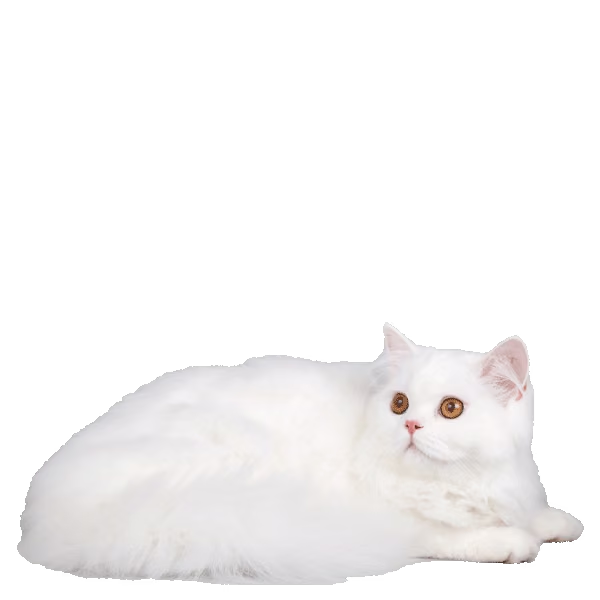
Highlander
The Highlander is a playful, affectionate breed distinguished by its curled ears, bobbed tail, and outgoing, dog-like personality.
- Size
- Large
- Lifespan
- 10–15 years
- Origin
- United States
- Temperament
- Playful
- Standard colours
- Black, White and Blue and 12 more
Characteristics
Coat and grooming
How the Highlander coat is built, and what that means when you groom it.
- Coat layers
- Double coat
- Coat texture
- Plush
- Coat length
- Medium
- Shedding
- Moderate shedding
Grooming guidance
Critical: A Highlander should not be shaved.
The undercoat keeps heat out as well as in, and the outer coat shields the skin from sun and insect bites. Clipping the whole coat off removes both. It often grows back patchy, soft or a different colour, and in some animals the guard hairs never return properly. Brush the undercoat out instead of cutting it off.
Highlander colours and patterns
What each club's breed standard says about every Highlander colour and pattern. Point at a ruling to see the club's own wording.
Breed standards describe the Highlander in Black, White, Blue, Lilac, Silver, Platinum, Brown, Chocolate, Seal, Sable, Cinnamon, Red, Cream, Fawn and Champagne. Standard patterns: Solid, Pointed, Tabby, Mackerel tabby, Classic tabby, Spotted tabby, Ticked tabby, Tortoiseshell, Torbie, Mink, Sepia, Smoke and Shaded.
| Colour or pattern | TICA | ACFA |
|---|---|---|
| Black | Standard | Standard (“Black”) |
| White | Standard | Not recognised (“White”) |
| Blue | Standard | Standard (“Blue”) |
| Lilac | Standard | No ruling |
| Silver | Standard (“Silver/Smoke”) | Standard (“Silver Tabby”) |
| Platinum | Standard | No ruling |
| Brown | Standard | Standard (“Brown Tabby”) |
| Chocolate | Standard | No ruling |
| Seal | Standard | Standard |
| Sable | Standard | Standard |
| Cinnamon | Standard | No ruling |
| Red | Standard | Standard (“Red”) |
| Cream | Standard | Standard (“Cream”) |
| Fawn | Standard | No ruling |
| Champagne | Standard | No ruling |
| Patterns | ||
| Solid | Standard (“Solid”) | Standard (“Solid Colors”) |
| Pointed | Standard (“Pointed”) | Standard (“Pointed”) |
| Tabby | Standard (“Tabby”) | No ruling |
| Mackerel tabby | No ruling | Standard (“McTabby”) |
| Classic tabby | No ruling | Standard (“Classic Tabby”) |
| Spotted tabby | No ruling | Standard (“Spotted Tabby”) |
| Ticked tabby | No ruling | Standard (“Ticked Tabby”) |
| Tortoiseshell | Standard (“Tortie”) | Standard (“Tortoiseshell”) |
| Torbie | No ruling | Standard (“Patched Tabby”) |
| Mink | Standard (“Mink”) | Standard (“Mink”) |
| Sepia | Standard (“Sepia”) | Standard (“Sepia”) |
| Smoke | Standard (“Silver/Smoke”) | Standard (“Smoke”) |
| Shaded | No ruling | Standard (“Shaded”) |
| Bicolour | No ruling | Not recognised (“And White”) |


What the rulings mean
- Standard
- Described by the club's breed standard.
- Not recognised
- The club does not accept this colour or pattern for the breed.
Colour changes
How a Highlander's colours can change over its life.
Brownchanges toCopal
Coat · With age · from 0 to 52 weeks
Blackchanges toRusset
Coat · Progressive
Tabbychanges toSolid
Coat · With age · from 0 to 39 weeks
Whitechanges toShaded
Coat · With age
Whitechanges toChinchilla
Coat · With age
Tabbychanges toShaded
Coat · With age · from 0 to 6 weeks
Tabbychanges toChinchilla
Coat · With age · from 0 to 6 weeks
Bluechanges toTortoiseshell
Coat · With age
Blackchanges toBrown
Coat · With body condition · can change back
Blackchanges toBrown
Coat · In the sun · can change back
Blackchanges toBrown
Coat · Progressive
Whitechanges toPointed
Coat · With age · from 1 to 52 weeks
Solidchanges toSmoke
Coat · With age · from 3 to 104 weeks

Sources
Each ruling comes from the club's published breed standard or colour list.
Highlander breed standard
What each club's standard asks of the Highlander: size, build and forms. A club speaks only for itself, and a figure no club published is left out.
Measurements


Conformation
Head shape
Broad
“Wide, inverted pear-shaped head”
Muzzle shape
Square
“whisker pads should make the muzzle appear squared”
Eye shape
Oval
“Slightly flattened or hooded oval in shape”
Eye shape
Oblique
“Set on a slight bias”
Eye set
Wide-set
“set far apart”
Eye size
Medium
“Medium to large sized”
Eye size
Large
“Medium to large sized”
Ear carriage
Curled back
“flexible ear tips curled back”
Ear carriage
Erect (prick)
“as erect as possible”
Ear set
LowFault
“ears too small or low set”
Ear size
Small
“Small to medium in size”
Ear size
Medium
“Small to medium in size”
Ear tip
Rounded
“ear tips more rounded than pointed”
Ear tip
Tufted (lynx tips)
“ear tufts are desired but not required”
Leg length
Medium
“Medium in length, back legs longer than front”
Body type
Rectangular
“Rectangular in shape”
Bone and substance
Heavy
“Moderately heavy and substantial”
Feet
Cat foot
“Medium to large, rounded with large knuckles”
Toes
Polydactyl (extra toes)Disqualifying
“Polydactyl”
Tail length
Short
“Shortened and thick”
Tail length
LongDisqualifying
“Full length tail”
Tail length
TaillessDisqualifying
“No tail or docked”
Tail shape
KinkedAlternate
“Kinks and curls are allowed”
Tail shape
StraightAlternate
“no point difference between straight or kinked tails”


Markings


Parts of the body


About the Highlander cat
The Highlander is a large, affectionate cat from the United States, recognised by its curled ears, short bobbed tail, and outgoing, dog-like temperament.
The Highlander is a large domestic cat that was developed in the United States during the mid-2000s. Two things mark it out from other cats: ears that curl loosely backwards at the tips and a naturally short, bobbed tail. Its body is muscular and solid, and many Highlanders hold onto a kitten-like appetite for play long after they have grown up.
Most Highlanders sit at the larger end of the scale for domestic cats, and toms are heavier than queens. The coat comes in a short and a long version, and the face carries a broad muzzle with a strong chin that lends it an alert, open look. For plenty of owners the personality is the real appeal. This is a curious, people-oriented, active cat that likes to trail household members from room to room.
People call the Highlander dog-like because so many enjoy a game of fetch, pick up simple cues, and come to greet visitors rather than slip away and hide. It is still a fairly young breed, so registry recognition and breeding numbers remain smaller than you would find with long-established cats.
| Attribute | Detail |
|---|---|
| Origin | United States |
| Size | Large |
| Lifespan | 10 to 15 years |
| Role | Companion and family cat |
| Good with | Children, dogs, and other cats when introduced properly |
Who it suits
The Highlander fits an active household that wants an involved, interactive cat rather than a standoffish one. It settles well into family life, including homes with children and other pets, because it is sociable and easygoing. Anyone who is out of the house for long stretches each day should plan for company or a second pet, as this cat looks for attention and play.
History and origin of the Highlander
The Highlander is a recent American breed created in the mid-2000s by crossing curl-eared and bobtailed cats, aiming for a large, friendly companion.
The Highlander is a modern breed that came together in the United States. The breeding work behind it started around 2004, which places it among the younger pedigree cats. Breeders were after a large, sturdy animal with curled ears, a short tail, and a sociable nature.
The breed was assembled from crosses of curl-eared cats and bobtailed cats. Both the curled ear and the short tail trace back to that founding stock, and breeders selected for these features alongside size and a friendly disposition. In the early days the breed was sometimes registered under a different working name before Highlander stuck.
The International Cat Association followed the breed through its development programme, the route new breeds take as they work towards full recognition. Numbers built up slowly, and the Highlander is still less common than the established breeds.
Since the breed is so recent, its written record is short and centred on the work of the founding breeders. Pedigrees, registry classes, and the standard are all being refined as the population grows. In South Africa a Highlander would be registered through TICA channels, since the breed does not yet feature in most South African Cat Council listings.
Appearance and breed standard
The Highlander is a large, muscular cat with loosely curled ears, a short bobbed tail, a broad muzzle, and a coat in short and long lengths across many colours.
The Highlander is a large, powerfully built cat. Its body is long and muscular with a deep chest, and the hind legs run slightly longer than the front legs. Two features give the breed away: the ears, which curl gently backwards, and the tail, which is naturally short and often carried high.
The head is broad with a forehead that runs flat to gently rounded, prominent whisker pads, and a strong, deep chin. The eyes are large and set wide apart, which gives the face an open, alert expression.
| Trait | Standard |
|---|---|
| Height | Roughly 25 to 30 cm at the shoulder |
| Weight | About 4.5 to 9 kg, toms heavier than queens |
| Coat | Short or long, dense and soft |
| Colours | Many colours and patterns, with tabby patterns common |
| Eyes | Large, wide-set, colour in proportion to coat |
Coat and colours
The coat turns up in two lengths. The shorthair version is dense and lies close to the body, while the longhair version is longer and softer with feathering on the tail and legs. A broad range of colours and patterns is accepted, and tabby markings show up often. Whatever the length, the coat stays fairly low-maintenance for a cat of this size.
What the Highlander standard says, club by club
Tail length for the Highlander: ACFA over 5.1 cm; TICA over 5.1 cm.
Clubs set their own figures for the Highlander. These come from each club's published standard: ACFA, TICA.
Size
- Tail length: ACFA over 5.1 cm; TICA over 5.1 cm
Build and forms
At least one club accepts each of these:
- Head shape: Broad
- Muzzle shape: Square
- Eye shape: Oval, Walnut, Oblique
- Eye set: Wide-set
- Eye size: Medium, Large
- Ear carriage: Curled back, Erect (prick)
- Ear size: Small, Medium
- Ear tip: Rounded, Tufted (lynx tips)
- Leg length: Medium
- Body type: Rectangular
Forms the clubs penalise
A fault or a disqualification is a judgment under a show standard. It can affect placings and, at some clubs, registration.
- Disqualifying: Toes: Polydactyl (extra toes) (ACFA, TICA); Tail length: Long (ACFA, TICA); Tail length: Tailless (TICA)
- Fault: Ear set: Low (ACFA, TICA)
Markings
Each club's ruling on the breed's named marks:
- Locket: Disqualifying (ACFA, TICA)
See every point side by side: compare the clubs.
Rulings come from each club's published breed standard, and clubs revise their standards. Before a show or a registration, check the current text with the club.
What does each club give for Tail length in the Highlander?
Tail length: ACFA over 5.1 cm; TICA over 5.1 cm.
Which forms do clubs penalise in the Highlander?
Disqualifying: Toes: Polydactyl (extra toes) (ACFA, TICA); Tail length: Long (ACFA, TICA); Tail length: Tailless (TICA). Fault: Ear set: Low (ACFA, TICA).
Which Highlander colours the clubs accept
Every club we track accepts Black, Blue, Silver, Brown, Seal, Sable for the Highlander.
On the Highlander, every club we track agrees on Black, Blue, Silver, Brown, Seal, Sable. Clubs compared: ACFA, TICA.
Patterns listed as standard for the Highlander: Solid, Pointed, Tabby, Mackerel tabby, Classic tabby, Spotted tabby.
Where the clubs split
At least one club accepts each of these, and at least one other penalises or refuses it.
- White: Standard (TICA); Not recognised (ACFA)
Rulings come from each club's published breed standard, and clubs revise their standards. Before a show or a registration, check the current text with the club.
Which Highlander colours do all the clubs accept?
All of these clubs accept Black, Blue, Silver, Brown, Seal, Sable: ACFA, TICA.
Do clubs disagree about Highlander colours?
Yes. Clubs rule differently on White.
Temperament and personality
The Highlander is outgoing, affectionate, and playful, often described as dog-like for its sociability with people, children, and other pets.
The Highlander is friendly and firmly people-focused. It likes to stay close to the household, joins in with whatever is going on, and comes to greet visitors instead of backing away. That playful streak carries on through adulthood, and the breed enjoys games, climbing, and interactive toys.
Around the family the Highlander is affectionate and often angles for a lap or a bit of attention. With strangers most cats are confident and curious rather than shy. With children it is usually patient and tolerant, though youngsters should still be shown how to handle a cat gently. With other pets, dogs and cats alike, the Highlander generally settles in well when introductions are taken slowly.
The dog-like tag comes from habits such as fetching toys, following owners about, and answering to simple cues. This is a social cat that prefers company to long spells on its own.
| Trait | Rating |
|---|---|
| Affection | 5 |
| Energy | 4 |
| Trainability | 4 |
| Vocalness | 3 |
| Shedding | 3 |
Care and grooming
The Highlander needs routine brushing, daily active play, and a stimulating indoor space, with grooming demands that vary by short or long coat.
Grooming
- Brush a shorthair Highlander about once a week to lift out loose hair.
- Brush a longhair Highlander two to three times a week to head off mats, paying extra attention to the tail feathering and behind the ears.
- Check the curled ears weekly and clean them gently if wax builds up, since the curl can gather debris.
- Trim the nails every two to three weeks and keep scratching posts on hand.
- Brush the teeth regularly and book dental checks.
Exercise
- Set aside two play sessions a day with wand toys, balls, or a game of fetch.
- Provide climbing furniture such as cat trees and shelves that put the breed's strength and energy to use.
- Rotate puzzle feeders and toys to keep the cat interested.
- Think about a second pet or supervised harness time for extra activity.
Environment
The Highlander suits an indoor home with vertical space to climb and perches by the windows. Because it is so social, it does best where someone is around for part of the day or where it has an animal companion. Keep a few quiet hiding spots available too, so the cat can rest undisturbed.
Grooming a Highlander
The Highlander coat: Double coat, Plush, Medium, Moderate shedding. Main grooming rule: Do not shave.
Most of what a Highlander needs from grooming follows from its coat.
- Coat layers: Double coat
- Coat texture: Plush
- Coat length: Medium
- Shedding: Moderate shedding
What this coat asks of you
- A double coat has a soft undercoat beneath longer guard hairs. Brush right down to the undercoat, because that is the layer that packs down and traps loose hair.
- A plush coat is dense and soft, so a gentle brush that reaches the base of the hair works better than a stiff one.
- Medium-length hair starts to tangle wherever it rubs, so pay attention to those spots.
- Moderate shedding goes on through the year, and regular brushing catches most of it before it lands on the furniture.
What to tell a groomer
Mention these when you book. The coat notes on this page explain each one.
- Do not shave
A groomer who knows the breed can adapt all of this to the individual animal. Sore skin, mats pressed against the skin or a sudden change in the coat are worth showing to a vet.
What kind of coat does a Highlander have?
On our records: Coat layers: Double coat; Coat texture: Plush; Coat length: Medium; Shedding: Moderate shedding.
How much does a Highlander shed?
Moderate shedding goes on through the year, and regular brushing catches most of it before it lands on the furniture.
What should a groomer know about a Highlander?
These grooming rules apply: Do not shave.
Nutrition and feeding
The Highlander needs a complete, protein-forward cat diet portioned to its large frame and activity level, with fresh water always on hand.
The Highlander does well on a complete and balanced cat food built around animal protein. As a large, active cat it may get through more than an average-sized breed, but portions still need to match age, weight, and activity so it does not put on excess weight. Wet and dry foods both work, and many owners run a mix of the two. Fresh water should always be within reach.
| Life stage | Amount per day | Meals |
|---|---|---|
| Kitten (to 12 months) | Per label, fed to appetite while growing | 3 to 4 |
| Adult (1 to 7 years) | About 60 to 90 g dry or equivalent wet | 2 |
| Senior (7 years and older) | Adjusted to weight and activity | 2 |
Treats and supplements
Hold treats to roughly 10 percent of daily calories and trim meal portions to match. A cat on a complete diet usually needs no extra supplements, though a vet may suggest joint support for a large, ageing cat or a coat supplement in certain cases. Bring in any new food slowly over several days.
Health and common conditions
The Highlander generally lives 10 to 15 years; routine veterinary care, weight control, and attention to the ears support a healthy life.
The Highlander is generally a healthy breed with a typical lifespan of 10 to 15 years. As a young breed its long-term health picture is still being pieced together, and responsible breeders screen their breeding cats and steer clear of pairings that could push the ear curl or the tail to the point of discomfort. Routine veterinary care, vaccinations, parasite control, and a healthy weight are the groundwork for a healthy cat.
| Condition | Signs | Note |
|---|---|---|
| Ear infections | Scratching, odour, discharge, head shaking | The curled ear can trap debris, so keep the ears clean and dry |
| Obesity | Weight gain, low activity, trouble grooming | Common in large indoor cats; control portions and play daily |
| Dental disease | Bad breath, drooling, reluctance to eat | Regular brushing and dental checks help prevent it |
| Hypertrophic cardiomyopathy | Lethargy, fast breathing, weakness | A heart condition seen across many cat breeds; vet screening helps |
Preventive care
- Annual veterinary exams, moving to twice-yearly visits for senior cats.
- Core vaccinations and parasite prevention kept on schedule.
- Weekly ear checks with gentle cleaning when needed.
- Weight monitoring and portion control.
- Routine dental care at home and at the clinic.
Training and enrichment
The Highlander is intelligent and people-oriented, which makes it one of the more trainable cats for cues, fetch, and harness walking using reward-based methods.
The Highlander's curiosity and its bond with people leave it open to training. Many learn to fetch, come when called, and answer to simple cues. Short, upbeat sessions work best, and that playful nature can be put to work to keep training enjoyable. Litter training tends to be straightforward with a clean box in a quiet corner.
Basics
- Start with a single cue, such as a name response, and reward every success.
- Keep sessions short, around two to five minutes, and finish on a win.
- Use a clicker or a marker word so the cat ties the action to the reward.
- Build up to tricks like sit, high five, or fetch once the basics are solid.
- Introduce a harness indoors before any outdoor walks, letting the cat set the pace.
Breeding and raising kittens
Highlander breeding focuses on health and temperament alongside the curled ear and bobbed tail, with care taken not to exaggerate either trait.
Cats reach sexual maturity at a few months of age, though responsible breeders hold off until a cat is physically mature and health-screened before breeding. Pregnancy in cats runs roughly 63 to 67 days, and litters are commonly three to five kittens.
With the Highlander, breeding sets out to keep the ear curl and the short tail within a healthy range while protecting overall structure, temperament, and vigour. Because both signature traits come from specific genetics, careful pairing matters so that the curl and the tail stay moderate and never affect the cat's comfort.
Kittens are born with straight ears that start to curl over the first weeks. They should stay with the mother and litter until around 12 weeks, so they are weaned, socialised, and started on vaccinations before they move to new homes. Early handling helps support the breed's sociable nature.
| Metric | Value |
|---|---|
| Sexual maturity | Around 5 to 10 months |
| Gestation | About 63 to 67 days |
| Average litter size | 3 to 5 kittens |
| Weaning age | About 8 weeks |
| Recommended rehoming age | About 12 weeks |
A registered Highlander: the record behind the chip
Free lifetime registration for your Highlander with United Pet Club, searchable by every SPCA branch, at home and abroad.
Registering a Highlander in South Africa
Every stray that reaches an SPCA branch gets scanned, and the scan only helps when a registry answers with a name and number. Give your Highlander that answer: a free United Pet Club profile, good for her whole life, indoor cat or garden wanderer. Registering your cat takes minutes and never carries a fee.
If a chip is already under her skin, finish the job by recording the number. Register the microchip on the free lifetime plan: any brand a South African vet implants is accepted, updating after a move between provinces costs nothing, and the record is searchable around the clock. Create your free account and cover cat and chip together.
How do I register my Highlander in South Africa?
Sign up for a free United Pet Club account, add her name, colouring, and a photo, and save. The lifetime plan holds the profile at no cost for her whole life, indoors or out.
How do I register my Highlander's microchip?
Capture the 15-digit number from your vet's paperwork in your free account with your current contact details. The plan accepts every chip brand and never charges for the record or its updates.
Do cats have to be microchipped in South Africa?
No law requires it, but the SPCA recommends it and shelters chip on adoption as a matter of course. A chip only speaks for a Highlander once the number is registered, and that registration is free here.
What does registering a Highlander cost?
Not a rand. Profile, microchip record, and every update are covered by the free lifetime plan, with nothing to renew.
Frequently asked questions
Common questions about the Highlander cat cover its size, temperament, care needs, lifespan, suitability for families, and availability.
How big does a Highlander cat get?
The Highlander is a large breed. Many adults weigh between about 4.5 and 9 kg, with males larger than females, on a muscular, substantial frame.
What is the Highlander's personality like?
It is outgoing, affectionate, and playful, and is often called dog-like because it follows people, greets visitors, and can learn fetch and simple cues.
Is the Highlander hard to care for?
Care is moderate. The shorthair needs weekly brushing and the longhair a few times a week, the curled ears need regular gentle checks, and the cat needs daily active play.
How long do Highlander cats live?
The typical lifespan is 10 to 15 years with routine veterinary care, a healthy weight, and good dental and ear hygiene.
Is the Highlander good with children and other pets?
Yes. It is generally sociable and tolerant with children, dogs, and other cats when introductions are made gradually.
Are Highlander cats easy to find in South Africa?
They are relatively uncommon, since the breed is recent and bred in smaller numbers, so tracking down a kitten from a reputable breeder may take time and a waitlist.
Why do Highlanders have curled ears and short tails?
Both traits come from the breed's founding genetics and are selected for in breeding. Kittens are born with straight ears that begin to curl in the first weeks.
From the community
Ask about the HighlanderNo questions about the Highlander yet. Be the first to ask.
Browse Cat breeds