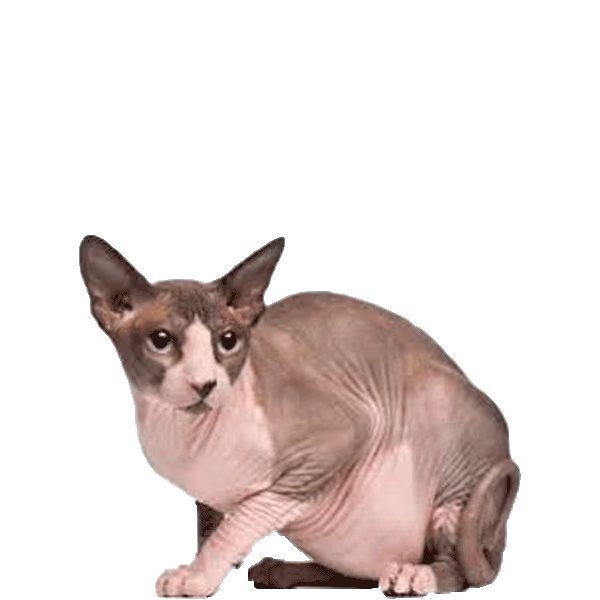
The Dwelf is a playful, affectionate breed combining hairless skin, short legs, and curled ears with an outgoing, curious personality.
How the Dwelf coat is built, and what that means when you groom it.
Caution: A Dwelf needs protection from the sun.
Bare skin burns quickly and offers no insulation against cold either. Time outdoors needs shade, a coat in cool weather, or a sunscreen a vet has approved for animals.
The Dwelf is a small hairless cat with shortened limbs and backward-curling ears. It is not recognised by the Southern African Cat Council (SACC) and is extremely rare in South Africa, with the NSPCA raising concerns about deliberately breeding for stacked physical mutations.
The Dwelf is among the rarest cats likely to be encountered in South Africa. It was developed in the United States in the early 2000s by crossing three breeds: the Sphynx for a hairless coat, the Munchkin for shortened legs, and the American Curl for backward-arching ears. The name blends "dwarf" and "elf," pointing to the cat's low stature and distinctive ear shape.
The Southern African Cat Council (SACC), which governs cat shows and breed registrations in South Africa, has not granted the Dwelf recognition. Owners who wish to register a Dwelf can do so through TICA's experimental breed framework, which is the most accessible international route for South African keepers of rare breeds. Importing a Dwelf from overseas requires a South African veterinary import permit and the relevant health certification.
The National Council of SPCAs (NSPCA) in South Africa has, in line with international welfare bodies, expressed increasing concern about the deliberate breeding of animals for physical mutations that compromise their health or mobility. The Dwelf's combination of three heritable anomalies places it squarely in the category of breeds that welfare advocates scrutinise. Prospective owners should discuss the breed's health profile with a veterinarian who has experience with exotic cats before proceeding.
| Attribute | Detail |
|---|---|
| Origin | United States |
| Size | Small |
| Lifespan | 12 to 15 years |
| Group / role | Companion cat (rare/experimental breed) |
| Recognition | Not recognised by the SACC; registerable under TICA |
The Dwelf suits dedicated, experienced cat owners who have considered the welfare debates surrounding the breed and can commit to its daily needs. In South Africa, where the breed is uncommon and specialist veterinary knowledge of hairless cats is not widespread, an owner must be willing to seek out appropriate veterinary care and to provide year-round indoor temperature management. It is not suited to anyone looking for a low-maintenance companion.
The Dwelf was developed in the United States in the early 2000s by deliberately crossing the Sphynx, Munchkin and American Curl to produce a single cat combining hairlessness, short legs and curled ears.
The Dwelf is a recent and entirely human-designed breed. It appeared in the United States in the early 2000s when breeders chose to combine three established lines: the Sphynx for a hairless coat (arising from a recessive mutation first recorded in the 1960s), the Munchkin for its shortened limbs (caused by a dominant gene affecting limb cartilage), and the American Curl for its distinctive arching ears (a dominant mutation that first appeared in California in 1981).
The intention was to fix all three traits simultaneously in a small companion cat. Because the short-leg mutation and the hairless trait each carry welfare implications, the breed has attracted scrutiny internationally since its introduction. The Dwelf holds no championship status in any major registry and remains a niche experimental breed worldwide. South Africa has seen only isolated examples, and there is no established local breeding community.
The Dwelf is a small, compact, muscular hairless cat with shortened legs, large backward-curling ears, wrinkled warm skin and wide-set eyes.
The Dwelf's appearance is arresting and immediately recognisable. Short legs give the body a low-slung profile. The head is wedge-shaped with pronounced cheekbones, wide-set eyes and the large ears that arc backward at the tips. The skin is bare, wrinkled around the head and shoulders, and warm to the touch. A fine, near-invisible down is present on some individuals.
Because there is no fur to carry pigment, coat colour manifests as variation in skin tone. Patterns that would appear as tabby or pointed markings on a coated cat show up as shifts in skin pigmentation on the Dwelf.
| Feature | Standard |
|---|---|
| Height | Approx. 15 to 18 cm at the shoulder |
| Weight | 1.8 to 3.2 kg |
| Coat | Hairless; may carry fine down; skin is warm and suede-like |
| Colours | Skin pigment in any colour or pattern |
| Eyes | Large, wide-set, round to lemon-shaped, colour varies |
The Dwelf's skin is fully exposed to its environment. Without any insulating layer, the cat is sensitive to both heat and cold, and this is a practical daily concern in South Africa's seasonal extremes. Skin pigment can appear in any colour or pattern; the markings are simply tones rather than textures.
The Dwelf is highly sociable, affectionate and curious, forming strong bonds with its people and generally adapting well to children and other household pets.
The Dwelf is a social and affectionate cat with a strong need for human contact. It tends to follow its people from room to room, seek out warmth and company, and investigate rather than avoid new situations. This sociability makes it rewarding for owners who are home frequently, and difficult for those who are regularly absent for long hours.
The breed generally does well with children who handle it calmly, with other cats, and with dogs. Its curiosity and energy remain fairly consistent through adulthood. Without sufficient interaction and stimulation it can show signs of boredom or low-level anxiety.
| Trait | Rating |
|---|---|
| Affection | 5 |
| Energy | 4 |
| Trainability | 3 |
| Vocalness | 3 |
| Shedding | 1 |
South Africa's seasonal extremes present specific challenges: Highveld winters are cold enough to put a hairless cat at genuine risk, while the northern provinces bring intense summer heat. Year-round skin care and strict indoor housing are non-negotiable.
The Dwelf is an indoor-only cat, and this requirement is especially significant in South Africa. On the Highveld, which includes Johannesburg and Pretoria, winter nights can drop to near or below freezing. A hairless cat has no coat insulation and loses body heat rapidly; without indoor heating, there is a real risk of hypothermia. Electric heated cat beds, thermal blankets and a reliably warm indoor temperature are essential from around April through August.
In Cape Town, damp winter conditions make cold penetration a greater concern for a bare-skinned animal than the thermometer reading alone suggests. In the hotter northern provinces such as Limpopo and Mpumalanga, peak summer conditions require shade, ventilation and avoidance of direct sun to prevent overheating and skin damage.
Regardless of season or region, the Dwelf must not be housed outdoors, in uninsulated garages or in outbuildings with no climate control.
The Dwelf needs a high-protein, portion-controlled diet, with somewhat higher energy intake to compensate for the heat loss caused by its bare skin.
Because it has no coat, the Dwelf expends more metabolic energy maintaining its body temperature than a coated cat of equivalent size. A complete, high-protein commercially formulated cat food provides the most reliable nutritional base. Portions should be measured against the cat's weight and adjusted as needed to prevent obesity, which would add strain to the already-stressed short limb structure. Fresh water must be freely available at all times.
| Life stage | Amount per day | Meals |
|---|---|---|
| Kitten (2 to 12 months) | Free-fed or 4 small portions | 3 to 4 |
| Adult (1 to 7 years) | Approx. 50 to 70 g measured to body weight | 2 to 3 |
| Senior (7+ years) | Adjusted to activity and current weight | 2 |
Keep treats to a small share of daily calories. A diet that is complete and balanced for the cat's life stage rarely requires supplementation, but any addition (such as omega fatty acids for skin condition) should be discussed with a veterinarian first.
The Dwelf typically lives 12 to 15 years, but its three-mutation genetic background requires active monitoring of skin, skeletal and ear health; access to a vet experienced with exotic breeds is important in South Africa.
The Dwelf generally lives 12 to 15 years. Its genetic complexity means health monitoring needs to be proactive rather than reactive. The hairless skin is prone to oil accumulation and sunburn, and provides no buffering against South Africa's seasonal temperature extremes. The short-leg mutation creates ongoing skeletal and spinal stress. The curled ears are structurally more prone to wax buildup and infection than standard upright ears.
In South Africa, access to veterinarians with specific experience in hairless or dwarf cat breeds is limited outside major urban centres. Owners in Johannesburg, Pretoria and Cape Town have more options; those in smaller towns and rural areas are advised to identify a suitable practice before acquiring the cat, not after a health issue develops.
| Condition | Signs | Note |
|---|---|---|
| Hypothermia | Shivering, huddling, lethargy, cold to the touch | Real risk during Highveld winters; indoor heating is essential |
| Skin issues and sunburn | Blackheads, greasy patches, redness, peeling or soreness on skin | Weekly cleaning reduces oil buildup; limit sun exposure in the northern provinces |
| Skeletal and spinal strain | Reluctance to jump, abnormal gait, back tenderness | Related to the short-leg gene; worsens with excess weight |
| Ear infections | Head shaking, discharge, odour from ear folds | Curled ear canal needs regular cleaning |
| Cardiac conditions | Lethargy, breathing changes | Reported in related hairless lines; early screening recommended |
The Dwelf's intelligence and strong drive for social interaction make it more receptive than most cats to reward-based training for handling routines, litter habits and basic commands.
The Dwelf is intelligent, observant and highly motivated by social interaction and food rewards, which makes training sessions more productive than they typically are with other cat breeds. Short, positive sessions using a clicker or verbal marker paired with a treat work best. Early training is particularly valuable because the Dwelf requires bathing, ear cleaning and nail trimming regularly throughout its life; a cat that is comfortable with handling is far easier to maintain.
The Dwelf is not recognised by the SACC. South African breeders work under TICA's experimental framework, imports require veterinary permits, and the breed's three-mutation genetic structure requires careful pairing.
The Southern African Cat Council (SACC) does not recognise the Dwelf as a breed. There is no SACC breed standard, no show class and no SACC-affiliated studbook for the Dwelf in South Africa. Owners who wish to register a Dwelf must do so through TICA, which accepts the breed under its experimental or rare-breed programme. Importing Dwelf cats from overseas, which is the most common route for South African owners, requires a veterinary import permit from the Department of Agriculture, Land Reform and Rural Development, along with health certificates and current rabies vaccination documentation.
Breeding the Dwelf is genetically demanding regardless of location. The short-leg mutation cannot be used homozygously; mating two short-legged parents risks producing non-viable offspring. Regular outcrossing to one of the parent breeds is necessary to maintain structural and general health. Litters are typically small at two to four kittens. Newborns arrive without coat insulation and need a heated, clean whelping environment from the first day.
Given the NSPCA's stated position on breeding for physical mutations, prospective breeders in South Africa are advised to engage with a veterinarian before starting a programme and to carry out full health screening for cardiac, skeletal and skin conditions on both parent animals.
| Metric | Value |
|---|---|
| Sexual maturity | Around 6 to 12 months |
| Recommended breeding age | After physical maturity (12 months or older) |
| Gestation | Approx. 63 to 67 days |
| Average litter size | 2 to 4 kittens |
| Weaning age | Around 8 to 12 weeks |
Free lifetime registration for your Dwelf with United Pet Club, searchable by every SPCA branch, at home and abroad.
Start with the basics: her name, her colouring, a photo, your cell number. Saved, that is a lifetime record with United Pet Club, and it costs nothing at any point. Cat registration works with or without a microchip in the picture.
A scanner reads your Dwelf's chip in seconds; the registry decides whether the reading goes anywhere. Capture the 15-digit number in your free United Pet Club account and it goes straight to your phone. Free for life, every brand accepted, every update free. Microchip registration closes the loop.
Sign up for a free United Pet Club account, add her name, colouring, and a photo, and save. The lifetime plan holds the profile at no cost for her whole life, indoors or out.
Capture the 15-digit number from your vet's paperwork in your free account with your current contact details. The plan accepts every chip brand and never charges for the record or its updates.
No law requires it, but the SPCA recommends it and shelters chip on adoption as a matter of course. A chip only speaks for a Dwelf once the number is registered, and that registration is free here.
Not a rand. Profile, microchip record, and every update are covered by the free lifetime plan, with nothing to renew.
Questions from South African prospective owners frequently focus on SACC recognition, NSPCA welfare concerns, Highveld winter management, how to find a kitten, and import requirements.
No. The Southern African Cat Council (SACC) does not recognise the Dwelf as a breed and there is no SACC studbook or show class for it. South African owners can register a Dwelf through TICA, which accepts it under an experimental or rare-breed framework.
The National Council of SPCAs (NSPCA) has raised concerns about breeding animals for physical characteristics that compromise their welfare, including heritable conditions affecting mobility or thermoregulation. While the NSPCA has not issued a specific statement naming the Dwelf, its broader welfare positions apply to a cat combining hairlessness, shortened limbs and structurally atypical ears. Prospective owners are encouraged to review NSPCA guidance and to discuss health implications with a veterinarian before acquiring one.
Yes, but only with appropriate indoor heating. The Highveld has cold, dry winters with overnight temperatures that can drop close to or below freezing. A hairless cat has no insulating coat and is at genuine risk of hypothermia without a reliably heated indoor space. An electric heated cat bed and a warm home are essential from approximately May through August.
Dwelfs are extremely rare in South Africa and there is no established local breeding community. Most South African owners import kittens from breeders in Europe or the United States. This requires a veterinary import permit, health certification for the kitten and compliance with South African biosecurity requirements. Always request full health screening documentation for both parents from the breeder.
For committed, experienced owners who can provide daily attention, regular grooming and a warm, safe indoor environment year-round, the Dwelf can be an affectionate and engaging companion. It is not a low-maintenance cat, and the welfare considerations surrounding the breed mean prospective owners should research it carefully before deciding.
The Dwelf typically weighs 1.8 to 3.2 kg. Its short legs and compact body make it appear smaller than that weight implies.
No. The Dwelf is hairless and produces no shed fur. It does produce skin oils and some dander, so it is not fully hypoallergenic.
