
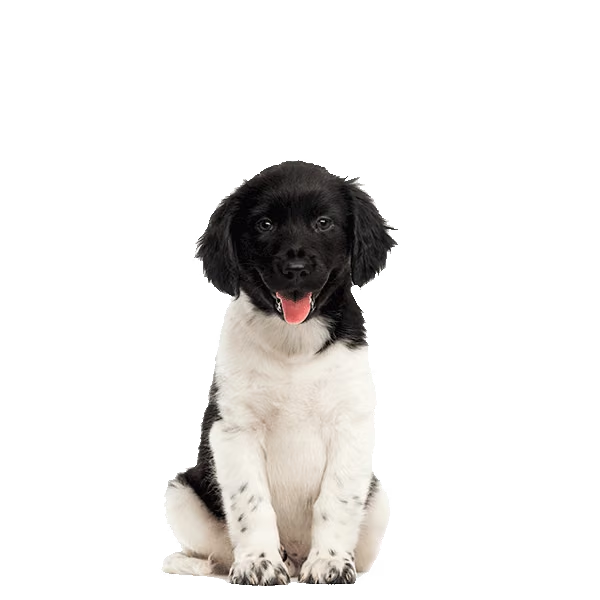
Stabyhoun
The Stabyhoun is a friendly, gentle Dutch farm dog known for its versatility as a pointer, retriever, and devoted companion.
- Size
- Medium
- Lifespan
- 13–14 years
- Origin
- Netherlands
- Temperament
- Friendly
- Standard colors
- Black, White, Brown and Orange
Characteristics
Coat and grooming
How the Stabyhoun coat is built, and what that means when you groom it.
- Coat layers
- Single coat
- Coat texture
- Silky
- Coat length
- Medium
- Shedding
- Moderate shedding
Grooming guidance
Caution: A Stabyhoun coat mats easily.
Fine or long hair tangles at the base of the coat, out of sight, where the mats tighten and pull on the skin. Brushing has to reach right down to the roots in sections, not just skim the surface.
Stabyhoun colors and patterns
What each club's breed standard says about every Stabyhoun color and pattern. Point at a ruling to see the club's own wording.
Breed standards describe the Stabyhoun in Black, White, Brown and Orange. Standard patterns: Piebald, Roan and Spotted.
| Color or pattern | FCI | AKC | UKC | KUSA |
|---|---|---|---|---|
| Black | Standard (“black”) | Standard (“Black & White”) | Standard (“Black”) | Standard (“black”) |
| White | Standard (“with white markings”) | Standard (“Black & White”) | Standard (“with white markings”) | Standard (“with white markings”) |
| Brown | Standard (“brown”) | Standard (“Brown & White”) | Standard (“brown”) | Standard (“brown”) |
| Orange | Disqualifying | Disqualifying (“Orange & White”) | Standard (“orange”) | Disqualifying |
| Patterns | ||||
| Piebald | Standard (“a pied dog in black or brown with white markings”) | Standard (“a pied dog in black or brown with white markings”) | Standard (“Black, brown or orange, with white markings”) | Standard (“a pied dog in black or brown with white markings”) |
| Roan | Standard (“black or brown roans are accepted”) | Standard (“Roan”) | Standard (“Ticking or roaning in the white is permissible”) | Standard (“black or brown roans are also accepted”) |
| Spotted | No ruling | Standard (“Spotted”) | No ruling | No ruling |
| Solid | Disqualifying (“the absence of white colour”) | Disqualifying (“the absence of white colour”) | No ruling | Disqualifying (“the absence of white colour”) |
| Tricolour | Disqualifying (“Tan marking or tricolor is disqualifying”) | Disqualifying (“Tan marking or tricolor is disqualifying”) | No ruling | Disqualifying (“Tan marking or tri-colour is disqualifying”) |
| Tan point | Disqualifying (“Tan marking or tricolor is disqualifying”) | Disqualifying (“Tan marking or tricolor is disqualifying”) | No ruling | Disqualifying (“Tan marking or tri-colour is disqualifying”) |


| Color or pattern | FCI | AKC | UKC | KUSA |
|---|---|---|---|---|
| Brown | No ruling | No ruling | Standard (“brown in brown or orange dogs”) | No ruling |
| Dark brown | Standard (“dark brown for dogs with black and white coat”) | Standard (“dark brown for dogs with black and white coat”) | Standard (“dark brown in black dogs”) | Standard (“dark brown for dogs with black and white coat”) |
| Light brown | Standard (“a lighter brown colour for dogs with a brown and white coat colour”) | Standard (“a lighter brown colour for dogs with a brown and white coat colour”) | No ruling | Standard (“a lighter brown colour for dogs with a brown and white coat colour”) |
| Yellow | No ruling | No ruling | Fault (“Yellow eyes”) | No ruling |
| Color or pattern | FCI | AKC | UKC | KUSA |
|---|---|---|---|---|
| Black | Standard (“Black in dogs with a black and white coat colour”) | Standard (“Black in dogs with a black and white coat colour”) | Standard (“black or brown in color, depending on the color of the coat”) | Standard (“Black in dogs with a black and white coat colour”) |
| Liver | Standard (“Brown in dogs with a brown and white coat colour”) | Standard (“Brown in dogs with a brown and white coat colour”) | Standard (“black or brown in color, depending on the color of the coat”) | Standard (“Brown in dogs with a brown and white coat colour”) |
What the rulings mean
- Standard
- Described by the club's breed standard.
- Fault
- Named by the club's breed standard as a fault: the animal can be shown but is penalised.
- Disqualifying
- The club's breed standard disqualifies an animal of this colour or pattern.
Color changes
How a Stabyhoun's colors can change over its life.
Blackchanges toRust
Coat · With body condition · can change back
Blackchanges toGrey
Coat · Progressive
Blackchanges toBrown
Coat · In the sun · can change back
Whitechanges toRoan
Coat · With age · from 2 weeks
Blackchanges toSnow nose
Nose · With the season · can change back
Blackchanges toPink
Nose · With the season · can change back

Sources
Each ruling comes from the club's published breed standard or color list.
About the Stabyhoun
The Stabyhoun is a gentle, biddable farm dog from Friesland in the Netherlands, rare in New Zealand but valued as an all-round pointer, retriever and companion.
The Stabyhoun is a medium-sized dog bred on small farms in Friesland, in the north of the Netherlands. For generations it did whatever job a farm needed: pointing and retrieving game for the hunter, keeping vermin off the property, and watching the house at night. Its name comes from a Frisian phrase usually translated as "stand by me dog", a fair description of how attached it becomes to its family.
Numbers stay low worldwide, and New Zealand has only a handful of Stabyhouns, most tracing back to imports cleared through strict biosecurity checks. The breed is soft-natured and even-tempered, working alongside people rather than off on its own, which suits a dog that spends half its life in the paddock and the other half on the couch.
Stabyhouns are affectionate, easygoing and quick to pick up new tasks. They cope well with a change of pace, happy to put in a solid day outside then settle down inside for the evening. Owners talk most about how versatile the breed is.
| Attribute | Detail |
|---|---|
| Origin | Netherlands (Friesland) |
| Size | Medium |
| Lifespan | 13 to 14 years |
| Group / role | Pointing and retrieving farm dog, companion |
| Good with | Families, children, and other dogs when socialised |
Who this breed suits
The Stabyhoun fits an active household that can offer daily exercise and steady company. It bonds hard and does not settle when left alone for long stretches. Owners into tramping, hunting, or dog sport tend to get on well with the breed's drive and willingness to work. A first-time owner can manage a Stabyhoun if they commit to consistent training and socialisation from puppyhood.
History and origin
The Stabyhoun developed over centuries as an all-purpose farm dog in Friesland, the Netherlands, gaining formal recognition from the Dutch kennel body in 1942.
The Stabyhoun comes from the Frisian woodland country of the Netherlands, a patchwork of small mixed farms across Friesland and parts of Drenthe. Dutch writing from the nineteenth century already describes dogs of this type, and most accounts put the breed's roots well before that. Farmers needed one dog that could turn its paw to several jobs, not a specialist hunting hound.
On the farm the Stabyhoun pointed and retrieved birds and small game, hunted moles and polecats for their pelts, kept rats down around the buildings, and kept watch over the property. A family with one working dog needed that dog to earn its keep several times over, so breeders selected for an all-round, cooperative temperament rather than a single skill.
For part of its history the Stabyhoun worked and was bred alongside the Wetterhoun, another Frisian breed, and the two lines crossed from time to time. Dutch breed enthusiasts later drew a firmer line between the two populations. The Stabyhoun received formal recognition from the Dutch kennel authority in 1942.
The breed has stayed rare throughout its history, and breeding is still managed closely to protect a limited gene pool. Dedicated associations in the Netherlands keep records and coordinate matings to keep the population sound. Outside the Netherlands, numbers remain small. Any Stabyhoun entering New Zealand goes through the Ministry for Primary Industries' import health standard and a period of quarantine, which keeps local numbers modest and each import a considered decision.
Appearance and breed standard
The Stabyhoun is a sturdy, medium-sized dog with a moderately long coat, usually black and white, and a well-feathered tail.
The Stabyhoun is a well-balanced, medium-sized dog, built a touch longer than it stands tall. The frame is sturdy without being heavy, giving it the stamina for a full day in the paddock without looking bulky. The head is dry with a friendly expression, the ears set fairly low and hanging close to the cheeks. The tail is long, reaching about to the hock, and carries good feathering.
| Trait | Standard |
|---|---|
| Height | Males about 53 cm; females about 50 cm |
| Weight | About 18 to 23 kg |
| Coat | Moderately long, sleek, with feathering on the legs and tail |
| Colours | Black and white most common; also brown and white or orange and white |
| Eyes | Round, dark brown in black dogs; lighter brown in brown dogs |
Coat and colours
The coat sits close to the body over most of the dog, smooth rather than curly, with longer feathering on the back of the legs, the tail and the rump. A slight wave along the spine is acceptable, but the coat should never be curly. Black and white is the pattern most commonly seen. Brown and white turns up too, and orange and white less often. Ticking or roan flecks through the white areas are common and accepted. A clear ground colour paired with tidy feathering gives the Stabyhoun a neat, balanced outline rather than a heavily coated look.
Temperament and personality
The Stabyhoun is friendly, gentle and devoted to its family, generally good with children and other dogs, and reserved rather than pushy with strangers.
The Stabyhoun has a soft, steady temperament and forms strong attachments within its household. It is patient and gentle, which suits family life well, and it is generally reliable around children who have been taught to handle it properly. The breed wants to be part of whatever the family is doing and would rather be included than left to its own devices.
With strangers the Stabyhoun tends to hang back a little at first, polite but reserved, before warming up once it has sized someone up. It is not a sharp guard dog, though it will let you know when someone is at the gate. Around other dogs it is usually sociable, and early socialisation helps it settle into a household with other pets. Its hunting background means it may take off after small animals, so introductions to cats and other small pets need care and supervision.
The breed keeps an independent streak from its working days and can be sensitive, so heavy-handed correction tends to backfire. A patient, steady approach gets the best out of it.
| Trait | Rating |
|---|---|
| Affection | 5 |
| Energy | 4 |
| Trainability | 4 |
| Vocalness | 2 |
| Shedding | 3 |
Care and grooming
The Stabyhoun needs moderate grooming, daily exercise and regular company, and settles into most Kiwi households that can meet those needs.
The Stabyhoun is fairly low-maintenance for its coat type, but it has real exercise and companionship needs that owners should plan for before bringing one home.
Grooming
- Brush the coat about once a week to clear loose hair and stop the feathering from matting.
- Step up the brushing during the two seasonal moults each year.
- Check and clean the hanging ears regularly to cut the risk of infection.
- Bathe only when needed; the coat sheds dirt well and does not need frequent washing.
- Trim nails every few weeks and check teeth and feet while you are at it.
Exercise
- Give the dog at least 60 minutes of activity a day across walks, free running and play.
- Add mental work such as scent games, retrieving or training sessions to use up the breed's working drive.
- Dog sport such as agility, obedience and field trials suits the breed well.
- Build up a young dog's stamina gradually to protect growing joints.
Environment
The Stabyhoun does well on a section with secure fencing and copes well with New Zealand's temperate climate thanks to a weatherproof coat, though it still appreciates shelter from the worst of a southerly. It can manage in a smaller home if its exercise needs are met, but it is not suited to being left alone through a full working day. A household where someone is around for much of the day, or where the dog can tag along to activities, suits the breed best.
Nutrition and feeding
Feed the Stabyhoun a complete, balanced diet matched to its life stage and activity level, split into two meals a day once it reaches adulthood.
As a medium-sized, active breed, the Stabyhoun does well on a complete and balanced diet formulated for its life stage. A working or sporting dog may need more calories than one kept at a moderate pace. Adjust portions to keep the dog lean, since extra weight puts strain on the joints. Fresh water should be available at all times.
| Life stage | Amount per day | Meals |
|---|---|---|
| Puppy (2 to 6 months) | Per puppy-food label, by weight and age | 3 to 4 |
| Junior (6 to 12 months) | Transitioning toward adult portions | 2 to 3 |
| Adult (1 to 7 years) | About 200 to 300 g of quality dry food | 2 |
| Senior (8 years and older) | Slightly reduced calories, monitor weight | 2 |
Treats and supplements
Keep treats to no more than about 10 percent of daily calories and use them for training rewards. Most Stabyhouns on a complete commercial diet need nothing extra. If you are weighing up joint support or another supplement, or feeding a home-prepared or raw diet, check with a vet first to keep things balanced for the dog's age and workload.
Health and common conditions
The Stabyhoun is a generally healthy breed with a lifespan of 13 to 14 years, though careful breeding and routine vet care help manage the conditions seen in the population.
The Stabyhoun is regarded as a robust, generally healthy breed, helped along by careful population management within the Dutch breed associations. Typical lifespan runs to 13 or 14 years. Because the gene pool is small, breeders screen thoroughly and coordinate matings to limit inherited problems. As with any breed, individual dogs can still develop the conditions below.
| Condition | Signs | Note |
|---|---|---|
| Hip dysplasia | Stiffness, limping, reluctance to jump | Screening of breeding stock helps reduce risk |
| Epilepsy | Seizures, often appearing in young adults | Managed with veterinary care; affected dogs not bred |
| Patent ductus arteriosus | Heart murmur, poor growth, fatigue | A congenital heart defect picked up by a vet |
| Cerebral dysfunction | Neurological signs in puppies | A rare inherited condition tracked by breeders |
Preventive care
- Keep vaccinations and parasite control current on your vet's schedule.
- Choose a puppy from a breeder who screens for hip dysplasia and follows breed-association guidelines.
- Keep the dog at a healthy weight and give it regular, joint-friendly exercise.
- Check and clean the ears routinely to head off infection.
- Book annual vet checks, moving to twice yearly once the dog reaches its senior years.
Training and socialisation
The Stabyhoun is intelligent and willing but sensitive, so it responds best to patient, consistent, reward-based training started early.
The Stabyhoun is intelligent and keen to work alongside its handler, which makes it trainable across obedience, fieldwork and dog sport. It carries an independent streak from its farm-dog past, so it can take a while to mature and may push the boundaries now and then. The breed is sensitive and does not respond well to harsh correction; calm, consistent handling gets far better results. Keep sessions short, varied and rewarding to hold the dog's interest.
Basics
- Start socialisation in puppyhood, introducing the dog to people, other animals and new places.
- Teach core cues such as sit, stay, recall and loose-lead walking with rewards.
- Get a reliable recall sorted early, since the breed's hunting instinct can pull it toward small animals.
- Build up tolerance to being alone gradually to head off separation problems.
- Add scent work, retrieving or a dog sport to give the breed's working drive somewhere to go.
Breeding
Stabyhoun breeding is closely coordinated by Dutch breed associations to protect a small gene pool, with litters of around seven puppies raised by attentive dams.
Breeding the Stabyhoun is closely managed because the worldwide population is small and the gene pool limited. Breed associations in the Netherlands set guidelines that include health screening and rules against mating closely related dogs, which helps keep genetic diversity up. Anyone thinking about breeding is expected to work within these programmes rather than go it alone.
Dogs should reach physical and behavioural maturity before breeding, generally around two years old, and clear the relevant health checks first. After a successful mating, gestation runs about nine weeks. Litter sizes vary but average around seven puppies. The breed generally makes a calm, attentive mother, and puppies stay with the dam and litter through the early weeks to support healthy social development before heading to new homes, typically at about eight weeks. Handling and socialisation during this period matter a great deal for the breed's temperament later on.
New Zealand's small Stabyhoun population means most puppies are still imported, each one clearing MPI's import health standard and a period in quarantine before joining a family here. Anyone hoping to bring a Stabyhoun home usually starts with Dogs New Zealand and its affiliated clubs, since there is no large domestic breeding programme to draw on locally.
| Metric | Value |
|---|---|
| Sexual maturity | Around 1 to 2 years; breed at maturity |
| Gestation | About 63 days (9 weeks) |
| Average litter size | About 7 puppies |
| Weaning age | About 6 to 8 weeks |
| Go-home age | About 8 weeks |
Registering a Stabyhoun in New Zealand, microchip and all
Alongside council registration, a free United Pet Club record keeps a live phone number behind your Stabyhoun and its chip.
Stabyhoun registration and microchip registration in New Zealand
Adding your Stabyhoun to the registry is a ten-minute job at most: name, date of birth, photo, contact details, save. The profile is free for life and works whether the chip is already in or booked for the next vet visit. Dog registration is the place to start.
A scanned chip is only ever as useful as its record. Pop your Stabyhoun's fifteen digit number into a free United Pet Club account and the record does the rest: free updates after every move, every brand accepted, searchable day and night. Microchip registration first, account alongside.
How do I register my Stabyhoun in New Zealand?
Setting up a free United Pet Club account, adding your Stabyhoun's details and a photo, and saving is all it takes. The record stays free for the dog's whole life, chip or no chip.
How do I register my Stabyhoun's microchip?
Just add the fifteen digit number to your free account along with your current address and phone. Under the lifetime plan there is nothing to pay for the registration or any later update.
Does my Stabyhoun need a microchip in New Zealand?
Dogs registered for the first time since 2006 need one under the National Dog Database rules, working farm dogs aside. The council record and your United Pet Club profile do different jobs, and the second one is free.
What does registering a Stabyhoun cost?
Nothing. The free lifetime plan carries the profile, the chip record, and every update, and no renewal notice ever arrives.
Frequently asked questions
Common questions about the Stabyhoun's size, temperament, care needs, lifespan, suitability and availability in New Zealand.
How big does a Stabyhoun get?
The Stabyhoun is a medium-sized dog. Males stand about 53 cm at the shoulder and females about 50 cm, with weight generally between 18 and 23 kg.
Is the Stabyhoun good with families and children?
Yes. The breed is friendly, gentle and affectionate, and it is generally reliable with children who have been taught to handle it properly. It bonds closely with its household and likes being part of family life.
Is the Stabyhoun hard to look after?
Care is moderate. The coat only needs about a weekly brush, but the dog needs at least an hour of exercise a day, mental stimulation and regular company. It is not suited to being left alone for long stretches.
How long do Stabyhouns live?
Typical lifespan is 13 to 14 years. The breed is generally healthy, and routine vet care plus a healthy weight support a long life.
Is the Stabyhoun a good first dog?
It can be, for an active owner prepared to commit to early socialisation and consistent, reward-based training. The breed is sensitive and can take its time to mature, so patience pays off.
Are Stabyhouns easy to find in New Zealand?
No. The Stabyhoun is one of the rarer breeds worldwide, with most dogs still in the Netherlands. New Zealand's population is tiny, and bringing one in means clearing MPI's import health standard and quarantine. Buyers often go on a waiting list with a breeder registered through Dogs New Zealand.
Do Stabyhouns shed a lot?
Shedding is moderate, with heavier seasonal moults twice a year. Weekly brushing, stepped up during those periods, keeps loose hair under control.
From the community
Ask about the StabyhounNo questions about the Stabyhoun yet. Be the first to ask.
Browse Dog breeds