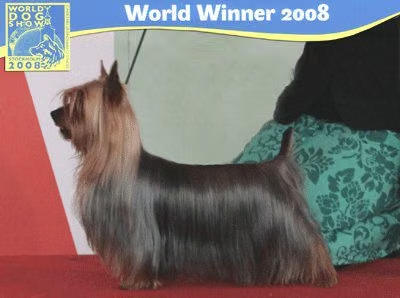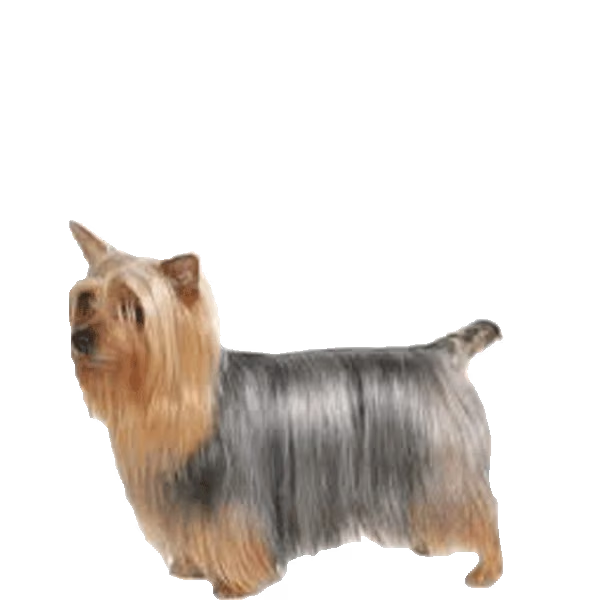
The Silky Terrier is a spirited, refined toy terrier that combines a keen, curious mind with a glossy, elegant coat.
How the Silky Terrier coat is built, and what that means when you groom it.
Caution: A Silky Terrier coat mats easily.
Fine or long hair tangles at the base of the coat, out of sight, where the mats tighten and pull on the skin. Brushing has to reach right down to the roots in sections, not just skim the surface.
Information: A Silky Terrier needs clipping every few weeks.
This coat keeps growing rather than shedding out, so it has to be trimmed every few weeks. Left to grow it mats down against the skin and traps moisture, dirt and heat.
A few of the Silky Terrier profiles members have added to United Pet Club.
A small toy breed from Australia, the Silky Terrier carries a fine silky coat and a sharp, curious nature that suits flats and family homes alike.
The Silky Terrier is a small companion dog that took shape in Australia in the late 1800s. It carries the build and instincts of a working terrier packed into a toy frame: about 23 to 25 centimetres at the shoulder and 3.5 to 5 kilograms on the scale. The breed's calling card is a long, flat, silk-textured coat parted down the back, paired with a confident, busy manner that sets it apart from the softer lap breeds.
Size aside, the Silky Terrier behaves like a proper terrier. It notices movement, has plenty to say when something changes, and investigates first and asks questions later. Owners often say the dog seems unaware of its own size. It bonds tightly with its household and likes to stay within earshot through the day.
The coat is the Silky Terrier's most recognisable feature. It hangs straight and parts naturally along the spine, giving a tidy, refined outline. The adult coat is blue and tan, a colour that settles in as the dog matures from its darker puppy coat.
| Trait | Detail |
|---|---|
| Origin | Australia |
| Size | Toy (about 3.5 to 5 kg, 23 to 25 cm tall) |
| Lifespan | 13 to 15 years |
| Group/role | Toy companion (terrier ancestry) |
| Good with | Families, older children, attentive owners; supervise around very young children and small pets |
The Silky Terrier suits owners who want a small, lively companion and can give it regular attention. It settles well in flats and on suburban sections alike, provided it gets daily walks and play. The coat needs routine brushing, so the breed suits people happy to keep up a grooming routine. Its alertness makes it a handy watchdog, though the same trait can tip into barking that needs early training. Households with very young children or small caged pets should supervise interactions, since the breed keeps a terrier's chase instinct.
Sydney breeders crossed the Australian Terrier with the Yorkshire Terrier in the late 1800s to create the refined, silky-coated companion known today.
The Silky Terrier's story starts in Australia in the late 1800s. Breeders around Sydney crossed the Australian Terrier with the Yorkshire Terrier, working toward a small companion that kept its terrier character while gaining a longer, finer coat. The result pulled features from both founding breeds and, before long, was distinct enough to stand as a breed of its own.
In its early years the breed carried several names, including the Sydney Silky, a nod to its home city. Regional standards were drawn up across Australia in the early 1900s and were later brought together into one national standard. The blue and tan colouring and silk-textured coat became the fixed points of the breed type.
The breed reached the United States in the years after the Second World War, carried home in part by returning servicemen. The American Kennel Club recognised it in 1959, placing it in the Toy Group, where it remains today. It also made its way to New Zealand, where Dogs New Zealand, the country's national kennel club, recognises the breed in the Toy group. In its homeland and abroad it has kept its place as a companion rather than a working dog.
Bred down to toy size, the Silky Terrier never lost the temperament of its terrier ancestors. Its history as a city companion produced a dog built to live close to people while keeping the sharp, ready attitude of a ratting terrier.
A compact, refined toy dog, the Silky Terrier carries a long, straight, silk-textured blue and tan coat parted down the back, with small erect ears.
The Silky Terrier is compact and lightly built, slightly longer than it stands tall. The body sits low but is not stocky, built on fine bone with a level topline. The head is moderately long, with a flat skull, small almond-shaped dark eyes, and small V-shaped ears carried erect. The overall look favours refinement over ruggedness, though the dog moves with a free, light step.
| Feature | Standard |
|---|---|
| Height | About 23 to 25 cm at the shoulder |
| Weight | About 3.5 to 5 kg |
| Coat | Long, straight, fine, silk-textured; parted along the back |
| Colours | Blue and tan |
| Eyes | Small, almond-shaped, dark |
The coat is the breed's signature feature: a single layer, flat, glossy, and silky to the touch. It falls straight from a part that runs from behind the ears to the base of the tail. Body coat is kept long, roughly 13 to 15 centimetres, while the hair on the face and lower legs is trimmed shorter. A topknot of fine hair sits on top of the head.
The adult colour is blue and tan. The blue ranges from silver-blue through to slate, set against tan markings on the muzzle, cheeks, legs, and around the base of the tail. Puppies are born much darker, often close to black, and the blue lightens gradually as the coat settles over the first one to two years.
Friendly, curious, and full of energy, the Silky Terrier bonds closely with its family, stays watchful, and is quick to bark at anything out of the ordinary.
The Silky Terrier is a confident, energetic companion with a strong attachment to its household. It is affectionate with familiar faces and prefers to stay part of the action rather than nap on the sidelines. Curious and busy by nature, it tends to trail its owners from room to room, checking out anything new.
Around strangers the Silky Terrier is alert and watchful. It announces visitors without fail, which makes it a handy small watchdog, though barking needs managing from an early age. Most settle quickly once introductions are made. With children the breed is playful, but its fine build and terrier spirit suit households with older, gentle kids better than homes with toddlers.
With other pets the breed can get along well, particularly when raised alongside them. Its terrier background leaves a real chase drive, so small animals such as rodents and birds can set off a pursuit, and time together should be supervised. Dogs of a similar size are usually accepted without fuss, though the Silky Terrier can be bold and will not always back down from a bigger dog, which owners need to keep in mind.
| Trait | Rating |
|---|---|
| Affection | 5 |
| Energy | 4 |
| Trainability | 4 |
| Vocalness | 4 |
| Shedding | 2 |
Regular brushing of the long coat, daily walks and play, and a home where it can stay close to its people are the basics of Silky Terrier care.
The Silky Terrier is an active toy breed with a coat that needs consistent upkeep. Day-to-day care comes down to coat maintenance, moderate exercise, and plenty of time with the household.
The Silky Terrier settles well in flats and smaller homes, so long as it gets daily activity and company. It is an indoor dog through and through and is not suited to living outside. The breed likes to be near its people and can turn bored or noisy if left alone for long stretches. A secure section is a bonus, but check the fencing carefully, since the breed can dig and squeeze through gaps.
A measured diet of quality small-breed food, split into two or three meals a day, keeps the Silky Terrier at a healthy, lean weight.
As a small, active breed, the Silky Terrier does well on a complete diet formulated for small or toy dogs. These foods carry the calorie density and smaller kibble size the breed needs. Because the dog is so light, even a small amount of overfeeding can show up as weight gain, so portions should be measured out rather than left down free choice. Fresh water should always be on hand.
| Life stage | Amount per day | Meals |
|---|---|---|
| Puppy (2 to 6 months) | About 60 to 90 g | 3 to 4 |
| Puppy (6 to 12 months) | About 60 to 120 g | 2 to 3 |
| Adult | About 60 to 90 g | 2 |
| Senior | About 60 g, adjusted for activity | 2 |
Keep treats to around 10 percent of daily calories to guard against weight gain. Small, low-calorie treats work well for training, given the breed's size. Most Silky Terriers on a complete commercial diet need no extra supplements. Talk to a vet before adding anything, such as joint or dental support, since needs vary with age and health.
Generally healthy with a 13 to 15 year lifespan, the Silky Terrier can be prone to dental disease, patellar luxation, and a handful of knee and eye conditions.
The Silky Terrier is a generally sound breed with a typical lifespan of 13 to 15 years. As with many toy breeds, the main concerns sit around the knees, teeth, and a handful of inherited conditions. Buying from breeders who screen their stock, and keeping up with routine vet care, cuts the risk of most problems.
| Condition | Signs | Note |
|---|---|---|
| Patellar luxation | Skipping gait, occasional hind-leg lameness | Common in toy breeds; ranges from mild to needing surgery |
| Dental disease | Bad breath, tartar, loose teeth | Frequent in small breeds; managed with home and professional dental care |
| Legg-Calve-Perthes disease | Limping, hip pain, muscle loss in a young dog | Affects the hip joint in small breeds; often shows up before one year old |
| Progressive retinal atrophy | Night blindness, declining vision | Inherited eye disease; breeders can screen for it |
| Tracheal collapse | Honking cough, especially with excitement or pressure on the neck | Use a harness rather than a collar to ease strain |
Intelligent but independent, the Silky Terrier responds best to short, consistent, positive-reinforcement sessions, with early focus on barking and socialisation.
The Silky Terrier is bright and picks things up quickly, but it carries a terrier's independent streak and can turn wilful if training is inconsistent. It responds best to short, upbeat sessions that hold its attention and reward cooperation. Harsh correction tends to backfire, making the dog stubborn or anxious rather than obedient. Early socialisation to people, places, and other animals helps take the edge off the breed's watchfulness, and barking should be addressed from day one before it sets in as a habit.
The Silky Terrier reaches maturity at around one to two years, has small litters averaging three to five pups, and benefits from health-screened breeding stock.
Breeding the Silky Terrier calls for the same care as other toy breeds, where small litters and delicate pups are the norm. Dogs should reach full physical and behavioural maturity before breeding, generally around one to two years old, and both parents should be screened for the inherited conditions seen in the breed, including patellar and eye problems. Responsible breeding aims to keep the breed's sound temperament and correct coat type while cutting the risk of passing on hereditary disease.
Gestation runs about 63 days. Litters are small, often three to five pups, and whelping should be watched closely, since toy breeds can struggle to deliver. Pups are born much darker than their adult colour and develop the blue and tan coat over the first one to two years. Early handling and gentle socialisation in the first weeks help shape steady, confident adults. Pups should stay with the dam until at least eight weeks old.
| Metric | Value |
|---|---|
| Sexual maturity | About 6 to 12 months |
| Recommended breeding age | 1 to 2 years |
| Gestation | About 63 days |
| Average litter size | 3 to 5 pups |
| Weaning age | About 6 to 8 weeks |
| Earliest rehoming age | 8 weeks or older |
Alongside council registration, a free United Pet Club record keeps a live phone number behind your Silky Terrier and its chip.
Keeping a Silky Terrier findable is mostly paperwork: a profile carrying your phone number, a photo, and the dog's details, sitting where a scan can reach it. Registering your dog with United Pet Club sets that up free, and the record never lapses or bills you.
A scanned chip is only ever as useful as its record. Pop your Silky Terrier's fifteen digit number into a free United Pet Club account and the record does the rest: free updates after every move, every brand accepted, searchable day and night. Microchip registration first, account alongside.
Setting up a free United Pet Club account, adding your Silky Terrier's details and a photo, and saving is all it takes. The record stays free for the dog's whole life, chip or no chip.
Just add the fifteen digit number to your free account along with your current address and phone. Under the lifetime plan there is nothing to pay for the registration or any later update.
Dogs registered for the first time since 2006 need one under the National Dog Database rules, working farm dogs aside. The council record and your United Pet Club profile do different jobs, and the second one is free.
Nothing. The free lifetime plan carries the profile, the chip record, and every update, and no renewal notice ever arrives.
Common questions about the Silky Terrier cover its size, temperament, grooming needs, lifespan, suitability, and where to find one in New Zealand.
It is a toy breed, standing about 23 to 25 cm at the shoulder and weighing roughly 3.5 to 5 kg once fully grown.
Friendly, curious, and full of spirit. The breed bonds closely with its family, stays alert and watchful, and will bark to announce anything out of the ordinary.
Care is moderate. The long coat needs brushing several times a week, and the dog needs daily walks and play, but its small size keeps exercise needs manageable.
The typical lifespan is 13 to 15 years, long even for a toy breed, especially with good dental care and a lean weight.
Yes to both, with a few conditions. It settles well in a flat if exercised daily, and it suits families with older, gentle children better than homes with toddlers.
It sheds lightly. The single, silk-textured coat drops little hair, but it needs regular brushing to stay free of mats.
The breed is established but less common than mainstream toy breeds. Pups are usually available through dedicated breeders listed with Dogs New Zealand, and dogs sometimes turn up through breed-specific rescue.