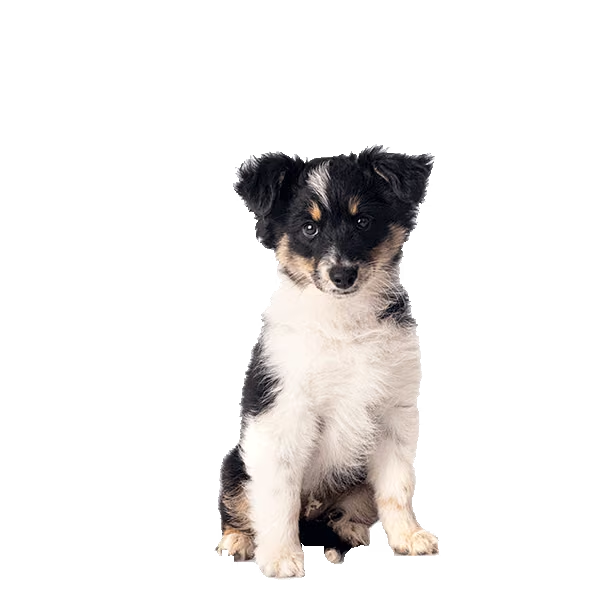
The Miniature American Shepherd is an intelligent, energetic herder that delivers the smarts and drive of its larger cousin in a compact frame.
How the Miniature American Shepherd coat is built, and what that means when you groom it.
Critical: A Miniature American Shepherd should not be shaved.
The undercoat keeps heat out as well as in, and the outer coat shields the skin from sun and insect bites. Clipping the whole coat off removes both. It often grows back patchy, soft or a different colour, and in some animals the guard hairs never return properly. Brush the undercoat out instead of cutting it off.
Caution: A Miniature American Shepherd coat mats easily.
Fine or long hair tangles at the base of the coat, out of sight, where the mats tighten and pull on the skin. Brushing has to reach right down to the roots in sections, not just skim the surface.
Information: A Miniature American Shepherd drops its undercoat in heavy bursts.
The undercoat comes out in heavy bursts over a few weeks. An undercoat rake, or a bath followed by a proper blow-dry, clears it far faster than daily brushing. Clipping the coat down is not a shortcut for this.
The Miniature American Shepherd is a small, sharp-witted herding dog from the United States with all the drive of a full-size shepherd in a compact build.
The Miniature American Shepherd is a small herding breed that began in the United States. It sits well under the height of a standard herding dog but keeps the same working instinct, stamina, and quick thinking. Owners often say it behaves like a big dog squeezed into a small frame.
This is an active dog that fixes its attention on its family. It bonds tightly with its household, keeps half an eye on everything going on around it, and wants a task to get stuck into. Without enough mental and physical work it gets bored quickly and starts inventing its own entertainment, which owners rarely appreciate.
The breed suits a household that can offer daily exercise and training. It takes well to dog sports such as agility, obedience, and herding trials, and its manageable size makes it an easy traveller. Loyal and quick to learn, it rewards an owner who stays involved.
| Attribute | Detail |
|---|---|
| Origin | United States |
| Size | Small |
| Lifespan | 12 to 13 years |
| Group / role | Herding dog, companion |
| Good with | Active families, children, other dogs when socialised |
This breed suits people after an involved, trainable companion who can commit to regular activity: a good match for active singles, couples, and families. It is a poor fit for households away from home for long stretches or wanting a low-energy lapdog, since an under-exercised dog of this type tends to become restless and noisy.
Bred down from small Australian Shepherds in California from the late 1960s, the Miniature American Shepherd gained American Kennel Club recognition in 2015.
The breed's story starts in California in the late 1960s, when breeders began selecting the smallest dogs turning up within Australian Shepherd litters. The aim was to hold on to herding ability and temperament while bringing the size down, producing a compact dog that could still work stock and travel easily.
Through the 1970s and 1980s these small dogs were shown and registered under a handful of names, Miniature Australian Shepherd among them, and proved popular on the horse-show circuit, where a dog that fitted easily in a truck cab was a real advantage. Dedicated breeders kept careful records and worked to fix the type.
The name changed to Miniature American Shepherd to mark the dog out as a breed in its own right rather than simply an undersized Australian Shepherd. The American Kennel Club first recorded it in its Foundation Stock Service before granting full recognition in the Herding Group in 2015.
The breed has since become more popular both as a companion and as a dog-sport competitor. It remains close to the Australian Shepherd in looks and working style, the main difference being size. New Zealand buyers should note that any dog imported into the country, including this breed, must clear New Zealand's biosecurity and quarantine requirements, which are strict by international standards. Locally, the breed can be registered with Dogs New Zealand, the country's national body for pedigree dogs (formerly the New Zealand Kennel Club).
The Miniature American Shepherd is a small, balanced dog with a medium-length double coat in black, blue merle, red, or red merle, often marked with white and copper.
The Miniature American Shepherd is a touch longer than it is tall, with a level topline and a moderate, athletic build, essentially a scaled-down Australian Shepherd. The tail may be naturally short, docked where that is still permitted, or left natural length. Ears are triangular, set high, and break forward or to the side when the dog is paying attention.
| Trait | Detail |
|---|---|
| Height | Males 14 to 18 in (36 to 46 cm); females 13 to 17 in (33 to 43 cm) |
| Weight | 20 to 40 lb (9 to 18 kg) |
| Coat | Medium-length double coat, weather resistant, moderate feathering |
| Colours | Black, blue merle, red, red merle, with or without white and copper trim |
| Eyes | Brown, blue, amber, or any combination, including flecks and marbling |
The double coat has a coarser outer layer over a softer undercoat that thickens up in cold weather, useful given New Zealand's cool temperate climate. Four base colours are recognised: black, blue merle, red (liver), and red merle. White and copper points can show on the face, chest, legs, and underside, and eye colour varies widely, sometimes differing between the two eyes on the same dog. Merle-to-merle breeding carries known health risks, so eye and ear checks matter in merle lines.
Loyal, sharp, and full of energy, the Miniature American Shepherd sticks close to its family, stays watchful around strangers, and does best with a job to do.
This is an intelligent, alert dog that attaches strongly to its people, often trailing its family from room to room and wanting to be included in whatever is happening. With children it is generally playful and gentle, though its herding instinct can show up as nipping at heels or circling kids who are running about, a habit that responds well to early training.
Around strangers the breed tends to hold back rather than greet everyone warmly. It prefers to weigh a person up before it warms to them, which makes it a capable watchdog, but ongoing socialisation matters so that natural reserve does not tip into shyness or suspicion.
It generally gets on well with other pets, especially when raised alongside them, though the same herding drive that keeps it watchful can prompt chasing of cats or smaller animals, so early introductions want supervising. Energy and the need for a job are what define this dog: leave a Miniature American Shepherd bored and it will find its own work, usually not the kind an owner had in mind.
| Trait | Rating |
|---|---|
| Affection | 5 |
| Energy | 5 |
| Trainability | 5 |
| Vocalness | 3 |
| Shedding | 3 |
The Miniature American Shepherd needs weekly brushing, daily exercise, and regular mental work, and settles into most homes that keep it active.
Day-to-day care comes down to coat upkeep, exercise, and keeping the dog's mind occupied. It is a healthy, active breed that does not need elaborate grooming, but it does need consistent attention to both its energy levels and its coat.
The breed adapts to flats or houses provided its exercise needs are met, though a securely fenced garden is a bonus. New Zealand's cool temperate climate suits its double coat well, though shade and water still matter on the hotter days inland or up north. It does best as part of daily family life rather than left to its own devices outdoors.
Feed a complete diet matched to the dog's life stage and activity level, typically 0.75 to 1.5 cups of quality dry food a day split into two meals.
A complete and balanced diet formulated for the dog's life stage keeps this active breed in good shape. Amounts depend on age, size within the standard, and activity level, so adjust portions to keep a visible waist and ribs that are easy to feel. Working and sport dogs may need more than the figures below; a less active pet may need less.
| Life stage | Amount per day | Meals |
|---|---|---|
| Puppy (2 to 6 months) | Per label, fed to growth needs | 3 to 4 |
| Puppy (6 to 12 months) | 0.75 to 1.5 cups | 2 to 3 |
| Adult | 0.75 to 1.5 cups | 2 |
| Senior | 0.5 to 1.25 cups, adjusted for activity | 2 |
Keep treats to around 10 percent of daily calories, which leaves room for the frequent training this breed enjoys. Small, low-calorie pieces work best for repetition work. A dog on a complete commercial diet usually needs no supplements; check with a vet before adding any, joint or skin products included.
Generally a healthy breed with a lifespan of 12 to 13 years, though it can inherit eye disorders, hip dysplasia, and a drug sensitivity linked to the MDR1 gene.
The breed is generally healthy and typically lives 12 to 13 years. Responsible breeders screen for inherited conditions, so puppies from health-tested parents carry lower risk. As with any breed, regular veterinary care and keeping weight in check support a long life. Because New Zealand's biosecurity rules restrict which animals and animal products can enter the country, owners bringing a dog in from overseas should check current import and quarantine requirements well ahead of travel.
| Condition | Signs | Note |
|---|---|---|
| MDR1 drug sensitivity | Adverse reaction to certain medications | Genetic test available; tell every vet the result |
| Hip dysplasia | Stiffness, limping, trouble rising | Screen breeding stock; keep the dog lean |
| Progressive retinal atrophy | Night blindness, gradual vision loss | DNA test available for carriers |
| Collie eye anomaly | Usually no signs; found on eye exam | Screen puppies and breeding dogs |
| Cataracts | Cloudy eye, reduced vision | Detected on routine eye exams |
Highly trainable and keen to please, the Miniature American Shepherd responds best to short, positive, varied sessions that put its energy and herding drive to work.
Few breeds are easier to train once an owner stays consistent. This dog picks things up fast, watches its handler closely, and wants a job. That same intelligence means it learns bad habits just as quickly, so clear rules and early structure count for a lot. Keep sessions short and varied to hold its attention, and give it an outlet, obedience work, tricks, or a dog sport, to burn off its energy. Get on top of the herding instinct early so that circling and heel-nipping do not become set habits.
Responsible breeding pairs health-tested adults, avoids merle-to-merle crosses, and produces small litters of typically three to seven puppies after roughly a nine-week pregnancy.
Breeding this dog calls for planning and health screening rather than chance pairings. Females reach sexual maturity within their first year, but responsible breeders hold off until full physical and mental maturity, generally around two years, before breeding. Both parents should be cleared for hip, eye, and MDR1 status before a mating is arranged.
Mating follows the female's heat cycle, which comes round roughly twice a year. Pregnancy runs about 63 days. Litters tend to be small for the dog's size. Merle colouring is a major genetic concern: pairing two merle dogs can produce double merle puppies with serious eye and hearing defects, so that cross is avoided.
Raising the litter means attentive care of the dam and pups through weaning, with early handling and socialisation from the first weeks to set up a steady adult temperament. Puppies usually go to new homes from eight weeks. Anyone bringing breeding stock into New Zealand from overseas needs to factor in the country's biosecurity and quarantine rules, which can add considerable time to the process.
| Metric | Value |
|---|---|
| Sexual maturity | Within first year |
| Recommended breeding age | Around 2 years |
| Heat cycle | About twice per year |
| Gestation | About 63 days (9 weeks) |
| Average litter size | 3 to 7 puppies |
| Weaning age | About 6 to 8 weeks |
Alongside council registration, a free United Pet Club record keeps a live phone number behind your Miniature American Shepherd and its chip.
Adding your Miniature American Shepherd to the registry is a ten-minute job at most: name, date of birth, photo, contact details, save. The profile is free for life and works whether the chip is already in or booked for the next vet visit. Dog registration is the place to start.
Getting the chip implanted was the vet's job; giving the number somewhere to point is yours. Registering the microchip with United Pet Club costs nothing on the lifetime plan, suits any brand a Kiwi vet reaches for, and keeps the record searchable at any hour from anywhere. Creating a free account ties the profile and the chip together.
Setting up a free United Pet Club account, adding your Miniature American Shepherd's details and a photo, and saving is all it takes. The record stays free for the dog's whole life, chip or no chip.
Just add the fifteen digit number to your free account along with your current address and phone. Under the lifetime plan there is nothing to pay for the registration or any later update.
Dogs registered for the first time since 2006 need one under the National Dog Database rules, working farm dogs aside. The council record and your United Pet Club profile do different jobs, and the second one is free.
Nothing. The free lifetime plan carries the profile, the chip record, and every update, and no renewal notice ever arrives.
Common questions about the Miniature American Shepherd cover its size, temperament, care needs, lifespan, suitability, and where to find one.
It is a small breed. Males stand about 14 to 18 inches (36 to 46 cm) and females about 13 to 17 inches (33 to 43 cm) at the shoulder, with most dogs weighing 20 to 40 pounds (9 to 18 kg).
Loyal, intelligent, alert, and energetic. It bonds closely with its family, tends to be reserved with strangers, and needs daily activity and mental work to stay settled.
Grooming is moderate, with weekly brushing and more during shedding seasons. The harder part is meeting its exercise and training needs, which are high for a dog of this size.
Typical lifespan is 12 to 13 years. Health screening of the parents and good preventive care help support a full life.
It can suit an active first-time owner ready to commit to daily exercise and consistent training. It is not a good fit for anyone away from home for long hours or after a calm, low-energy dog.
Generally, yes. It is usually playful with children and gets on with other animals, though its herding instinct can lead to nipping or chasing, so early training and supervision help.
The breed is recognised and has grown in popularity, with puppies available through dedicated breeders and occasional adults through breed-specific rescue. Anyone importing a dog needs to meet New Zealand's biosecurity and quarantine requirements, and health-tested litters can have waiting lists.
